

Watching the years tick down on your property’s lease can be a source of significant stress. As the term shortens, concerns about your home’s value and future saleability grow, while the legal path forward-the statutory lease extension-can seem tangled in jargon and financial uncertainty. You might be wondering how much it will cost, who to trust for professional advice, or how to handle a difficult freeholder.
This guide is designed to replace that anxiety with clarity and confidence. We provide a comprehensive, step-by-step walkthrough of the entire process, demystifying each stage from the initial valuation to final completion. By the end, you will have a clear understanding of your legal rights, a practical plan to follow, and a realistic expectation of the costs involved, from the premium payable in pounds (£) to professional fees. It’s time to take control, protect your most valuable asset, and secure your investment for the future.
What is a Statutory Lease Extension and Why is it Crucial?
Owning a leasehold property means you own the right to occupy it for a set period. As this term shortens, your property becomes a diminishing asset, losing value year on year. A statutory lease extension is a legal right designed to protect you from this decline. Under the Leasehold Reform, Housing and Urban Development Act 1993, qualifying leaseholders can compel their freeholder to grant two significant benefits:
- A 90-year extension on top of your remaining lease term.
- A reduction of your future ground rent to zero (known as a “peppercorn” rent).
To provide you with complete clarity and confidence, our RICS-certified experts explain the key concepts in this short video.
This right is a powerful tool for protecting your property’s value, but it’s crucial to act decisively. The longer you wait, the more expensive the process becomes. To qualify, you generally must have owned the property for at least two years. This right has been refined by subsequent legislation, including the Commonhold and Leasehold Reform Act 2002, which further strengthened leaseholders’ positions.
The 80-Year Rule: The Most Important Deadline
The most critical date in any lease’s timeline is when it drops below 80 years. At this point, a legal concept called ‘marriage value’ is introduced into the extension calculation. In simple terms, marriage value is the increase in the property’s value resulting from the extension. Your freeholder is legally entitled to 50% of this uplift, which can add thousands, or even tens of thousands, of pounds to the premium you must pay. Acting before this deadline is essential for a cost-effective extension.
Impact on Mortgages and Salability
A short lease is a major red flag for mortgage lenders, who often refuse to lend on properties with fewer than 80-85 years remaining. This severely restricts your ability to remortgage and dramatically shrinks your pool of potential buyers to cash purchasers only. A lease extension is therefore not just a cost; it is an essential investment in your property’s future, ensuring it remains a valuable and marketable asset that gives you financial peace of mind.
The Statutory Route vs. An Informal Agreement: Which is Right for You?
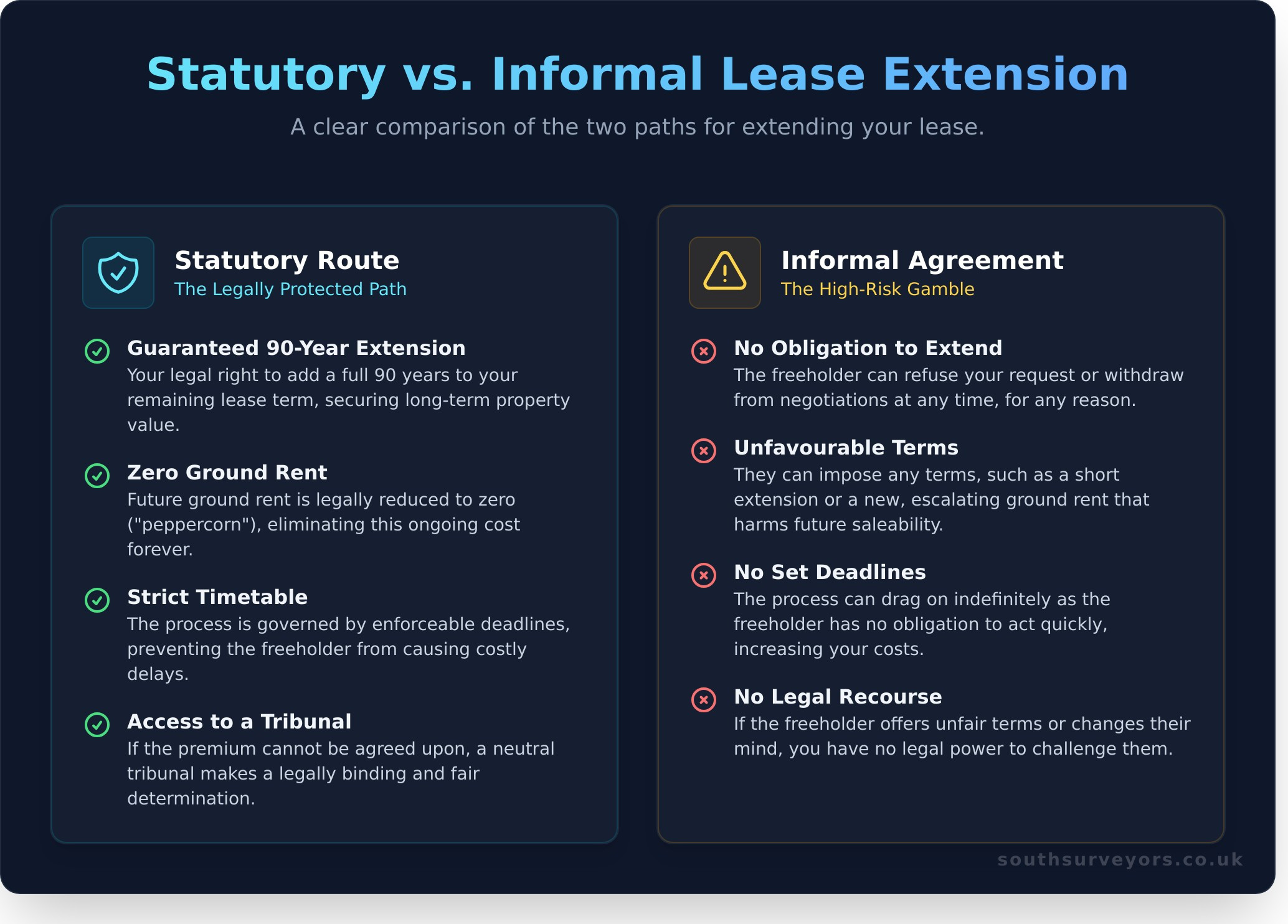
When seeking to extend your lease, you face a critical decision: should you follow the formal statutory process or negotiate an informal agreement directly with your freeholder? While an informal negotiation might seem like a simpler, faster option, it’s vital to understand the significant differences in protection and outcomes. The right choice provides clarity and confidence, ensuring your property remains a valuable asset. The UK government provides a clear overview of your rights when extending your lease, which forms the basis of the statutory route.
Benefits of the Statutory Route
Opting for a formal statutory lease extension provides a robust legal framework designed to protect your interests as a leaseholder. This route offers certainty and peace of mind, with legally guaranteed terms that cannot be altered by the freeholder. The primary advantages include:
- A Guaranteed 90-Year Extension: Your lease will be extended by a full 90 years on top of the unexpired term, securing the property’s value for the long term.
- Zero Ground Rent: Your future ground rent will be reduced to a ‘peppercorn’ rate, which effectively means you will pay nothing for the remainder of the lease.
- A Strict Timetable: The process is governed by legally enforceable deadlines, preventing the freeholder from causing unnecessary and costly delays.
- Access to a Tribunal: If you and your freeholder cannot agree on the premium, the First-tier Tribunal (Property Chamber) can be appointed to make a fair and legally binding determination.
Risks of an Informal (Voluntary) Agreement
While potentially quicker in some cases, an informal agreement lacks the legal safeguards of the statutory process. In this scenario, the freeholder holds most of the negotiating power, which can lead to significant disadvantages for you:
- No Obligation to Extend: The freeholder is under no legal duty to grant an extension and can refuse your request or withdraw from negotiations at any time without reason.
- Unfavourable Terms: They can propose any terms they wish, such as a shorter extension period or, more commonly, a new, escalating ground rent that could make your property difficult to sell or mortgage in the future.
- No Set Deadlines: Without a statutory timetable, the process can drag on indefinitely, allowing the freeholder to delay and potentially increase your costs as the lease continues to shorten.
- No Legal Recourse: If the freeholder changes their mind or offers unreasonable terms, you have no legal pathway to challenge them and must either accept or start the formal process from scratch.
Ultimately, for most leaseholders, the security and guaranteed favourable terms of a statutory lease extension offer the most reliable path forward. Engaging a professional, RICS-certified surveyor from the outset ensures you receive expert guidance, helping you make an informed decision that protects your investment for years to come.
The Statutory Lease Extension Process: A 7-Step Timeline
Navigating a statutory lease extension can seem complex, but it follows a well-defined legal path designed to protect both leaseholders and freeholders. Understanding this timeline provides clarity and confidence, transforming a daunting task into a manageable project. The entire process, from initial checks to final registration, is governed by the Leasehold Reform, Housing and Urban Development Act 1993. For a comprehensive overview, the government-funded Leasehold Advisory Service provides an excellent guide on the statutory route for lease extension. Here is a breakdown of the key stages.
Step 1 & 2: Check Eligibility and Appoint Professionals
Estimated Timeline: 1-2 Weeks
The first step is to confirm you meet the legal criteria. The primary requirements are:
- You must have owned the flat for at least two years.
- The original lease must have been for a term of more than 21 years.
Once eligibility is confirmed, you must appoint a specialist solicitor and an RICS-certified valuation surveyor. This professional team forms the foundation of a successful application, providing the legal and financial expertise required to protect your interests.
Step 3 & 4: The Valuation and Serving the Section 42 Notice
Estimated Timeline: 2-4 Weeks
Your RICS surveyor will conduct a thorough inspection and prepare a comprehensive valuation report. This determines the realistic premium (the price) for your lease extension. Based on this expert valuation, your solicitor will draft and serve the Section 42 Notice (or Tenant’s Notice) on the freeholder. This formal document includes your offer premium and officially commences the legal process.
Step 5 & 6: The Landlord’s Counter-Notice and Negotiations
Estimated Timeline: 2-6 Months
Upon receiving your notice, the freeholder has two months to respond with a Section 45 Counter-Notice. This will either accept your terms, accept your right but dispute the premium, or reject your claim (which is rare if you are eligible). Typically, the landlord’s counter-offer will be higher than yours. This triggers a negotiation period, skillfully handled by your and the landlord’s surveyors, to agree on a fair premium.
Step 7: Agreement, Completion, and Registration
Estimated Timeline: 1-3 Months
Once a premium is agreed, the solicitors take over to finalise the legal work. They will draft the new lease, ensuring the terms are correct (90-year extension, peppercorn ground rent). After you transfer the funds, the new lease is completed and officially registered with HM Land Registry. This final step legally documents your extended lease, securing the value of your property for the future.
Calculating the Premium: The Critical Role of the Valuation
The ‘premium’ is the price you pay the freeholder for your statutory lease extension. Arriving at a fair figure for this premium is often the most complex and contentious part of the entire process. The freeholder will seek the highest price, while you, the leaseholder, will want the lowest. This is where a professional, evidence-based valuation becomes your most crucial negotiating tool, providing the clarity and confidence needed to secure a fair deal.
Key Factors Influencing the Premium
A specialist RICS surveyor calculates the premium based on a prescribed formula, but the final amount is influenced by several key variables. Understanding these factors will help you appreciate how the final figure is determined.
- The current value of your property: This includes both the current value with the short lease and the potential value with an extended lease. A higher property value generally leads to a higher premium.
- The number of years remaining on the lease: This is a critical factor. The premium increases significantly as the lease gets shorter, especially once it drops below the 80-year mark.
- The amount of ground rent you currently pay: The surveyor will calculate the value of the ground rent payments the freeholder will lose for the remainder of the original lease term.
- The potential ‘marriage value’: If your lease has fallen below 80 years, the calculation must include ‘marriage value’. This is the increase in the property’s value arising from the extension, and the law states this profit must be split 50/50 between you and the freeholder, substantially increasing the premium.
Why You Must Have a RICS Valuation
Attempting a statutory lease extension without an expert valuation is a significant risk that can cost you thousands of pounds. A comprehensive report from a RICS-Certified surveyor is an essential investment that empowers your position.
An expert valuation provides a realistic and defensible figure for your opening offer, preventing you from starting negotiations at a disadvantage. Should the matter be referred to a First-tier Tribunal, your RICS report serves as credible, expert evidence. Furthermore, your surveyor can negotiate skilfully on your behalf with the freeholder’s valuer, challenging their assumptions and ensuring you do not overpay. This professional guidance is invaluable for achieving a successful outcome with peace of mind.
Get a professional RICS valuation to start your lease extension with confidence.
What Happens if You Can’t Agree? The First-tier Tribunal
It’s important to remember that the vast majority of statutory lease extension claims are settled amicably through professional negotiation between surveyors. The process is designed to encourage a fair agreement without needing formal intervention. However, in the rare instances where a dispute over the premium or terms cannot be resolved, there is a clear and established path forward: an application to the First-tier Tribunal (Property Chamber).
The Tribunal acts as an independent judicial body, not to take sides, but to impartially determine the correct premium and terms of the lease extension based on the law and the evidence presented. It should be viewed as a final resort to ensure a fair outcome is reached when negotiations have been exhausted.
The Tribunal Application Process
If you and your freeholder cannot agree, there are strict deadlines for escalating the matter. An application can be made to the Tribunal, but it must be done:
- No earlier than two months after the freeholder serves their Counter-Notice.
- No later than six months after the date the Counter-Notice is served.
Missing this six-month deadline will mean your claim is deemed withdrawn, and you will have to wait another 12 months before you can serve a new notice. During a hearing, both parties (typically represented by their surveyor and/or solicitor) present their valuation evidence. The Tribunal panel, often comprising a lawyer and an expert surveyor, will review the arguments and issue a determination. This decision is legally binding on both you and the freeholder, providing a definitive conclusion to the process.
Costs and Considerations
Proceeding to a Tribunal will inevitably incur additional costs, including application fees and professional representation. This reinforces why reaching a negotiated settlement is almost always the preferred outcome. The strength of your position, whether in negotiation or at a Tribunal, rests entirely on the quality of your initial valuation report.
A comprehensive, meticulously prepared valuation from a RICS-Certified professional provides the robust evidence needed to justify your position. This is why your choice of surveyor is one of the most critical decisions in the entire statutory lease extension process. An expert valuation gives you the clarity and confidence to negotiate effectively and provides a powerful foundation for your case if a dispute does arise. For professional advice and a valuation you can rely on, contact our team of experts at South Surveyors.
Secure Your Property’s Future with Confidence
Navigating the lease extension process can seem daunting, but understanding your rights is the first step towards protecting your most valuable asset. As we have explored, the statutory route provides crucial legal protection that an informal agreement cannot guarantee. The key to a successful statutory lease extension lies in following the correct procedure and, most critically, obtaining an accurate and robust valuation of the premium payable to your freeholder.
Don’t leave this critical calculation to chance. At South Surveyors, our team of specialist lease extension valuation experts provides the clarity and confidence you need. As a firm regulated by RICS and with deep knowledge of the South London property market, we ensure your valuation is both accurate and defensible, placing you in the strongest possible negotiating position. To get started, contact our expert RICS valuers today for a free consultation on your lease extension.
Take control of your leasehold future and secure the long-term value of your home.
Frequently Asked Questions
How long does a statutory lease extension take from start to finish?
The entire process for a statutory lease extension can vary significantly, typically taking anywhere from three months to over a year. The timeline depends on how quickly terms are agreed. Key stages include the initial valuation, serving the formal notice, a negotiation period, and, if an agreement cannot be reached, an application to the First-tier Tribunal. Engaging professional, RICS-certified experts early on can help streamline this process and provide much-needed clarity and confidence.
Can my freeholder refuse a statutory lease extension?
If you meet the eligibility criteria, such as having owned the property for at least two years, your freeholder cannot legally refuse your right to a statutory lease extension. However, they can, and often do, dispute the premium you have offered in your notice. This is where professional negotiation, backed by a robust and accurate valuation report from a qualified surveyor, becomes absolutely essential to reaching a fair and reasonable agreement on the final price.
Who pays for the legal and valuation fees in a statutory lease extension?
As the leaseholder initiating the claim, you are responsible for paying your own legal and valuation fees. In addition, the law requires you to cover the freeholder’s “reasonable” legal and valuation costs. These costs are specifically for investigating your right to the claim, valuing the property, and preparing the Counter-Notice. You are not, however, responsible for the freeholder’s costs related to negotiation or any tribunal proceedings, should they become necessary.
What is a Section 42 Notice and why is it so important?
A Section 42 Notice is the formal legal document that a leaseholder serves on the freeholder to officially start the statutory lease extension process. Its importance cannot be overstated; it legally compels the freeholder to sell you a lease extension and crucially fixes the valuation date. Any errors or omissions in this notice can invalidate your entire claim, forcing you to start again and potentially incur extra costs. Therefore, professional legal assistance is vital for its correct preparation.
What should I do if my freeholder doesn’t respond to my notice?
Your freeholder is legally required to serve a Counter-Notice by the deadline specified in your Section 42 Notice, which must be at least two months away. If they fail to respond within this timeframe, you can apply to the County Court for a Vesting Order. This court order will force the freeholder to grant the lease extension on the terms you proposed in your initial notice. It is a powerful protection for leaseholders, but one that requires prompt and correct legal action.
Is it better to extend my lease before selling my property?
It is almost always highly advisable to extend your lease before selling, especially if it is approaching or has fallen below 80 years. A short lease can significantly reduce your property’s value and deter potential buyers, as many lenders are unwilling to offer mortgages on such properties. Completing the extension provides certainty, maximises your sale price, and gives you a much stronger position in the property market. It provides peace of mind for both you and your future buyer.