

Embarking on a construction or renovation project is an exciting prospect, but it often comes with a significant concern: keeping control of the budget. The fear of spiralling costs and the confusion between different types of surveyors can quickly overshadow the vision for your property. This is where the expertise of a professional quantity surveyor becomes invaluable. Often described as the ‘cost managers’ of the construction world, they are the key to ensuring your project is delivered on time and, crucially, on budget, providing essential financial peace of mind.
But what exactly do they do, and how are they different from the RICS building surveyor you might hire for a property purchase? This comprehensive guide is designed to provide clarity and confidence. We will demystify the crucial role of a Quantity Surveyor, explain precisely when you need their services, and show how their expert financial management can protect your investment from unforeseen expenses. By the end, you’ll be empowered to make informed decisions and manage your project with real confidence.
What is a Quantity Surveyor? The Financial Expert of Construction
Think of a quantity surveyor (QS) as the financial guardian of your construction project. In simple terms, they are professional cost consultants who specialise in the built environment. Their primary goal is to manage all costs related to building and civil engineering projects, from initial calculations to the final figures, ensuring you achieve the best value for your money and stay firmly within your budget.
While an architect is responsible for the design and a builder carries out the physical work, the quantity surveyor focuses exclusively on the financial health and contractual management of the project. They provide the clarity and confidence you need to make informed financial decisions from start to finish.
To better understand this essential role, this short video provides a helpful overview:
The Core Mission: Maximising Value, Minimising Risk
An RICS-Certified QS brings cost certainty and robust financial control to your residential project. They are experts in identifying and managing financial risks, foreseeing potential issues like material price increases or design change costs before they escalate. A crucial part of their role is managing the procurement and tendering process. They prepare detailed documents to ensure you receive competitive and comparable quotes, helping you select the right contractor for the job at the right price, giving you complete peace of mind.
Client-Side vs. Contractor’s QS: Two Sides of the Same Coin
It’s important to understand that there are two main types of QS. A Professional Quantity Surveyor (PQS), also known as a client-side QS, works directly for you-the property owner. Their loyalty is to your project, and their focus is on protecting your financial interests. In contrast, a contractor’s QS works for the building company, managing their costs to maximise their profitability. As a homeowner undertaking a build or renovation, you would always hire a PQS to act as your independent and trusted advisor.
The Key Responsibilities of a Quantity Surveyor Through the Project Lifecycle
A quantity surveyor is far more than just a cost estimator; they are the financial guardian of your residential project from the initial concept to the final handover. Their involvement is structured chronologically, providing clarity and confidence at every stage. By embedding themselves in the project lifecycle, they ensure every financial decision is informed, transparent, and aligned with your budget, ultimately protecting your investment and ensuring value for money.
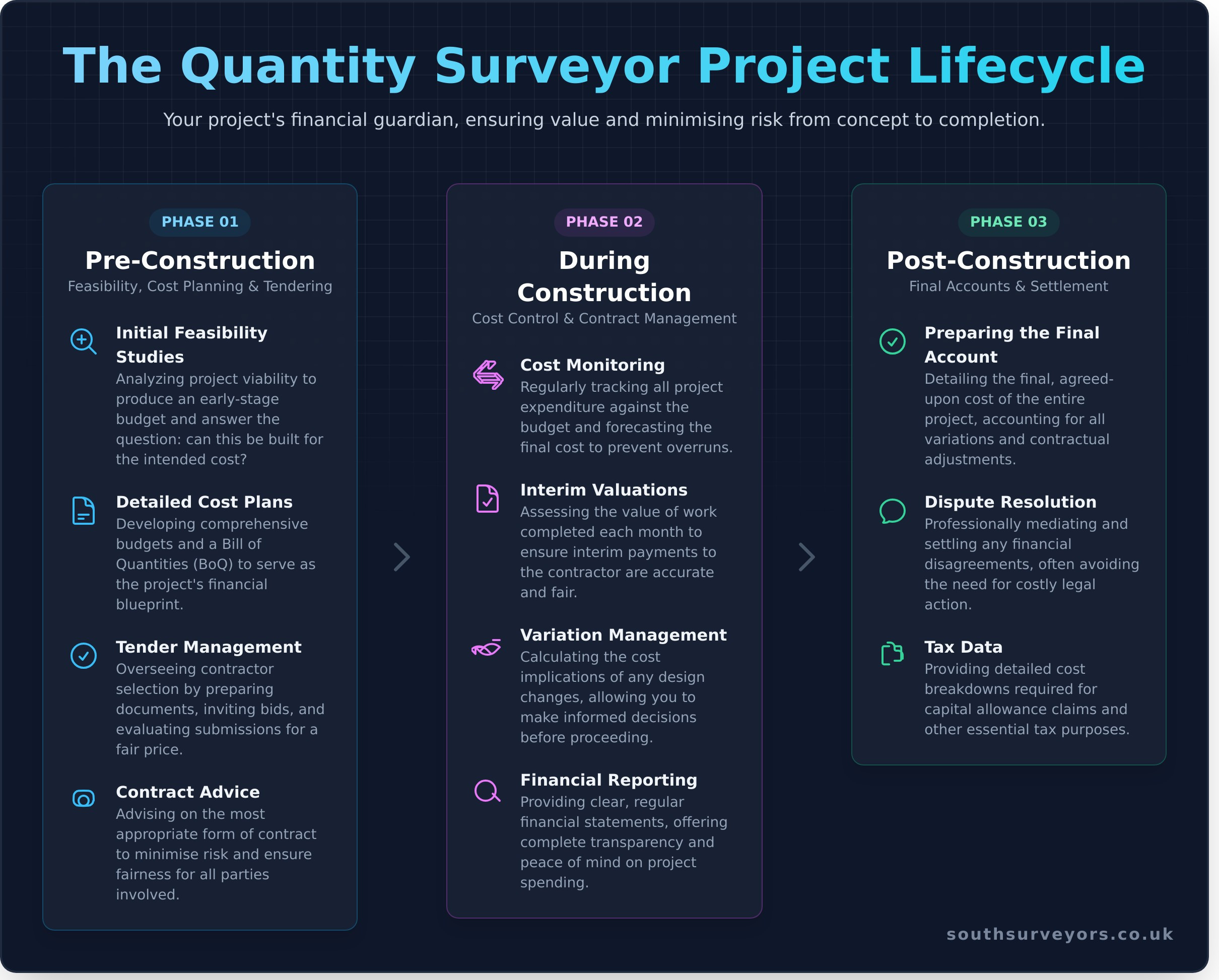
Pre-Construction: Feasibility, Cost Planning, and Tendering
This foundational stage is where robust financial planning prevents future problems. An expert quantity surveyor provides the critical data needed to decide if a project is viable before significant costs are incurred. Their key tasks include:
- Initial Feasibility Studies: Analysing your ideas to produce an early-stage budget, answering the crucial question: can this be built for the intended cost?
- Detailed Cost Plans: Developing comprehensive budgets and a Bill of Quantities (BoQ), which itemises all materials, parts, and labour required. This document becomes the financial blueprint for the project.
- Tender Management: Overseeing the process of selecting a contractor by preparing tender documents, inviting bids, and evaluating submissions to ensure you receive a fair and competitive price.
- Contract Advice: Advising on the most appropriate procurement route and form of contract to minimise risk and ensure fairness for all parties.
During Construction: Cost Control and Contract Management
Once work begins on-site, the surveyor’s role shifts to active cost management and contractual administration. They act as your eyes and ears, ensuring the project stays on track financially. This involves a range of specialist activities, from measuring progress to negotiating variations. Key responsibilities include:
- Cost Monitoring: Regularly tracking all project expenditure against the agreed budget and forecasting the final cost.
- Interim Valuations: Assessing the value of the work completed each month to certify that interim payments made to the contractor are accurate and fair.
- Variation Management: If you decide to change an element of the design, they will calculate the cost implication of this variation, allowing you to make an informed decision before proceeding.
- Financial Reporting: Providing you with clear, regular financial statements, offering complete transparency and peace of mind.
Post-Construction: Final Accounts and Settlement
The project’s completion doesn’t end the surveyor’s work. This final phase is about ensuring all financial matters are formally and fairly concluded. It provides a clean financial close to the project, preventing lingering disputes. Their duties involve:
- Preparing the Final Account: A comprehensive document that details the final, agreed-upon cost of the entire project, accounting for all variations and contractual adjustments.
- Dispute Resolution: Assisting in professionally mediating and settling any financial disagreements that may have arisen with the contractor, often avoiding the need for costly legal action.
- Tax Data: Providing detailed cost breakdowns required for capital allowance claims and other tax purposes.
Quantity Surveyor vs. Building Surveyor: A Crucial Distinction for Property Owners
For many property owners, the distinction between a Quantity Surveyor and a Building Surveyor is a common point of confusion. While both are RICS-certified professionals crucial to the property industry, their roles are fundamentally different and serve entirely separate purposes. Understanding this difference is essential for ensuring you engage the right expert for your specific needs, saving you both time and money.
The simplest way to distinguish them is to focus on their core question:
- A Quantity Surveyor asks: “How much will this project cost to build or renovate?”
- A Building Surveyor asks: “What is the physical condition of this existing building?”
Focus: Construction Cost vs. Building Condition
A quantity surveyor is your financial expert for construction projects. Their expertise lies in cost planning, budget management, procurement, and contract administration for new builds, extensions, and large-scale renovations. They ensure a project is delivered on budget by meticulously managing all financial aspects from the initial estimate to the final account.
In contrast, a Building Surveyor provides a comprehensive assessment of the physical state of an existing property. They are experts in building pathology, identifying defects, and advising on repairs and maintenance. Their work is diagnostic, focused on protecting buyers and owners from unforeseen structural issues and costly repairs.
When You Need a Quantity Surveyor
Engaging a professional from this field is vital when you are undertaking a construction project. You should hire a quantity surveyor for:
- Planning and budgeting for a new home build from the ground up.
- Undertaking a significant extension, loft conversion, or major renovation.
- Managing costs for a commercial development or multi-unit residential project.
When You Need a Building Surveyor
A Building Surveyor is your trusted advisor when dealing with an existing structure. Their services are indispensable in the following scenarios:
- Before purchasing any existing house, flat, or commercial property.
- To investigate specific issues such as damp, subsidence, or cracks.
- For professional advice on the maintenance and repair of a property you already own.
Making an informed property purchase requires a clear, expert assessment of its condition. For property purchases, a RICS Building Survey provides essential clarity. It empowers you with the knowledge to proceed with confidence, negotiate effectively, or walk away from a potentially poor investment.
How to Find and Appoint a RICS Chartered Quantity Surveyor
Once you understand the immense value a quantity surveyor brings to your residential project, the next crucial step is appointing the right professional. Your choice will directly impact your project’s financial health, efficiency, and ultimate success. Making an informed decision provides the clarity and confidence needed to move forward, ensuring your investment is managed with expert care from start to finish.
Why ‘Chartered’ Matters: The RICS Standard
In the UK, the Royal Institution of Chartered Surveyors (RICS) is the globally recognised mark of property professionalism. A ‘Chartered’ status is far more than a title; it is a guarantee of competence, ethical conduct, and accountability. RICS members are required to adhere to strict codes of practice, undertake continuous professional development, and hold comprehensive professional indemnity insurance. This framework is designed to protect you, the client, and ensures you receive expert, reliable advice you can trust.
Finding the Right QS for Your Project
Securing a qualified expert is more straightforward than you might think. We recommend a structured approach to ensure you find the perfect fit for your specific needs:
- Use the RICS ‘Find a Surveyor’ Tool: This official directory is the most reliable place to start. It lists all regulated firms and professionals in your area, allowing you to verify their credentials instantly.
- Seek Professional Recommendations: Your architect, project manager, or even your builder will likely have worked with reputable QS firms. Their firsthand experience can provide trusted referrals.
- Check for Relevant Experience: Ensure your chosen quantity surveyor has a strong portfolio of residential projects similar in scale and complexity to yours. Don’t hesitate to ask for case studies or references to confirm their expertise.
After creating a shortlist, the appointment process typically begins with an initial consultation to discuss your project’s scope. You should then receive a detailed fee proposal outlining the services and costs. Always ensure you sign a formal letter of appointment that clearly defines the terms of engagement before any work commences. This establishes a professional foundation and gives you complete peace of mind.
For expert advice and a comprehensive fee proposal for your residential project, the RICS-certified team at South Surveyors is here to help.
From Financial Planning to Property Confidence
Ultimately, a quantity surveyor is the indispensable financial guardian of any construction or development project. Their expert management of costs, contracts, and procurement from inception to completion is vital for delivering value and keeping the project on budget. Understanding this role-and how it differs from that of a Building Surveyor who assesses a property’s physical condition-is crucial for making informed decisions in the property world.
While a QS oversees the finances of a new build, a RICS Home Survey is essential for understanding the true state of a property you plan to purchase. At South Surveyors, we provide the clarity you need to invest with confidence. Regulated by RICS for your complete peace of mind, we leverage expert local knowledge across South London to deliver clear, comprehensive reports that empower you to avoid unforeseen costs.
Planning to buy a property? Ensure you know its true condition. Get a quote for a RICS survey today and proceed with your purchase, certain in your investment.
Frequently Asked Questions
What are the main qualifications for a quantity surveyor?
A professional quantity surveyor in the UK is typically accredited by the Royal Institution of Chartered Surveyors (RICS). The path to qualification involves completing a RICS-accredited degree, followed by a period of structured training known as the Assessment of Professional Competence (APC). Achieving Chartered status (MRICS) confirms they adhere to the highest industry standards, providing you with expert, reliable advice and complete peace of mind for your residential project.
How much does it cost to hire a quantity surveyor?
The cost varies based on your project’s size and complexity. Fees are often a percentage of the total construction cost, typically between 1% and 3%. For smaller residential works, a fixed fee or an hourly rate between £100 and £200 may be more suitable. Investing in this professional expertise provides crucial clarity on your budget from the outset and helps protect you from unexpected expenses, ensuring financial control throughout the build.
Can a quantity surveyor help me save money on my building project?
Absolutely. A key role of a quantity surveyor is to deliver value and provide cost certainty. Through meticulous cost planning, tender analysis, and value engineering, they ensure you get the best value without compromising quality. Their expertise in cost control helps prevent budget overruns, identifies cost-effective alternatives, and verifies contractor invoices are accurate. This professional oversight often saves clients far more than the surveyor’s fee, giving you real confidence in your project’s finances.
Is a quantity surveyor the same as a project manager or an estimator?
While their roles can overlap, they are distinct. A quantity surveyor is a specialist in construction costs, contracts, and financial management. A project manager oversees the entire project timeline, team coordination, and final delivery. An estimator, often working for a builder, focuses solely on pricing a specific job for a tender. A QS provides independent, comprehensive financial control from start to finish, acting exclusively in your best interest.
Do I need a quantity surveyor for a small home extension or loft conversion?
Engaging a quantity surveyor for smaller projects like extensions or loft conversions is a very wise investment. Even on a smaller scale, costs can quickly spiral without expert financial control. A QS ensures you receive fair and comparable quotes from builders, helps you manage a realistic budget, and provides oversight on payments and variations. This professional guidance delivers invaluable peace of mind and helps prevent costly disputes, ensuring your project stays on track financially.
What is a ‘Bill of Quantities’ (BoQ)?
A Bill of Quantities (BoQ) is a detailed document prepared by a quantity surveyor that itemises all the work, materials, and labour required for a construction project. Each item is measured and described according to a standard industry methodology. The BoQ’s primary purpose is to ensure all contractors submitting a tender are pricing the exact same information, which creates a transparent and fair comparison process and gives you clarity when selecting a builder.