

Whether you’re buying your dream home, selling a cherished property, or managing a rental investment, the A-G ratings on an Energy Performance Certificate can feel like another complex hurdle in an already stressful process. You might be wondering what a ‘D’ rating truly means for your monthly bills, or how to navigate the legal requirement of obtaining a valid epc certificate to market your property. This uncertainty can stand in the way of making a confident, informed decision, leaving you questioning if a poor rating is a deal-breaker or simply a negotiation point.
Our comprehensive guide is designed to provide the clarity and confidence you need. We will demystify the entire process, from understanding the implications of each rating to the practical steps for commissioning a reliable assessment. You will learn not only how to read an EPC report with ease but also how to use its findings as a powerful tool-whether for negotiating a better purchase price, planning future energy-saving improvements, or ensuring your property meets all legal standards for selling or letting in the UK. Let’s turn confusion into clarity and empower your next move.
Key Takeaways
- An EPC provides a clear forecast of a property’s potential energy costs, giving you the clarity needed to budget accurately for future bills.
- Look beyond the A-G rating; understanding the full EPC certificate reveals specific, cost-effective recommendations for improving your home’s efficiency.
- A strong EPC rating can significantly boost a property’s appeal to buyers and tenants, while a poor one can provide leverage for price negotiation.
- Recognise the distinct roles of an EPC and a RICS Home Survey to gain a complete assessment of both a property’s performance and its condition.
What is an Energy Performance Certificate (EPC)?
An Energy Performance Certificate (EPC) is a standardised report that provides a comprehensive assessment of a property’s energy efficiency. The core purpose of the Energy Performance Certificate (EPC) is to give potential buyers and tenants clear, reliable information about a property’s potential energy consumption and typical running costs, helping them make an informed decision.
In the UK, it is a legal requirement to have a valid EPC when a property is built, sold, or rented out. Once issued by an accredited assessor, the certificate remains valid for 10 years, providing a long-term reference for the property’s performance.
To help you understand this essential document, the following video answers some of the most frequently asked questions:
The EPC Rating Scale Explained (A to G)
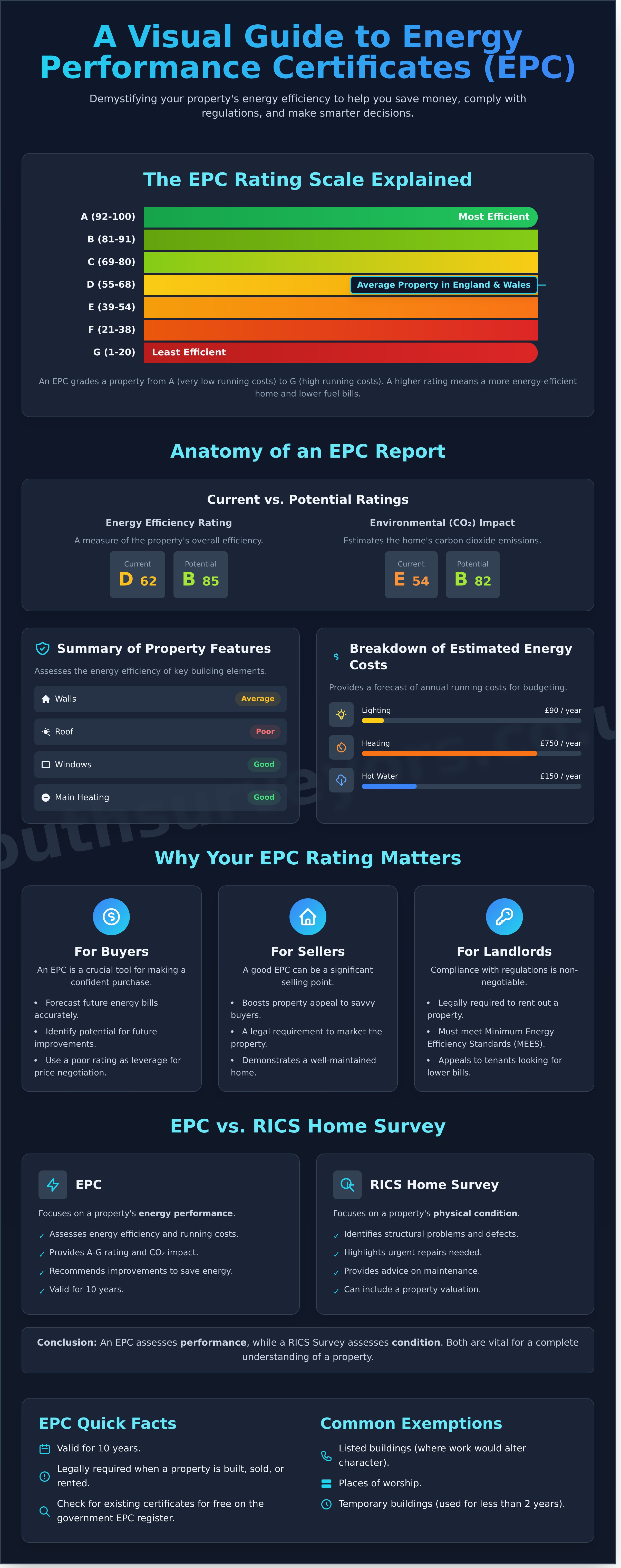
The core of the EPC is its easy-to-understand rating scale, which grades a property from A (most efficient) to G (least efficient). This system provides a quick visual guide to a home’s performance. Properties rated ‘A’ benefit from very low running costs and a minimal environmental impact, while those in the lower bands will be more expensive to heat and light. For context, the average property rating in England and Wales is currently band D.
How to Check if a Property Already Has a Valid EPC
Before commissioning a new report, it is wise to check if a valid certificate already exists. You can do this for free by visiting the official government EPC register for England and Wales. Simply enter the property’s postcode or the report reference number (RRN) to find and download existing documents. Note that if you have made significant energy efficiency improvements, commissioning a new epc certificate is recommended to reflect these positive changes.
Are Any Properties Exempt from Needing an EPC?
While most residential properties require an EPC, certain buildings are exempt. These exemptions are specific and should be approached with care. Common examples include:
- Listed buildings, where compliance with minimum energy performance requirements would unacceptably alter their character or appearance.
- Places of worship.
- Temporary buildings that will be used for less than two years.
- Some industrial sites, workshops, and non-residential agricultural buildings.
If you are uncertain about your property’s status, seeking professional advice from an accredited assessor is the best way to ensure compliance and gain peace of mind.
How to Read and Understand Your EPC Report
Your Energy Performance Certificate (EPC) is far more than a simple A-G rating. It’s a comprehensive document designed to provide clarity on a property’s energy usage and potential running costs. Understanding its key components empowers you to make informed decisions, whether you are buying, selling, or improving your home. To gain real confidence in a property’s performance, it’s essential to look beyond the headline grade. A full copy of a property’s certificate can typically be viewed on the official UK government EPC register.
Decoding the Key Sections of the Certificate
At first glance, the colourful graph stands out, but the real value lies in the detail. A professional report is structured to be clear and methodical. Key areas include:
- Energy Efficiency Rating: This is the primary A (most efficient) to G (least efficient) graph, accompanied by a numerical score from 1-100. It provides an at-a-glance summary of the property’s overall performance.
- Environmental Impact (CO2) Rating: A similar A-G scale shows the property’s carbon dioxide emissions, helping you understand its environmental footprint.
- Summary of Features: This section provides a list of key building elements-such as walls, roof, and windows-with a simple description (e.g., ‘Good’, ‘Average’, ‘Poor’) of their current energy efficiency.
- Breakdown of Energy Performance: Here you will find an estimate of the property’s annual energy costs for lighting, heating, and hot water.
Current vs. Potential Ratings: Your Improvement Roadmap
The certificate prominently displays two important ratings. The ‘Current’ rating reflects the property’s energy efficiency as it stands today. The ‘Potential’ rating shows the score the property could achieve if you were to implement all the recommended improvements. This gap between current and potential is your roadmap-a powerful tool for visualising how you can increase your home’s value, lower running costs, and improve its comfort.
The Recommendations Report: An Action Plan for Savings
This is arguably the most valuable section of the EPC certificate for homeowners. It provides a tailored action plan with specific, prioritised recommendations for improvement. Each suggestion, such as ‘installing loft insulation’ or ‘upgrading to a modern condensing boiler’, comes with an estimated installation cost (e.g., £400 – £800) and the typical savings you could expect on your energy bills each year. Use this report as a reliable starting point to plan renovations that offer the best return on investment.
The EPC Assessment: How to Get a New Certificate
Obtaining an Energy Performance Certificate is a regulated process designed to provide clarity and confidence for property owners, buyers, and tenants. To ensure accuracy and compliance, the assessment and issuance of your certificate must be carried out by a qualified and accredited professional. This ensures the entire process is thorough, reliable, and meets the highest industry standards.
Finding an Accredited Domestic Energy Assessor (DEA)
The first and most critical step is to find a certified professional. Only an accredited Domestic Energy Assessor (DEA) is legally permitted to conduct the survey and produce an official epc certificate. The most reliable way to find a qualified expert in your area is through the official government EPC register for England, Wales, and Northern Ireland, or the separate Scottish EPC Register. We recommend contacting two or three local assessors to compare quotes and availability. Before booking, always confirm their accreditation and ensure they hold adequate professional indemnity insurance for your peace of mind.
What Happens During the EPC Survey?
The on-site assessment is a non-invasive visual inspection, not a structural survey. The DEA will not drill holes or lift floorboards. Instead, they gather data on the elements that contribute to your home’s energy efficiency. As thoroughly outlined in many guides on Energy Performance Certificates Explained, the assessor methodically examines key features of the property, including:
- Insulation: The level of loft, wall, and floor insulation.
- Heating: The main heating system, boiler model, and heating controls.
- Hot Water: The system used to heat water and the insulation of the tank.
- Windows: The type of glazing (e.g., single, double, triple).
- Lighting: The number of low-energy light bulbs in fixed outlets.
The assessor will also take internal and external measurements to determine the total floor area and take photographic evidence to support their assessment.
How Much Does an EPC Cost and How Long Does it Take?
The cost of an EPC in the UK typically ranges from £60 to £120, depending on the size, type, and location of your property. The on-site survey itself is efficient, usually taking between 30 and 60 minutes to complete. After the visit, the assessor will input the collected data into approved software to calculate the energy rating. Your official certificate is then lodged on the national register and typically emailed to you within a few days of the assessment, providing a comprehensive overview of your property’s energy performance.
Why Your EPC Rating Matters: A Guide for All Parties
An epc certificate provides more than just a letter grade; it’s a crucial indicator of a property’s energy efficiency, which has significant financial and legal implications. Understanding its importance provides clarity and confidence whether you are buying, selling, or letting a property. Moving beyond the technical details, the rating offers a clear forecast of a property’s running costs and market appeal.
For Home Buyers: An Indicator of Future Costs
As a buyer, you should view a low EPC rating as a red flag for potentially high future energy bills. The certificate is an invaluable tool for financial planning. The accompanying recommendations report outlines specific improvements, such as adding loft insulation or upgrading a boiler, allowing you to budget for these necessary upgrades. Furthermore, a poor rating can be a valid and powerful point during price negotiations, reflecting the investment required to bring the home up to a more efficient standard. For first-time buyers in particular, understanding these potential costs is crucial when planning your budget alongside other expenses like first time buyer stamp duty in 2026.
For Home Sellers: A Key Marketing Tool
In today’s competitive market, energy efficiency is a major selling point. A property with a high EPC rating (typically a C or above) is instantly more attractive to prospective buyers who are conscious of rising energy prices. Before listing your home, consider implementing some of the lower-cost recommendations from your report. Investing a small amount to improve your rating can enhance your property’s marketability, potentially leading to a quicker sale and a better final price. An efficient home is a modern necessity that savvy buyers actively seek.
For Landlords: Understanding MEES Regulations
For landlords in the UK, adhering to the Minimum Energy Efficiency Standards (MEES) is a non-negotiable legal requirement. These regulations are designed to protect tenants from living in cold, inefficient homes. It is essential to understand your obligations:
- The Standard: Privately rented properties in England and Wales must have a minimum EPC rating of ‘E’.
- Legal Compliance: It is unlawful to grant a new tenancy or continue an existing one for a property that falls below this ‘E’ rating, unless a valid exemption has been registered.
- Penalties: Failing to comply can result in significant financial penalties from your local authority, potentially reaching up to £5,000 per breach.
Ensuring your rental property meets these standards is vital for avoiding legal issues and demonstrating your duty of care as a landlord. For expert guidance on your property’s compliance, the team at South Surveyors is here to provide professional, RICS-certified advice.
How an EPC Complements a RICS Property Survey
While both an Energy Performance Certificate (EPC) and a professional property survey are essential documents in a property transaction, they serve fundamentally different purposes. Confusing the two can leave you with an incomplete understanding of your potential purchase. The best way to think about it is with a simple analogy: an EPC is like a car’s MPG rating, telling you how efficient it is to run. A comprehensive property survey is the full mechanic’s inspection, telling you what’s wrong under the bonnet.
To make an informed decision, you need both: one tells you the likely cost to live in the property, and the other reveals the potential cost to fix it.
Different Focus, Different Expertise
The two reports are produced by different professionals with distinct areas of focus. Understanding this distinction is key to appreciating their combined value.
- An EPC Certificate is created by an accredited Domestic Energy Assessor. Their focus is purely on energy efficiency, using standardised software to model how a property retains heat and consumes energy. They assess elements like loft insulation, boiler efficiency, and window glazing to calculate a rating.
- A comprehensive home survey is conducted by a qualified property surveyor. Their expertise lies in the physical condition and structural integrity of the building. They identify major and minor defects, signs of damp, structural movement, and other issues that could lead to significant repair costs.
Creating a Complete Picture: A Practical Example
Imagine you are buying an older property. The EPC report gives it a rating of ‘E’ and recommends upgrading the single-glazed windows to double-glazing to improve its efficiency. This seems like a straightforward upgrade. However, a detailed Level 3 Building Survey might then reveal that the timber window frames are suffering from wet rot and the brickwork lintels above them are cracked. Suddenly, the job is not just about new glass; it involves structural repairs and full window replacements, a significantly more complex and costly undertaking. The EPC identified an opportunity for improvement, but the building survey uncovered the essential reality of the building’s condition.
Making Your Property Decision with Total Confidence
An EPC is a legal necessity that provides valuable insight into your future energy bills. But to truly protect your investment, a professional survey is indispensable. It provides the crucial information you need to understand the property’s structural health, budget for necessary repairs, and even renegotiate the purchase price. Real confidence when buying a home comes from having the complete picture-understanding both the running costs and the physical condition. Only then can you be sure you are making a sound financial decision.
Get clarity on your property’s condition with a professional property survey from South Surveyors.
From EPC Insight to Property Confidence: Your Final Checklist
Understanding your Energy Performance Certificate is a crucial first step in any UK property transaction. It provides a clear, standardised snapshot of a home’s energy efficiency and potential running costs, empowering you to make smarter financial choices whether you are buying, selling, or letting a property.
However, while an epc certificate provides valuable data on energy performance, it doesn’t reveal the underlying structural condition of the property. The recommendations in the report-such as installing new windows or loft insulation-require expert assessment to understand their true cost and feasibility. This is where a comprehensive RICS survey provides the missing piece of the puzzle, turning data into a detailed action plan. For first-time buyers navigating the complexities of property purchase, understanding both energy efficiency costs and tax implications like first time buyer stamp duty changes in 2026 is essential for making a fully informed decision.
To move forward with complete peace of mind, partner with a team you can trust. At South Surveyors, our work is regulated by RICS, ensuring the highest professional standards. With expert local knowledge across South London, we deliver clear, comprehensive reports for truly informed decisions. Get clarity and confidence with a RICS-certified property survey.
Armed with the right information from both your EPC and a professional survey, you are now in a strong position to navigate your next property move successfully.
Frequently Asked Questions About EPC Certificates
What is the minimum EPC rating for renting a property in 2026?
Currently, the Minimum Energy Efficiency Standards (MEES) in the UK require a privately rented property to have an EPC rating of ‘E’ or higher. While the government had proposed raising this minimum to a ‘C’ rating, these plans were scrapped in 2023. Therefore, unless new legislation is introduced, the minimum required rating is expected to remain ‘E’ in 2026. Landlords should always stay informed on the latest government regulations to ensure compliance.
Can I sell a house with a low EPC rating like F or G?
Yes, it is perfectly legal to sell a property with a low EPC rating. The legal requirement for a sale is simply to have a valid EPC available for potential buyers to view. However, a poor rating of F or G can impact the property’s marketability, as buyers may be concerned about high energy bills and the cost of future improvements. A low rating might be used as a point for price negotiation, so it is a factor to consider.
How long is an EPC certificate valid for in the UK?
An EPC certificate is valid for 10 years from its date of issue. You will need a valid certificate if you are selling, renting out, or newly building a property. If your certificate expires, you only need to get a new one when you next need to market the property for sale or rent. If you make significant energy efficiency upgrades, you may choose to get a new assessment done sooner to reflect the improvements on your certificate.
Do I need a new EPC if I install a new boiler or windows?
You are not legally obligated to commission a new EPC after installing a new boiler or windows, as long as your current certificate is still within its 10-year validity. However, it is highly advisable to do so. These upgrades can significantly improve your property’s energy efficiency. Obtaining an updated EPC will reflect a higher rating, making your property more attractive to prospective buyers or tenants and potentially increasing its value.
What are the most cost-effective ways to improve my EPC rating?
Several cost-effective measures can provide a significant boost to your EPC rating. The most common recommendations include increasing your loft insulation to the standard 270mm depth, installing cavity wall insulation, and ensuring all light fittings use low-energy LED bulbs. Simple fixes like draught-proofing around windows and doors can also make a surprising difference. These upgrades often offer the best return on investment for improving your home’s energy performance.
Is an EPC included as part of a RICS Level 2 or Level 3 survey?
No, an EPC assessment is a distinct service and is not included within a RICS Home Survey (Level 2 or Level 3). A RICS survey provides a comprehensive report on the property’s condition and structural integrity. In contrast, an EPC must be carried out by a specifically accredited Domestic Energy Assessor (DEA), who focuses solely on factors affecting energy efficiency to produce the official certificate and rating for the property.
Can I perform my own EPC assessment?
No, an official EPC assessment must be conducted by an accredited professional. To ensure consistency and legal validity, only a qualified and accredited Domestic Energy Assessor (DEA) is permitted to carry out the survey and produce an EPC certificate. They use government-approved software and a standardised methodology to assess your property’s energy features, ensuring the final report is accurate, reliable, and can be lodged on the official government register.