The prospect of extending your property’s lease can be a source of significant anxiety. Faced with confusing legal terms, the worry of the lease dipping below the critical 80-year mark, and the uncertainty of the final cost, it’s easy to feel overwhelmed. Many homeowners turn to a lease extension calculator for an initial idea, but what do the numbers truly mean? This is where professional clarity is essential, and it starts with a realistic estimate backed by expert knowledge.
Our free calculator is designed to provide you with that crucial starting point: a reliable ballpark figure for your premium in 2026, estimated in pounds (£). In this guide, we will not only walk you through using the tool but also demystify the key factors that determine the final price, from ground rent to the elusive ‘marriage value’. Our goal is to replace financial uncertainty with understanding, giving you the confidence that comes from reliable, expert estimates to plan effectively, understand the next steps, and negotiate fairly with your freeholder.
Key Takeaways
Get an immediate budget estimate for your premium by using our free lease extension calculator before you begin the formal process.
Understand the three critical factors-including the remaining lease term and ground rent-that directly influence the final cost of your extension.
Learn why an online estimate is an excellent tool for initial planning but why a formal RICS valuation is essential for legal negotiations.
Discover the clear, step-by-step statutory process you’ll need to follow after your initial calculation to successfully extend your lease with confidence.
How to Use Our Free Lease Extension Calculator
Navigating the cost of a lease extension can feel complex. To provide you with immediate clarity and confidence, we have developed this free lease extension calculator. It is designed to give you a reliable preliminary estimate of the premium you might expect to pay, based on established statutory formulas used by RICS-Certified surveyors.
To better understand the key factors involved in this calculation, this short video offers a helpful overview.
Simply enter the three key details below to receive your instant estimate. Please be assured that any information you enter is processed in your browser and is not stored or shared by us. Your privacy is paramount.
[Embedded Lease Extension Calculator Tool Here]
This tool provides an estimate for guidance purposes only. A formal valuation from a qualified surveyor is required for legal proceedings.
While our calculator provides a valuable starting point, understanding the data you input is crucial for interpreting the results. Below, our experts break down each required field to help you source the most accurate information.
Input 1: Current Property Value (£)
This is the most significant factor influencing the premium. For an accurate estimate, you should input the property’s current market value as if it had a very long lease. You can get a good initial idea by researching recent sale prices of similar properties in your local London neighbourhood on portals like Zoopla or Rightmove. Online valuation tools can also offer a helpful, though less precise, starting point.
Input 2: Years Remaining on the Lease
You can find the exact number of years remaining on your lease in your title deeds or the original lease agreement. Accuracy here is vital, particularly if your lease is approaching the 80-year mark. Once a lease drops below 80 years, “marriage value” applies, which can significantly increase the cost of an extension. The original 99-year lease, once considered the longest practical term of a lease, is why many London properties now face this critical deadline.
Input 3: Annual Ground Rent (£)
Ground rent is a regular payment made to the freeholder as a condition of the lease. This amount is specified in your lease agreement. It is essential to check your lease for any clauses that state the ground rent will increase over time, as these “escalating” ground rents must be factored into the formal valuation and will increase the final premium you have to pay.
Understanding Your Results: The 3 Key Factors That Determine Cost
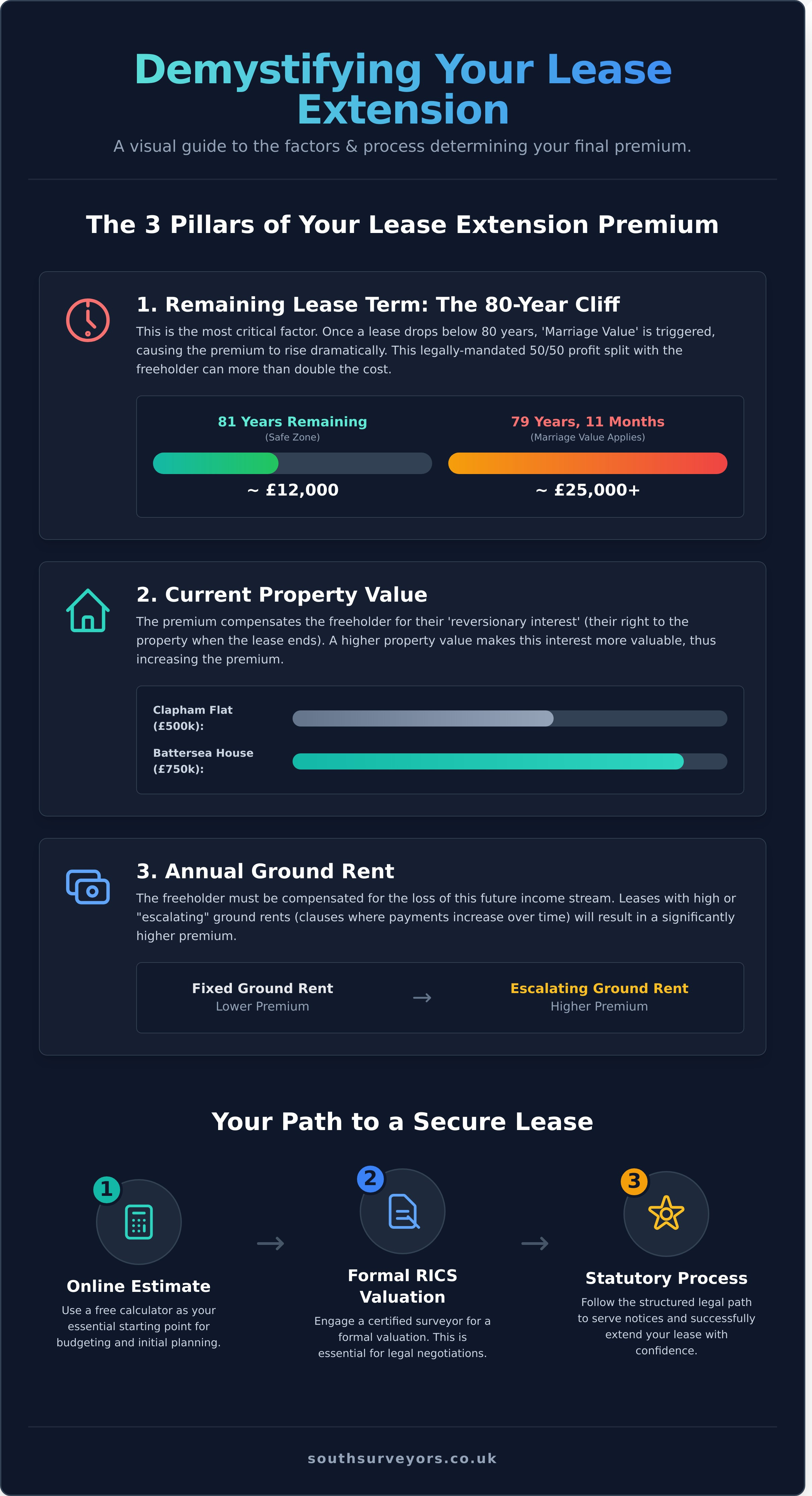
The figure produced by a lease extension calculator is known as the ‘premium’ – the one-off price you pay to the freeholder to add years to your lease. This isn’t an arbitrary number; it’s calculated based on established valuation principles. To give you clarity and confidence in your results, it’s crucial to understand how your inputs directly influence the final cost. These three factors interact, meaning a change in one can significantly affect the others.
Let’s use a clear example to illustrate: a two-bedroom flat in Clapham, currently valued at £500,000.
Factor 1: The Remaining Lease Term (The 80-Year Rule)
This is the single most critical deadline for any leaseholder. Once a lease drops below 80 years, the valuation formula changes to include ‘marriage value’. In simple terms, marriage value is the increase in the property’s value resulting from the lease extension. The law states that this profit must be split 50/50 with the freeholder. This causes the premium to rise dramatically. For our Clapham flat, the premium at 81 years might be £12,000. At 79 years and 11 months, it could easily jump to over £25,000. Acting before this threshold is essential to save a substantial amount of money.
Factor 2: The Property’s Value
Part of the premium compensates the freeholder for their ‘reversionary interest’ – their right to take possession of the property when the original lease term expires. The higher your property’s value, the more this future right is worth to them today. Therefore, a £750,000 property in Battersea will command a higher premium than our £500,000 Clapham flat, assuming all other factors are equal. Crucially, any improvements you have made as a leaseholder (such as a new kitchen or bathroom) are disregarded during the valuation, ensuring you are not paying to extend the lease on value you created yourself.
Factor 3: The Ground Rent
A statutory lease extension reduces your future ground rent payments to zero (known as a ‘peppercorn’ rent). The premium must therefore compensate the freeholder for this loss of future income. A higher or escalating ground rent – for example, one that doubles every 10 years – means the freeholder is losing a more valuable asset, which significantly increases the premium. While the Leasehold Reform Act 2022 has banned ground rents on most new leases, existing ground rents remain a key component when calculating your premium. Understanding these financial elements is a core part of navigating the official lease extension process and achieving a fair price.
Why an Online Calculator Is Only a Starting Point
For many South London leaseholders, the first step in exploring a lease extension is using an online lease extension calculator. These tools are incredibly useful for providing an initial, ballpark figure, helping you understand the potential costs and budget accordingly. Even respected resources like the government-funded Leasehold Advisory Service calculator offer a valuable starting estimate. However, it is crucial to recognise that this figure is purely indicative and cannot be used for any formal proceedings.
An automated calculation, no matter how sophisticated, provides a broad estimate. To proceed with clarity and confidence, you need a precise, defensible valuation that reflects the true market value of your specific property. This is where professional expertise becomes essential.
Limitations of Automated Tools
An online calculator works with averages and algorithms, but it cannot see your property. This creates a significant margin for error, as the calculation will not account for the unique factors that determine your property’s precise value. Key limitations include:
Property Specifics: The tool cannot assess your property’s condition, the quality of any improvements (like a new kitchen or loft conversion), or specific desirable features that impact its market value in South London.
Local Market Nuances: A calculator struggles to differentiate between postcodes. It won’t factor in the hyper-local market dynamics, recent comparable sales on your street, or the premium commanded by a property near a popular park or transport link.
Outdated Data: The property market moves quickly. The data underpinning a calculator, particularly regarding ground rent terms and historic valuation data, can become outdated, leading to an inaccurate premium estimate.
The Role of a RICS Registered Valuer
Transitioning from an online estimate to a formal valuation is the most critical step in the lease extension process. A RICS Registered Valuer provides a comprehensive, expert assessment that gives you a reliable and legally robust figure. This professional valuation is not just a number; it is your primary tool for negotiation and the foundation of your formal offer to the freeholder (the Section 42 Notice).
A thorough RICS valuation report provides the leverage needed to negotiate effectively with your freeholder, ensuring you pay a fair price. It replaces uncertainty with a professional, evidence-based figure, giving you real confidence as you move forward. This expert report is the key to a successful and fair lease extension outcome.
The Lease Extension Process: What Happens After the Calculation?
An estimate from a lease extension calculator provides a crucial starting point, giving you a clear idea of the potential premium. But what comes next? Navigating the lease extension journey can feel daunting, but it follows a structured path. With the right professional guidance, you can proceed with confidence, knowing your investment is protected. The process typically follows one of two routes: an informal negotiation or a formal statutory claim.
The Informal (Negotiated) Route
This path involves approaching your freeholder directly to negotiate the terms of the extension without serving any legal notices. It is a voluntary agreement that relies on mutual cooperation.
Pros: This route can be faster and potentially cheaper, avoiding some legal costs if your freeholder is cooperative and the terms offered are fair.
Cons: It offers no legal protection. The freeholder is not obliged to grant an extension, can withdraw at any time, and may propose unfavourable terms, such as retaining a high ground rent.
The Formal (Statutory) Route
This is the legally protected path defined by the Leasehold Reform Act 1993. It gives eligible leaseholders the right to a 90-year extension at a peppercorn ground rent (effectively zero).
Pros: Your rights are protected by law with a clear, structured timeline. It guarantees a fair premium determined by a set valuation formula and eliminates future ground rent payments.
Cons: The process is more rigid and can take longer. It requires formal notices and incurs necessary professional fees for both a solicitor and a surveyor from the outset.
The formal process begins when your solicitor serves a Section 42 Notice on the freeholder. This legal document includes your premium offer, which must be based on a professional valuation from a RICS-Certified surveyor. This detailed valuation provides the robust evidence needed to support your claim, moving far beyond the initial estimate from a simple lease extension calculator.
Whichever route you choose, expert advice is essential for achieving a successful outcome. A surveyor provides the accurate valuation needed for any negotiation, while a solicitor handles the complex legal framework. For professional, RICS-regulated advice to help you make an informed decision, contact the team at South Surveyors. We provide the clarity and confidence you need to secure your property’s future.
From an Online Estimate to a Confident Negotiation
As we’ve demonstrated, an online lease extension calculator is an excellent tool for gaining an initial understanding of your potential premium. It clarifies how critical factors like your remaining lease term, ground rent, and property value directly impact the cost. However, to successfully navigate the legal process and negotiate with your freeholder, this preliminary estimate must be substantiated by a professional assessment.
This is where expert guidance becomes essential. A formal valuation provides the robust, evidence-backed figure you need for statutory negotiations, giving you peace of mind and a significant advantage. At South Surveyors, all our valuations are carried out by RICS Registered Valuers who possess deep, expert knowledge of the South London property market.
What is ‘marriage value’ and how does it affect my lease extension cost?
Marriage value is the increase in your property’s value that results from the lease extension. This potential ‘profit’ is shared equally (50/50) between you and the freeholder. Crucially, this only applies when a lease has fewer than 80 years remaining. Extending a lease with 79 years left will be significantly more expensive than one with 81 years, making it essential to act before your lease drops below this critical 80-year threshold to manage your costs effectively.
How long does the entire lease extension process typically take?
The duration of a lease extension can vary significantly. An informal negotiation directly with your freeholder might conclude in as little as 2-4 months. However, the formal statutory route, which offers greater legal protection, typically takes between 6 to 12 months. This process can be extended if disagreements arise that require a First-tier Tribunal to resolve. Professional management and prompt communication are key to ensuring a smooth and timely process for all parties.
Can my freeholder refuse to extend my lease?
If you meet the eligibility criteria, such as owning the property for at least two years, you have a statutory right to a lease extension. This means your freeholder cannot legally refuse your formal request. While they can dispute the premium and terms, they cannot deny the extension itself. This legal protection provides leaseholders with the clarity and confidence to proceed. An informal request, however, can be refused by the freeholder without any legal justification.
Should I accept the first premium offer from my freeholder?
It is rarely advisable to accept a freeholder’s first offer without your own due diligence. This initial figure is often a starting point for negotiation and may be higher than the fair market value. While an online lease extension calculator can provide a rough guide, you must commission an independent valuation from a RICS-certified surveyor for real confidence. This professional report provides a robust, evidence-based figure, giving you a powerful position from which to negotiate a fair premium.
Is it worth extending my lease if I plan to sell my property soon?
Yes, extending your lease is highly recommended, even if you plan to sell. A short lease, particularly one below 80 years, can severely limit your pool of potential buyers as many mortgage lenders will not approve a loan on the property. By extending the lease, you significantly enhance its marketability and value, often adding more to the sale price than the extension cost. This proactive step can lead to a faster, more profitable sale and provide peace of mind.
What are the typical professional fees involved besides the premium?
Beyond the premium itself, you should budget for several professional fees. These include your own costs for a RICS-certified surveyor to conduct the valuation and a solicitor to handle the legal work. Additionally, under the statute, you are required to cover the freeholder’s reasonable legal and valuation costs. While a lease extension calculator estimates the premium, it is vital to factor in these additional professional fees, which can amount to several thousand pounds, for a complete financial picture.