

Buying a new home is an exciting milestone, but it often comes with a confusing array of technical decisions. You’re likely facing one of the most common questions from homebuyers: should you choose a RICS Level 2 or Level 3 survey? The fear of overpaying for a report you don’t need, or worse, choosing one that isn’t thorough enough and misses a costly hidden issue, is a very real concern. Understanding the fundamental difference between a RICS level 2 and 3 survey is the first, most crucial step toward gaining the confidence you need to proceed with your purchase.
This guide has been created by our RICS-Certified experts to provide you with complete clarity. We will break down exactly what each survey entails, compare their costs, and explain which type of property each is best suited for. Our goal is to demystify the jargon and empower you to make a sound, informed decision for your potential new home. By the end, you will have the peace of mind that comes from choosing the right professional survey to protect your most significant investment.
Key Takeaways
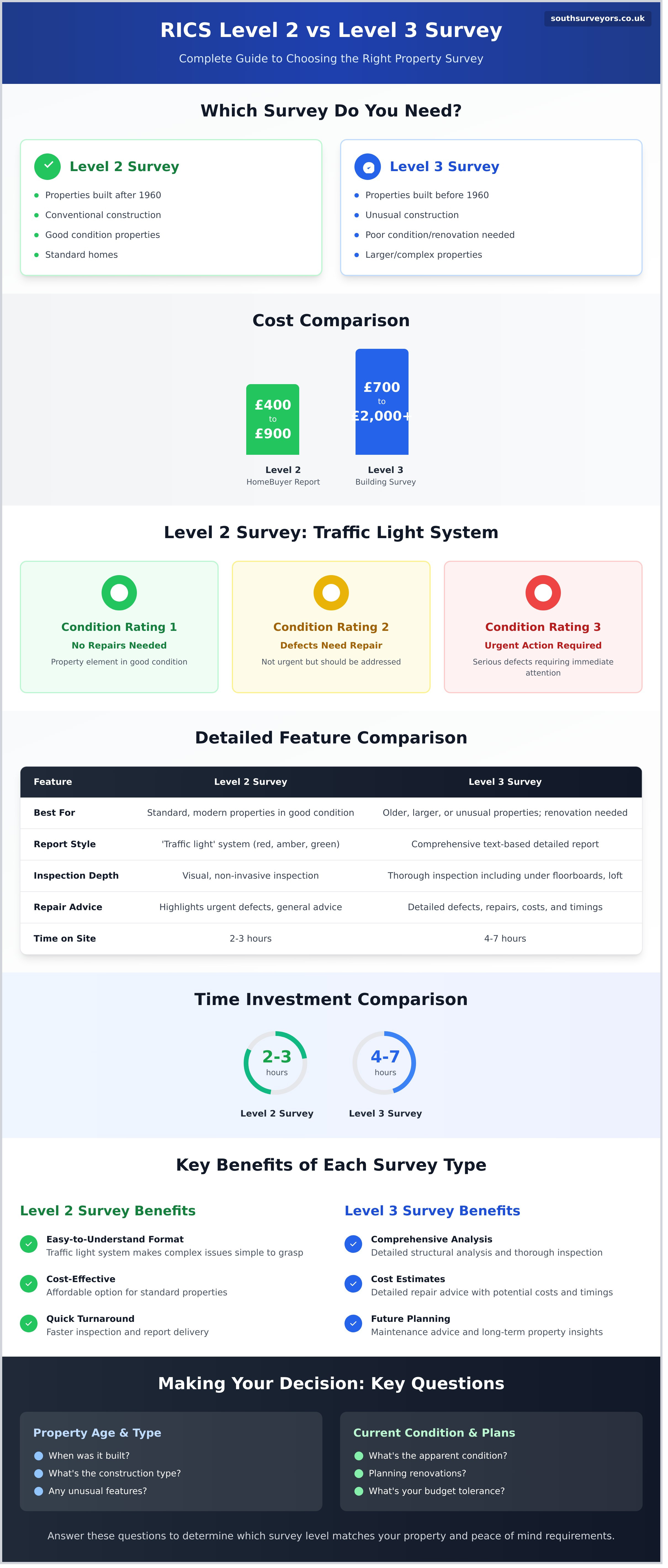
- A primary difference between RICS level 2 and 3 survey reports is their suitability; Level 2 is for conventional, newer homes, while Level 3 is for older, unusual, or poorly maintained properties.
- Discover how the Level 2 Survey’s ‘traffic light’ system gives you a clear, at-a-glance summary of a property’s condition and any urgent defects requiring attention.
- The critical difference between RICS level 2 and 3 survey lies in the detail; the Level 3 offers a comprehensive structural analysis, including advice on repairs and future maintenance costs.
- Make a confident decision by understanding the financial difference between RICS level 2 and 3 survey costs versus the potential risk of future repairs, considering the property’s age, construction, and your renovation plans.
At a Glance: Key Differences Between a Level 2 and Level 3 Survey
Choosing the right property survey can feel complex, but the decision is simpler than it seems. In short: a RICS Level 2 Survey (formerly the HomeBuyer Report) is designed for conventional, modern homes in good condition, while a RICS Level 3 Survey (formerly the Building Survey) provides a comprehensive, in-depth analysis for older, larger, or more complex properties.
The primary difference between a RICS Level 2 and 3 survey lies in the depth of the inspection and the detail of the final report. Both are conducted by RICS-certified professionals, a standard for Chartered Surveyors in the UK, but they are tailored to different property types to give you the clarity and confidence you need.
For a clear visual breakdown, our expert surveyor explains the key distinctions in this short video:
Quick Choice Guide: Which Survey for Which Property?
To help you make a quick, informed decision, here’s a simple guide:
- Choose a Level 2 Survey if: The property was built after 1960, is of conventional construction (e.g., brick and tile), and appears to be in a reasonable condition.
- Choose a Level 3 Survey if: The property is older (pre-1960s), has an unusual construction, is in a visibly poor state of repair, or if you are planning significant renovations or extensions.
Comparison Table: RICS Level 2 vs. Level 3 Survey
| Feature | RICS Level 2 Survey | RICS Level 3 Survey |
|---|---|---|
| Best For | Standard, modern properties in good condition. | Older, larger, or unusual properties; those needing renovation. |
| Report Style | Uses a ‘traffic light’ system (red, amber, green) for easy-to-understand condition ratings. | A highly detailed, comprehensive text-based report with in-depth analysis and descriptions. |
| Inspection Depth | A visual, non-invasive inspection of accessible parts of the property. | A more thorough and detailed inspection. The surveyor will look in more areas (e.g., under floorboards, in the loft) where safe and agreed. |
| Advice on Repairs & Costs | Highlights urgent defects and provides general repair advice. Does not typically include cost estimates. | Provides detailed advice on defects, repairs, and ongoing maintenance, often including projected timings and potential costs. |
| Typical Cost | £400 – £900 | £700 – £2,000+ |
| Time on Site | Typically 2-3 hours. | Typically 4-7 hours, depending on the property’s size and complexity. |
A Deep Dive into the RICS Level 2 Home Survey (HomeBuyer Report)
The RICS Level 2 Home Survey, often referred to by its former name, the HomeBuyer Report, is the most popular type of survey for property buyers in the UK. Its primary purpose is to provide you with clear, professional advice on the condition of a property, highlighting any significant or urgent problems that could affect its value. This survey is designed to give you the clarity and confidence you need to proceed with your purchase.
One of the most valued features of a Level 2 Survey is its famous ‘traffic light’ system. Our RICS-Certified surveyors use this simple colour-coded rating to assess the condition of different parts of the property. A green rating (Condition Rating 1) means no repairs are needed, amber (Condition Rating 2) indicates defects that need repairing but are not urgent, and red (Condition Rating 3) signals serious defects that require urgent investigation or repair. This straightforward format makes the report easy to understand and helps you prioritise any necessary actions.
It’s important to understand that this is a non-intrusive, or ‘surface-level’, inspection. The surveyor will not lift floorboards, drill into walls, or move heavy furniture. The assessment is based on a thorough visual inspection of all accessible areas, providing a comprehensive overview without causing any damage to the property.
What Does a Level 2 Survey Report Include?
A thorough RICS Level 2 Survey provides a detailed summary of the property’s condition. Our expert report will give you peace of mind by including:
- A comprehensive visual inspection of the interior and exterior, from the roof down to the foundations.
- Checks on all visible and accessible parts of the building, including walls, ceilings, floors, windows, and doors.
- A visual assessment of services such as the gas, electricity, water, and drainage systems (though the surveyor will not test them).
- Highlights of urgent problems that could impact the property’s value. Our RICS-certified reports meet the high standards reflected in official government guidance on property valuations, ensuring you receive a reliable assessment.
When is a Level 2 Survey the Right Choice?
Choosing the right survey is a crucial step. A Level 2 Home Survey is the ideal choice for you if the property you are buying is:
- A conventional house, flat, or bungalow.
- Built from common materials and is in a reasonable state of repair.
- Relatively modern (typically built within the last 100 years).
It provides a robust level of detail for most standard property purchases, offering significantly more assurance than a basic mortgage valuation without the expense of a full structural survey.
What a Level 2 Survey Doesn’t Tell You
Managing expectations is key to understanding the report’s scope. A key difference between RICS level 2 and 3 survey is the level of detail on repairs. A Level 2 report will identify defects but will not typically include:
- Detailed advice on how to carry out specific repairs.
- Cost estimates for the repair work required.
- Investigation of hidden or unexposed parts of the building, such as the structure behind walls or beneath floors.
If the survey uncovers complex issues, the surveyor will recommend further investigation by a specialist, such as a structural engineer or damp expert.
Exploring the Comprehensive RICS Level 3 Building Survey
When you need the most thorough and detailed property health check available, the RICS Level 3 Building Survey is the definitive choice. It moves far beyond a simple condition rating, providing a comprehensive analysis that equips you with a deep understanding of the property’s structure and fabric. The most significant difference between a RICS level 2 and 3 survey is this depth of investigation and the detailed, actionable advice that follows.
This survey is designed to give you complete clarity and confidence, especially when dealing with complex properties. It serves as an essential tool for planning and budgeting, transforming potential unknowns into a clear roadmap for future maintenance and repairs.
What’s Included in a Level 3 Survey?
A RICS-certified surveyor conducts a meticulous inspection of the property’s construction and condition. The final report delivers an in-depth analysis of any defects found, explaining their cause and the potential implications if left unaddressed. Crucially, it includes professional advice on necessary repairs and outlines future maintenance options, allowing you to plan ahead. Many surveyors can also provide projected costs and timelines for this work, though you should always verify this is part of their service.
When Should You Always Choose a Level 3 Survey?
While suitable for any property, a Level 3 Survey is strongly recommended, and often essential, in specific circumstances. You should always opt for this comprehensive report if:
- The property is over 50 years old or is a listed building.
- It is built with unconventional materials, such as a timber frame or thatched roof.
- The building is in a visibly poor state of repair or has been extensively altered.
- You are planning to undertake significant renovations or structural work yourself.
The True Value: Using a Level 3 Survey for Negotiation
Investing in a Level 3 Survey can deliver a substantial return. The detailed report provides powerful, impartial evidence to support renegotiating the purchase price. If the survey uncovers issues requiring £10,000 of repairs, you have a solid basis for making an informed counter-offer. This detailed insight prevents you from facing costly, unexpected surprises after you move in, giving you the peace of mind that you are making a sound financial decision. It empowers you to proceed with your purchase with real confidence.
Unsure which survey is right for your property? Contact our expert team for tailored, professional advice.
Once you have this level of detail, you can begin to plan not just for repairs but for how you’ll enjoy your new home. For many, this includes creating a welcoming outdoor space. If you’re looking for inspiration for garden or patio furnishings, UK-based specialists like Rengard offer a wide range of high-quality options.
Making the Final Decision: Cost vs. Risk
Choosing the right survey requires balancing the key factors we’ve discussed-the property’s age, construction, condition, and your future plans for it. However, the most critical consideration is not simply the survey’s price, but the potential financial risk of uncovering major issues after you’ve completed the purchase. The higher cost of a Level 3 survey should be seen as an investment in peace of mind and protection against unforeseen expenses that could run into thousands of pounds.
Think of it like a comprehensive health check for what is likely your biggest ever investment. While a basic check-up might suffice for the young and healthy, a more thorough examination is prudent for anything older or showing signs of wear. Ultimately, the difference between a RICS Level 2 and 3 survey lies in the depth of this examination and the level of assurance it provides.
Is a Level 3 Survey Ever ‘Too Much’?
In some scenarios, a Level 3 survey could be considered overkill. For a standard new-build home, for instance, a RICS Level 2 HomeBuyer Report is often perfectly adequate to identify any immediate issues. While even new properties can have defects, the scale is typically less severe. However, if you have any doubts at all, especially regarding an older or more complex property, commissioning a more detailed survey is always the safer and more responsible choice.
Don’t Confuse a Mortgage Valuation with a Survey
It is crucial to understand that a mortgage valuation is not a survey. This report is commissioned by your lender for one purpose only: to confirm the property is adequate security for the loan they are providing you. It offers no protection for you, the buyer, and will not detail the defects, potential repairs, or ongoing maintenance costs you will be responsible for. Relying solely on a valuation is a significant financial risk.
Getting Expert, Impartial Advice
If you remain unsure which survey is right for the property you wish to buy, the best course of action is to speak directly with a qualified surveyor. A professional, RICS-certified surveyor can assess the property’s details from an online listing and provide a clear recommendation, giving you the confidence to proceed correctly. Making an informed decision now can save you from significant stress and expense in the future.
Contact our expert team for clear advice on your property.
Making Your Decision with Clarity and Confidence
Choosing the right survey is a pivotal decision in your property purchase. The key takeaway is that a Level 2 Home Survey is perfectly suited for conventional, modern homes in good condition, while the comprehensive Level 3 Building Survey is essential for older, larger, or significantly altered properties where a deeper investigation is required. Ultimately, understanding the difference between RICS level 2 and 3 survey is about aligning the report’s detail with the property’s specific risks to protect your investment.
At South Surveyors, our team of local South London property experts is here to provide the impartial advice you need. As a firm regulated by RICS for your peace of mind, we deliver clear, actionable reports that give you the confidence to proceed with your purchase or negotiate better terms. We translate complex findings into a straightforward assessment, so you know exactly where you stand.
Ready to proceed with total confidence? Get a Free, No-Obligation Quote for Your Survey today and let our expertise guide your next step.
Frequently Asked Questions
What is the main difference between a HomeBuyer Report and a RICS Level 2 Survey?
There is no functional difference; the RICS Level 2 Survey is simply the modern name for what was previously known as the HomeBuyer Report. The Royal Institution of Chartered Surveyors (RICS) updated the terminology to provide greater clarity for homebuyers. Both refer to the same mid-level inspection suitable for conventional properties in a reasonable state of repair. When you instruct a RICS-Certified professional for a Level 2 Survey, you are receiving the direct, updated equivalent of the former HomeBuyer Report.
Can I rely on the mortgage valuation instead of getting a survey?
No, a mortgage valuation is not a substitute for a property survey. The valuation is a brief assessment conducted for your mortgage lender to confirm the property is worth the amount you are borrowing. It will not detail potential defects or provide advice on repairs. Investing in a separate RICS survey is the only way to get a comprehensive understanding of the property’s condition, giving you the clarity and confidence to proceed with your purchase and avoid unexpected costs.
How much more does a Level 3 Building Survey typically cost than a Level 2?
A RICS Level 3 Building Survey is significantly more detailed, and its price reflects this. Typically, a Level 3 survey can cost between £600 and £1,500+, often 50-100% more than a Level 2 survey, which may range from £400 to £800. This higher cost covers the surveyor’s extra time on-site for a more in-depth, ‘behind the scenes’ inspection of the property’s structure and fabric, providing a much more exhaustive report for your peace of mind.
Is a Level 2 survey detailed enough for a 1930s semi-detached house?
A Level 2 survey can be sufficient for a 1930s semi-detached house, provided it is in a reasonable, well-maintained condition and has not been significantly altered. However, if the property shows clear signs of disrepair, has had major extensions, or if you plan significant renovation work, a Level 3 Building Survey is the more prudent choice. The key difference between a RICS Level 2 and 3 survey is the depth of inspection, and an older property often benefits from the more thorough Level 3.
Do RICS surveys include a property valuation?
A property valuation is not automatically included in a standard RICS survey, but it can be added as an optional extra for both Level 2 and Level 3 reports. The primary purpose of the survey is to assess the property’s physical condition, highlighting defects and advising on necessary repairs. If you require an expert opinion on the property’s current market value, you must specifically request that a valuation be included with your survey report.
How long does it take to receive the survey report after the inspection?
You can typically expect to receive your comprehensive report within 3 to 7 working days after the physical inspection is completed. The turnaround time can vary depending on the surveyor’s schedule and the complexity of the property. Our RICS-Certified surveyors often provide a brief telephone call on the day of the inspection to give you an immediate summary of their key findings, ensuring you have initial feedback while the detailed written report is being prepared.