

Last Tuesday, a buyer in Greenwich nearly signed on a charming period conversion before a professional rics survey revealed that the “characterful” damp was actually a failing roof structure requiring a £12,500 overhaul. It’s a classic South London story where the pressure to move fast in competitive spots like Crystal Palace or Dulwich often leads to expensive oversight. You likely feel that same frantic energy, worrying that if you don’t move instantly, you’ll lose out on your dream terrace in the SE19 or SE10 postcodes. It’s hard to stay objective when you’ve already mentally placed your furniture in a house in Bromley or Croydon.
We agree that the property ladder feels like a high-stakes sprint, but nobody wants to inherit a money pit hidden behind a fresh coat of paint. This guide provides the clarity and confidence you need to navigate the SE, BR, and CR markets without nasty surprises. You’ll discover how to decode confusing jargon like heave or subsidence and gain the expert leverage to negotiate a better price. We’ll preview the essential steps for 2026, from understanding local Victorian brickwork to getting a jargon-free report that actually helps you make a move with total peace of mind.
Key Takeaways
- Understand why a basic mortgage valuation isn’t enough to protect your investment and how a RICS survey provides the expert health check you need for a South London home.
- Learn how to choose between a Level 2 and Level 3 survey to suit the specific age and architectural style of your Croydon semi or Dulwich villa.
- Uncover the “South London Specials”-common hidden defects like Victorian foundation issues in East Dulwich or “quick-fix” renovation blunders in trendy SE London flips.
- Master the art of using your report to negotiate a better deal, ensuring you don’t pay over the odds for properties with “Red Light” defects.
- Gain the clarity and confidence to navigate the 2026 property market with hyperlocal insights across the SE, BR, DA, CR, and SM postcodes.
RICS Survey 101: The “Gold Standard” for Your South London Property Purchase
Buying a home in South East London is a high stakes game. Whether you are eyeing a charming Victorian terrace in Herne Hill or a sleek apartment in Bromley, you are likely committing to the biggest financial outlay of your life. Relying on a “good feeling” or a quick twenty minute viewing is a recipe for expensive surprises. An expert rics survey acts as a deep dive health check for your potential investment. It shifts your position from crossing your fingers to holding a factual, evidence based report on the property’s condition.
Think of it as a professional MOT for a house. You wouldn’t buy a used car without checking the engine, so why skip the structural check on a £600,000 house in SE24? A qualified professional from the Royal Institution of Chartered Surveyors (RICS) brings a level of scrutiny that the untrained eye simply cannot match. They look behind the fresh “staging” paint and the cleverly placed furniture to find the issues that actually matter. This regulation ensures your surveyor is a vetted expert with years of training, not just a bloke with a ladder and a sense of optimism.
The RICS Badge: Why Adherence to Standards Matters
When you see the RICS logo, you are looking at a guarantee of quality and accountability. To become RICS certified, professionals must undergo years of rigorous academic and practical training, followed by a demanding assessment of professional competence. This isn’t just about knowing how to spot a crack; it’s about following a strict code of ethics and maintaining professional indemnity insurance. This insurance is vital because it protects your investment if something goes wrong. RICS is the global mark of property professionalism, ensuring every report meets a consistent, high quality benchmark.
Surveyor vs. Mortgage Valuer: Clearing Up the Confusion
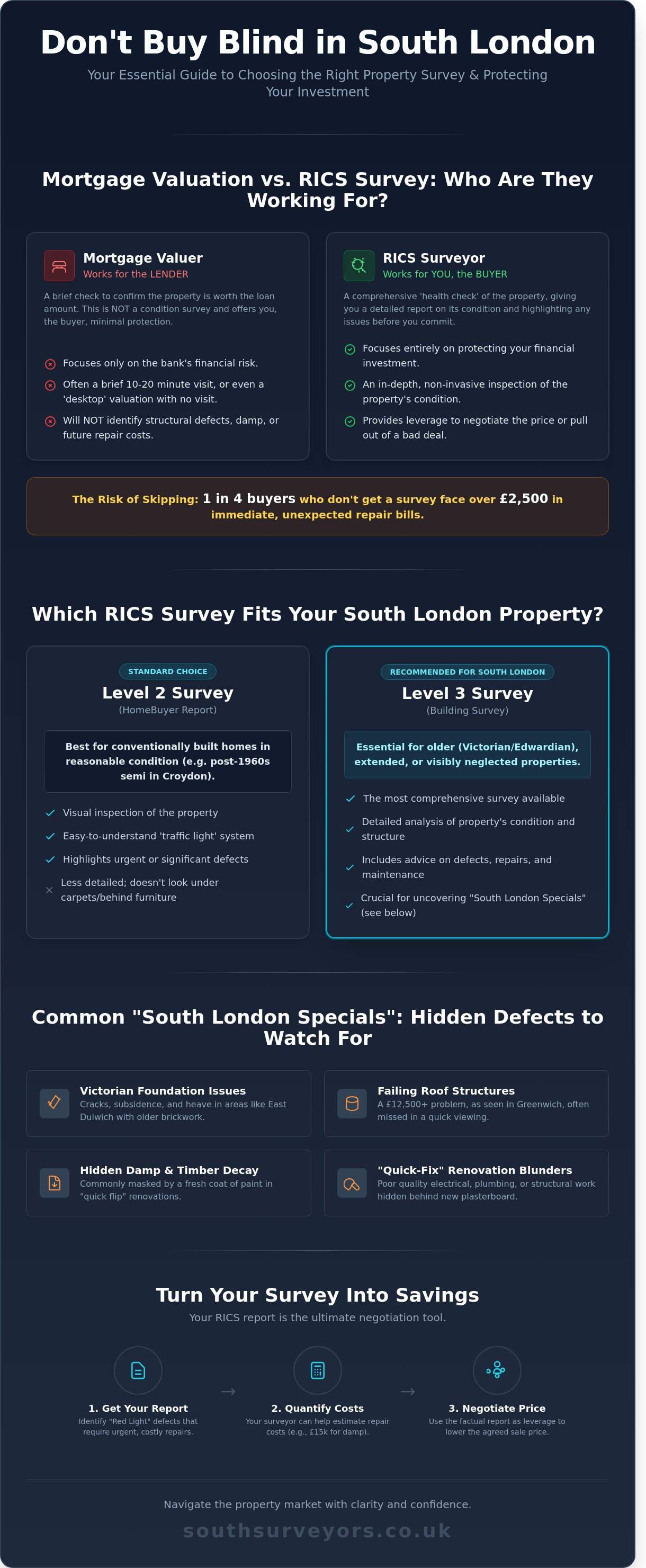
A common mistake buyers make in postcodes like CR0 or SM1 is assuming the bank’s “valuation” is a survey. It isn’t. The mortgage valuer works for the lender, not for you. Their only job is to confirm the house is worth at least what the bank is lending. They might spend ten minutes at the property, and in some cases, they don’t even visit in person, using “desktop valuations” instead. They won’t tell you if the roof needs replacing or if the floor joists are rotting.
In contrast, your surveyor works exclusively for you. We’ve seen cases where a bank valuation came back “clean” on a property in Dulwich, only for a Level 3 Survey to uncover £15,000 of hidden damp and timber decay. Without that survey, the buyer would have inherited a massive repair bill the moment they picked up the keys. By choosing a comprehensive inspection, you gain the clarity and confidence to either walk away, or more likely, negotiate the price down to cover the necessary repairs. It’s about making an informed decision rather than a blind gamble.
- The Valuer: Checks if the bank can get its money back.
- The Surveyor: Checks if the house is actually safe and sound for you.
- The Risk: 1 in 4 buyers who skip a survey end up with over £2,500 in immediate repairs.
Level 2 or Level 3? Choosing the Right Fit for Your Croydon Semi or Dulwich Villa
Choosing the right rics survey doesn’t have to be a headache. It’s essentially a three-tier system designed to match the complexity of your potential new home. Level 1 is a basic visual snapshot, often too light for most buyers in the competitive London market. Level 2 is the “HomeBuyer” standard, while Level 3 is the “Building Survey”, a deep dive into the property’s bones. In South East London, where a single street in Crystal Palace (SE19) might feature both a 2010 apartment block and a crumbly Victorian terrace, picking the wrong tier can lead to expensive surprises.
Think of the extra cost as a smart insurance policy. Upgrading from a Level 2 to a Level 3 usually costs around £200 to £300 more. When you consider that the average repair bill for an overlooked structural issue in a Bromley (BR1) Victorian house can easily top £20,000, that extra couple of hundred pounds is the best money you’ll ever spend. It’s the difference between a general check-up and an MRI scan. You wouldn’t want a “standard” report for a complex split-level conversion in Streatham (SW16) that has three different roof types and a basement of unknown origin.
Professional RICS reports aren’t just for peace of mind; they are the industry benchmark. This is why they are often required for official processes, such as the UK Government guidance on property valuations for Help to Buy schemes. Having that RICS badge on your report means the findings are legally robust and widely respected by lenders and solicitors throughout the CR and SM postcodes. It gives you the clarity and confidence to negotiate or walk away if the numbers don’t add up.
The Level 2 Survey: Perfect for Modern Homes in Sutton or Sidcup
If you’re eyeing a 1960s terrace in Sutton or a tidy 1990s semi in Sidcup (DA14), the Level 2 rics survey is likely your best friend. It’s designed for properties built after 1950 that use standard construction methods. The report uses a brilliant “traffic light” system. Green means all good, amber indicates a repair is needed but isn’t urgent, and red flags serious defects that need immediate attention. It’s clear, punchy, and gives you enough leverage to ask for a price reduction if that amber light turns out to be a damp issue. You can check out our Level 2 vs Level 3 comparison guide for a side-by-side look at the features.
The Level 3 Building Survey: Essential for Period Gems in Peckham
For those falling in love with a period gem in Peckham (SE15) or a sprawling villa in Dulwich, nothing less than a Level 3 will do. These older homes, often built before 1900, have survived wars, subsidence, and decades of questionable DIY. A Level 3 Building Survey provides a forensic look at the structure and fabric. It’s also essential if you’re planning a loft conversion or a rear extension in a CR postcode. The surveyor will get into the nooks and crannies, providing maintenance advice that helps you plan your budget for the next decade. If you’re unsure which path to take, you can always get a quick quote from our team to see what fits your specific property.
The “South London Special”: Hidden Defects We Often Find in SE, BR, and CR Postcodes
Buying a property in South London is a rite of passage that often involves falling in love with a drafty Victorian terrace or a charming 1930s semi. Whether you are eyeing a spot in East Dulwich or a leafy street in Herne Hill, the aesthetic charm frequently masks what we call the “South London Special.” These are structural realities born from the specific way our corner of the city was built and renovated over the last 150 years. A professional rics survey acts as your x-ray vision, helping you see through the fresh Farrow & Ball paint that developers use to hide decades of movement or moisture.
In trendy pockets like SE15 and SE5, we frequently see “quick-fix” renovation blunders. Developers often prioritise open-plan living by removing chimney breasts or load-bearing walls without installing the correct steel supports. In 2023, our team flagged missing building regulations for structural alterations in 15% of the properties we inspected in these areas. Without the right paperwork or structural integrity, you aren’t just buying a home; you’re buying a future headache with the local council and your insurance provider.
Subsidence and Clay: The South London Ground Game
London clay is a fickle beast that dominates the geology of SE22 and SE24. This soil acts like a sponge, expanding when wet and shrinking during dry spells. This constant shifting causes the “stepping” cracks you might see in Victorian brickwork. While some cracks are just the house stretching its legs, others signal a structural disaster. In Bromley (BR) gardens, mature oak trees are often the main culprits. A single mature oak can suck up to 500 litres of water a day from the soil, causing localised sinking that wreaks havoc on shallow Victorian footings.
Damp, Timber, and Trendy Renovations
Damp is the most common uninvited guest in South East London. Statistics show that 40% of London surveys identify significant damp issues, ranging from simple condensation to complex rising damp. In Greenwich terraces, we often see “tanking” gone wrong. Slapping a waterproof membrane on a basement without addressing the external source of moisture often forces water higher up the walls. It’s a £5,000 mistake that looks great during the viewing but ends in a salty, peeling mess within months.
Moving further out to Bexleyheath (DA) or Croydon (CR), the 1930s semi-detached houses bring different challenges. We often find “wall tie failure” here, where the metal bits holding your cavity walls together have rusted away over the last 90 years. It’s a subtle defect that a basic mortgage valuation will miss every time. However, a comprehensive rics survey will catch the slight bulging of the brickwork before it becomes a major safety risk. Local knowledge isn’t just a “nice to have”; it is the difference between a sound investment and a money pit. At South Surveyors, we provide the clarity and confidence you need to ensure your South London dream doesn’t turn into a structural nightmare.
From Jargon to Justice: How to Use Your RICS Report to Negotiate
Receiving your survey results can feel like getting a surprise bill after a long holiday. It is often thirty pages detailing things you didn’t know were wrong with your potential new home in SE24. Step one is simple: do not panic. Every property has issues, even the ones that look like they’ve been plucked straight from a Pinterest board. A professional rics survey isn’t designed to kill your vibe; it’s there to provide the clarity you need to buy with confidence. Even a house that looks flawless on the surface can have damp lurking behind a fresh coat of expensive paint.
Translating the Technical Stuff
Surveyors sometimes use language that sounds like it belongs in a Victorian medical textbook. When we talk about “spalling brickwork,” we simply mean the brick face is flaking away due to moisture and frost damage. “Heave” is just the ground moving upwards, often because a large tree was removed nearby and the soil has expanded. An “infestation” might sound terrifying, but it often refers to common woodworm that is easily treated. We pride ourselves on acting as your knowledgeable friend, stripping away the jargon so you understand exactly what needs fixing without the heart palpitations.
Once you’ve digested the report, identify the “Red Light” defects. These are the non-negotiables that require immediate financial attention, such as structural movement, a failing roof, or outdated electrics. Don’t guess the costs. We recommend getting at least two formal quotes from local tradespeople in the CR or SM postcodes. Having a £5,400 quote for damp proofing in black and white is far more persuasive than a vague “it looks a bit wet” during a phone call with an agent.
The Negotiation Power Play
This is where your investment pays off. In Croydon, we’ve seen a £1,000 survey result in a £10,000 price reduction because the buyer had the facts. Estate agents can’t ignore a RICS-certified report. It is an objective, third-party truth that removes the emotion from the room. You aren’t being difficult; you are being diligent. You can see how this worked in practice in our case study on saving £20k in Herne Hill, where the data did the talking.
The art of the “polite renegotiation” with the estate agent should be firm but fair. Present the rics survey findings alongside your repair quotes and ask how the seller intends to bridge the gap. If the “BS-detector” goes off because the seller refuses to acknowledge a £12,000 structural issue, you must be prepared to walk away. Your survey has already saved you from a potential money pit, and that is a win in itself. Trust the data and don’t blink. If you’re ready to get the facts on your side for a property in the BR or DA areas, book your professional survey with our local experts today.
Clarity and Confidence: Why South Surveyors is Your Local Expert
Choosing a surveyor shouldn’t feel like a blind date with a spreadsheet. At South Surveyors, we’ve realised that while the technical data is vital, the way we deliver it matters just as much. We are strictly regulated by the Royal Institution of Chartered Surveyors. This isn’t just a badge we wear to look fancy; it’s your legal guarantee that we follow a code of conduct established over 150 years ago. When you book a rics survey with us, you aren’t just getting a PDF. You’re getting a professional safety net for one of the biggest investments of your life.
Our team doesn’t just work in London; we live here. Whether you’re eyeing a period conversion in the SE postcodes or a family home in Bromley (BR) and Dartford (DA), we know exactly what to look for. We’ve spotted specific subsidence issues in Croydon (CR) and damp patterns in Sutton (SM) that generic, national firms often miss. We’ve conducted over 1,450 inspections across these neighbourhoods in the last 24 months alone. This volume of work gives us a database of local structural quirks that is second to none.
We don’t believe in the “one-size-fits-all” approach favoured by corporate robots. Our reports are tailored to your specific property and your specific concerns. If we find a slipped tile or a dodgy lintel, we don’t just bury it in a table; we explain why it happened and what it will cost to fix. We want you to have real clarity and confidence before you sign that contract. Our pricing is transparent from the start, with no hidden “admin fees” or surprise add-ons popping up at the last minute.
Meet the Faces Behind the Clipboards
Our surveyors, including experts like Jazz Ettienne, are known for their patience and communication. We’ve found that a 15-minute follow-up call after the inspection does more for a buyer’s peace of mind than a hundred pages of jargon. We bridge the gap between being a technical expert and a helpful neighbour. Based at our Islington office, our reach extends across the South East and North London. Whether you are buying in a leafy street in Chislehurst or a modern apartment in Greenwich, you’ll have a surveyor who actually picks up the phone to talk you through the results.
Your Next Steps to a Stress-Free Move
Moving house is famously stressful, but the rics survey part of the journey doesn’t have to be. We’ve streamlined our process so you can get a bespoke quote in under 60 seconds via our website. Once you book, we handle the heavy lifting, including liaising with the estate agents to arrange access. On the day of the survey, our expert will conduct a thorough visual inspection, and you can often expect a phone call the same afternoon to discuss the key findings. This means you aren’t left biting your nails for a week waiting for a report to land in your inbox.
Don’t leave your property purchase to chance or rely on a basic mortgage valuation that only protects the bank. You deserve a detailed look at what you’re actually buying. Get your tailored RICS survey quote today and move into your new home with your eyes wide open.
Secure Your South London Sanctuary with Real Clarity
Navigating the property market in SE, BR, DA, CR, or SM postcodes requires more than just a keen eye for a stylish kitchen island. You’ve learned that choosing between a Level 2 and Level 3 report is the difference between a surface-level glance and a deep dive into your future home’s structural health. From spotting Victorian damp in Dulwich to identifying specific subsidence risks in Croydon, having the right data allows you to negotiate with absolute authority. Investing in a professional rics survey isn’t just a box-ticking exercise; it’s your financial safety net in a competitive 2026 market.
South Surveyors brings local expertise to every inspection. We’re fully regulated by RICS and backed by over 100+ 5-star reviews from buyers across South East London. We don’t just send a PDF and disappear. Every report includes a personal phone consultation to ensure you understand every detail before you exchange contracts. It’s about giving you the peace of mind you deserve.
Get your tailored RICS survey quote and buy with confidence
Your South London dream is within reach, and we’re here to make sure it’s built on solid ground.
Frequently Asked Questions
How much does a RICS survey cost in South London in 2026?
Expect to pay between £650 and £1,850 for a professional RICS survey in South London by 2026. Prices in postcodes like SE24 or BR1 vary based on the property size and the specific level of detail your surveyor needs to investigate. A Level 2 survey usually sits at the lower end of this scale, while a comprehensive Level 3 report for a Victorian terrace in Herne Hill reflects the higher price point due to the depth of the inspection.
How long does it take to receive the final RICS report after the inspection?
You’ll typically receive your final digital report within 3 to 5 working days after the physical inspection is complete. Our surveyors in the CR and SM areas prioritise clarity and speed, ensuring you aren’t left waiting while your property chain moves forward. We often provide a quick verbal update on the same day to give you immediate peace of mind before the full 50 page document arrives in your inbox.
Can I attend the property survey while the surveyor is working?
It’s best to let your surveyor work solo to ensure they don’t miss any tiny cracks or damp patches during their 4 hour inspection. While you can’t shadow them for the whole duration, we love a good chat about the findings afterwards. Many of our clients in Greenwich or Bromley meet us at the property for a 15 minute debrief once the hard work is done to get a head start on the results.
What is the difference between an RICS Level 2 and a Level 3 survey?
A Level 2 survey is a standard health check for modern homes, while a Level 3 survey is a deep dive into the property’s bones. If you’re buying a 1930s semi in Bexley or a quirky conversion in SE15, the Level 3 provides the thorough analysis needed for older structures. It includes detailed repair advice and cost estimates that a standard Level 2 report simply doesn’t cover, giving you real confidence in your investment.
Will a RICS survey find asbestos or Japanese Knotweed?
Your surveyor will identify suspected asbestos or Japanese Knotweed if they are visible during the walk-through of the house and garden. We flag these 2 specific issues in every RICS survey because they can impact property value and mortgage offers significantly. However, we don’t take physical samples for lab testing. If we spot a 2 metre patch of Knotweed in a Dulwich garden, we’ll recommend a specialist follow-up to protect your interests.
Do I need a survey if I am buying a new-build flat in Greenwich?
You definitely need a survey, though a professional snagging list is often the smarter choice for a brand-new SE10 apartment. Even in shiny new developments, 1 in 4 new builds has defects like poorly fitted windows or hidden plumbing leaks. Getting an expert eye on your Greenwich flat ensures the developer fixes these 15 to 20 minor issues before you legally complete, saving you a massive headache later on.
Does a RICS survey include a property valuation?
A standard RICS survey doesn’t include a property valuation unless you specifically request it as an add-on service. Most buyers in the DA or BR postcodes find that the technical report is what gives them the clarity to proceed. If your lender requires a formal figure, we can include a RICS Registered Valuation to ensure your £450,000 investment matches the actual market data for the local area.
What happens if the survey reveals major structural issues?
If the report reveals structural trouble, you use that data to renegotiate the purchase price or ask the seller to fix the issues before exchanging contracts. Finding a £15,000 subsidence problem doesn’t have to kill the deal. It gives you the evidence needed to lower your offer, just like the buyer in Herne Hill who saved £20,000 after our thorough inspection highlighted hidden defects that the estate agent hadn’t mentioned.