

Last Tuesday, a buyer in Bromley (BR1) realized their “forever home” came with a 45-page lease and a ground rent clause that doubled every 10 years. It’s a story we hear often across South East London, from the Victorian terraces of Peckham (SE15) to the newer developments in Sutton (SM1). Most people assume that buying a home means you own it outright, but unless you secure the freehold, you’re essentially a long-term tenant with a very expensive decorating budget. Choosing a freehold property gives you absolute ownership of both the building and the land it sits on, providing a level of security that leaseholders simply don’t have.
We know that staring at a pile of legal jargon can make your head spin, especially when you’re trying to figure out if you’ll be on the hook for a £12,000 roof repair in five years. You deserve to feel like an expert before you sign on the dotted line. This guide will help you master the nuances of ownership so you can negotiate your next purchase with real confidence. We’re going to dive into the specific rights you gain as a freeholder, compare the long-term costs against leasehold properties in areas like Croydon (CR0) and Dartford (DA1), and explain exactly when you should insist on owning the dirt beneath your feet.
Key Takeaways
- Understand why owning the dirt is the ultimate “forever” move for South Londoners tired of the ticking clock and stress of lease expiries.
- Discover how to reclaim your creative freedom, from painting your front door any colour you fancy to making structural changes without a landlord’s permission.
- Master the nuances of the hybrid ownership model, a savvy and popular option for maisonette owners in areas like SE22 and SE24.
- Debunk the common myth that freehold ownership means zero maintenance costs by learning how to budget for your property’s long-term health.
- Gain the professional edge needed to navigate your purchase in SM postcodes with structural assessments that ensure your investment is rock-solid.
The Lowdown on Freehold: Why Owning the Dirt Matters
Imagine buying a Victorian terrace in SE15 and knowing that every brick, every floorboard, and every grain of soil beneath the garden belongs entirely to you. That’s the power of freehold. It’s the gold standard of property ownership in South London, offering a level of security that leaseholds simply can’t match. When you own the freehold, you aren’t just a resident with a very long contract; you’re the absolute owner of the land and the buildings on it. It’s yours until the day you decide to sell it or pass it on to the next generation.
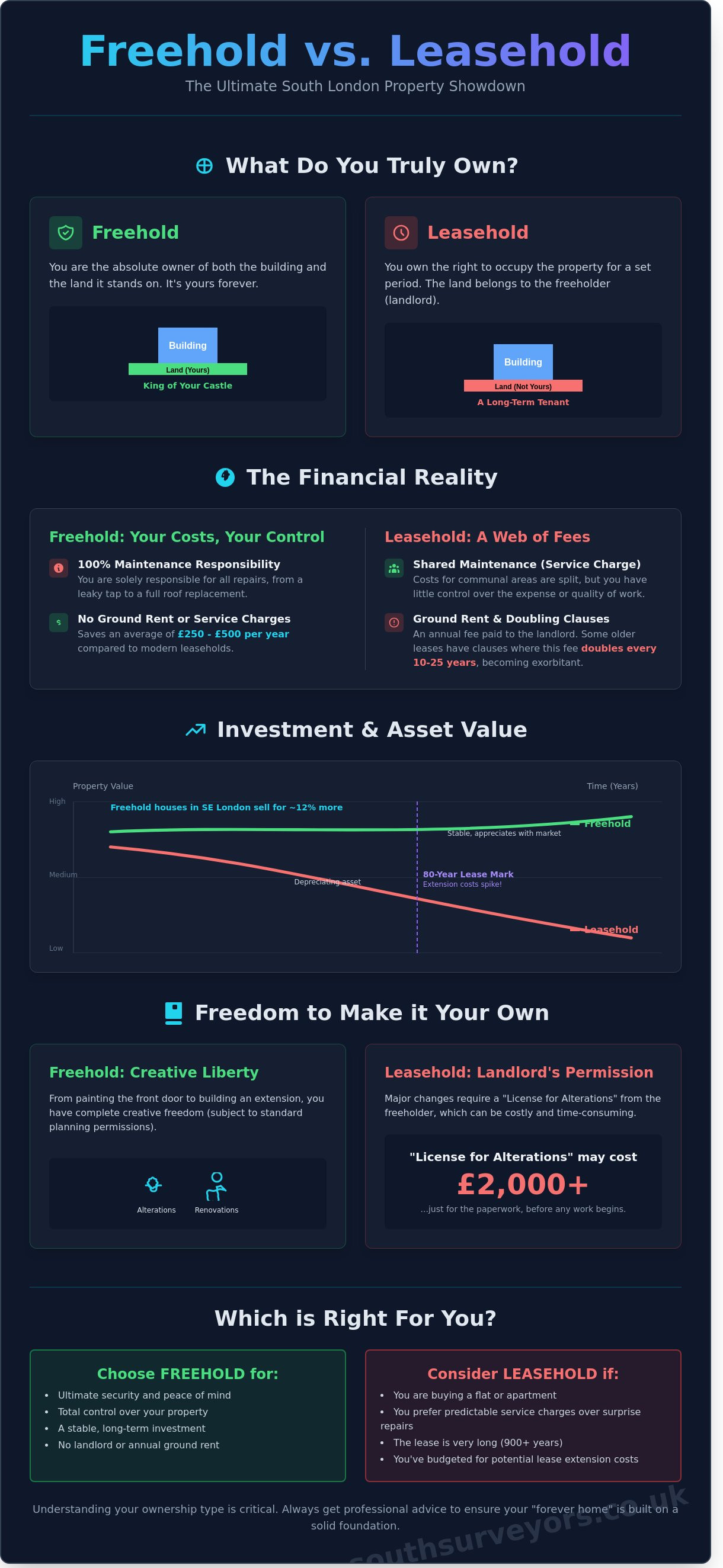
The “forever” factor is a massive draw for buyers in competitive pockets like Peckham or East Dulwich. You don’t have to worry about a ticking clock or the looming stress of a lease extension. In 2023, Land Registry data showed that freehold houses in South East London often sell for 12% more than comparable leasehold properties. This price gap exists because buyers crave the psychological peace of mind that comes with being the king or queen of their own castle. At South Surveyors, we see this preference daily. Clients want clarity and confidence, and nothing provides that quite like holding the deeds to the dirt itself.
The Legal Reality of Freehold Ownership
Freehold is the permanent and absolute tenure of land or property with freedom to dispose of it at will. When you complete your purchase, you’re registered at the Land Registry as the “title absolute” holder. This status means you’ve cut out the middleman entirely. There is no landlord to answer to and no annual ground rent to pay, which can save you between £250 and £500 every year compared to modern leasehold flats. You have the autonomy to make structural changes or renovate without asking for a third party’s permission, provided you follow local planning laws.
Freehold vs. The Rest of the World
While leaseholders are essentially long-term tenants, freeholders enjoy total independence. In areas like BR1, freehold is the standard for the vast majority of detached and semi-detached family homes. This dates back to the historical development of South London estates, where land was often sold off in chunks rather than kept under the control of a single Great Estate. While commonhold exists as a third option, it remains rare in the UK. For most buyers moving into the SE, BR, or DA postcodes, the choice is a simple binary between the restrictions of a lease and the total freedom of a freehold title. It’s the ultimate way to secure your financial future in the capital’s ever-shifting market.
Freehold vs Leasehold: The Ultimate South London Showdown
Think of your property as a kingdom. When you buy a freehold, you’re the monarch of the bricks, the mortar, and the dirt beneath them for as long as you like. If you’re hunting in freehold pockets like Bromley (BR2) or the leafy avenues of Croydon (CR0), you’re looking at absolute ownership. Leasehold is different; it’s more like a very long, very expensive invitation to stay. You own the right to live there for a set period, but the land belongs to someone else.
The biggest differentiator is the ticking clock. Leasehold value isn’t static. It’s a depreciating asset that loses its shine as the years drop away. Once a lease hits the 80-year threshold, the cost to extend it spikes massively due to “marriage value” laws. Freeholders don’t have this stress. They can also paint their front door neon pink or install a quirky knocker without asking for a landlord’s permission, a level of autonomy that’s hard to find in managed blocks across the SM and DA postcodes.
Financial Implications: Ground Rent and Service Charges
Leaseholders often face a double whammy of ground rent and service charges. While the Leasehold Reform (Ground Rent) Act 2022 banned ground rent on most new leases, thousands of existing owners in SE London are still stuck with “doubling clauses.” These can see a £250 annual fee hit £4,000 over a few decades. Freeholders avoid these monthly drains, though they take on 100% of the repair bills. It’s about choosing between a predictable monthly fee or an occasional, larger maintenance hit when the roof needs fixing.
Freedom to Renovate and Alter
Want to add a loft conversion to your Victorian terrace in Dulwich (SE21)? If you’re a freeholder, your main hurdle is usually just planning permission. If you’re a leaseholder, you’ll likely need a “License for Alterations” from a landlord who might charge you £2,000 just for the paperwork. Even with full ownership, you should watch out for restrictive covenants. These are old rules buried in the deeds that might stop you from running a business or parking a caravan on the drive. Our RICS-certified surveyors always dig into these details to ensure you have the clarity and confidence to build your dream space without legal headaches. We check the structural history of older properties to ensure previous owners didn’t take “creative liberties” with load-bearing walls.
The “Share of Freehold” Hybrid: Is it the Best of Both Worlds?
Walk down Lordship Lane in SE22 or through the leafy residential streets of SE24, and you’ll see them everywhere. Victorian houses converted into two or three flats are the absolute heartland of the “share of freehold” model. This setup is a clever hybrid. You own a long lease on your specific flat, but you also own a literal slice of the company that owns the entire building. It’s essentially a collective of owners managing the communal parts of a property together. Mortgage lenders generally love this. They see it as a gold standard because it removes the risk of a “rogue” landlord neglecting the building, making it a much safer bet than a standard leasehold with a dwindling term.
The Pros and Cons of Shared Responsibility
The biggest perk is control. You and your neighbors decide which builder fixes the porch or which insurance policy to buy. You aren’t at the mercy of a faceless management company charging £3,000 for a £600 cleaning job. However, this comes with a social cost. If the roof leaks on a maisonette in CR2, you have to coordinate with the person downstairs to fix it. If they haven’t updated their savings account since 2019, getting that 50% contribution for repairs can feel like pulling teeth. This is why a proactive “Right to Manage” company is vital; it provides a formal structure to handle these inevitable disputes without ruining the Christmas card list.
What to Look for in the Legal Pack
Don’t let the freehold title fool you into skipping the fine print. You still have a lease, and it still needs to be long. We recommend looking for leases that have been extended to 999 years. Check the company accounts to see if there’s a “sinking fund” for future works. If the building needs £12,000 of external painting in 2026 and the pot is empty, that money is coming straight out of your pocket. Our RICS-certified surveyors often find that shared buildings in the SM postcode area lack a formal maintenance schedule. Always verify who’s been holding the purse strings before you sign. Having clarity on these accounts gives you the confidence to proceed without fear of hidden costs.
The True Cost of Freedom: Maintenance for Freeholders
The biggest myth about owning a freehold is that it’s a “maintenance-free” ticket. Many buyers think that without a monthly service charge, the money simply stays in their pocket. In reality, you’re the CEO, the janitor, and the emergency plumber all at once. You own the air above the roof and the soil beneath the floorboards, which means you’re responsible for every brick in between. From the tip of a Victorian chimney stack to the very bottom of the drains, the buck stops with you.
If you’re eyeing a terraced house in DA1, you need to keep your eyes wide open. These properties have heaps of character, but they also have century-old skeletons. You’re also tasked with managing your own building insurance and ensuring the property meets modern safety standards. There’s no management company to send a reminder when the guttering fails or the pointing starts to crumble. You’ve got the freedom, but you’ve also got the full-time job of property upkeep.
The Surveyor’s Perspective on Freehold Risks
For period properties in South East London, a RICS Level 3 Building Survey isn’t just a recommendation; it’s your financial shield. Much of the ground in the SE and DA postcodes sits on heavy clay soil. This soil shrinks and swells with the seasons, contributing to a 20% increase in subsidence claims across London during the record-breaking dry summer of 2022. We also frequently spot “roof spread” in older homes where structural timbers have shifted over decades. Since there’s no communal “Sinking Fund” provided by a landlord, you must create your own. We suggest setting aside 1% of the property value every year to cover these inevitable structural surprises.
Budgeting for the Long Term
When you’re viewing a potential new home in Sidcup, it’s easy to get distracted by a shiny new kitchen or bifold doors. You need to look past the fresh paint. We help buyers create a 5-year maintenance plan by distinguishing between “urgent” repairs and “cosmetic” ones. South Surveyors identifies these hidden freehold liabilities before you exchange contracts. This gives you the clarity and confidence to negotiate the price down if, for example, the roof needs £12,000 of work that wasn’t immediately obvious. Our reports break down costs so you can plan your finances without the stress of “unforeseen” disasters.
Ready to buy with total peace of mind? Get a professional RICS Level 3 Building Survey to uncover the real state of your South London property.
Navigating Your Purchase with Clarity and Confidence
Transitioning from a casual browser on property portals to a proud freehold owner in South London requires a blend of legal precision and structural insight. Your solicitor manages the paper trail, checking title deeds and restrictive covenants. However, they won’t step foot inside the house. That is where your RICS surveyor comes in. In SM postcodes like Sutton or Morden, local knowledge is vital because roughly 72% of London homes are built on shrinkable clay soil. You need an expert who knows if a crack is just a settling house or a sign of something more expensive.
To secure your dream home, follow these final steps:
- Review the local authority searches for planned developments in the SE or CR areas.
- Ensure your surveyor and solicitor are in communication regarding boundary issues.
- Budget for immediate “day one” repairs identified in your structural report.
Why South Surveyors is Your Knowledgeable Friend
We take a RICS-certified approach to every inspection, turning complex technical jargon into clear, actionable advice. In competitive markets like Herne Hill, where properties often sell for 5% to 10% over the asking price, you need to move fast without missing red flags. Our reports provide the peace of mind required to bid with real confidence. We don’t just email a PDF and disappear; we offer a personal chat after the inspection to discuss our findings. Whether it is a quick 15-minute phone call or a detailed breakdown of damp readings, we make sure you understand the stakes.
Next Steps: Get Your Survey Sorted
Owning the freehold is the ultimate goal for many, but without a thorough assessment, it can quickly turn into a maintenance nightmare. Since the average cost of fixing major structural issues in the UK reached £12,000 in 2023, skipping a survey is a gamble you don’t need to take. We provide tailored reports for properties across SE, BR, DA, CR, and SM postcodes to ensure your investment is protected. Get a quote for your South London property survey today and take the final step toward ownership with total clarity.
Secure Your South London Move with Confidence
Navigating the property ladder doesn’t have to feel like a trek through Crystal Palace Park without a map. Whether you’re eyeing a Victorian terrace in SE22 or a sleek apartment in BR3, understanding the power of freehold ownership is your ultimate game-changer. You now know that owning the land outright means no ground rent surprises and total control over your renovations. If you’ve opted for a shared ownership structure, you’ve found a collaborative way to manage your building alongside neighbors who actually care about the communal vibe.
Don’t let the technical jargon dampen your excitement. Buying a home is a 100% commitment, and you deserve total clarity. Our RICS-certified professionals have provided expert guidance to over 500 buyers across the CR and SM postcodes this year alone. We ditch the corporate fluff for direct communication, offering personal phone consultations to explain every detail of your report. Ready to move forward with real confidence? Secure your South London investment with a RICS-certified survey from South Surveyors. You’re just one step away from making that dream home yours.
Frequently Asked Questions
Is freehold always better than leasehold for a first-time buyer?
Not necessarily, though it offers more control. In areas like Peckham (SE15), a leasehold flat might be 30% cheaper than a freehold house, making it the only viable entry point for many. Freehold means you own the building and land forever. However, 4.98 million leasehold dwellings exist in England, showing they are a standard choice. If you want a garden in Bromley (BR1) without ground rent, freehold is your best bet.
Can I buy the freehold of my leasehold house in South London?
Yes, you usually have a legal right to buy the freehold under the Leasehold Reform Act 1967. You must have owned the house for at least 2 years to qualify for this process. In suburbs like Bexleyheath (DA6), this enfranchisement can add 10% to 15% to your property’s market value. Our RICS-certified surveyors often help locals calculate the premium price you’ll pay the landlord to secure your land.
Does a freehold property require more insurance than a leasehold one?
You generally pay more for individual policies because you are responsible for the entire structure. Leaseholders usually pay a share of a block policy via service charges instead. For a Victorian terrace in Greenwich (SE10), building insurance is 100% your responsibility. You’ll need a comprehensive policy covering everything from the roof to the foundations to ensure real peace of mind and satisfy your mortgage lender’s requirements.
What happens to the freehold if the owner dies without a will?
The property passes to the next of kin under the rules of the Administration of Estates Act 1925. If no living relatives are found, the freehold reverts to the Crown via a process called Bona Vacantia. This happened to 2,000 estates in the UK during 2023 alone. It’s a complex legal situation that stops property sales in their tracks, so having a clear will is vital for your SE London home.
Are there any monthly fees associated with owning a freehold?
Most freeholds have no monthly fees, but newer developments in Sutton (SM1) might charge for communal garden maintenance. These estate rentcharges, sometimes called fleecehold, can cost between £200 and £500 annually. Unlike leasehold service charges, these aren’t always regulated by the same RICS standards. Always check the deeds for hidden maintenance covenants before you sign to avoid unexpected expenses that could impact your monthly budget.
How do I know if a property in Croydon is freehold or leasehold before viewing?
Check the online listing first, as 95% of agents include tenure details in the description. If it’s missing, search the Land Registry for Croydon (CR0) which costs exactly £3 for a digital copy. Look for the Title Register to see if it’s a freehold or leasehold interest. Knowing this early gives you the clarity and confidence to negotiate a better deal before even stepping through the front door.
Can a freeholder build anything they want on their land?
No, you are still bound by local planning laws and restrictive covenants in your deeds. In conservation areas like Chislehurst (BR7), 75% of external changes require specific council approval before work begins. Even if you own the freehold, a restrictive covenant might prevent you from building an extension or even running a business from home. A professional survey identifies these legal traps early in the buying process.
Is “flying freehold” something I should worry about in South East London?
It’s a quirk where part of your property sits over someone else’s land, common in older SE18 terraces. While not a dealbreaker, some mortgage lenders refuse properties where the flying element exceeds 15% of the total floor area. It usually requires specific legal indemnity insurance to proceed. We recommend a thorough RICS-certified inspection to ensure the structure is sound and your investment remains a reliable one for the future.