

Last Tuesday, a buyer in Bromley received the email every house hunter dreads: the mortgage valuation came back £25,000 below the agreed purchase price. It’s a total gut-punch when you’ve already mentally moved into your new place in SE22 or CR0. You’re likely staring at the screen wondering, “a surveyor down valued my property what next?” while feeling the sudden pressure to find extra cash you simply don’t have. It’s incredibly stressful when a professional’s figure doesn’t match the market reality you’ve seen during your months of searching.
The good news is that a down valuation isn’t an automatic deal-breaker for your dream home. We’re here to help you navigate this hurdle with clarity and confidence. You’ll discover exactly how to handle the shortfall, from savvy price renegotiations with the seller to understanding when a formal appeal to the lender is actually worth the effort. We’ll break down a clear, step-by-step plan to bridge the gap and keep your move across the SE, BR, or SM postcodes on track without losing your sanity or your deposit.
Key Takeaways
- Understand why competitive bidding wars in areas like Peckham (SE15) and Dulwich (SE21) often lead to a gap between the agreed sale price and the lender’s assessment.
- Discover exactly how to handle a situation where a surveyor down valued my property what next using a proactive six-step checklist to keep your sale on track.
- Learn how to transform a down valuation into a powerful bargaining chip to renegotiate the price with the estate agent using professional RICS-backed evidence.
- Identify the critical difference between a basic lender’s valuation and a detailed independent survey, and how the latter provides the clarity and confidence needed to protect your investment.
The Dreaded Down Valuation: What Is Actually Happening?
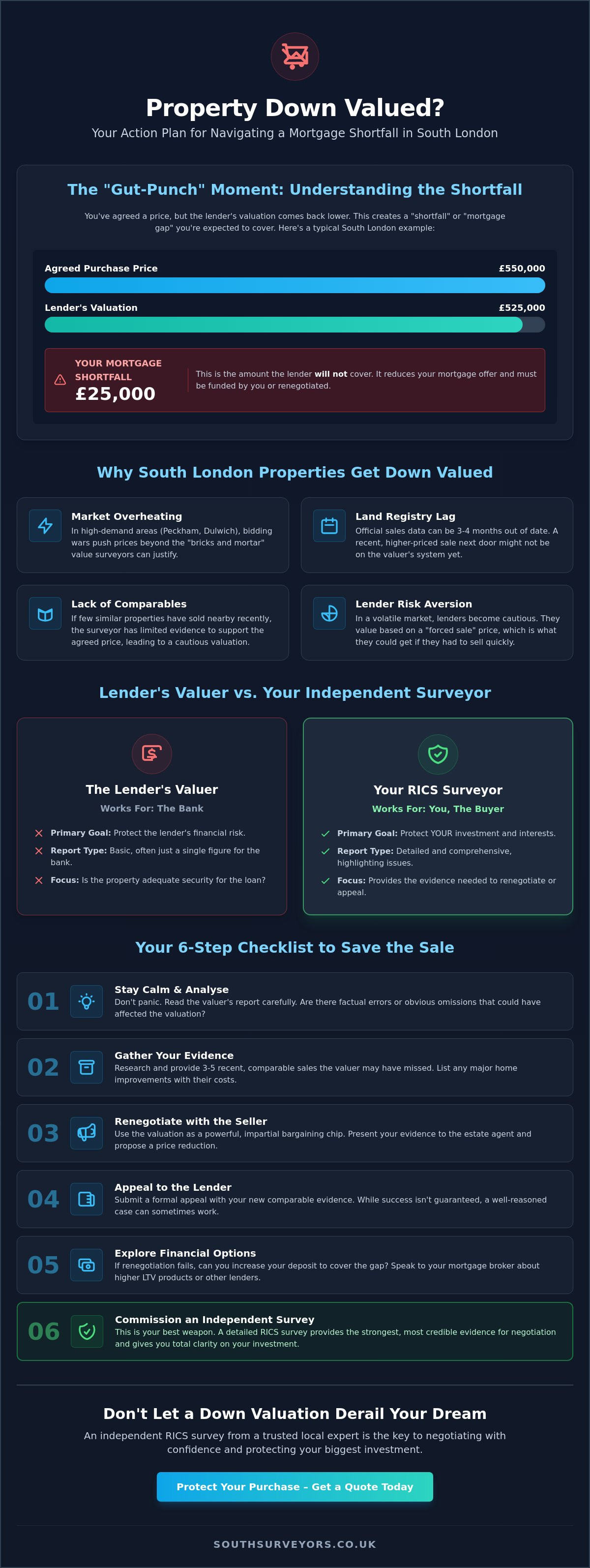
You have found the perfect Victorian terrace in Hither Green or a sleek flat in Croydon. The offer is accepted, the champagne is chilled, and then the email arrives. The lender’s valuer says the house isn’t worth the £550,000 you agreed on. This is a down valuation. It’s a frustrating discrepancy between your agreed sale price and the bank’s assessment of risk. If you are currently staring at your screen wondering, “surveyor down valued my property what next,” you aren’t alone. It’s a common hurdle in the SE and BR postcodes where prices can fluctuate faster than a barista’s mood.
It’s vital to distinguish between a mortgage valuer and an independent RICS-certified chartered surveyor. The valuer works for the bank to ensure their investment is safe. Our team at South Surveyors provides a more comprehensive look at how property valuation works, focusing on your interests rather than just the lender’s balance sheet. This discrepancy often impacts your Loan-to-Value (LTV) ratio, potentially shrinking your mortgage offer and leaving you with a significant gap to fill.
To better understand this concept, watch this helpful video:
Why Lenders Play It Safe in 2026
In 2026, lenders have become notably risk-averse. They don’t care about the bespoke plywood kitchen or the proximity to the best brunch spot in East Dulwich. They look for “forced sale” value, which is what the property would fetch if they had to sell it quickly in a pinch. With 2026 market volatility affecting parts of South East London like Dartford (DA) and Sutton (SM), surveyors are being extra cautious. A standard down valuation is just a lower price tag, whereas a “zero valuation” means the lender won’t lend a penny until essential repairs, like structural work or major damp issues, are completed. This caution is a response to the shifting economic climate in the CR and SM postcode areas.
The Emotional Rollercoaster of the “Shortfall”
Finding out there’s a “mortgage gap” feels like a personal affront. It feels like the bank is telling you that you’re overpaying for your dream home in Crystal Palace. The shortfall is the extra cash a buyer must find if they don’t successfully renegotiate the purchase price with the seller. While it feels like a massive spanner in the works, this is a standard part of the London property jungle. We’re here to give you the clarity and confidence to handle these moments. Understanding that a surveyor down valued my property what next is just the first step in a tactical negotiation helps take the sting out of the news.
Why South London Properties Get Down Valued: The Local Reality
You’ve found the perfect Victorian terrace in Peckham (SE15) or a leafy sanctuary in Dulwich (SE21). You’ve survived the bidding war, your offer is accepted, and then the mortgage valuation drops like a lead balloon. It’s a common story in the SE and BR postcodes. When a surveyor down valued my property what next is the question that keeps many South Londoners awake at night. Usually, this happens because the market is moving faster than the data can keep up with.
Surveyors rely on “comparable evidence,” which means they look at what similar houses in your specific street or postcode sold for recently. If no properties have changed hands in your corner of East Dulwich for six months, the surveyor has a thin file to work with. They can’t just take your word for it that the market has spiked; they need cold, hard proof from the official government valuation body and Land Registry records to justify the price to the bank.
The “Dulwich Effect” and Market Overheating
In high-demand areas like Greenwich (SE10) or the Village in SE21, emotional investment often trumps logic. Buyers get swept up in the local charm and competitive atmosphere, leading to offers that exceed the “bricks and mortar” value. This creates a gap between the price you’re willing to pay and the figure a bank-appointed valuer sees. Land Registry data often suffers from a 3 to 4 month lag, meaning the record-breaking sale next door might not even show up on the surveyor’s system yet. This delay is a primary reason why you might find yourself wondering why a surveyor down valued my property what next.
Unique features can also be a double-edged sword. That trendy loft conversion with the views over South London might look great on Instagram, but if it lacks the proper building regulations or “regs,” a valuer will likely treat it as mere storage space. This instantly knocks thousands off the expected valuation, regardless of how many bedrooms the estate agent claimed it had.
Hidden Defects in Period Properties
South London is famous for its stunning Victorian and Edwardian stock, but these older homes come with vintage problems. In Croydon (CR) and parts of the SM postcode, the local geology can lead to structural concerns. Seeing signs of subsidence in a CR property can immediately spook a valuer, leading to a significant reduction to cover potential stabilization costs.
- Damp and Timber: Common in older Bromley (BR) homes, rising damp or woodworm can trigger a “retention” where the bank holds back funds until repairs are made.
- Roofing Issues: If a survey reveals a slate roof in DA or SE postcodes is reaching the end of its 80 year lifespan, the valuer will factor in the £10,000 to £15,000 replacement cost.
- The Cost of Repair: A down valuation isn’t just a random guess; it often reflects the exact amount the surveyor thinks it will cost to bring the property up to a “standard” mortgageable condition.
If you’re worried about hidden issues affecting your purchase, getting an independent, RICS-certified survey can provide the clarity you need to renegotiate with confidence.
The “What Next” Checklist: 6 Ways to Save Your Sale
Finding out the bank’s surveyor down valued my property what next is a question that usually triggers immediate panic. Whether you are eyeing a Victorian terrace in Greenwich (SE10) or a semi-detached home in Bromley (BR1), a valuation gap does not have to be the end of the road. It is a pivot point. You have six proactive paths to keep your South London move on track without losing your shirt. Think of this as your strategic toolkit for turning a “no” into a “how”.
Option 1 & 2: Renegotiate or Meet the Gap
The most direct route is a transparent conversation with the seller. Armed with your RICS report, you can ask for a price reduction that reflects the bank’s reality. In competitive markets like Bexleyheath (DA6), a 50/50 split is a popular survival strategy. If the valuation is £15,000 short, you might offer to pay £7,500 extra from your savings while the seller drops their price by £7,500. This keeps the mortgage lender satisfied as the loan stays within their approved LTV limits. If you have the cash and the long-term investment still looks solid, simply plugging the gap with savings is the fastest way to keep the chain moving.
Option 3 & 4: Challenge or Change Lenders
You can challenge a RICS valuation, though it requires precision. You will need to provide three solid “comparables”—similar properties sold within the last 90 days within a 0.5-mile radius of your postcode. If that feels like a dead end, consider switching lenders entirely. Different banks use different surveying panels. A property in Croydon (CR0) might be undervalued by one firm but meet the mark with another. A savvy mortgage broker is your best ally here; they know which lenders are currently taking a more realistic view of South East London price trends.
Option 5 & 6: Bridging Loans or Pulling Out
For high-stakes transactions in areas like Dulwich or Sutton (SM1), some buyers look at bridging loans. These are short-term, high-interest options that “bridge” the financial gap until traditional finance is secured. Use these with extreme caution. Monthly interest rates often hover between 0.5% and 1.5%, which adds up fast. Finally, remember that walking away is a position of strength, not a failure. If a comprehensive home survey reveals the down-valuation is due to structural damp or subsidence, exiting the contract protects your future. It is better to lose a survey fee than buy a money pit.
Using a RICS Level 3 survey as a strategic tool provides the technical evidence you need for these high-pressure negotiations. It transforms a vague “feeling” that the price is too high into a factual list of necessary repairs. When a surveyor down valued my property what next steps I took were defined by this data, giving me the clarity and confidence to negotiate from a place of facts, not fear.
Art of the Pivot: How to Renegotiate Like a Pro
Receiving a lower valuation feels like a punch to the gut, but it’s actually the ultimate bargaining chip. If you’re wondering “surveyor down valued my property what next,” the answer is simple: you start talking. A down valuation isn’t a dead end; it’s a redirection. It gives you the evidence needed to ask for a price that reflects the home’s true condition and market standing. In the competitive South East London market, where prices can be volatile, having a professional reason to lower your offer is a position of strength, not weakness.
Using your Building Survey as Ammunition
A mortgage valuation is often just a brief tick-box exercise for the lender’s benefit. To really win at the negotiating table, you need a level 3 building survey. This isn’t just a one-page summary. It’s a comprehensive, 50-page deep dive into the property’s structural health. When you present a seller with a RICS-certified report detailing specific defects like rising damp or subsidence, you aren’t just “asking” for a discount. You’re justifying it with expert evidence.
The trick is to turn defects into discounts. Don’t just point at a crack; get a quote from a local tradesman to fix it. If a roof repair in a DA or SE postcode costs £6,000, that’s a direct, logical deduction from the asking price. Sellers find it incredibly difficult to argue with hard numbers backed by professional RICS terminology. It shifts the conversation from “I want to pay less” to “The house is worth less because of these facts.”
The Estate Agent’s Role in South London Deals
Estate agents in Bromley or Sidcup want the deal to cross the finish line just as much as you do. When the question of “surveyor down valued my property what next” arises, use the agent as your bridge. Remind them that if you walk away, the next buyer’s surveyor will likely flag the exact same issues. No seller wants their home to become “stale” on the market after a failed sale.
In the tightly knit South London property chain, a single collapse in a BR or CR postcode can ruin five other moves. Keeping the conversation professional and calm is your secret weapon. If you approach the seller with a “we’re in this together” attitude, they’re far more likely to meet you in the middle. You’re helping them avoid the hassle of relisting and the risk of another down valuation later.
Need a report that gives you the upper hand in negotiations? Book a professional survey with our local experts today.
Clarity and Confidence: Why an Independent RICS Survey is Your Best Weapon
It is vital to understand that the bank’s valuation and an independent survey are two very different beasts. When a mortgage lender sends someone to your potential new home in SE10 or BR3, they aren’t doing it for your benefit. That “valuation” is a high level risk assessment for the bank. It’s designed to ensure they can recoup their loan if things go south. Often, these are mere “desktop valuations” where the surveyor doesn’t even set foot inside the property. If that surveyor down valued my property what next becomes your main concern, you need to realize the bank’s report won’t give you the “why” or the evidence you need to fight back.
An independent RICS survey is your personal toolkit. It’s a comprehensive health check that puts you in the driver’s seat. Instead of a one page tick box exercise, you get a detailed breakdown of the property’s condition. This document is the ultimate leverage. Whether you are looking at a Victorian conversion in Croydon (CR) or a 1930s semi in Sutton (SM), having a professional report allows you to go back to the seller with cold, hard facts. You aren’t just guessing that the price is too high; you’re proving it with technical evidence.
The South Surveyors Difference
We believe in providing clarity and confidence, not just a PDF full of jargon. Our team knows the South London property market inside out, from the busy streets of Dartford (DA) to the quiet corners of Bromley (BR). We don’t just send a report and disappear. Our surveyors, like Jazz, make it a point to hop on a phone call with you. They’ll spend the time needed to walk you through the findings, explaining what is a genuine deal breaker and what is just standard wear and tear for an older London home.
Getting an independent RICS valuation means you have a figure based on local market data and physical condition, totally separate from the lender’s agenda. This objective view is exactly what you need to keep your head clear when emotions are running high. We act as your knowledgeable friend in the industry, making sure you don’t overpay for a property with hidden headaches.
Next Steps: Get the Facts Before You Fold
If you haven’t already, booking a Level 2 or Level 3 survey is the smartest move you can make. Information is power. When a surveyor down valued my property what next feels like a dead end, our reports provide the map to a solution. You can use our findings to renegotiate the purchase price, ask the seller to carry out essential repairs, or simply walk away with your deposit intact.
- Level 2 Survey: Perfect for modern homes in areas like Bexley or Sidcup.
- Level 3 Survey: Essential for older, larger, or renovated properties in SE postcodes.
- Direct Access: Talk to your surveyor directly to get the “real story” behind the red flags.
Don’t let a bank valuation rattle you. The South London property jungle is tricky, but with the right expert in your corner, you can navigate it with total peace of mind. We’re here to make sure your investment is as solid as it looks on the surface.
Take the Reins and Save Your South London Sale
A down valuation doesn’t mean your property dreams in SE15 or CR0 are over. It’s simply a signal to pause and strategize. You have the power to renegotiate with your buyer or provide the lender with robust comparable evidence from the local area. The key is moving away from guesswork and toward professional certainty. When you’re staring at a lower than expected figure and wondering, surveyor down valued my property what next, the smartest move is to secure an independent assessment that reflects the true state of the market.
Our RICS-Certified professionals bring deep expertise across the SE, BR, and DA postcodes, providing detailed reports that are easy to digest and delivered without delay. We don’t just send a document and disappear; our surveyors are famously communicative and happy to answer your personal questions over the phone. You deserve to move forward with peace of mind and real confidence in your property’s value.
Get the clarity you need with a RICS-Certified survey from South Surveyors
Don’t let a single valuation derail your plans; there’s always a path forward when you’ve got the right experts in your corner.
Frequently Asked Questions
Can I challenge a surveyor’s down valuation?
Yes, you can challenge the decision, though it requires a methodical approach. You’ll need to provide three comparable properties sold within the last six months within a 0.5 mile radius of your home. In fast moving markets like East Dulwich or Peckham, prices shift quickly, so your evidence must be recent and robust. Most lenders have a formal appeals process, but data suggests only 10% to 15% of these challenges result in a valuation increase.
What is the most common reason for a down valuation in South London?
The primary culprit is usually a lack of recent “sold” price data to support an optimistic asking price. Surveyors rely on Land Registry data rather than the aspirational figures you see on property portals. In competitive areas across the BR and SE postcodes, bidding wars often push prices £20,000 above local averages. If you’re wondering, “surveyor down valued my property what next?”, the answer often lies in checking if those high local sales have actually completed yet.
Will a different lender give me a better property valuation?
It’s possible because different lenders use different surveying firms with varying levels of local expertise. One surveyor might know the nuances of the CR0 market better than another. However, keep in mind that many banks use the same large valuation panels. Switching lenders means starting your application from scratch and paying for a new valuation fee, which typically ranges from £250 to £600 depending on the property’s purchase price.
Should I pull out of a house sale if it is down valued?
Don’t reach for the exit door just yet. A down valuation is a common hurdle, not a deal breaker. First, try to negotiate with the seller to meet in the middle or lower the price to the surveyed value. If you’re buying a dream home in Greenwich or Blackheath and the gap is only 5%, you might choose to bridge it with extra cash. If the seller won’t budge and the gap is too wide, pulling out protects you from overpaying.
How do I tell the seller the house has been down valued?
Be direct, transparent, and back your claims with the surveyor’s findings. Send a copy of the relevant report section or a formal letter from your mortgage broker to the estate agent. Explain that the bank’s RICS-certified professional has set a limit on the loan, creating a financial shortfall. Sellers in areas like Bexley or Sidcup usually prefer a price renegotiation over the risk of the entire chain collapsing and starting the process from scratch.
Does a down valuation mean the house has structural problems?
Not always, as a valuation focuses on market price while a survey focuses on condition. However, if a surveyor identifies damp, roof issues, or subsidence during their visit, they will likely reduce the valuation to reflect the cost of repairs. When asking “surveyor down valued my property what next?”, your first step should be checking the report for specific defects. If repairs are needed, you have a professional basis to negotiate a lower price for that Victorian terrace in Bromley.
How long does a valuation challenge usually take?
The process typically takes between 5 and 10 working days once you submit your evidence. You must move quickly to gather your comparables and send them to your mortgage broker. The lender’s valuation panel then reviews the data to see if their original figure was too conservative. Given the speed of the market in the SM and DA postcodes, acting fast ensures you don’t lose your mortgage offer or frustrate the rest of the chain.
Can I use a RICS Level 3 survey to negotiate the price?
Absolutely, this is your strongest tool for securing a fair deal. A RICS Level 3 survey provides a comprehensive analysis of the building’s structure and hidden issues. If the report identifies £10,000 of essential timber treatment or repointing needed on a property in Croydon, you can present this evidence to the seller. It moves the conversation from “I want a discount” to “the professional report shows these costs,” giving you real clarity and confidence.