

Last Tuesday, Sarah finally received the email she’d been waiting for while sitting in a coffee shop in East Dulwich, but as she opened her 50-page document, her excitement turned into a cold sweat. Instead of a simple “yes” or “no” on her Victorian terrace, she was staring at 5,400 words of dense text and technical warnings about damp proof courses and sub-floor ventilation. Buying a home in postcodes like BR1 or SE22 is already stressful enough without feeling like you need a degree in structural engineering just to read your own paperwork. You’re likely feeling overwhelmed by the sheer volume of information and worried about those “red light” warnings hiding potentially massive repair bills. We’re here to change that by helping you with understanding your RICS survey report so you can turn that anxiety into an actionable plan.
As RICS-Certified professionals, we believe every buyer deserves total clarity and confidence before signing on the dotted line. This guide breaks down the traffic light system, explains the vital differences between Level 2 and Level 3 reports, and shows you exactly how to use these findings to negotiate a fairer price before you exchange contracts. We’ll give you the tools to decode the jargon and ensure your South London investment in the SM or DA area is as solid as it looks.
Key Takeaways
- Stop the “50-page PDF panic” by learning how to cut through technical jargon and navigate the RICS traffic light system with total ease.
- Master the art of understanding your RICS survey report by zeroing in on Sections D and E, the crucial “meat” of the inspection covering the home’s interior and exterior.
- Identify whether a Level 2 or Level 3 report is right for your specific property, whether it’s a modern build in Sutton (SM) or a period home in Croydon (CR).
- Turn “Condition Rating 3” red flags into leverage by using specific repair quotes from South London trades to negotiate a better deal on your purchase price.
- Move from report to reality with expert tips on using your findings to make informed, stress-free decisions about your future home in the SE or BR postcodes.
Deciphering the Jargon: Why Your RICS Report Isn’t as Scary as It Looks
You’ve just opened a 50-page PDF and your heart has probably hit the floor. It’s a dense document filled with technical terms, but don’t panic. Opening your report for the first time is often the most stressful part of the process. Think of it as a comprehensive health check for your future home. Understanding your RICS survey report is about looking past the volume of text to find the genuine “health” of the building. It’s designed to give you clarity and confidence, acting as a roadmap for your investment rather than a list of reasons to run away.
Professional Chartered surveyors in the United Kingdom are essentially your knowledgeable friends in a very expensive property jungle. We use some “standard text” to ensure we meet strict RICS regulations, which can sometimes feel a bit clinical. However, the real magic happens in the bespoke nuggets of wisdom we weave into those paragraphs. These are the specific observations about that exact property in Bromley or that flat in Sutton that you won’t find in a template.
To better understand this concept, watch this helpful video:
The RICS Traffic Light System: Red, Amber, and Green
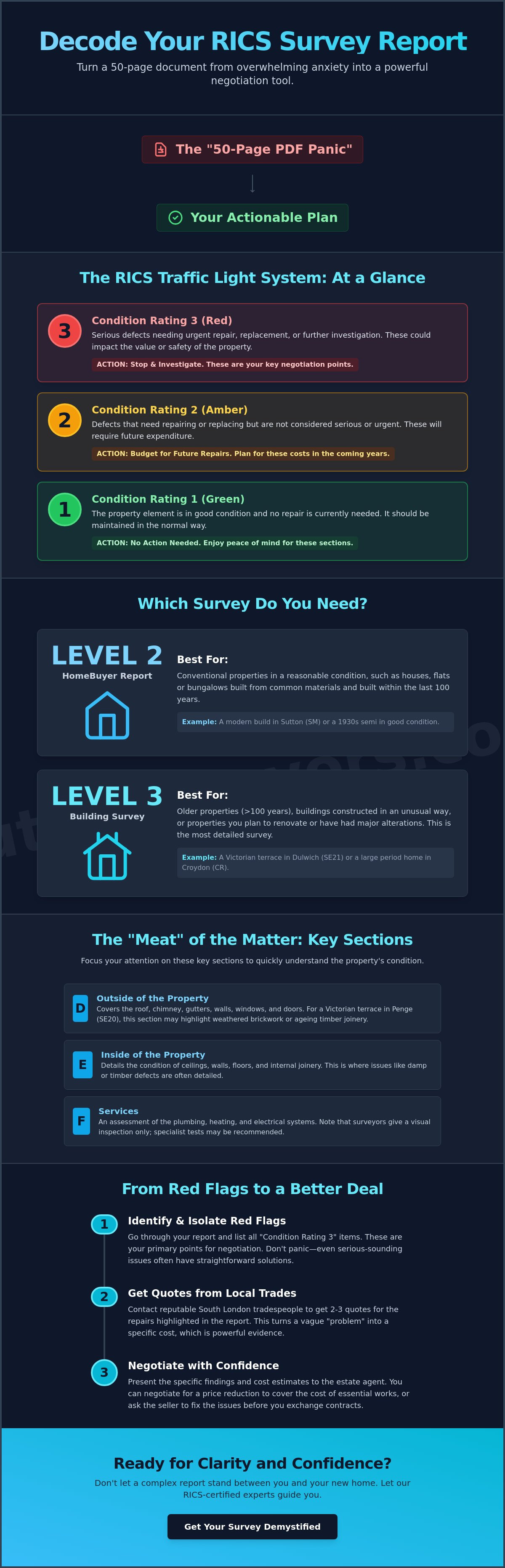
The report uses a simple colour-coded system to help you prioritize. Condition Rating 1 (Green) means the area is in good nick and no repair is currently needed. You can relax and enjoy these sections. Condition Rating 2 (Amber) identifies defects that need repairing or replacing but aren’t considered serious or urgent. You’ll want to budget for these in the next few years. Condition Rating 3 (Red) is the “stop and think” zone. These are serious defects or issues that need urgent attention before you commit to the purchase. Seeing red isn’t always a dealbreaker, but it’s a signal to investigate further.
Postcodes and Property: Why Local Context Matters in SE and BR
South East London has a unique architectural DNA. If you’re looking at a Victorian terrace in Dulwich (SE21), a “red” rating for damp is incredibly common because of how those 19th-century bricks breathe. It needs context rather than a knee-jerk reaction. Similarly, Croydon (CR) has a massive variety of architecture, from Edwardian villas to 1960s concrete experiments, and each requires a different level of scrutiny.
The soil in the SE, BR, and DA postcodes is often heavy clay. This specific ground type can cause seasonal movement in older properties. A surveyor who knows the local landscape understands that a small crack in a house in Orpington might be a standard “settling” issue, whereas the same crack elsewhere might be a red flag. Understanding your RICS survey report means trusting that your surveyor is applying this local lens to every page.
The Meat of the Matter: Navigating Sections D to G
Once you’ve skimmed the summary, it’s time to dive into the technical heart of the document. This is where your RICS-certified surveyor details every nook and cranny they’ve poked, prodded, and peered into. When understanding your RICS survey report, you’ll spend most of your time in Sections D and E. These chapters cover the outside and inside of the property, respectively. It’s easy to feel overwhelmed by the sheer volume of text here, but the trick is to look for the Condition Ratings (1, 2, or 3) attached to each element. A ‘maintenance note’ might suggest clearing a gutter, while a ‘structural warning’ usually points to something that could impact the building’s stability or your bank balance.
Sections D, E, and F: The Shell and the Services
In South London, the age of the property stock varies wildly. If you’re looking at a Victorian terrace in Penge (SE20), Section D will often highlight issues with original timber joinery or weathered brickwork. For those buying 1930s semis in Bromley (BR), pay close attention to the roof coverings and chimney stacks. These areas are prone to flashings failing or tiles slipping over time. Section F covers ‘Services’ like gas, electrics, and water. You’ll almost always see these marked as a CR3 (red) because surveyors aren’t registered engineers. They don’t turn on the gas or test the wiring; they simply recommend a specialist test. Don’t panic when you see red here; it’s a standard safety precaution to ensure you’re fully informed before exchanging contracts.
If you’re feeling a bit lost in the technical jargon, it’s often helpful to speak with a professional surveyor who knows the local South East London building styles inside out.
Section G: Damp, Subsidence, and the Clay Soil Factor
Section G is often dubbed the ‘scary section’ because it deals with damp and structural movement. In postcodes like Croydon (CR) and Sutton (SM), the ground is famously heavy with London Clay. This soil is prone to ‘shrink-swell’ cycles, which means it expands when wet and contracts when dry. This often triggers amber warnings for subsidence, even if the movement is historic and long-settled. You also need to distinguish between ‘rising damp’, which is a failure of the damp-proof course, and ‘condensation’, which is often just a result of modern living in an old, unventilated house. Understanding this distinction can save you thousands in unnecessary specialist treatments.
Subsidence is the downward movement of the ground supporting a building, typically caused by the ‘shrink-swell’ cycle of London’s clay soil as it reacts to seasonal changes in moisture levels.
- Condition Rating 1: No repair is currently needed. The property is performing as expected.
- Condition Rating 2: Defects that need repairing or replacing but aren’t considered serious or urgent.
- Condition Rating 3: Serious defects that need urgent attention, repair, or further investigation by a specialist.
By focusing on these specific sections, you’ll gain the clarity needed to decide whether to proceed, renegotiate, or walk away. Understanding your RICS survey report doesn’t have to be a chore if you know which red flags actually matter in the South London market.
Level 2 vs. Level 3: Which Report Are You Actually Holding?
Before you dive into the nitty-gritty of your surveyor’s findings, you need to be sure about the tool you’re using. Understanding your RICS survey report starts with knowing exactly how much detail you asked for. It’s the difference between a high-level summary and a forensic investigation. If you’ve got a 40-page document full of technical jargon and repair timelines, you’re likely looking at a Level 3. If it’s a punchy, color-coded overview, it’s probably a Level 2.
The HomeBuyer Report (Level 2) for Modern Pads
If you’re moving into a relatively new apartment in Sutton (SM) or a standard post-war semi-detached home that hasn’t been heavily modified, the Level 2 report is the standard choice. It’s designed to give you clarity without drowning you in data you don’t need. The standout feature here is the RICS 1-2-3 traffic light system. A ‘1’ means no repair is currently needed; ‘2’ suggests it’s not urgent but needs attention; ‘3’ is a serious defect that needs fixing immediately.
While this report is brilliant for spotting obvious issues like damp or roof damage, it doesn’t go behind the scenes. You won’t find a detailed breakdown of how to fix the problems or what those repairs might cost in the current UK market. It’s a snapshot of the property’s condition on the day. For a deeper look at what this entails, check out The RICS Level 2 Survey Explained.
- Best for: Conventional properties in reasonable condition.
- The Vibe: Concise, easy to read, and focused on urgent risks.
- What’s missing: Hidden structural analysis or advice on complex renovations.
The Full Building Survey (Level 3) for Period Gems
When you’re eyeing up one of those grand, quirky Victorian villas in Herne Hill or a charming but weathered terrace in Dartford (DA) or Bexley (DA), a Level 2 just won’t cut it. These older “gems” often have secrets hidden behind their lath and plaster walls. The Level 3 Building Survey is an in-depth analysis that leaves no stone unturned. It’s essential for understanding your RICS survey report when the property is over 50 years old or has been significantly extended.
The real value here lies in the “what next” factor. Your surveyor won’t just tell you the roof is leaking; they’ll explain why it’s happening, how to fix it, and provide a rough timeline for maintenance. It’s a comprehensive manual for your future home. You can find more details in our Level 3 Building Survey: A Complete Guide for Home Buyers.
- Best for: Period properties, fixer-uppers, or homes with unusual construction.
- The Vibe: Thorough, technical, and incredibly reassuring for cautious buyers.
- The Benefit: Includes estimated repair costs to help you negotiate that final price.
From Report to Reality: How to Use Your Survey to Negotiate
Opening your survey for the first time can feel a bit like opening a school report you know isn’t going to be all ‘A’s. Seeing red ‘Condition Rating 3’ boxes next to a charming period property in SE19 or a flat in Sutton can trigger immediate buyer’s remorse. Before you cancel the movers, remember that understanding your RICS survey report is about context, not just counting the red marks. Most houses have a story to tell, and it’s rarely a fairy tale without a few bumps in the road.
- Step 1: Keep your cool. Most older homes in South London have defects. It’s rare to find a Victorian terrace in Greenwich or a 1930s semi in Bexley that doesn’t have a few ‘reds’ on the list. These are often maintenance issues rather than terminal flaws.
- Step 2: Get the numbers. If the surveyor flags a roof issue in CR0, don’t guess the cost. Get two or three specific quotes from local tradespeople. Having a £4,200 quote in hand is much more powerful than saying “the roof looks a bit dodgy.”
- Step 3: Call your surveyor. A quick chat can clarify if a ‘red’ is a “fix this before you move in” or a “keep an eye on this over the next five years” situation.
- Step 4: Be a problem solver. Approach the seller with the mindset of “I want to buy this, but we need to address these specific costs to make the deal work.”
The ‘Walk-Away’ vs. the ‘Work-With-It’ Defects
Not all red flags are created equal. Serious structural movement or a forest of Japanese Knotweed in the garden of a DA postcode property can be genuine deal-breakers. These often affect mortgageability and might be your cue to exit. On the other hand, things like outdated wiring, a 15-year-old boiler, or a few slipped tiles are standard negotiation points. You can use a professional RICS valuation to justify a price reduction. If the market value assumes the house is in good repair, but the survey proves otherwise, you have a solid, evidence-based reason to ask for a discount that reflects the actual state of the building.
Talking to Your Surveyor Post-Report
A 50-page PDF is comprehensive, but it cannot replace a ten-minute phone call. Our surveyors know the specific quirks of SE and CR postcodes, from the heave-prone clay soil in Crystal Palace to the typical damp patterns in Victorian Lewisham homes. Ask them the “golden question”: if this was your house, what would you fix first? This perspective helps you prioritise your renovation budget. understanding your RICS survey report through the lens of a local expert gives you the clarity to move forward or walk away with your deposit intact.
Ready to get the facts on your potential new home? Book your professional RICS survey with our local experts today.
Clarity and Confidence: How South Surveyors Demystifies the Process
Buying a home in South East London is often a high-stakes game of speed and strategy. You’ve fought off other bidders in Peckham or finally found that hidden gem in Sidcup, so the last thing you need is a 50-page document full of technical jargon that leaves you more confused than when you started. We believe that understanding your RICS survey report should feel like a conversation with a knowledgeable friend, not a chore involving a dictionary of architectural terms.
We pride ourselves on being more than just a report generator for South Londoners. Our RICS-certified expertise is backed by a human touch that recognizes the emotional and financial weight of your investment. Whether you’re eyeing a terrace in the BR postcode or a flat in the SE area, our local knowledge saves you money. We know which streets in Eltham are prone to specific drainage issues and which Victorian conversions in Bromley might hide expensive structural surprises. This hyperlocal insight allows us to provide context that a generic, national firm simply cannot match.
Talk to a Human, Not a Template
The standard RICS traffic light system is helpful, but it doesn’t tell the whole story. When you see a “red” or “amber” zone on your report, it’s easy to panic. That’s where we step in. Our surveyors, including Jazz, make themselves available to talk through the findings personally. We don’t just flag a problem; we explain what it means for your wallet and your timeline.
We provide the clarity and confidence needed to navigate the South London property jungle without the stress. If you’re still weighing up which level of inspection you need, check out The Ultimate Guide to Building Surveys: Navigating South London’s Property Jungle for a deeper dive into the process.
Ready to Move Forward in South London?
Whether you’re purchasing in the DA, CR, or SM postcodes, we’ve seen every quirk these homes have to offer. From rising damp in drafty Victorian builds to subsidence risks in 1930s semi-detached houses, our experience is your best defense against “buyer’s remorse.” We’ve helped hundreds of buyers in Peckham and Eltham turn a daunting survey into a powerful tool for price negotiation or peace of mind.
- Jargon-free summaries: We translate “spalling brickwork” into “what you need to fix now.”
- Direct access: Speak to the surveyor who actually walked through the property.
- Fast turnaround: Because the South London market waits for no one.
Don’t let understanding your RICS survey report be the hurdle that stops your move. Get the expert, local perspective you deserve. Get your tailored RICS survey quote from South Surveyors today and take the next step toward your new front door with total certainty.
Take the Stress Out of Your South London Move
Buying a home in the SE or BR postcodes is a massive milestone. That thick stack of paper shouldn’t keep you up at night. Understanding your RICS survey report is really about peeling back the layers of a property to see what’s actually going on behind the fresh paint. Whether you’ve opted for a Level 2 Home Survey or a more thorough Level 3 building survey, you now have the data to negotiate a better price or plan for future repairs. Our RICS-Certified Professionals have helped hundreds of buyers across DA, CR, and SM postcodes turn technical jargon into actionable plans. Our surveyors are known for spending 15 minutes on the phone after every inspection to explain the findings, a level of service reflected in our hundreds of positive client testimonials. You’re not just buying a house; you’re securing your future. Having a professional on your side makes all the difference when it’s time to sign on the dotted line. Your South London dream home is within reach. We’re here to help you cross the finish line with total peace of mind.
Get Clarity and Confidence on Your Purchase—Book Your Survey with South Surveyors
Frequently Asked Questions
Is a RICS survey report easy to understand for a first-time buyer?
Yes, RICS reports are designed to be accessible, using a simple traffic light system to highlight issues. Green means everything is fine, amber suggests future work, and red indicates urgent repairs. Understanding your RICS survey report shouldn’t feel like decoding a secret message. Our RICS-Certified professionals ensure the language is clear and jargon-free, giving you the peace of mind needed to move forward with your purchase in SE22 or beyond.
What happens if my RICS survey report has a ‘red’ condition rating?
A ‘red’ condition rating signals that a property element requires urgent attention, but it’s not a reason to walk away immediately. It means you need to investigate the cost of repairs before exchanging contracts. Whether it’s a roof issue in Croydon (CR0) or structural concerns in Sutton (SM1), our surveyors provide the clarity you need. We recommend getting professional quotes for any red-rated items to understand the full financial impact.
Can I use my RICS survey report to lower the house price?
You can absolutely use the findings of your report to renegotiate the purchase price or ask the seller to fix the issues. If your surveyor identifies £4,000 worth of damp proofing needed in a Bexley (DA5) terrace, showing the report to the seller is a powerful tool. Understanding your RICS survey report allows you to make informed decisions and often leads to saving thousands of pounds during the final negotiations.
How long does it take to get the final RICS report after the inspection?
Most buyers receive their final digital report within 3 to 5 working days after the physical inspection is completed. At South Surveyors, we know the South East London market moves fast, so we prioritise a quick turnaround without compromising on thoroughness. Whether the property is in Bromley (BR1) or Sidcup (DA14), we’ll keep you updated throughout the process so you aren’t left waiting in the dark.
What is the difference between a mortgage valuation and a RICS survey report?
A mortgage valuation is a brief check for the lender’s benefit, while a RICS survey is a detailed health check for your benefit. The bank only wants to know if the house is worth the loan. A professional survey identifies hidden defects that could cost you a fortune later. For a buyer in Dulwich (SE21), relying only on a valuation is a risky move that often misses serious structural problems.
Do I need a Level 3 survey for a house in South London that looks fine?
A Level 3 survey is highly recommended for older properties or those with visible extensions, even if they look “fine” on the surface. Many Victorian and Edwardian homes in areas like Crystal Palace (SE19) or Carshalton (SM5) have hidden issues like timber rot or outdated wiring. This comprehensive “Full Structural” survey provides a deep dive into the building’s fabric, ensuring you don’t face nasty surprises after moving in.
Can a RICS report help me with a Party Wall agreement in Bromley?
While a standard survey report identifies if a Party Wall agreement might be necessary, it doesn’t serve as the legal agreement itself. If you’re planning an extension or loft conversion in Bromley (BR2), your surveyor will flag where your work affects a neighbouring boundary. We can then provide separate professional advice on the Party Wall Act 1996 to ensure your project stays compliant and your neighbours stay happy.
What are the most common ‘red’ flags found in South London property surveys?
The most frequent “red” flags in South London include rising damp, Japanese Knotweed, and structural movement caused by the region’s heavy clay soil. In postcodes like SE13 and CR2, we often find 15 percent of period properties have issues with Victorian drainage systems. Identifying these early through a meticulous inspection allows you to plan for repairs or rethink your investment before it’s too late.