

What if that gorgeous Edwardian semi in Bromley or a trendy loft in SE1 is actually a “money pit” in disguise? Even with 2026 reforms requiring sellers to provide upfront reports, you still need to know exactly what you’re looking at before signing on the dotted line. When you’re eyeing up a property across the SE, BR, or DA postcodes, an independent RICS survey roof inspection South London isn’t just a box-ticking exercise. It’s your primary shield against the hidden structural gremlins that love to lurk behind a fresh coat of paint or a cleverly staged loft conversion.
We understand the stress of falling in love with a home only to dread a report filled with confusing technical jargon. You want clarity, not a headache. This guide is designed to demystify the updated 2026 RICS Home Survey Standards and help you decide if a Level 3 Building Survey is the right move for your potential CR or SM home. We’ll preview how to distinguish urgent repairs from aesthetic fixes and show you how to use your survey as a powerful tool for price negotiations. By the end, you’ll have the confidence to move forward or walk away with your bank balance intact.
Key Takeaways
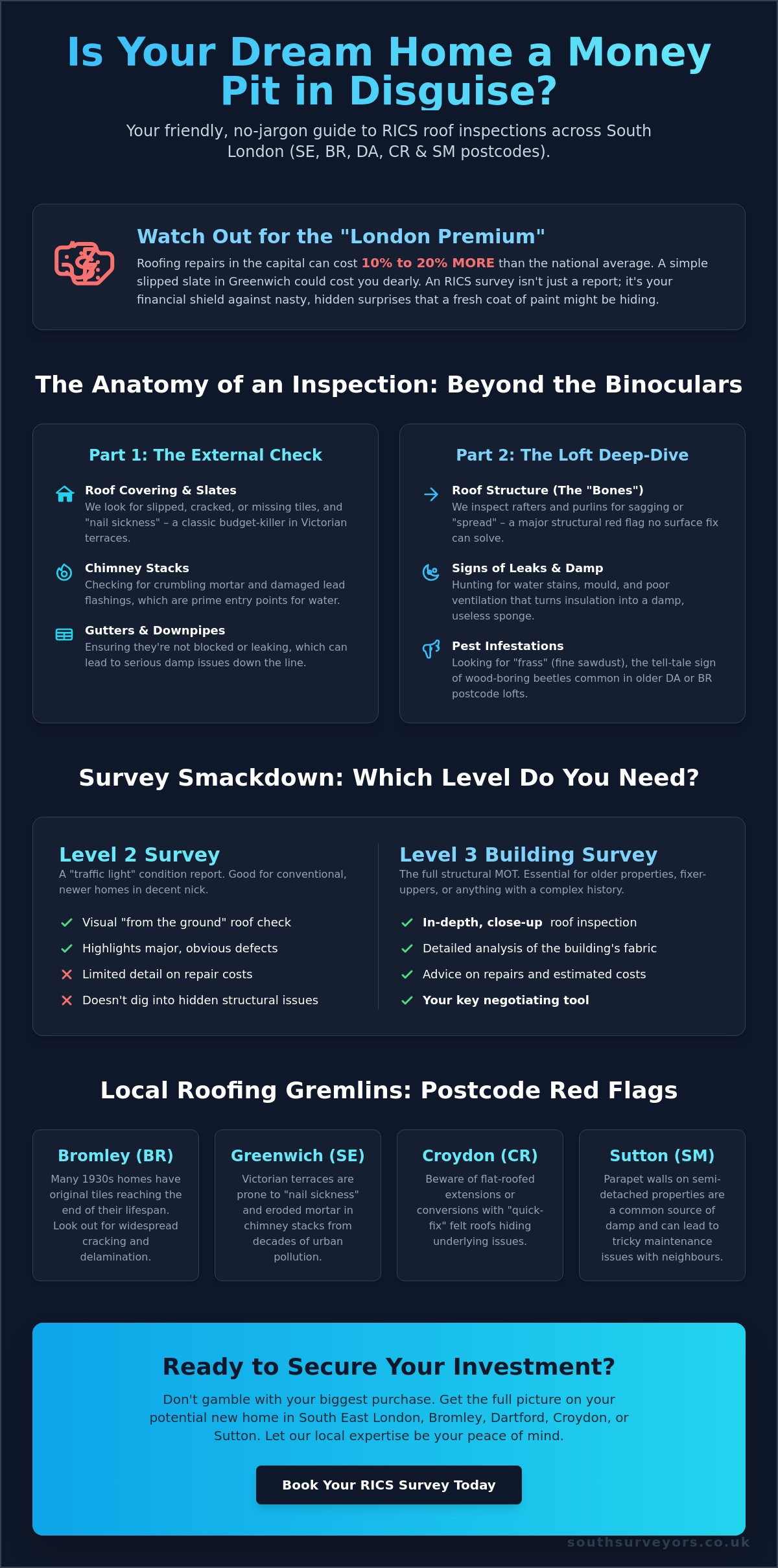
- Learn why “nail sickness” and slipped slates are the silent budget-killers for Victorian terraces in Greenwich and across the SE postcode.
- Understand why a professional RICS survey roof inspection South London requires a deep dive into the loft hatch to check the structural “bones” rather than just a quick glance from the street.
- Discover the critical differences between a Level 2 Condition Report and a Level 3 Building Survey so you don’t bring a basic checklist to a complex structural battle.
- Identify common parapet wall red flags in CR and SM postcodes that could lead to unexpected legal and maintenance headaches with your new neighbours.
- Master the art of using your survey findings to distinguish between simple aesthetic fixes and the urgent repairs that give you serious leverage during price negotiations.
Why Your South London Roof is More Than Just a Lid
South London isn’t just a collection of postcodes; it’s a living museum of architectural styles. From the sprawling Victorian terraces of East Dulwich to the sleek Art Deco blocks in Streatham, each roof tells a different story. But here’s the thing: that story can quickly turn into a horror script if you don’t look closely. Relying on a quick glance from the pavement is a bit like buying a vintage car because the paint looks shiny. You need to know what is a home inspection really entails for the highest point of your investment.
To see exactly how a high-stakes assessment looks in practice, watch this breakdown of a professional site visit:
A professional RICS survey roof inspection South London is your best defense against the “London Premium.” In 2026, roofing repairs in the capital often carry a 10 to 20 percent price hike compared to the national average. If you’re dealing with a complex valley gutter or a crumbling chimney stack, those costs escalate faster than a morning commute on the Overground. A RICS-regulated survey provides more than just a list of faults; it offers a professional safety net and a rigorous standard that protects your deposit from being swallowed by hidden defects.
The “Money Pit” Myth vs. South London Reality
Period properties in Dulwich (SE21) and Greenwich (SE10) are stunning, but they’ve spent over a century battling London’s unique micro-climate. Decades of urban pollution can silently erode the lime mortar in chimney stacks, while the wind tunnels created by newer high-rises put extra stress on aged slates. An expert surveyor provides the emotional security of knowing that your dream home isn’t secretly a financial trap waiting to spring. Without that professional eye, you’re essentially gambling on the weather and the honesty of previous owners.
Postcode-Specific Roofing Trends: From SE to BR
Different areas have different “tells” that only a local expert will spot. In Bromley (BR1), we often see 1930s builds where the original tiles are reaching the end of their natural lifespan. Contrast that with Croydon (CR0), where many conversions feature “quick-fix” felt roofs hiding under a deceptive layer of gravel. Local knowledge is vital because South London’s clay-heavy soil can cause subtle structural shifts that manifest as cracks in your roofline. You want someone who knows the difference between a minor settlement crack and a major structural red flag that could derail your mortgage application.
The Anatomy of a RICS Roof Inspection: Beyond the Binoculars
If you think a roof inspection is just a surveyor standing on the pavement with a pair of binoculars, think again. A proper RICS survey roof inspection South London is a two-part detective story. The first chapter happens outside, but the real plot twists are usually found inside the loft. That tiny hatch in the ceiling is actually the most important door in your potential new home. It’s where we see the “bones” of the building. We’re looking at the rafters and purlins, the timber frame that holds everything up. If these are sagging or showing signs of “spread,” you’ve got a structural issue that no amount of fancy tiling can fix. We also check for “frass,” that fine sawdust left by wood-boring beetles, which is a common find in older DA or BR postcode lofts.
Then there’s the “wet stuff.” We aren’t just looking for active leaks; we’re hunting for the ghosts of leaks past and the threat of condensation future. In South London’s humid micro-climate, poor ventilation in a loft can turn your insulation into a damp sponge. We also pay close attention to the flashings and chimney stacks. These are the Achilles’ heels of Victorian terraces in places like Greenwich or Forest Hill. If the leadwork is pulling away or the mortar is crumbling, water will find a way in. Understanding surveyor responsibilities is vital here. You need to know that your expert is looking for these specific failure points to protect your investment. A missing tile might cost a few pounds, but a failing parapet wall can run into the thousands.
RICS Condition Ratings Explained (Amber, Red, Green)
RICS reports use a simple traffic light system to help you prioritize repairs. Ratings shouldn’t scare you; they should empower you. Condition Rating 1 (Green) means everything is fine. Condition Rating 2 (Amber) isn’t a deal-breaker, but it means the roof needs a maintenance plan so it doesn’t turn into a disaster later. Condition Rating 3 (Red) is the serious one. This indicates a defect that needs urgent attention or further investigation before you exchange contracts. It’s the ultimate leverage for price negotiations in competitive areas like Croydon or Sutton.
Modern Tech: Drones and Camera Poles in South London
Narrow streets in the SE or DA postcodes often make it impossible to get a good angle from the ground. That’s where we bring in the tech. High-resolution camera poles and drones allow us to see the “unseeable” on three-storey Victorian homes or complex roof valleys in the SM postcode area. However, tech has its limits. A drone can’t feel if a timber is soft or smell the tell-tale scent of dry rot. It’s a tool, not a replacement for a human expert climbing the ladder. If you want a team that balances high-tech tools with old-school thoroughness, it’s worth seeing how we approach a RICS survey for your local area.
Level 2 vs. Level 3: Which Survey Actually Climbs the Ladder?
Choosing between a Level 2 and a Level 3 survey is like deciding between a routine GP check-up and a full-body MRI. If you’re buying a relatively modern property in a development in Morden, a RICS Level 2 (Condition Report) is usually your best bet. It’s a high-level health check that identifies obvious problems without digging too deep into the structural weeds. However, for anything built before 1900, or a property that has been heavily modified, a RICS Level 3 Building Survey in South London is the gold standard. This is the deep dive you need to catch structural issues that a standard report might skim over. If your only concern is a leaky extension or a sagging ridge that the bank flagged during valuation, you might even opt for a specific defect report, which zooms in on that one single problem with surgical precision.
A professional RICS survey roof inspection South London is about more than just finding faults; it’s about matching the level of scrutiny to the age and complexity of the building. We’ve seen plenty of buyers try to save a few hundred pounds by opting for a Level 2 on a Victorian terrace, only to find out later that the roof needs a total overhaul. That small saving at the start can lead to a very expensive “money pit” scenario later on. Think of the extra cost for a Level 3 as an insurance policy against the unknown structural gremlins that older South London homes often hide.
Choosing Your Level: A Decision Framework
Properties in Peckham or Morden are famous for their “creative” extensions and 1980s loft conversions. If the house has been altered in any way, you almost certainly need a Level 3. A Level 2 might miss a £15,000 roof failure that only becomes apparent when you analyze how the new rafters meet the original timber frame. If you’re planning your own major renovations or a loft conversion after you move in, getting the detailed structural breakdown of a Level 3 isn’t just helpful. It’s essential for your architect and builder to work from a position of fact rather than guesswork.
What’s Included (and What’s Not)
It’s vital to remember that all RICS surveys are non-invasive. We don’t peel back your potential new roof tiles, lift lead flashings, or pull up floorboards to see what’s underneath. If we see signs of trouble, we might suggest “further investigations” by a specialist. Don’t panic when you see this in your report. It’s simply our way of saying that a specialist contractor needs to take a closer look before you commit to the purchase. For those buying a newer property who want to understand the basics of a standard report, check out The RICS Level 2 Survey Explained to see if it fits your specific needs.
Local Red Flags: Common Roofing Gremlins in Croydon to Greenwich
Every neighborhood in South London has its own architectural quirks, and with those come specific roofing gremlins. If you’re looking at a Victorian terrace in Greenwich or a period home in SE London, you need to watch out for “nail sickness.” This isn’t a medical condition; it’s what happens when the original iron nails holding slates in place finally rust away. One day you have a perfect roof, and the next, your slates are sliding off like a deck of cards. A professional RICS survey roof inspection South London is the only way to catch this before it becomes a full roof replacement. We also see major issues with parapet walls. These shared walls are iconic to our terrace streets, but they are notorious for letting in water if the leadwork or rendering fails. Because they’re shared, a leak in your neighbor’s section can quickly become your structural nightmare.
Over in Sidcup or Bexley, the 1960s and 70s builds often feature flat roofs. While modern materials are great, many older felt roofs in the DA postcode area are well past their ten-year lifespan. They might look fine from a distance, but they often hide “ponding” water and internal rot. Then there’s the drainage. London’s heavy downpours are a brutal test for original cast-iron gutters. If they’re blocked or cracked, they dump hundreds of liters of water directly into your brickwork, leading to damp issues that can take months to dry out.
The Buyer’s Binocular Guide: Spotting Issues on a Second Viewing
Don’t just look at the kitchen tiles during your second viewing. Take a pair of binoculars and head outside. Look for sagging ridge lines; that’s the horizontal line at the very top of the roof. If it looks like a swaybacked horse, you’ve got structural trouble. Inside the loft, look for “daylight.” If you can see the sky through the tiles, water can definitely see you. A massive red flag in 2026 is spray foam insulation. While it was sold as an energy saver, many lenders now refuse mortgages on properties with spray foam because it traps moisture against the roof timbers and makes a proper inspection impossible.
Neighbourly Matters: The Party Wall Factor
Roof repairs in dense South London postcodes aren’t just about tiles and timber. Because so many of our homes are semi-detached or terraced, significant work often triggers the Party Wall Act. This is a legal requirement to notify your neighbors before you start hacking away at shared structures. It’s why talking to the person next door is as important as the survey itself. For a deep dive into the legalities, check out The Party Wall Act: A Friendly Guide for South London Homeowners. If you want to avoid a legal battle before you’ve even unpacked, start by getting a professional building survey to document the exact state of play.
Securing Your Investment with South Surveyors
At South Surveyors, we don’t just work in South London; we live and breathe its unique architectural landscape. When you book a RICS survey roof inspection South London with our team, you’re hiring experts who have likely already poked their heads into the loft of the house three doors down. We’ve seen how the foundations in Sutton react to a dry summer and how the slate roofs in Forest Hill handle a winter storm. Our mission is to strip away the intimidating corporate jargon that often plagues this industry. We replace it with clear, actionable facts. You won’t find pages of “weasel words” in our reports. Instead, you’ll get a document written in plain English that tells you exactly what’s wrong, why it matters, and what you should do next.
A survey isn’t just a hurdle to clear before you get your keys. It’s your most powerful bargaining chip during the final stages of a property transaction. If our inspection reveals that the roof on your dream Croydon semi needs significant leadwork or a total retile, that’s a cost you shouldn’t have to shoulder alone. We provide the RICS-regulated evidence you need to go back to the estate agent and renegotiate the sale price with absolute confidence. It moves the conversation from a vague feeling that the house is “too expensive” to a fact-based discussion about structural integrity and fair market value.
Empowered Decision Making
Moving from a state of “I hope it’s okay” to “I know exactly what I’m buying” is a game-changer for your mental health during a move. We know that reading a survey report can be stressful, which is why our personal touch extends beyond the PDF. We’re always available for follow-up calls to clarify the scary bits and ensure you feel empowered to make the right choice for your future. If you’re also looking for a cold, hard market figure to satisfy your lender or your own curiosity, check out our RICS Valuation: The No-Nonsense Guide for those needing a market figure too.
Book Your South London Survey Today
Getting started is simple and transparent. Whether you’re buying a period property in the leafy streets of BR1 or a modern apartment in the SM postcode area, we provide bespoke quotes tailored to the specific property type. Don’t wait until you’re a week away from exchanging contracts. Booking early in the conveyancing process is vital to avoid delays and give you enough time to investigate any red flags we might find in the SE, BR, DA, CR, or SM postcodes. Secure your peace of mind and get your RICS survey quote from South Surveyors today.
Take the High Ground on Your South London Move
Buying a home in the SE, BR, or CR postcodes is a massive milestone, but it shouldn’t be a gamble. We’ve explored why the loft hatch is often more important than the front door and how a Level 3 survey can save you from a five-figure roofing disaster. Whether it’s spotting “nail sickness” in a Victorian terrace or navigating the legal maze of the Party Wall Act, knowledge really is power. A professional RICS survey roof inspection South London ensures that your “forever home” doesn’t turn into a structural headache the moment the first autumn storm hits.
As a RICS Regulated Firm, South Surveyors is obsessed with getting the details right. We combine hyperlocal expertise with detailed reports written in plain English, so you aren’t left scratching your head over technical jargon. We’re here to provide the clarity you need to negotiate fairly and move in with total peace of mind. Ready to secure your future? Book your expert South London RICS survey today and let’s get your move off to a flying start. You’ve done the hard work of finding the house; let us do the hard work of making sure it’s sound.
Frequently Asked Questions
Does a RICS Level 2 survey include a full roof inspection?
A Level 2 survey includes a visual inspection of the roof from ground level and inside the loft hatch. It’s designed to spot obvious problems like missing tiles or major sagging. However, it doesn’t involve climbing onto the roof or using specialist tech like drones. For older period properties in SE London, this high level check might miss the subtle structural “bones” that a more detailed RICS survey roof inspection South London would catch.
How much does a specialist roof survey cost in South London?
Costs for specialist inspections vary widely depending on the height of the property and the equipment needed. In postcodes like SE10 or BR1, you’ll often find a “London premium” of 10 to 20 percent compared to national averages due to access difficulties. While we don’t provide repair quotes, a comprehensive Level 3 survey often removes the need for a separate specialist by providing a deep structural analysis of the timber frame and coverings.
Can a surveyor tell if a roof has asbestos in it?
Surveyors can identify materials that are highly likely to contain asbestos, such as certain types of old cement roofing sheets or soffit boards common in 1950s Croydon builds. Because we don’t take physical samples for lab testing, we’ll flag these as “suspected” risks. It’s a vital safety step that ensures you don’t accidentally disturb dangerous fibres during a future loft conversion or minor repair in your new SM postcode home.
What happens if the surveyor can’t get into the loft?
Will a bad roof survey affect my mortgage offer?
Yes, a RICS survey roof inspection South London that highlights urgent “Red” defects can lead to a mortgage retention. This means the lender might hold back some of the loan until the roof is fixed. Lenders are particularly cautious with older terraces in places like Greenwich or Sutton. Getting your survey done early gives you the time to negotiate a price reduction or ask the seller to fix the issues before you exchange contracts.
How long does a roof inspection take during a full building survey?
The roof assessment usually takes between 30 and 60 minutes of the total time spent on site. This includes a methodical check of the external tiles and chimney stacks using binoculars, followed by a thorough crawl through the loft space. If the property has a complex layout or multiple extensions, which is very common in Morden or Peckham, the surveyor might spend even longer ensuring every valley gutter and flashing is sound.
Do I need a drone survey for a three-storey Victorian house?
Drones are incredibly helpful for high-level Victorian homes in narrow streets where ground-level views are restricted. While they aren’t always a mandatory requirement, they offer high-resolution evidence of slipped slates or crumbling mortar that binoculars might miss. In dense areas like Camberwell or Sidcup, using modern tech ensures you have a complete picture of the roof’s health without the massive expense and hassle of erecting scaffolding just for a look.
Can I use a roof survey report to lower the house price?
Absolutely, your survey report is your most powerful tool for renegotiation. If we find that a roof in DA or CR postcodes needs £10,000 worth of work that wasn’t visible during your initial viewing, you have every right to ask for a price reduction. Most sellers in the South London market expect some level of negotiation based on survey findings. It’s a standard way to ensure you aren’t overpaying for a property that needs immediate structural investment.