

Understand the crucial differences between a RICS Level 2 and Level 3 survey to make a confident, informed decision for your property purchase in London.
What is a Homebuyers Survey? (The RICS Level 2 Explained)
When you’re buying a property, you need to look beyond the fresh paint and new carpets. A Homebuyers Survey, officially known as the RICS Level 2 Home Survey and often referred to by its former name, the RICS HomeBuyer Report, is a detailed inspection designed to give you a clear picture of a property’s condition.
It’s an intermediate-level survey ideal for conventional properties that appear to be in reasonable shape. One of its most valued features is the easy-to-understand ‘traffic light’ system, which rates the condition of different parts of the property. This helps you quickly identify areas that need attention, from urgent repairs (red) to issues requiring further investigation (amber) and elements that are in good condition (green).
Crucially, a Homebuyers Survey provides vital information that a simple mortgage valuation will not. While a lender’s valuation is for their benefit, a survey is for yours-protecting your investment from potentially costly hidden problems.
Key Features of a Level 2 Survey
-
General Condition: A thorough assessment of the overall state of the property.
-
Urgent Defects: Clear highlighting of significant issues that require immediate attention.
-
Common Problems: Checks for underlying problems like damp, timber decay, and structural movement.
-
Actionable Advice: Guidance on necessary repairs and ongoing maintenance to keep the property in good condition.
When is a Homebuyers Survey the Right Choice?
This survey is the most suitable option for you if the property you’re considering meets these criteria:
-
It was built within the last 70-80 years.
-
It is constructed from common materials (e.g., brick and tile).
-
It appears to be in a good state of repair.
-
You are not planning any major structural work or renovations.
For example, a 1980s terraced house in Bromley or a modern apartment near the Greenwich Peninsula would be a perfect candidate for a Level 2 Homebuyers Survey.
Mortgage Valuation vs. Homebuyers Survey: A Critical Distinction
Many buyers mistakenly believe a mortgage valuation is a survey. It is not.
-
A valuation is for the lender. Its sole purpose is to confirm the property is worth the amount you want to borrow against it.
-
A survey is for you, the buyer. It protects your financial future by uncovering hidden defects and giving you a true understanding of the property’s condition before you commit.
The Alternative: Understanding the RICS Level 3 Building Survey
For properties that are older, larger, have undergone significant changes, or are built from non-standard materials, a more detailed inspection is required. This is the RICS Level 3 Building Survey, widely known by its old name, a ‘Full Structural Survey’.
This is the most comprehensive investigation a surveyor can provide. It delivers an exhaustive analysis of the property’s structure, fabric, and condition. The report is far more detailed than a Level 2 survey, providing in-depth advice on the defects found, the potential consequences, and the necessary repairs, often including estimated costs and timelines.
What a Level 3 Survey Uncovers
-
Construction Details: A deep dive into the property’s structure and the materials used.
-
In-Depth Defect Analysis: A thorough examination of all visible and accessible elements, outlining both major and minor issues.
-
Repair Guidance: Detailed recommendations for remedial work and advice on future maintenance.
-
Further Investigations: Recommendations for specialist reports if issues like complex structural problems or asbestos are suspected.
Who Needs a Full Building Survey?
A Level 3 survey is essential for:
-
Buyers of properties over 80 years old, such as the Victorian and Edwardian homes common in areas like London Bridge, East Dulwich and Blackheath.
-
Anyone purchasing a property that is in obvious disrepair or has been neglected.
-
Properties that have been significantly altered or extended.
-
Buildings with unusual construction, such as timber frames, thatched roofs, or steel frames.
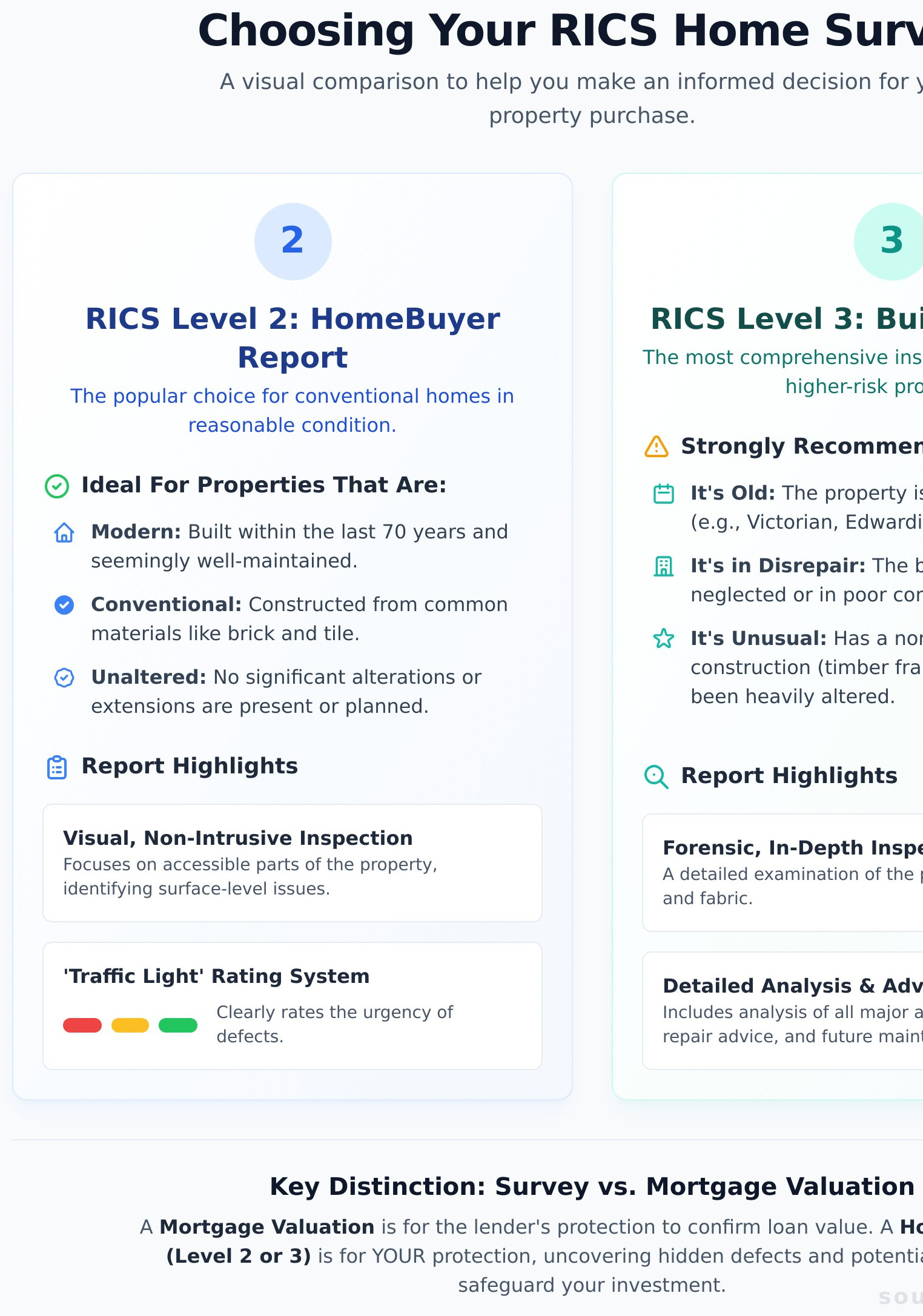
Head-to-Head: RICS Level 2 vs. Level 3 Survey Comparison
Choosing the right survey is about matching the level of inspection to the specific property you want to buy. This section breaks down the key differences to help you decide. While a Level 3 survey costs more upfront, uncovering a single major issue could save you thousands in the long run.
| Feature | RICS Level 2 Homebuyers Survey | RICS Level 3 Building Survey |
|---|---|---|
| Also Known As | HomeBuyer Report | Full Structural Survey |
| Depth of Inspection | A visual, non-intrusive inspection of the main elements. | A comprehensive and detailed inspection of all accessible areas. |
| Ideal Property Type | Conventional homes post 1930 in good condition. | Older properties pre 1930, listed buildings, or any property in poor condition. |
| Report Format | Concise report with a ‘traffic light’ summary for easy understanding. | Highly detailed, technical report with in-depth analysis and repair advice. |
| Typical Cost | Lower cost, reflecting the less detailed inspection. | Higher cost, reflecting the comprehensive nature of the survey. |
| Key Outcome | Provides confidence and flags significant, visible defects. | Provides a complete understanding of the property’s structure and any hidden issues. |
Still unsure? Our expert team can advise on the right survey for you.
Comparison Point 1: Depth of Inspection
A Level 2 survey is a "look and see" inspection. The surveyor will not typically lift floorboards or move furniture. A Level 3 survey is more thorough; the surveyor will inspect attics, look behind walls where possible, check drains, and go into much greater detail to understand how the building is constructed and where potential problems lie.
Comparison Point 2: Property Suitability & Scenarios
-
Scenario for Level 2: You’re buying a 1990s semi-detached house in Orpington. It’s of standard construction and appears well-maintained. A Homebuyers Survey will confirm its condition and flag any common issues for a property of its age.
-
Scenario for Level 3: You’ve fallen for a 1900s Victorian terrace in Peckham that has a loft conversion and a rear extension. A Full Building Survey is essential to assess the quality of the alterations and check for age-related issues like structural movement, damp, or timber decay.
Comparison Point 3: Report Detail and Advice
The Level 2 report is designed for clarity and ease of use, with its traffic light system giving you an at-a-glance summary. The Level 3 report is a much more substantial document. It describes defects in technical detail, explains the implications, and provides comprehensive advice on how to rectify them, often including projected costs and timelines for repairs.
Comparison Point 4: Cost vs. Long-Term Value
It’s tempting to choose the cheaper option, but this can be a false economy. The cost of a survey should be viewed as an investment, not an expense. The detailed findings in a Level 3 report on an older property can provide the evidence needed to renegotiate the purchase price by tens of thousands of pounds, paying for itself many times over.
After the Survey: Using Your Report for a Smarter Purchase
Receiving your survey report isn’t the end of the process; it’s the beginning of making a fully informed decision. The report is a powerful tool that gives you clarity and control.
Step 1: Review the Report with Your Surveyor
At South Surveyors, we believe a post-survey consultation is essential. This is your opportunity to speak directly with the RICS-certified surveyor who inspected the property. Prepare questions about the key findings and use this call to gain absolute clarity on the severity and implications of any issues identified.
Step 2: Leveraging Findings for Price Renegotiation
If the survey uncovers defects, you are in a strong position to act.
-
Get Quotes: For any significant repairs highlighted in the report, obtain quotes from qualified tradespeople.
-
Present Evidence: Share the relevant sections of the survey and the repair quotes with the estate agent.
-
Adjust Your Offer: You can then renegotiate the purchase price to reflect the unexpected costs you will have to incur. For example, you might say: "The survey has revealed an issue with the roof that will cost an estimated £5,000 to repair. We are still very keen on the property and would like to proceed, but we will need to revise our offer to £X to account for this unforeseen expense."
Step 3: Making the Final Decision with Confidence
Armed with a full understanding of the property’s condition and the cost of any necessary work, you can proceed with confidence. You can assess whether the issues are manageable or if they are deal-breakers. The survey provides the objective information you need to either commit to the purchase or walk away, knowing you’ve avoided a potentially disastrous investment.
Frequently Asked Questions
How much does a Homebuyers Survey cost in London?
The cost varies depending on the property’s value, size, and age. A Level 2 survey is less expensive than a Level 3. We provide a free, no-obligation quote tailored to your specific property.
Do I really need a survey for a new-build property?
Yes. Despite being new, these properties can have defects due to poor workmanship or materials. A survey can identify issues that can be fixed by the developer under warranty before they become your problem.
How long does a survey inspection take and when do I get the report?
A Level 2 inspection typically takes 2-4 hours, while a Level 3 can take a full day. You will usually receive your comprehensive report within 5-7 working days.
What happens if my Homebuyers Survey finds serious problems like subsidence?
The surveyor will detail the issue in the report and recommend further investigation by a specialist, such as a structural engineer. This information is critical for deciding whether to proceed and for negotiating with the seller.
Is a Homebuyers Survey the same as the old RICS HomeBuyer Report?
Yes. The RICS updated its survey standards, and the "RICS Level 2 Home Survey" is the modern equivalent of the service previously known as the "HomeBuyer Report".
Can a surveyor check for things like asbestos or Japanese knotweed?
Surveyors are trained to identify the visual signs of asbestos-containing materials and invasive plants like Japanese knotweed. If suspected, they will flag it in the report and recommend a specialist survey for confirmation and removal advice.
Does a ‘not guilty’ mortgage valuation mean the property is in good condition?
Absolutely not. A mortgage valuation is a risk assessment for the lender. It does not protect you and will not identify structural defects or repair costs. Only a RICS survey can provide this protection.
Get clarity and confidence. Request your free, no-obligation survey quote today.
-
Regulated by RICS for the highest professional standards.
-
Local South London expertise in all property types.
-
Clear, jargon-free reports and post-survey consultations.