

Planning an extension, loft conversion, or even simple structural changes is an exciting time for any homeowner. However, that excitement can quickly turn to anxiety when you encounter the complexities of The Party Wall etc. Act 1996. Questions immediately arise: Do my plans legally require a party wall agreement? How do I approach my neighbours without causing a dispute? The fear of confusing legal terms, unexpected costs, and project delays can feel overwhelming, threatening to derail your project before it even begins.
This comprehensive guide is designed to provide the clarity and confidence you need. As RICS-certified professionals, our goal is to demystify the process for you. We will explain exactly what a Party Wall Agreement is, help you determine if your project falls under the Act, and provide a clear, step-by-step overview of how to serve a notice correctly. By the end, you will be empowered to meet your legal obligations, maintain a positive relationship with your neighbours, and ensure your building work proceeds smoothly, without unnecessary disputes or delays.
What is a Party Wall Agreement? The Basics Explained
Embarking on a building project is exciting, but when your work affects a shared wall or boundary, it’s crucial to manage the process correctly to maintain good relationships with your neighbours. A Party Wall Agreement, also known as a Party Wall Award, is a legal document that provides clarity and protection for both you and your neighbours before and during construction.
Its purpose is to prevent and resolve potential disputes when a ‘Building Owner’ (the person carrying out the work) plans a project that falls under the scope of The Party Wall etc. Act 1996. The agreement details the proposed work, sets out safeguards to protect the ‘Adjoining Owner’s’ property from damage, and establishes a clear process for resolving any issues that may arise.
To help you understand this concept more clearly, watch this helpful overview:
It is essential to understand that a party wall agreement is a separate legal requirement from planning permission or building regulations approval. While you may have secured all necessary consents from your local authority, you still have a statutory duty to serve notice on your neighbours if your work falls within the Act’s remit. This ensures your project proceeds smoothly and with complete legal compliance, giving everyone involved peace of mind.
The Party Wall etc. Act 1996: The Law Behind the Agreement
The entire process is governed by a key piece of legislation designed to protect property owners. The Party Wall etc. Act 1996 provides a clear legal framework for managing building work that might affect shared walls, structures, or boundaries. Its primary goal is to safeguard the interests of all parties by preventing damage and establishing a fair dispute resolution procedure. Importantly, this is a civil matter between neighbours and is not enforced by your local council.
Key Terminology You Need to Know
Navigating the Act involves understanding a few specific terms. Here are the most common ones you will encounter:
- Party Wall: A wall that stands on the land of two or more owners and forms part of a building. It can also be a wall that stands entirely on one owner’s land but is used by two or more owners to separate their buildings.
- Party Fence Wall: A wall, such as a garden wall, that stands on a boundary line but is not part of a building. This does not include wooden fences.
- Party Structure: A broader term that includes party walls but also covers shared floors or ceilings that separate flats or maisonettes.
- Line of Junction: The boundary line between two properties. The Act covers the construction of a new wall on or up to this line.
When Do You Need a Party Wall Agreement? Common Projects
Determining whether your home improvement project requires a party wall agreement can feel complex, as the rules extend beyond just the shared wall itself. The Party Wall etc. Act 1996 is designed to protect all parties by providing a clear legal framework. It’s crucial to understand that even seemingly minor works can trigger the need to serve a formal notice on your neighbours.
The legislation, as outlined in the official government guidance, specifies three main categories of work. To provide clarity and confidence, we have broken these down with common, real-world examples to help you identify if your project is notifiable.
Category 1: Work Directly on a Party Wall or Structure
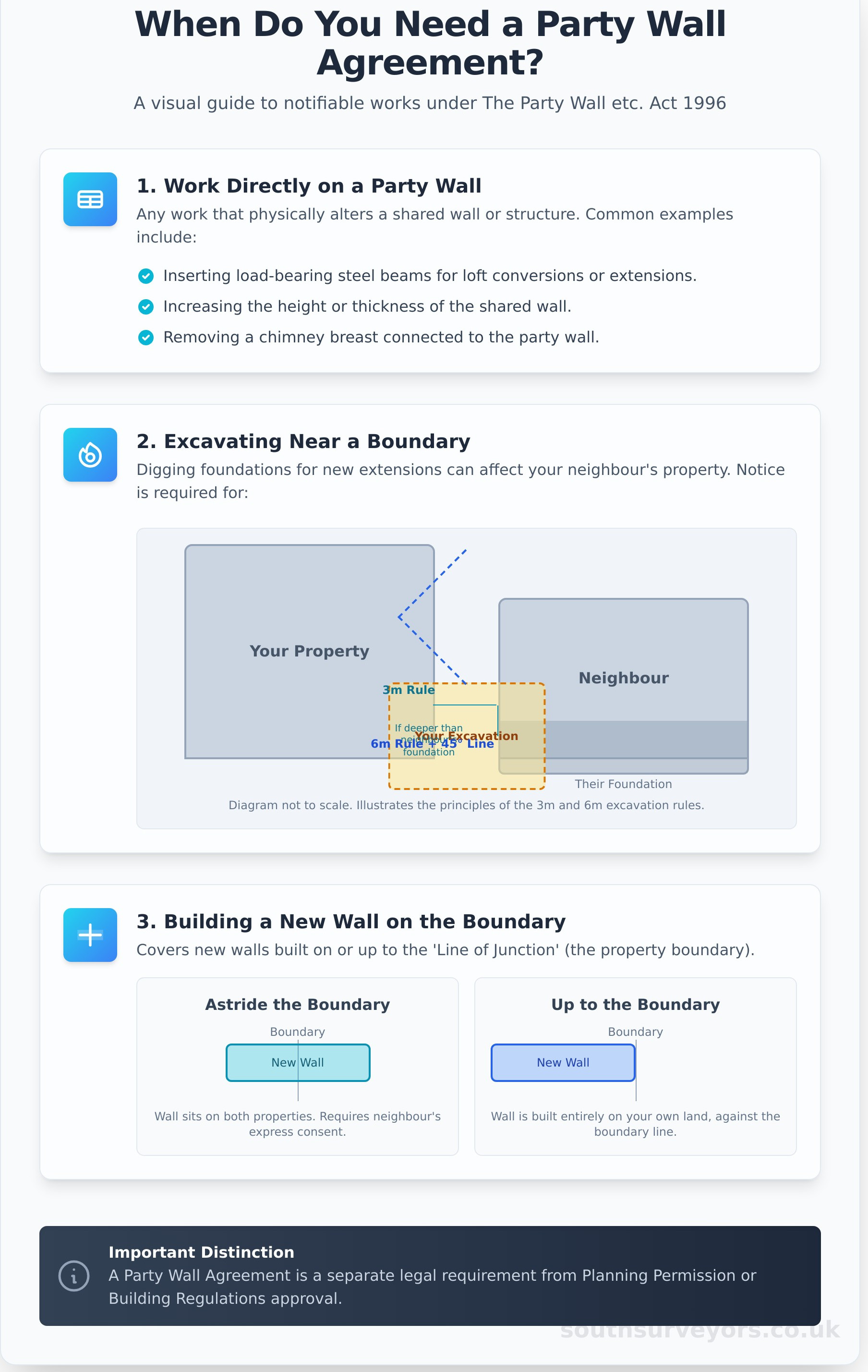
This is the most common trigger for the Act. It covers any work that will physically alter, repair, or rebuild a shared party wall or structure. You must serve a notice if your plans include:
- Cutting into the wall to insert load-bearing steel beams (a common requirement for loft conversions and open-plan layouts).
- Increasing the height or thickness of the party wall.
- Removing a chimney breast that is attached to the party wall.
- Underpinning the entire length of the wall to improve its foundations.
Category 2: Excavating Near an Adjoining Property
If your project involves digging foundations near a neighbour’s property, the Act will likely apply. This is to protect their building from potential subsidence or structural damage caused by your excavation work. Notice is required if you are:
- The 3-Metre Rule: Excavating within 3 metres of your neighbour’s building to a depth that is lower than the bottom of their existing foundations.
- The 6-Metre Rule: Excavating within 6 metres of your neighbour’s building if any part of the excavation intersects a 45-degree line drawn downwards from the bottom of their foundations.
A common project in this category is digging foundations for a new rear or side extension.
Category 3: Building a New Wall on the Boundary Line
The Act also covers the construction of new walls at or near the line of junction between two properties, even if no party wall currently exists. You will need to serve notice if you plan on:
- Building a new wall astride the boundary line, meaning it sits partially on your land and partially on your neighbour’s land (this requires their express consent).
- Building a new wall entirely on your own land but right up to the boundary line.
This section frequently applies when building the flank wall of a new extension that runs along the property boundary.
The Process: From Serving Notice to Getting an Award
Navigating the Party Wall etc. Act 1996 involves a clear, methodical process designed to provide clarity and protection for all homeowners. This structured approach ensures your project can proceed with confidence, safeguarding the interests of both you and your neighbours. From the initial notification to the final legal document, each step is crucial for a smooth and dispute-free project.
Step 1: Serving a Party Wall Notice
The entire process begins by serving a formal, written notice to all affected adjoining owners. A casual conversation is not legally sufficient. Your notice must include essential details: the full names and addresses of all property owners, a comprehensive description of the proposed works (often including drawings), and your planned start date. The notice periods are strict: you must provide at least two months’ notice for works affecting a party structure and one month’s notice for adjacent excavations. These legal requirements are set out in the full text of the Party Wall etc. Act 1996 and must be followed precisely.
Step 2: The Adjoining Owner’s Response
Once your neighbour receives the notice, they have 14 days to respond. Their decision will determine the next steps for your project. There are three potential outcomes:
- Consent in Writing: This is the most straightforward path. If your neighbour agrees in writing, you can proceed with the works as planned, without the need for surveyors.
- Dissent: Your neighbour can formally dissent. This does not stop your project, but it does trigger the dispute resolution process outlined in the Act.
- No Response: If 14 days pass without any response, it is automatically considered a dissent, and the process moves to the next stage.
Step 3: Appointing a Surveyor and the Party Wall Award
If a dissent occurs, surveyors must be appointed to resolve the matter. You and your neighbour can appoint a single ‘Agreed Surveyor’ to act impartially for both parties, which is often the most efficient option. Alternatively, each owner can appoint their own surveyor. These RICS-Certified professionals will then produce a legally binding document called a Party Wall Award. It is important to distinguish this from a simple “party wall agreement,” as the Award is a legal document that sets out the terms under which the work can proceed, including a Schedule of Condition to protect both properties from damage claims.
The Role of the Party Wall Surveyor Explained
When a dispute arises and a surveyor is appointed, a common misconception is that they work for the person who appointed or is paying them. In reality, a party wall surveyor has a unique and impartial role. Their primary legal duty is not to either neighbour, but to the Party Wall etc. Act 1996 itself. This statutory obligation ensures their focus remains on resolving the dispute fairly and enabling the proposed works to proceed lawfully, providing peace of mind for everyone involved.
What Does a Surveyor Actually Do?
An appointed surveyor acts as an independent expert to ensure all work complies with the Act and is carried out in a way that minimises risk to the adjoining property. Their involvement is a cornerstone of a robust party wall agreement, providing clarity and confidence from start to finish. Key responsibilities include:
- Reviewing Plans: Meticulously assessing architectural and structural engineering drawings to ensure they are compliant with the provisions of the Act.
- Preparing the Party Wall Award: Drafting and serving the legally binding Party Wall Award, which outlines the approved works, safeguards, and conditions.
- Resolving Disputes: Acting as a mediator to resolve any disagreements that may arise between neighbours before, during, or after the construction work.
The Schedule of Condition Survey
Before any notifiable work begins, the surveyor will conduct a Schedule of Condition survey. This is a comprehensive and detailed record, including written notes and high-resolution photographs, of the adjoining owner’s property. This document is not a structural survey; its sole purpose is to capture the exact condition of the property at a specific point in time. It is a vital safeguard that protects both parties:
- It protects the Building Owner from false or exaggerated claims of damage caused by their works.
- It protects the Adjoining Owner by providing a clear, impartial baseline against which any genuine damage can be assessed.
Choosing a Qualified Surveyor
The success of the process often depends on the surveyor’s competence and impartiality. It is essential to choose an experienced professional who specialises in party wall matters. Look for qualifications such as membership with the Royal Institution of Chartered Surveyors (RICS), as this demonstrates a commitment to the highest industry standards. Making the right choice ensures your project is handled professionally and efficiently. Find out how to choose a Party Wall Surveyor here.
Costs: Who Pays for the Party Wall Agreement?
A common and important question is about the financial responsibility for the party wall process. The Party Wall etc. Act 1996 is clear on this matter: in almost all circumstances, the Building Owner-the individual or entity carrying out the construction work-is responsible for all reasonable costs associated with obtaining the agreement. This principle ensures the Adjoining Owner is not left out of pocket for a project they did not initiate.
Why the Building Owner Pays
The logic behind this rule is straightforward: the person benefiting from the proposed works should bear the associated costs. The need for a party wall agreement arises directly from the Building Owner’s plans, so they are responsible for the professional fees required to manage the process. This statutory protection ensures the Adjoining Owner is not financially penalised for safeguarding their property rights, providing them with the peace of mind to engage an independent surveyor at no cost to themselves.
Typical Surveyor Fees and What They Cover
The costs involved can vary depending on the complexity of the project and whether the neighbours agree to use a single “Agreed Surveyor” or appoint their own. If the Adjoining Owner appoints their own surveyor, the Building Owner is responsible for their reasonable fees in addition to their own surveyor’s costs. These professional fees are essential for ensuring the process is managed correctly by an impartial expert.
In London, you can typically expect the following fee structures:
- Hourly Rates: A surveyor’s time is often charged at an hourly rate, which generally ranges from £150 to £300 + VAT.
- Fixed Fees for a Party Wall Award: For a standard project, a fixed fee for a surveyor to prepare and serve an Award often falls between £1,000 and £2,000 + VAT per surveyor.
These fees cover the critical tasks required to protect both parties, including:
- Conducting a detailed Schedule of Condition survey to document the Adjoining Owner’s property before work begins.
- Reviewing architectural and structural drawings to assess potential risks.
- Preparing, serving, and agreeing on the terms of the final Party Wall Award.
For a clear quote on your project and to ensure you receive expert, impartial advice, contact our RICS-regulated team. We provide the clarity and confidence you need to proceed correctly.
Proceed with Confidence: Finalising Your Party Wall Agreement
Navigating the Party Wall etc. Act 1996 can seem daunting, but as this guide has shown, the process is manageable with the right approach. The key takeaways are clear: serving a notice is a legal requirement for qualifying works, and appointing an impartial surveyor is essential for protecting the interests of all parties involved. Ultimately, a correctly managed party wall agreement is not a barrier to your project; it’s a vital framework that provides clarity, prevents costly disputes, and helps maintain good neighbourly relations from start to finish.
If you’re planning a project and require guidance, don’t leave it to chance. With our deep local expertise across South London, our team of expert surveyors is here to provide the clarity and confidence you need to proceed. As a firm proudly regulated by RICS, we uphold the highest professional standards, ensuring your complete peace of mind throughout the entire process.
Need expert advice on a Party Wall matter? Contact our RICS-regulated surveyors today.
Let us help you move forward with your home improvement plans, fully protected and professionally supported.
Frequently Asked Questions
What happens if I don’t serve a Party Wall Notice?
Proceeding with notifiable works without serving a Party Wall Notice is a breach of statutory duty. Your neighbour could obtain a court injunction to stop your project, leading to significant delays and legal costs. Furthermore, without an agreement or award in place, you lose the protections of the Act, and it becomes much harder to defend against any claims of damage to your neighbour’s property, even if your works were not the cause.
Can my neighbour stop my building work with a Party Wall Agreement?
No, the purpose of the Party Wall etc. Act 1996 is not to prevent lawful works but to ensure they are carried out in a way that protects the adjoining owner’s property. A neighbour cannot use the Act to veto your project. Instead, the process results in a Party Wall Award that sets out the timing and manner of the works. This provides a professional framework for your project to proceed while safeguarding your neighbour’s interests.
How long does the Party Wall Agreement process take from start to finish?
The timeline can vary significantly. If your neighbour provides written consent promptly after you serve the notice, the process can be concluded very quickly. However, if a dispute arises and surveyors are appointed, it typically takes several weeks to a few months to agree on the terms of the Party Wall Award. We always advise clients to allow at least two months for the process before their planned start date to avoid any construction delays.
Does a Party Wall Award expire if I delay my project?
Yes, a Party Wall Award is not valid indefinitely. Under the Act, the building works covered by the Award must commence within 12 months of it being served. If your project is delayed beyond this one-year period, the Award will expire. You would then be required to restart the entire process from the beginning, including serving new notices, which would incur additional professional fees and time.
Do I need a Party Wall Agreement for internal works like removing a non-load bearing wall?
A party wall agreement is typically not required for minor internal works that do not affect the party wall itself. Removing a non-load bearing stud wall, for example, is not notifiable. The Act applies to specific structural works, such as cutting into the party wall to insert a beam, raising the wall, or excavating nearby foundations. For clarity on your specific plans, it is always best to seek professional advice from a RICS-Certified surveyor.
Is a ‘Schedule of Condition’ necessary if my neighbour consents?
While not a legal requirement when a neighbour consents, commissioning a Schedule of Condition is a highly prudent step that we always recommend. This comprehensive report provides a factual, photographic baseline of your neighbour’s property before work begins. It offers crucial protection and peace of mind for both parties, as it can be used to fairly assess any subsequent claims of damage and prevent disputes over pre-existing defects.