

Planning an extension, or has a notice from your neighbour just landed on your doormat? For many homeowners, navigating the legal requirements of the Party Wall Act can feel intimidating, sparking fears of complex procedures and potential disputes. The dense legal language often adds to the uncertainty, leaving you unsure of your rights and responsibilities when undertaking or living next to building works.
But it doesn’t have to be this way. This crucial legislation is a framework designed to protect all parties involved, and understanding it is the key to proceeding with complete peace of mind. In this essential guide, our RICS-Certified experts demystify the Party Wall etc. Act 1996 from start to finish. We provide the professional clarity you need to manage your project correctly, protect your property, and maintain a positive relationship with your neighbours. You will gain the confidence to serve or respond to a notice, ensuring a smooth and successful outcome for everyone.
What is the Party Wall etc. Act 1996?
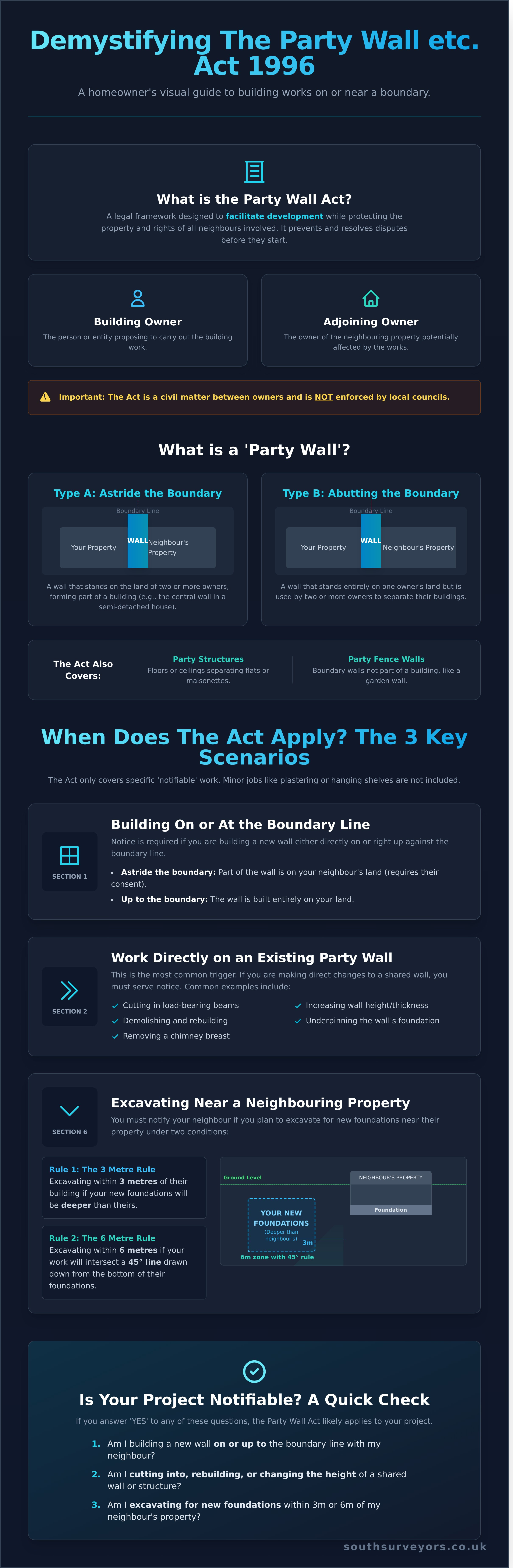
If you’re planning construction work on or near a boundary with a neighbouring property in London, understanding the Party Wall Act is essential. The Party Wall etc. Act 1996 is a crucial piece of legislation that provides a legal framework for preventing and resolving disputes between neighbours over such works. Crucially, its purpose is not to prohibit development but to facilitate it, ensuring projects can proceed while protecting the rights and property of all involved.
The Act defines two key roles: the ‘Building Owner’, who is the individual or entity proposing the work, and the ‘Adjoining Owner’, who is the owner of the neighbouring property. It is important to remember that this is a civil matter between owners. The Act is not enforced by local authorities or council planning departments; the responsibility for compliance rests entirely with the property owners themselves.
Defining a ‘Party Wall’ in Simple Terms
The term ‘party wall’ extends beyond just the obvious wall between two terraced houses. The Act covers several structures, which are typically categorised as follows:
- Type A: A wall that stands astride the boundary line of land belonging to two (or more) different owners. This is the most common type, such as the shared central wall in a semi-detached house.
- Type B: A wall that stands entirely on one owner’s land but is used by two (or more) owners to separate their buildings. An example would be if a neighbour has built an extension, and your own conservatory wall abuts it.
The Act also applies to ‘party structures’, such as the floors and ceilings between flats or maisonettes, and ‘party fence walls’, which are boundary walls that are not part of a building, like a garden wall.
The Spirit of the Act: Facilitating Development, Protecting Neighbours
At its core, the Party Wall Act strikes a careful balance. It grants the Building Owner the legal right to undertake specific types of work that might otherwise constitute trespass or nuisance, such as cutting into a party wall for structural beams. In return, it provides robust protections for the Adjoining Owner, including the right to receive formal notice, appoint a surveyor, and have a detailed Schedule of Condition prepared to document the state of their property before work commences.
By establishing this clear, structured process, the Act provides clarity and confidence for both parties. It helps prevent misunderstandings from escalating into costly and stressful legal disputes, ensuring your development project can move forward on good terms with your neighbours.
When Does the Party Wall Act Apply? The 3 Key Scenarios
Understanding whether your planned home renovation falls under the Party Wall etc. Act 1996 is the first crucial step to ensuring a smooth and legally compliant project. The Act doesn’t apply to minor jobs like re-plastering, drilling to hang shelves, or adding new electrical sockets. Instead, it covers specific types of construction work, known as ‘notifiable’ work, which could potentially affect your neighbour’s property. For a complete overview, the official government guidance on party walls provides a helpful summary. These works fall into three distinct categories.
Scenario 1: Building on or at the Boundary Line (Section 1)
This section applies when you are building a new structure on or very close to the boundary line between your property and your neighbour’s. This is common for London extensions and garden walls. The two main instances are:
- Building a new wall astride the boundary: This means the new wall is built directly on the boundary line, with part of it on your land and part on your neighbour’s. This requires their explicit consent.
- Building a new wall up to the boundary: This involves constructing a wall entirely on your own land, but right up against the boundary line.
Scenario 2: Work Directly on an Existing Party Wall (Section 2)
If your project involves making direct changes to an existing party wall or party structure, you must serve a notice. This is one of the most common triggers for the party wall act in practice. Common examples of this type of notifiable work include:
- Cutting into the wall to insert load-bearing beams, typically for a loft conversion or extension.
- Increasing the height or thickness of the party wall.
- Demolishing and rebuilding the party wall.
- Underpinning the entire thickness of the party wall to improve its foundation.
- Removing a chimney breast that is attached to the party wall.
Scenario 3: Excavating Near a Neighbouring Property (Section 6)
Any excavation work close to a neighbour’s property can be a source of concern, and the Act provides a framework to manage this risk. Notice is required if you plan to:
- Excavate within 3 metres of your neighbour’s building or structure, and your new foundations will be deeper than theirs.
- Excavate within 6 metres of your neighbour’s building or structure, if any part of your excavation will intersect a 45-degree line drawn downwards from the bottom of their foundations.
This applies to foundations for extensions, new basements, and even deep drainage trenches.
Is Your Project Notifiable? A Quick Check
Ask yourself these questions. If you answer ‘yes’ to any, your work is likely notifiable:
- Am I building a new wall on or up to the boundary line with my neighbour?
- Am I cutting into, rebuilding, or changing the height of a shared wall?
- Am I excavating for new foundations within 3 metres of my neighbour’s property?
The Party Wall Notice: How to Inform Your Neighbour Correctly
Before any work covered by the Party Wall etc. Act 1996 can begin, you are legally required to serve a formal, written notice to all affected neighbours. This is not just a courtesy; it is a crucial step that provides clarity and confidence, protecting both parties by setting out a clear framework for the project. We always recommend having a friendly, informal conversation with your neighbour before the formal notice arrives-this simple step can foster goodwill and make the entire process smoother.
Failing to serve a valid notice can lead to serious project delays and potential legal complications, including a court injunction to stop your work. The notice periods are strict: you must provide two months’ notice for works to a party structure or for excavations, and one month’s notice for building a new wall on the line of junction.
What Information Must a Valid Notice Include?
To be legally valid, your notice must be comprehensive and clear. Ambiguity can lead to disputes, so precision is key. For detailed official guidance, the government provides a helpful explanatory booklet on the Party Wall Act, which is an invaluable resource. At a minimum, your notice must contain:
- The full names and addresses of all property owners involved (as listed on the Land Registry).
- A clear and straightforward description of the proposed works.
- The date on which you propose to start the work.
- It is also best practice to include professional drawings and plans to give your neighbour complete clarity.
The Different Types of Party Wall Notices
The type of notice you serve depends entirely on the nature of your planned work. Each corresponds to a specific section of the party wall act and addresses different scenarios:
- Line of Junction Notice (Section 1): Served when you plan to build a new wall either on or up to the boundary line with your neighbour’s property.
- Party Structure Notice (Section 2): Required for any work that directly affects a shared party wall, such as cutting into it, increasing its height, or demolishing and rebuilding it.
- Notice of Adjacent Excavation (Section 6): This notice is necessary when you plan to excavate within 3 or 6 metres of your neighbour’s building, depending on the depth of the new foundations.
How to Serve a Notice
The Act specifies how a notice must be delivered to be considered legally served. You can deliver it in person, send it by post, or, if the property is empty, fix it to a conspicuous part of the building. We strongly advise obtaining proof of delivery, such as a certificate of postage or a signed acknowledgement from your neighbour. Relying on informal methods like email or text messages is risky, as they are not valid unless your neighbour has explicitly agreed in writing to accept notice that way.
Responding to a Notice: A Guide for the Adjoining Owner
Receiving a Party Wall Notice can feel daunting, but it is a standard part of the process designed to protect your property. Once you receive a notice, you have a statutory period of 14 days to respond. It is crucial to reply within this timeframe, as a failure to do so will automatically put you ‘in dispute’ with your neighbour, and a surveyor will have to be appointed.
Understanding your options is the first step toward making an informed decision. Importantly, remember that dissenting (disagreeing) with a notice does not block your neighbour’s project. Instead, it formally engages the protections of the party wall act to ensure the work is carried out correctly and your property is safeguarded.
You have three potential responses:
Option 1: Consent in Writing
Consenting in writing means you agree to the works proceeding as described in the notice. While this is the simplest route, it means you forfeit the future protections offered by the Act. This option is generally only advisable for very minor works, such as re-plastering, or in situations where you have absolute trust in your neighbour and their contractors.
Option 2: Dissent and Appoint an ‘Agreed Surveyor’
This is the most common and collaborative response. By dissenting, you trigger the Act’s protective mechanisms. You and your neighbour can then jointly appoint a single, impartial ‘Agreed Surveyor’ to act for both of you. This RICS-certified professional will produce a Party Wall Award to govern the works, providing you with peace of mind in a cost-effective and efficient manner.
Option 3: Dissent and Appoint Your Own Surveyor
You are fully entitled to appoint your own independent surveyor to represent your interests. Your neighbour (the Building Owner) will also appoint their own. The two surveyors will then work together to agree on the terms of the Party Wall Award. They will also select a ‘Third Surveyor’ to act as an impartial adjudicator should any disputes arise. The Building Owner is typically responsible for all reasonable surveyor fees.
Choosing to dissent and appoint a surveyor ensures a professional Schedule of Condition is prepared for your property before work begins, providing a clear and reliable record. For expert, RICS-certified advice on how to respond to a notice, contact our team for clarity and confidence.
The Party Wall Award: Your Project’s Legal Framework
When an Adjoining Owner dissents to a Party Wall Notice, the process moves towards a formal resolution. This culminates in a Party Wall Award (sometimes called a Party Wall Agreement), a comprehensive legal document drafted and served by the appointed surveyor or surveyors. Its core purpose is to authorise your proposed works under the party wall act while safeguarding the interests of all parties involved. This legally binding document resolves the “dispute,” providing a clear and impartial framework for the project to proceed with confidence.
The involvement of an impartial RICS Chartered Surveyor is non-negotiable in this process. Their expertise ensures the Award is fair, technically sound, and compliant with all statutory duties, providing clarity and professional oversight from start to finish.
What’s Included in a Party Wall Award?
A professionally drafted Party Wall Award is a detailed document that leaves no room for ambiguity. While each is tailored to the specific project, it will typically include:
- Full details of the works being undertaken.
- Stipulations on working hours and methods to minimise disruption.
- Specific protections required for the adjoining property, such as waterproofing or temporary supports.
- Arrangements for surveyors to access the property to carry out inspections.
- A clear breakdown of the surveyor’s fees and confirmation of who is responsible for payment (usually the Building Owner).
The Importance of the ‘Schedule of Condition’
Attached to almost every Party Wall Award is a crucial document: the Schedule of Condition. This is a detailed, factual report, complete with photographs, documenting the precise state of the Adjoining Owner’s property before any work commences. Its role is simple but vital: it acts as a definitive baseline record. This protects the Building Owner from false or exaggerated claims of damage and gives the Adjoining Owner complete peace of mind that any new issues will be accurately identified.
Enforcing the Award and Final Inspections
The Award’s authority extends throughout the construction phase. Should the Adjoining Owner report any damage they believe has been caused by the works, the surveyor will conduct a final inspection. By comparing the property’s current state to the original Schedule of Condition, they can professionally determine the cause and extent of the damage. The Award provides the mechanism for making good any damage or arranging for fair compensation, ensuring a clear and equitable resolution for all.
Need expert advice on a Party Wall matter? Contact our RICS surveyors.
Navigating the Party Wall Act with Confidence
Understanding your obligations under the party wall act is the first step towards a smooth and dispute-free construction project. By serving the correct notice in a timely manner and understanding the role of the Party Wall Award, you create a clear legal framework that protects all parties involved. This preparation is essential for maintaining a positive relationship with your neighbours and ensuring your project proceeds without costly delays or legal complications.
While the process can seem daunting, you don’t have to manage it alone. At South Surveyors, our RICS-regulated team specialises in all aspects of party wall matters across South London. We are committed to providing the clear, professional advice needed to give you complete clarity and confidence, whether you are building or responding to a notice. Whether you’re planning an extension to your family home or considering first time buyer stamp duty implications for your South London property purchase, understanding the legal framework is crucial for protecting your investment.
If you need to appoint a Party Wall Surveyor, contact our RICS-regulated experts for impartial advice. Let us help you proceed with your project correctly and with total peace of mind.
Frequently Asked Questions About the Party Wall Act
Do I need a party wall agreement for a loft conversion or extension?
Yes, in almost all cases. Loft conversions often require inserting steel beams into the party wall for support, while extensions typically involve excavating new foundations close to the boundary. Both are notifiable works under the Party Wall etc. Act 1996. Serving a formal notice is a legal requirement that protects both you and your adjoining owner, providing a clear framework for the project and ensuring peace of mind for all parties involved.
What happens if I start work without serving a Party Wall Notice?
Proceeding without serving a required notice is a significant risk. Your neighbour could obtain a court injunction to halt your project, leading to costly delays and legal fees. Furthermore, should any damage occur to their property, the burden of proof will be on you to show it was not caused by your works, which can be very difficult. Following the correct procedure provides a clear, documented process for resolving disputes and protects you from unsubstantiated claims.
Can my neighbour refuse to give access for works covered by the Act?
If the works are covered by the Party Wall Act and a Party Wall Award is in place, your neighbour cannot unreasonably refuse access to their land or property. The Act provides a legal right of access for you to undertake the specified works. The Award will set out the conditions of this access, such as working hours and notice periods, to ensure any disruption is kept to a minimum while allowing your essential project works to proceed.
How much does a Party Wall Surveyor cost, and who pays for it?
Typically, the building owner who is carrying out the work is responsible for all reasonable costs. This includes the fees for their own surveyor and, if the adjoining owner appoints one, the fees for their surveyor as well. In London, a straightforward Party Wall Award can cost between £900 and £1,500 plus VAT per surveyor. The final cost will depend on the project’s complexity and the time required to reach a fair and impartial agreement.
How do I find a qualified and impartial Party Wall Surveyor?
To ensure you receive expert and reliable advice, you should appoint a surveyor who is a member of a professional body like the Royal Institution of Chartered Surveyors (RICS). An impartial surveyor is duty-bound to administer the party wall act fairly, not simply act for the person who appointed them. We recommend checking qualifications, seeking local recommendations, and ensuring they have specific experience in this specialist area to give you complete clarity and confidence.
Does the Party Wall Act apply to garden fences or sheds?
Generally, the Act does not apply to simple timber garden fences, as they are not considered “structures” under the legislation. However, it does apply if you plan to build a new wall on the boundary (a party fence wall). Sheds and other outbuildings are also typically excluded unless their construction involves excavating for foundations within three metres of a neighbouring structure, which would then make the work notifiable under the Act.
What if I disagree with the final Party Wall Award?
A Party Wall Award is a legally binding document once it has been served. If you or your neighbour disagree with its terms, there is a strict 14-day window from the date of service to file an appeal in the County Court. An appeal can be a complex and costly process. It is always best to raise any concerns with the appointed surveyors during the drafting stage, as a professional RICS-certified surveyor will work to produce a fair award that addresses all valid points.