

Planning a property purchase in London is an exciting prospect, but it’s often accompanied by financial uncertainty. Are you concerned about how much to set aside for essential due diligence, or worried about what hidden defects a standard valuation might miss? Accurately forecasting the building survey cost London 2026 is a crucial step for any serious buyer, yet many are left confused by opaque pricing and the capital’s premium fees.
This complete budgeting guide is here to provide the clarity and confidence you need to move forward. We’ve done the research to deliver a data-driven forecast for detailed, Level 3 Building Survey costs, empowering you to plan with precision. We’ll demystify the factors that shape your final quote, explain why a comprehensive survey is a non-negotiable investment for London property, and guide you in selecting a thorough, highly qualified professional. Arm yourself with the right information to protect your future home and invest with complete peace of mind.
Key Takeaways
- Understand our data-driven forecast for the average building survey cost London 2026, allowing you to budget with confidence for your property purchase.
- Discover the specific factors-from property age and size to its condition-that directly influence the price of your final survey quote.
- Learn how to perform a cost-benefit analysis between a Level 2 and a Level 3 survey to ensure you get the right level of protection for your investment.
- Gain actionable advice on how to choose a RICS-certified surveyor based on value and expertise, providing clarity and peace of mind.
What is the Average Building Survey Cost in London for 2026?
Understanding the potential costs of a property survey is a crucial step in your home-buying journey. For those purchasing in the capital, the building survey cost London 2026 is notably higher than the UK average, reflecting the unique challenges and value of the city’s property market. An investment in a comprehensive RICS Level 3 Building Survey provides the clarity and confidence needed to make a sound financial decision, uncovering potential issues that could lead to significant unforeseen repair costs down the line.
To better understand why this professional assessment is so valuable, this short video from Move iQ explains what you need to know.
Estimated London Building Survey Costs (2026)
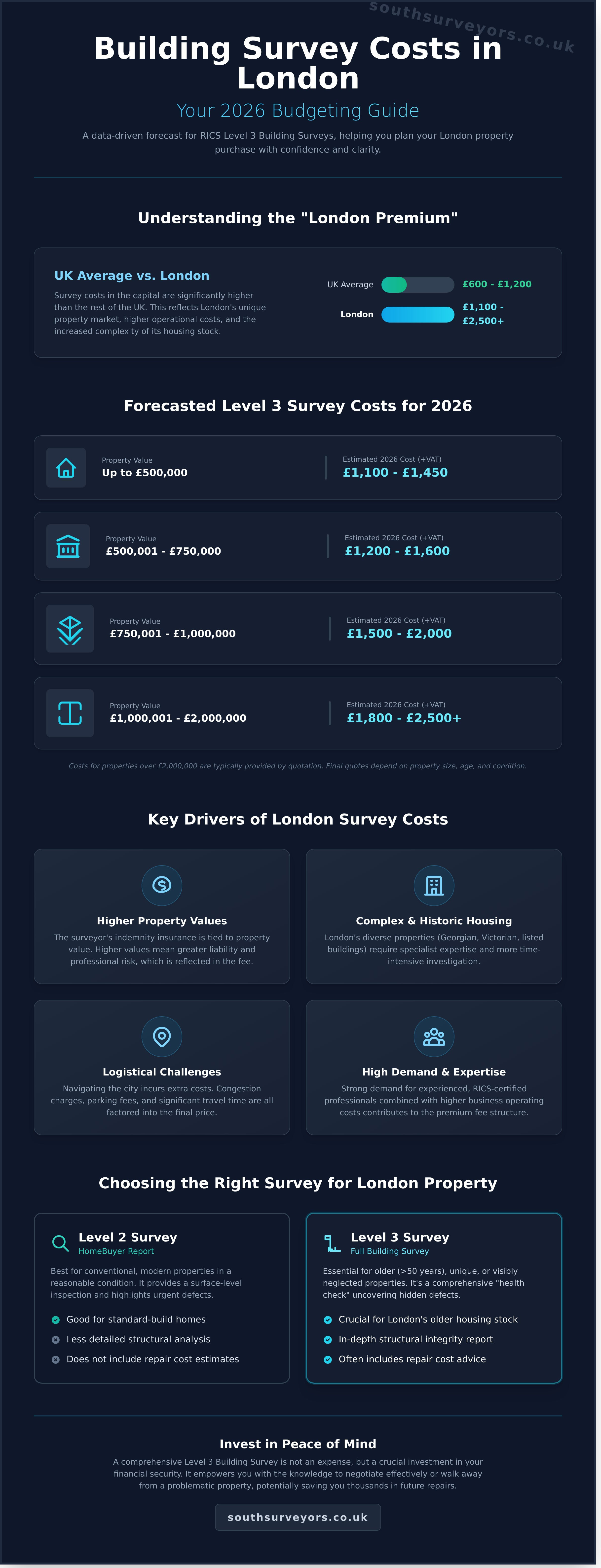
To provide a clear estimate, we have compiled a table outlining the expected costs for a RICS Level 3 Building Survey in London for 2026, based on property value. While a survey in other parts of the UK might cost between £600 and £1,200, London’s market commands a premium.
| Property Value (London) | Estimated Level 3 Survey Cost (+VAT) |
|---|---|
| Up to £500,000 | £1,100 – £1,450 |
| £500,001 – £750,000 | £1,200 – £1,600 |
| £750,001 – £1,000,000 | £1,500 – £2,000 |
| £1,000,001 – £2,000,000 | £1,800 – £2,500+ |
| Over £2,000,000 | By quotation |
Please note: These figures are forward-looking estimates for the building survey cost London 2026 and account for projected market adjustments. The final quote from a professional RICS-certified surveyor will depend on the specific size, age, and condition of the property.
Why is Surveying in London More Expensive?
Several factors contribute to the higher cost of building surveys in the capital. Understanding these provides insight into the value delivered by an expert London-based surveyor.
- Higher Property Values: The surveyor’s professional indemnity insurance is directly linked to the property’s value. Higher values mean greater liability and risk, which is reflected in the survey fee.
- Complex Housing Stock: London is home to a vast range of properties, from historic Georgian and Victorian terraces to listed buildings, each with unique structural characteristics that require specialist expertise and a more thorough investigation.
- Logistical Challenges: Navigating the city involves significant time and expense. Costs such as the Congestion Charge, parking fees, and extended travel times are factored into the overall price.
- This logistical complexity extends beyond professional services; many residents find it easier to explore Cruise Terminal Transfers for major journeys, such as travelling from the capital to the coast.
- Operational Costs & Demand: The general cost of operating a business in London is higher, and there is strong demand for highly experienced, RICS-certified professionals capable of navigating this complex market.
Ultimately, a comprehensive survey is an investment in your peace of mind. A RICS-certified surveyor provides a detailed, tailored report that clearly explains what building surveying entails in practice, empowering you to proceed with your purchase with real confidence.
Key Factors That Determine Your London Survey Quote
No two London properties are identical, and neither are their survey quotes. At South Surveyors, every quote we provide is tailored to the unique characteristics of the property you intend to purchase. Understanding the variables our RICS-Certified surveyors consider will provide you with clarity and confidence, helping you to accurately budget for your building survey cost London 2026. This section breaks down the key drivers behind your bespoke quote, empowering you to make a fully informed decision.
Property Purchase Price or Value
This is often the single most significant factor influencing the cost of a survey. The fee is directly linked to the level of risk and responsibility the surveyor undertakes, which is covered by their professional indemnity insurance. A higher-value property, such as a multi-million-pound home in Kensington, represents a greater liability than a starter flat in Croydon. Consequently, the survey fee will be higher to reflect this increased professional risk.
Age and Type of Property
The character and history of a building heavily influence the survey’s complexity. A modern new-build apartment in Canary Wharf requires a different level of scrutiny compared to a Victorian terraced house in Clapham, which may have hidden defects from over a century of use. Properties with special status, like Grade II listed buildings in Notting Hill or homes within a Greenwich conservation area, demand specialist knowledge and a more detailed inspection. Similarly, unique London properties such as Maida Vale mansion blocks or converted Shad Thames warehouses require a surveyor with specific experience. A more complex property like this often requires a thorough inspection, and understanding the different types of house surveys available is crucial to ensure you get the right level of detail.
Size and Complexity
Simply put, a larger and more complex property takes more time to inspect thoroughly. A five-bedroom townhouse in Richmond with a basement and a loft conversion will require a significantly longer on-site inspection than a one-bedroom flat in a Shoreditch block. Our surveyors assess complexity based on several elements:
- The total floor area, number of rooms, and storeys.
- The presence of extensions, basements, or loft conversions.
- Unusual construction methods or non-standard materials.
- The overall condition and extent of any visible disrepair.
These factors determine the time needed for a comprehensive assessment, which in turn influences the final building survey cost London 2026.
Level 2 vs. Level 3 Survey in London: A Cost-Benefit Analysis
For many London property buyers, choosing between a RICS Level 2 HomeBuyer Report and a Level 3 Building Survey is a common dilemma. The decision should not be driven by the upfront fee alone, but by a careful assessment of the property’s age, condition, and your personal appetite for risk. Viewing the survey as an investment in clarity and confidence, rather than just a cost, is the key to making the right choice.
When a Level 2 Survey Might Suffice
A Level 2 survey is best suited for modern, conventionally built properties that appear to be in good condition. Think of a 15-year-old purpose-built flat in Canary Wharf or a standard ex-local authority house from the 1980s. This report provides a ‘snapshot’ of the property’s condition, highlighting significant issues but without the deep diagnostic detail of a Level 3. While its lower cost is appealing, it’s crucial to understand you are receiving a less comprehensive inspection.
Why a Level 3 Building Survey is Essential for Most London Homes
Given London’s vast and varied housing stock, a Level 3 Building Survey is the most prudent choice for the majority of properties. It is absolutely essential for:
- Older buildings, such as a Victorian terrace in Clapham or a Georgian townhouse in Islington (typically anything built before 1950).
- Properties that are visibly in poor condition or have been significantly altered.
- Unconventional constructions or listed buildings.
This thorough report provides a detailed analysis of the property’s structure and fabric, offers advice on defects, outlines necessary repairs, and estimates timings and costs. The higher building survey cost London 2026 for this service directly reflects the significantly more detailed investigation and the peace of mind it delivers.
Calculating the ROI: How a Survey Saves You Money
Investing in a comprehensive survey provides powerful financial leverage. A £1,500 Level 3 survey that uncovers a hidden £25,000 roof issue or serious structural movement doesn’t just inform you of problems-it equips you to renegotiate the purchase price. The seller may agree to a reduction or to fix the issue before completion. In this scenario, the survey fee has paid for itself many times over, protecting you from immense future expense and stress. It transforms the building survey cost London 2026 from an expense into a strategic investment.
Unsure which survey you need? Talk to our experts.
How to Budget for Your 2026 Survey and Choose the Right Surveyor
Understanding the potential costs of a survey is the first step, but securing the best value for your investment is the ultimate goal. The right surveyor provides more than just a report; they deliver the clarity and confidence needed to proceed with one of life’s biggest purchases. Shifting your focus from the cheapest price to the most comprehensive service is crucial for protecting your investment.
This process is not just a financial transaction but an emotional one, and managing the associated stress is key. For Londoners navigating this high-stakes environment, professional support can be a valuable resource. For instance, practices such as Jonathan Cullen Therapy offer services to help individuals cope with the anxiety that can accompany significant life events like buying a home.
Planning Your Budget for 2026
As you look ahead, proactively budgeting for your survey will ensure there are no surprises. While our guide provides a strong forecast, a smart approach to financial planning is essential. To accurately estimate your total building survey cost London 2026, we recommend the following steps:
- Use our estimates as a baseline: Start with the figures detailed in this guide for the type of survey you need.
- Factor in a buffer: Add a contingency of 10-15% to your budget to account for potential market-driven price increases by 2026.
- Remember VAT: Always confirm if a quote is inclusive or exclusive of VAT, which is typically charged at 20% on top of the surveyor’s fee.
What to Look for in a London Surveyor
A thorough and reliable survey depends entirely on the expertise of the professional conducting it. When choosing a surveyor in London’s competitive market, insist on a partner who meets these essential criteria for your peace of mind:
- RICS Regulation: This is non-negotiable. Your surveyor must be a registered member of the Royal Institution of Chartered Surveyors (RICS), ensuring they adhere to the highest industry standards.
- Deep Local Knowledge: London is a city of distinct boroughs. A surveyor with extensive experience in the specific area you’re buying in will understand local property archetypes, common issues, and valuation nuances.
- Positive Client Reviews: Look for consistent, positive testimonials that praise the surveyor’s thoroughness, professionalism, and clear communication.
- Post-Survey Support: A great surveyor will be happy to walk you through their findings over the phone, patiently answering your questions to ensure you fully understand the report.
Getting and Comparing Quotes
To make a truly informed decision, it’s vital to gather and compare several options. However, a direct price comparison can be misleading. The cheapest quote is rarely the best value. Instead, focus on comparing the scope and quality of the service offered. Always ask for a sample report to see the level of detail and clarity you can expect. When you are ready to find a reliable expert, a RICS-certified firm like South Surveyors can provide a comprehensive quote tailored to your specific property needs.
Your Next Step: Budgeting for Your London Survey with Confidence
As we’ve explored, budgeting for your property survey in London requires a clear understanding of the key factors at play, from the property’s size and age to choosing between a Level 2 and a more comprehensive Level 3 report. A proactive approach is your best tool for managing the total building survey cost London 2026 and avoiding any unforeseen expenses down the line. An expert survey isn’t just a cost-it’s a crucial investment in your financial security and peace of mind.
At South Surveyors, we provide the clarity and confidence you need to proceed. As a firm regulated by RICS, we combine specialist knowledge of the South London property market with a commitment to excellence, backed by hundreds of 5-star reviews from satisfied clients. We are dedicated to helping you make a fully informed decision about your property purchase.
Ready to secure your investment? Get a free, no-obligation quote for your London property survey. Take the definitive step towards your new home, expertly advised and completely confident in your purchase.
Frequently Asked Questions
Is VAT included in building survey cost estimates?
Most initial quotes provided by surveyors will be exclusive of VAT. It is standard practice to add VAT at the current rate of 20% to the final fee. To ensure complete clarity and avoid unexpected costs, we always recommend you confirm with your chosen RICS-Certified professional whether their quote includes or excludes VAT. A transparent surveyor will provide a clear breakdown of all costs, giving you the confidence to budget accurately for your property purchase in London.
How long does a RICS Level 3 Building Survey take in London?
The time required for a comprehensive RICS Level 3 survey on-site can vary significantly depending on the property’s size, age, and complexity. For a typical London flat, it might take 3-4 hours, whereas a larger or older house could require 5-8 hours or more. Our expert surveyors are meticulous and take the necessary time to conduct a thorough inspection, ensuring no significant issue is overlooked. Following the inspection, the detailed report is typically compiled and delivered within 5-7 working days.
Can a building survey find every single problem with a property?
A RICS Building Survey is a visual, non-intrusive inspection, meaning the surveyor will not lift floorboards, move heavy furniture, or drill into walls. While it is the most thorough type of survey available, designed to identify all significant defects and potential issues visible at the time of inspection, it cannot uncover every concealed problem. Its purpose is to provide you with the expert knowledge and confidence to make an informed decision about the property’s overall condition.
Do I pay for the survey before or after it’s completed?
Standard industry practice requires payment for the survey to be made upfront, before the surveyor visits the property. This ensures the surveyor is compensated for their time and expertise, regardless of the property transaction’s outcome. Once payment is received, the inspection is booked and confirmed. Your RICS-certified surveyor will then carry out the inspection and issue the comprehensive report, providing you with the essential information you need to proceed with clarity and peace of mind.
Can I negotiate the fee with the surveyor?
While some surveying firms may have fixed pricing, it is sometimes possible to discuss the fee, particularly if you are commissioning multiple services. However, it’s important to prioritise expertise and thoroughness over cost alone. A cheaper survey may be less comprehensive, potentially costing you significantly more in the long run. Investing in a reliable, RICS-regulated surveyor ensures you receive a detailed, high-quality report that provides genuine value and protects your investment.
Is a mortgage valuation the same as a building survey?
No, they are fundamentally different. A mortgage valuation is a brief assessment conducted for your lender to confirm the property is worth the amount you wish to borrow. It is not a survey and will not detail the property’s condition. A RICS Building Survey, in contrast, is a comprehensive inspection conducted solely for your benefit as the buyer. It provides a detailed report on the building’s structure and condition, empowering you to make a fully informed purchasing decision.
Why do some surveyors charge much less than others?
When assessing the building survey cost London 2026 offers, a significant price difference often reflects the level of service, experience, and report quality. A lower fee may indicate a less experienced surveyor, a more basic ‘template’ report, inadequate insurance, or a lack of RICS regulation. Choosing a reputable, RICS-Certified professional guarantees adherence to the highest industry standards, providing you with a thorough, tailored report that delivers true peace of mind and could save you thousands in unforeseen repairs.