

You’ve found the perfect property, your mortgage application is progressing—perhaps with the help of a specialist broker like Doctors Mortgages for those in the medical field—and suddenly you’re faced with a list of required reports. It’s a common point of confusion for homebuyers: is the valuation organised by the lender enough, or are you missing a crucial step? This uncertainty often leads to the critical question at the heart of the mortgage valuation vs RICS survey debate: are you truly protected from hidden, expensive problems?
The answer lies in understanding who each report is for. A mortgage valuation is a brief assessment conducted for your lender to confirm the property is adequate security for their loan-it protects them, not you. A comprehensive RICS survey, however, is a thorough inspection carried out by an expert surveyor entirely for your benefit. It’s designed to give you a clear picture of the property’s condition and highlight issues that could cost you thousands of pounds in future repairs.
This essential guide will provide the clarity you need. We’ll break down what each report covers, helping you make an informed decision and proceed with the real confidence that comes from knowing you’re paying the right price and avoiding costly surprises.
Key Takeaways
- Understand that a mortgage valuation protects your lender’s investment, whereas a comprehensive RICS survey is designed exclusively to protect you from unforeseen issues and costs.
- Learn the critical distinctions in the mortgage valuation vs RICS survey comparison, from the level of inspection detail to the legal protection each report offers.
- Recognise why a lender’s valuation is not a substitute for your own independent survey, giving you the clarity needed to make a fully informed decision.
- Discover how a detailed RICS survey provides the expert evidence you need to potentially renegotiate the purchase price or confidently avoid a costly mistake.
What is a Mortgage Valuation? The Lender’s Essential Safeguard
When you apply for a mortgage, your lender will always insist on a mortgage valuation. This is a crucial first step in the property buying process, but it’s one that frequently causes confusion and creates a false sense of security for buyers. It is the first, and most fundamental, point of difference in the mortgage valuation vs RICS survey debate.
Put simply, a mortgage valuation is a brief risk assessment conducted for the lender, not for you. Even though you often pay the fee, its sole purpose is to reassure the bank that the property is adequate security for the loan they are providing. It is a mandatory part of the mortgage application and is not a substitute for a proper property survey.
To help clarify this fundamental difference, the following video provides a helpful overview:
The Primary Goal: Protecting the Lender
A lender’s primary concern is managing their financial risk. If you were to default on your mortgage payments, they need complete confidence that they can sell the property to recover the outstanding loan amount. The valuation confirms that the property’s market value supports the price you’re paying, protecting them from lending more than the asset is worth. It will flag obvious, major issues that could drastically affect value-such as severe structural movement-but it is not designed to find problems that will cost you, the buyer, money to fix.
What Does a Mortgage Valuer Actually Check?
A valuer’s inspection is typically very brief, often lasting just 15-20 minutes. They will note the property’s basic details (size, type, and location) and compare it against the sale prices of similar, recently sold properties in the area. In some cases, a lender might even opt for a ‘desktop’ valuation using online data, with no physical visit at all. While the report is often completed by one of the many qualified Chartered surveyors in the United Kingdom, their instruction from the lender is strictly limited to assessing value, not the property’s condition.
What the Valuation Report Tells You (and What It Doesn’t)
The report you receive from a mortgage valuation is often minimal, sometimes just a single figure confirming the property’s value. It is vital to understand what this report does not provide, as it offers no real clarity or peace of mind for you as the buyer. A valuation report will not:
- Detail minor or even moderate defects like a leaking gutter, faulty wiring, or hidden damp.
- Provide any professional advice on necessary repairs or future maintenance costs.
- Offer you any form of protection or recourse if problems are discovered after you move in.
This critical lack of detail is why relying solely on a mortgage valuation is a significant risk, and why understanding the difference between a mortgage valuation vs RICS survey is essential for making an informed and confident property purchase.
What is a RICS Survey? Your In-Depth Property Health Check
While a mortgage valuation serves the lender, a RICS Survey is a comprehensive property health check conducted exclusively for you, the buyer. Its purpose is to provide you with a detailed, expert understanding of the property’s condition before you are legally committed to the purchase. This is the crucial distinction in the mortgage valuation vs RICS survey debate: the survey is your personal, in-depth report, designed to give you clarity and confidence.
Conducted by a RICS-regulated Chartered Surveyor who works directly for you, this report highlights any defects, potential issues, and provides professional advice on repairs and maintenance. This empowers you to make a fully informed purchasing decision, a critical step recommended in the official Citizens Advice guide to buying a home.
The Primary Goal: Protecting You and Your Investment
Investing in a professional survey is one of the most important steps you can take to protect your financial future. It provides the impartial information you need to decide whether to proceed with the purchase, giving you real peace of mind. The key benefits include:
- Identifying hidden issues: A surveyor’s expert eye can spot problems you might miss, from subtle signs of damp to potential structural movement.
- Strengthening your negotiating position: If significant defects are found, the report provides powerful evidence to renegotiate the purchase price, potentially saving you thousands of pounds.
- Budgeting for the future: The survey helps you understand and plan for any necessary repairs or future maintenance costs, preventing nasty financial surprises down the line.
This principle of seeking expert, impartial advice extends beyond the physical survey to the legal intricacies of the purchase. While this guide focuses on the UK property market, the need for professional representation is universal. For instance, English-speaking buyers navigating the market in Israel rely on the legal expertise of firms like SALIOR Law Office to ensure a smooth and secure transaction.
What a RICS Chartered Surveyor Investigates
A RICS surveyor carries out a thorough, non-invasive visual inspection of the accessible parts of the property, a process which can take several hours depending on its size and complexity. Their investigation is comprehensive, covering the integrity of the building from top to bottom. This includes examining the condition of the roof, chimneys, walls, floors, windows, and doors. The surveyor will also look for major and common defects such as signs of damp, timber decay, and subsidence, and will assess the visible parts of the services like electrics and plumbing.
Understanding the Different RICS Survey Levels
RICS provides a clear framework to ensure you get the right level of detail. The two most common options are the RICS Home Survey Level 2 (previously known as a HomeBuyer Report), which is ideal for conventional properties in reasonable condition, and the RICS Building Survey Level 3, a more in-depth inspection suited to older, larger, or more complex properties that may have been significantly altered. The right choice depends entirely on the age, construction, and apparent condition of the home you intend to buy. Learn which survey is right for you.
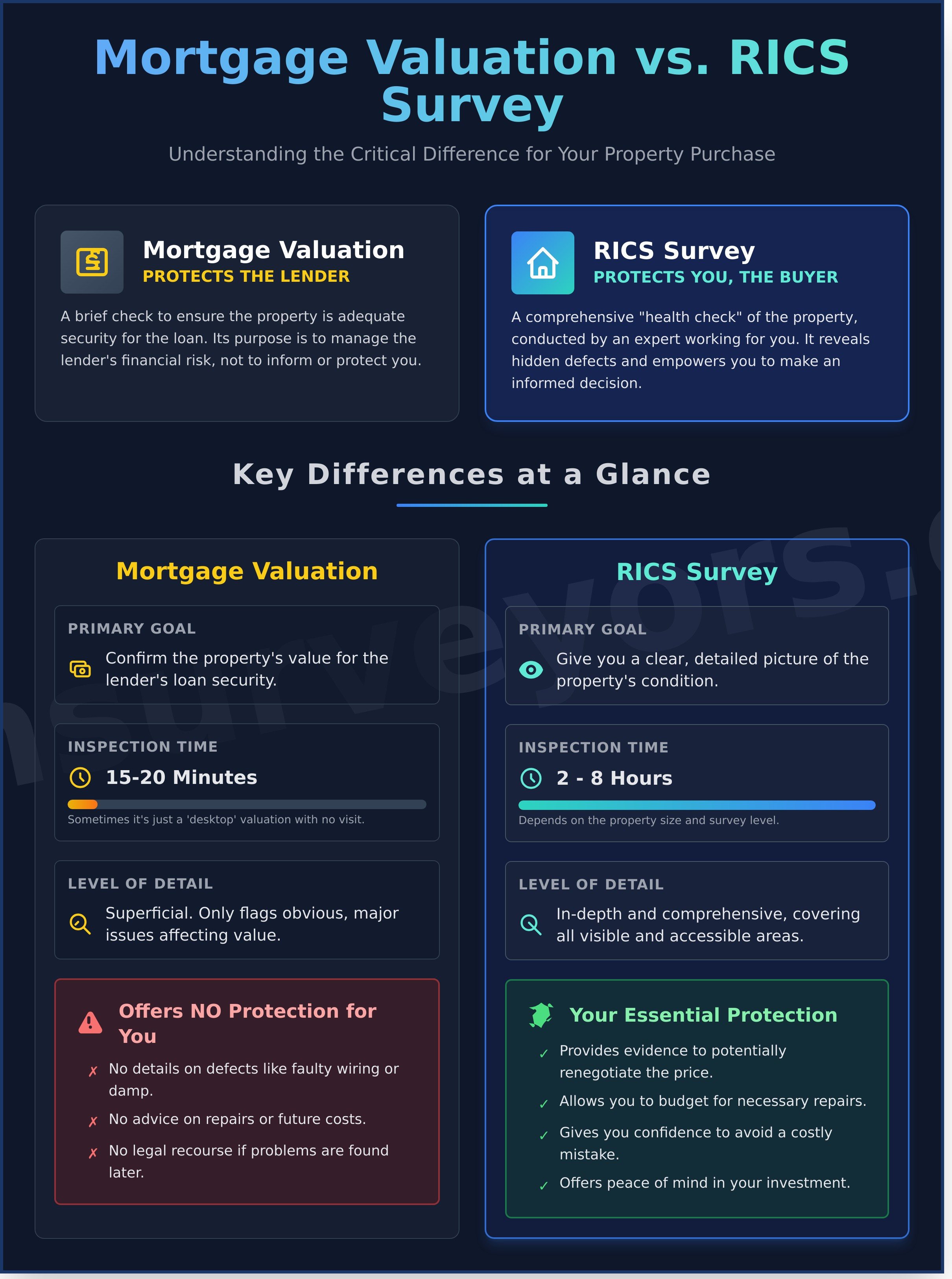
Key Differences at a Glance: Valuation vs. Survey
To make an informed decision, it’s crucial to understand that while both a valuation and a survey are part of the property buying process, they serve entirely different masters and have vastly different goals. One is a risk-assessment tool for the lender; the other is a vital due-diligence report for you, the buyer.
The core distinction in the mortgage valuation vs RICS survey debate is simple: a valuation is about the price, whereas a survey is about the condition.
Comparison Table: Mortgage Valuation vs. RICS Survey
| Feature | Mortgage Valuation | RICS Survey |
|---|---|---|
| Purpose | To confirm the property is adequate security for the lender’s loan. | To provide the buyer with a detailed, expert report on the property’s condition. |
| For Whom | Primarily for the mortgage lender. | Exclusively for you, the buyer. |
| Scope | A brief, non-invasive inspection (often 15-20 minutes) of obvious, major defects. | A thorough and comprehensive inspection of all accessible areas of the property. |
| Report Detail | A short, tick-box style report (2-4 pages) with a final valuation figure. | A detailed, multi-page document with photos, descriptions of defects, and repair advice. |
| Outcome | A ‘yes’ or ‘no’ on the mortgage loan amount. | An informed decision, negotiation power, and a plan for future maintenance. |
Purpose & Scope: A Mile Wide and an Inch Deep vs. Laser-Focused Detail
A mortgage valuation is broad but shallow. The surveyor’s only goal is to satisfy the lender that the property is worth what you plan to borrow. Think of it as a car’s basic MOT – it checks for major, obvious problems that affect its fundamental roadworthiness. In contrast, an RICS Home Survey is laser-focused and deep. It’s the equivalent of a full RAC mechanical inspection, designed to uncover hidden issues and give you a complete picture of the property’s health before you commit.
Outcome: A Single Number vs. an Actionable Blueprint
A valuation provides a single number-the property’s market value-but offers little context on why it’s worth that amount or what problems may lie beneath the surface. A comprehensive RICS survey, however, delivers an actionable blueprint for your potential new home. It details existing problems, flags future risks, and provides professional advice, empowering you to budget for repairs or even renegotiate the asking price with real confidence. To gain true clarity and peace of mind, a professional survey is your most powerful tool. Explore our tailored RICS survey services to make your next move a secure one.
Do I Need a RICS Survey if My Lender is Doing a Valuation?
The short answer is an emphatic yes. This is one of the most critical distinctions for a homebuyer to understand, and confusing the two can lead to significant financial risk. Relying solely on your lender’s report is one of the biggest gambles you can take when buying a property. The fundamental difference in the mortgage valuation vs RICS survey debate is who the report is for and what it is for.
The lender’s valuation protects the lender. A RICS Home Survey protects you. Viewing a survey not as a cost, but as an essential investment in your financial security and peace of mind, is the first step toward a confident purchase.
Why the Lender’s Valuation Isn’t Enough for a Buyer
A mortgage valuation is a brief, superficial check to confirm the property is worth the amount you want to borrow. The valuer is working for the lender and has no duty of care to you. Their primary concern is ensuring the bank can recover its loan if you default. They are not looking for issues that will affect your quality of life or cost you money, such as:
- A boiler that is near the end of its life.
- Faulty or outdated electrical wiring.
- Signs of non-urgent damp or timber defects.
- Poorly installed windows or minor roof issues.
Using Your Survey as a Powerful Negotiation Tool
An independent RICS survey provides you with impartial, expert evidence on the true condition of the property. This report is not just for your peace of mind; it’s a powerful negotiation tool. If your survey uncovers a serious issue, like a defective roof requiring a £10,000 repair, you have a credible basis to renegotiate the asking price. In this scenario, the survey fee has paid for itself many times over. It gives you the clarity and confidence to either secure a fairer price or walk away from a potentially disastrous purchase.
Real-World Example: The Cost of Skipping a Survey
Consider a buyer who, to save money, relies on their lender’s valuation and skips a survey. A few months after moving in, they notice a musty smell and crumbling plaster in the living room. A specialist contractor confirms extensive rising damp and rotten floor joists, presenting them with a devastating repair bill of £15,000. A comprehensive RICS Home Survey, which would have cost around £600, would have identified these defects before the purchase, saving them from immense stress and financial hardship. Don’t take the risk. Get a free quote for a RICS survey today.
Making the Right Choice: From Valuation to Comprehensive Survey
Navigating your property purchase requires understanding one critical distinction: a mortgage valuation protects your lender, while a RICS survey protects you. The lender’s valuation is a simple check to ensure the property is adequate security for the loan, but it won’t reveal the hidden defects or potential repair costs that could turn your dream home into a financial burden. Understanding the essential difference in the mortgage valuation vs RICS survey debate is the first step towards making a truly informed decision and safeguarding your most significant investment.
To proceed with genuine confidence, you need an impartial, expert assessment of the property’s true condition. As local South London experts proudly regulated by RICS, South Surveyors delivers comprehensive, easy-to-understand reports that empower you to negotiate effectively and budget for the future. We are committed to delivering the clarity you deserve. Get clarity and confidence in your property purchase. Request a free RICS survey quote today.
Invest in your peace of mind and take the next step towards securing your new home with certainty.
Frequently Asked Questions
What happens if the mortgage valuation is lower than my offer?
A lower valuation, or ‘down valuation’, means the lender will only offer a mortgage based on the surveyor’s figure, not your offer price. This creates a funding shortfall. Your primary options are to renegotiate the sale price with the seller, cover the difference yourself with a larger deposit, or, in some cases, challenge the valuation with compelling evidence. This situation highlights the importance of getting professional advice from various experts, including surveyors and experienced real estate agencies like Ray Lyon Realty, to proceed with clarity and confidence.
Can I use the same surveyor for both the mortgage valuation and my RICS survey?
While some lenders allow you to upgrade their basic valuation to a fuller survey with the same firm, we recommend instructing your own independent RICS-Certified surveyor. This ensures the report is created solely for your benefit, focusing on your interests rather than just the lender’s. It provides an impartial, expert assessment that gives you a true understanding of the difference between a mortgage valuation vs RICS survey and which is right for you.
How long does a RICS survey take and when do I get the report?
The on-site inspection for a RICS Home Survey Level 2 typically lasts between two and four hours, while a more detailed Level 3 survey can take longer. At South Surveyors, our commitment is to provide a thorough and timely service. You can expect to receive your comprehensive, easy-to-understand report within 3-5 working days of the inspection, giving you the detailed information needed to make an informed decision with peace of mind.
What are the most common problems found during a house survey?
Our expert RICS surveyors most frequently identify issues related to the roof, such as worn coverings or faulty flashing. Other common problems include signs of damp, timber defects like rot or woodworm, structural movement, and outdated electrical or heating systems. Identifying these potential unforeseen repair costs is a key benefit of a professional survey, empowering you to negotiate a better deal or budget effectively for future work.
Is a RICS Home Survey Level 2 enough for a London flat?
For most conventionally built flats in London that appear to be in a reasonable condition, a RICS Home Survey Level 2 is an excellent and suitable choice. It provides a thorough assessment of the property’s condition and identifies any urgent defects. However, for older, converted, or unusual properties, or if you have specific concerns, a more in-depth Level 3 Building Survey may provide greater clarity and peace of mind. Our team can provide tailored advice.
Does a ‘down valuation’ mean I shouldn’t buy the property?
Not at all. A down valuation is a professional opinion that the property is worth less than your offer in the current market; it is not a “do not buy” signal. Instead, view it as a powerful tool for negotiation. It provides a clear, evidence-based reason to ask the seller to reduce the price. A full RICS survey can further support this by detailing the specific defects that may have influenced the valuer’s professional opinion.