

The charm of a 1930s home, with its classic bay windows and generous proportions, is undeniable. Yet, beneath that character lies nearly a century of history, and with it, the potential for hidden and costly problems. This uncertainty often leads to one crucial question for prospective buyers: what type of survey for a 1930s house is the right choice? Is a standard Level 2 report sufficient to uncover potential issues, or does the age and construction style of the property demand a more thorough, expert investigation to give you true peace of mind?
In this comprehensive surveyor’s guide, we provide the clarity you need to make an informed decision. We will explain exactly why a RICS Level 3 Building Survey is the most reliable and essential choice for a property from this era. You will discover the specific defects we commonly uncover-from subtle signs of damp and structural movement to outdated wiring and the potential presence of asbestos. Our goal is to equip you with the detailed knowledge required to proceed with confidence, protect your significant investment, and ensure your dream home doesn’t hide any expensive surprises.
Key Takeaways
- A Level 3 Building Survey is the essential choice for a 1930s property, providing the most thorough inspection to uncover hidden defects.
- The key to answering ‘what type of survey for 1930s house’ is understanding that their age and construction style demand a deeper investigation.
- Discover the common defects our experienced South Surveyors specifically look for in interwar homes, from original wiring to potential structural weaknesses.
- Learn how a comprehensive survey report empowers you to negotiate the purchase price effectively and invest with clarity and confidence.
The Clear Answer: A RICS Level 3 Building Survey is Essential for a 1930s House
When asking what type of survey for a 1930s house is most appropriate, the answer from any RICS-Certified professional is unequivocal: a Level 3 Building Survey. Properties built nearly a century ago come with unique character, but also the potential for hidden defects and complex needs that have developed over decades. A thorough home inspection is therefore not just a recommendation, but a crucial step in protecting your investment and ensuring your peace of mind.
To help you visualise what a comprehensive survey entails, the following video provides an excellent overview of the process:
Unlike more modern, conventionally built homes, a 1930s property has been subject to different building regulations, materials, and years of potential alterations. Opting for a less detailed survey can be a false economy. The initial cost of a comprehensive Level 3 survey is a minor expense compared to the thousands of pounds you could save on unexpected structural repairs, damp issues, or roofing problems down the line.
What a RICS Level 3 Building Survey Investigates
This is the most in-depth, ‘structural’ survey available from the Royal Institution of Chartered Surveyors (RICS). It is designed to give you complete clarity and confidence before you commit to a purchase. Key benefits include:
- A thorough and detailed analysis of the property’s construction and overall condition.
- An inspection of visible and accessible areas, including roofs, cellars, and attics.
- Clear, professional advice on significant defects, necessary repairs, and ongoing maintenance obligations.
- Guidance on potential costs, which can help you budget for future works or even renegotiate the purchase price.
Why a RICS Level 2 Survey Often Isn’t Enough
While a RICS Level 2 Survey (often called a HomeBuyer Report) is suitable for newer, standard-construction properties, it lacks the depth required for a 1930s house. This survey uses a simple ‘traffic light’ system to rate the condition of different elements but does not provide detailed advice on how to rectify problems. It is far less comprehensive and may not uncover the subtle signs of structural movement, timber decay, or outdated wiring that a Level 3 survey is designed to identify. Choosing this option for a property of this age is a significant and unnecessary risk.
Understanding the Unique Character of 1930s Properties
The 1930s saw an unprecedented suburban building boom across the UK. Driven by a desire for a better quality of life, millions of new homes were constructed, often at great speed. This era gave us the iconic semi-detached house, complete with bay windows, hipped roofs, and generous gardens. While often built with sturdy materials, the methods were a blend of traditional craftsmanship and early modern techniques. Understanding this unique construction DNA is the first step in deciding what type of survey for a 1930s house will provide you with the necessary clarity and confidence.
After nearly a century of use, these properties have been subjected to significant wear, tear, and countless alterations. A professional RICS survey is essential to uncover the story of the home, distinguishing original features from later, potentially problematic, additions.
Typical Construction Methods and Materials
A RICS surveyor will pay close attention to the specific materials and building practices of the 1930s, as these are often the source of common defects. Key areas of investigation include:
- Cavity Walls: While an improvement on solid walls, early cavity walls often lacked insulation. More importantly, the metal wall ties used to connect the inner and outer layers of brickwork can be prone to corrosion and failure, which can lead to structural instability.
- Suspended Timber Floors: Ground floors were typically constructed this way, creating a sub-floor void. While good for ventilation, this design makes them vulnerable to damp, woodworm, and rot if airflow is restricted.
- Original Windows: Many homes still feature original steel-framed ‘Crittall’ windows. Though stylish, they offer poor thermal efficiency and are susceptible to rust and distortion.
- Roof Structure: Roofs were typically built with timber frames and covered in slate or clay tiles. Over time, these can suffer from slipped tiles, degraded felt, or even structural sagging. These materials and methods are often the source of the most common defects found in 1930s homes, requiring an expert eye to assess their current condition.
The Impact of Decades of Alterations
Few 1930s homes remain in their original state. A comprehensive survey is crucial for evaluating the quality and safety of nearly 100 years of modifications. Many have undergone significant changes, such as extensions, loft conversions, or the removal of internal walls and chimney breasts to create open-plan living spaces. A surveyor must assess whether this work was completed to a professional standard and with the correct structural support.
Furthermore, services like wiring and plumbing are often a patchwork of old and new. It is common to find modern consumer units connected to original, outdated wiring. This mix of original and updated elements requires a thorough investigation to identify potential safety hazards and future costs, reinforcing why choosing the right type of survey for a 1930s house is not just a recommendation, but a necessity for your peace of mind.
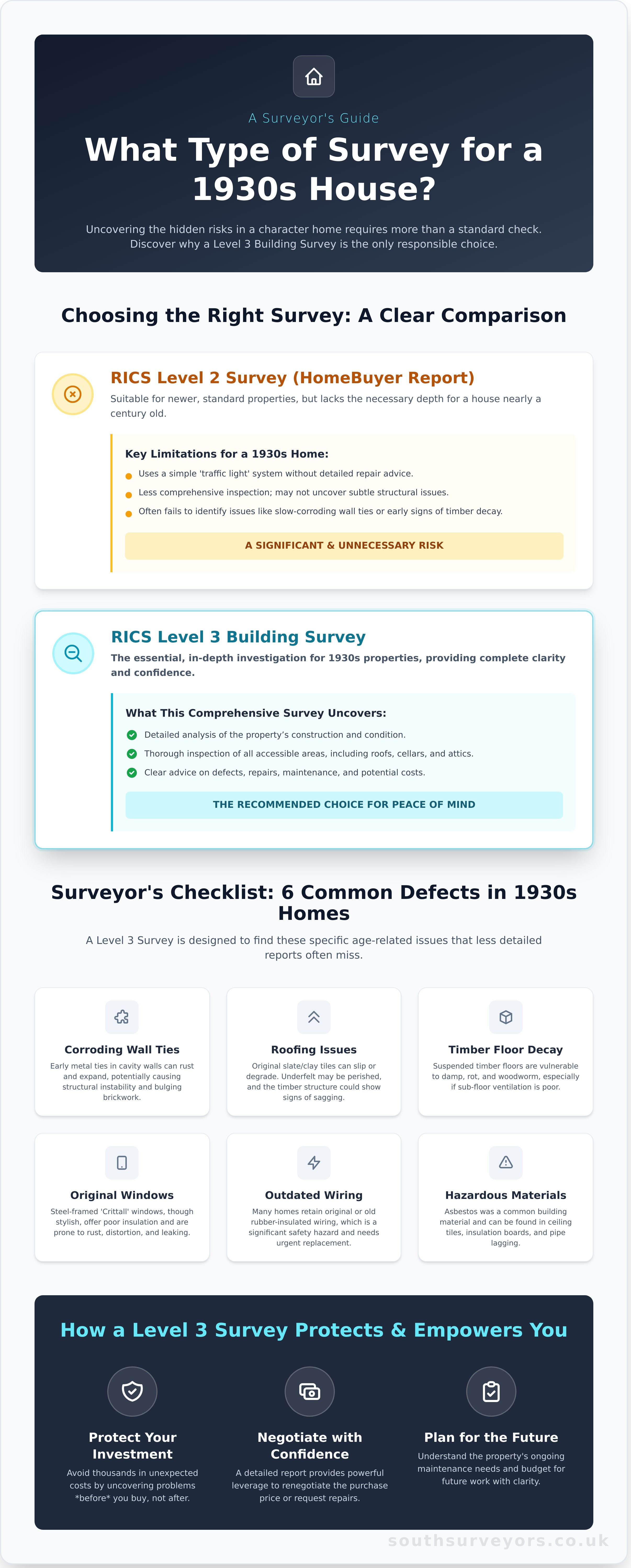
A Surveyor’s Checklist: 6 Common Defects Found in 1930s Homes
When inspecting a 1930s home, a RICS-certified surveyor looks for common, age-related defects that often lead to significant unforeseen costs. Understanding these risks is crucial when deciding what type of survey for a 1930s house to get. A comprehensive Level 3 Building Survey is designed to investigate these specific issues, providing you with the clarity and confidence to make an informed purchase. Here are six key areas we assess:
1. Roofing, Chimneys, and Leadwork
Original slate or clay tiles can become brittle, while underlying timbers decay. We inspect lead flashing around chimneys and in valleys, as failure here causes leaks. Chimney stacks are also checked for leaning or cracked brickwork, which can be costly to repair and pose a safety risk.
2. Structural Movement and Wall Tie Failure
Charming 1930s bay windows can be prone to subsidence. A hidden threat is corroding steel wall ties, which cause brickwork to crack and bulge. Our surveyors also identify failed lintels and assess the structural impact of past alterations, like removed chimney breasts that lack proper support.
3. Damp, Rot, and Woodworm
Damp is a frequent issue. A failed damp proof course can cause rising damp, while poor pointing leads to penetrating damp. We also check suspended timber floors, where poor ventilation creates ideal conditions for timber rot and wood-boring insect infestations that can compromise the floor’s structure.
4. Outdated Electrics and Plumbing
Services from the 1930s are long past their lifespan. A surveyor identifies archaic electrical systems, like rubber-insulated wiring or old fuse boxes, which pose a fire risk and require a full rewire. The potential presence of original lead supply pipes is another serious health concern that will be highlighted.
5. Presence of Hazardous Materials (Asbestos)
Asbestos was used extensively in the 1930s. A surveyor visually identifies materials suspected to contain it (ACMs), often found in ceiling tiles, pipe lagging, and floor tiles. The report will highlight these risks and recommend specialist testing and a safe management plan.
6. Ageing Drainage Systems
Original clay drainpipes are prone to cracking, collapse, or blockages from tree roots, leading to damp issues and expensive excavations. A surveyor lifts accessible manhole covers and looks for evidence of defects in the underground drainage system to highlight potential liabilities before you commit.
This checklist demonstrates why a thorough inspection is so valuable. It provides the crucial information needed to make an informed decision, negotiate on price, and budget for future work, ultimately giving you peace of mind in your purchase. For expert advice on what type of survey for a 1930s house you need, contact our RICS-certified team.
How a Level 3 Survey Protects Your Investment and Empowers You
Choosing a survey is about more than just identifying problems; it’s about making a sound financial decision with complete clarity. When asking what type of survey for 1930s house is best, the answer lies in which report gives you the most control. A comprehensive RICS Level 3 Survey provides the detailed insight needed to proceed with a major purchase confidently. Think of the survey fee not as a cost, but as an insurance policy against a potential money pit, empowering you before you complete the sale.
Gaining Significant Negotiation Power
A Level 3 Survey delivers a detailed, evidence-based report on the property’s condition. This professional document is your most powerful tool for renegotiation. If the survey uncovers issues like an ageing roof, damp, or structural movement, you can present the findings and associated repair cost estimates to the seller. This transforms a negotiation from an emotional plea into a factual discussion. A survey costing around £1,000 could easily save you £5,000-£10,000 or more on the purchase price, offering an exceptional return on your investment.
Creating a Roadmap for Future Costs
The report doesn’t just list defects; it helps you create an accurate budget for both immediate and future repairs. Your RICS surveyor will prioritise issues, distinguishing between urgent problems that need immediate attention and elements that will require ongoing maintenance. This detailed planning is central to the question of what type of survey for 1930s house you need, as it turns potential unknowns into a manageable budget. You can move into your new home with a clear plan, preventing nasty financial surprises in your first few years of ownership.
Making the Final Decision with Confidence
Ultimately, a thorough survey provides a clear, unvarnished picture of the property you are about to buy. It gives you the real confidence to proceed with the purchase, armed with all the facts and a full understanding of your future commitments. Equally, it provides the impartial, expert evidence you need to confidently walk away from a deal if the problems are too extensive or costly for you to take on. This ensures you make the right choice for your financial future and personal peace of mind. Ready to buy with confidence? Get a free quote for your survey.
Secure Your 1930s Property Investment with the Right Survey
When asking what type of survey for 1930s house is best, the answer is unequivocally a RICS Level 3 Building Survey. These characterful properties come with a unique set of potential issues, from historic structural movement to outdated wiring, that only the most thorough inspection can accurately identify. Opting for anything less leaves you vulnerable to costly and stressful surprises after you’ve moved in.
A Level 3 Survey is your most powerful tool for proceeding with clarity and confidence. It provides a detailed understanding of the property’s condition, empowering you to negotiate the purchase price, budget for necessary repairs, and ultimately protect your significant financial investment.
At South Surveyors, our RICS-Certified Chartered Surveyors possess specialist expertise in South London’s 1930s housing stock. We provide clear, comprehensive reports followed by a post-survey consultation to ensure you understand every detail. Get a free, no-obligation quote for your RICS Level 3 Building Survey today.
Make an informed decision and turn that charming 1930s house into your home with complete peace of mind.
Frequently Asked Questions
Is a mortgage valuation the same as a survey?
No, they serve very different purposes. A mortgage valuation is a brief inspection conducted for your lender to confirm the property is worth the amount you wish to borrow. In contrast, a property survey is a comprehensive health check on the building carried out for your benefit. An independent RICS survey provides the detailed report you need to make an informed decision and proceed with clarity and confidence, protecting you from unforeseen repair costs.
What if the Level 3 survey uncovers serious problems in the 1930s house?
This is precisely why a thorough survey is so essential. When considering what type of survey for a 1930s house is best, the Level 3 is designed to uncover these very issues. The detailed findings in your RICS report provide you with powerful evidence. You can use this information to renegotiate the purchase price with the seller, request that they complete the repairs before you exchange, or, in some cases, make the difficult but correct decision to withdraw from the purchase.
How long does a Building Survey take on a 1930s property?
The on-site inspection for a RICS Level 3 Building Survey on a typical 1930s house can take anywhere from three to six hours, depending on its size, complexity, and overall condition. Our RICS-Certified surveyors are meticulous and take the time needed for a thorough assessment. Following the inspection, you can expect to receive your comprehensive, easy-to-understand report within 5-7 working days, empowering you to move forward with your purchase without delay.
Does a RICS Level 3 survey include a valuation?
A RICS Level 3 Building Survey does not include a market valuation as a standard component. Its primary focus is an in-depth analysis of the property’s condition and construction. However, a professional market valuation can easily be added to the service upon request. This provides you with both a detailed condition report and an expert opinion on the property’s value, all delivered by a single, reliable RICS-Certified professional for your complete peace of mind.
How common is asbestos in 1930s houses and what should I do about it?
While asbestos use peaked after WWII, it can still be found in 1930s homes, often in materials added during later refurbishments like textured coatings (Artex), insulation boards, or garage roofs. A RICS surveyor will note any suspected asbestos-containing materials but will not test them. If asbestos is suspected, the advice is always to leave it undisturbed and seek guidance from a specialist asbestos contractor for safe management or removal, ensuring your family’s safety.
Can I be present during the property survey?
To ensure a thorough and uninterrupted inspection, we recommend that our RICS surveyor is allowed to conduct the survey alone. This allows them to focus entirely on the property without distraction. However, we pride ourselves on our client communication. You are welcome to arrange a brief chat with the surveyor towards the end of the inspection to discuss their initial findings, and they will always be available to talk you through the full report once it is complete.