

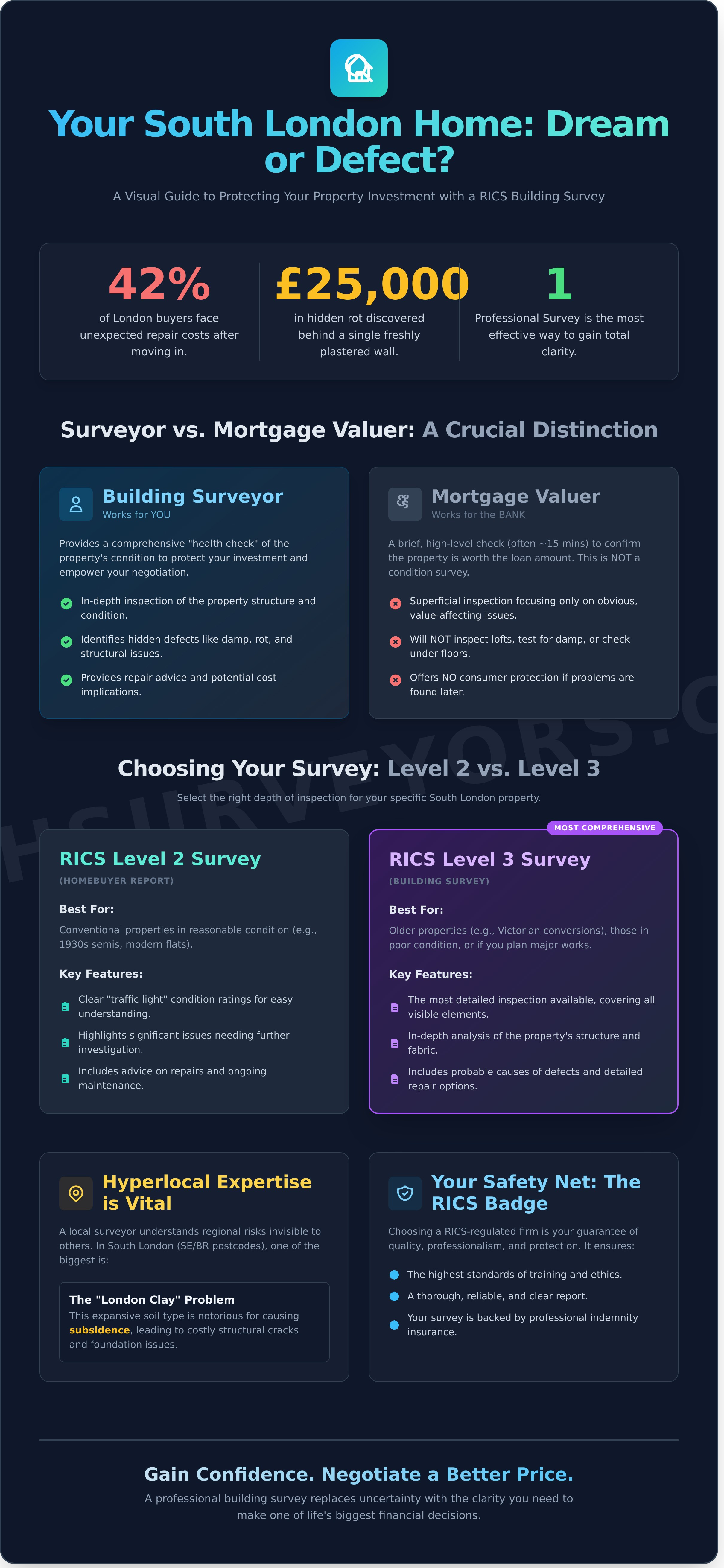
Last Tuesday, Sarah, a first-time buyer in Crystal Palace, discovered that her dream Victorian conversion in the SE19 postcode was actually hiding £25,000 worth of structural rot behind a freshly plastered wall. It’s a terrifying reality when you’re already braving the high stakes of a South London bidding war. With 42% of London buyers encountering unexpected repair costs after moving in, you’ve likely felt that familiar mix of excitement and dread while viewing homes in Bromley or Croydon. Engaging a qualified building surveyor is the most effective way to replace that uncertainty with total clarity and confidence.
We believe you deserve to know exactly what you’re buying before you commit your life savings. Don’t let a fresh coat of paint fool you. This guide will show you how a professional inspection saves you from “money pit” properties and provides the necessary leverage to negotiate a better purchase price. We’ll walk through the process of uncovering hidden defects and explain how our tailored reports give you the peace of mind to finally sign that contract.
Key Takeaways
- Understand why a RICS-certified expert acts as your property’s private investigator, uncovering hidden “money pit” defects before you commit.
- Learn to distinguish between RICS Level 2 and Level 3 reports to ensure you’re choosing the right depth of inspection for your specific South London home.
- Discover why hyperlocal expertise in SE and BR postcodes is vital for identifying regional risks like subsidence caused by the infamous “London Clay.”
- Gain the confidence to sign your contract or negotiate a better price by partnering with a professional building surveyor who prioritizes clarity over jargon.
- Master the art of choosing a surveyor who combines technical substance with a human touch, ensuring your report is both meticulous and easy to read.
What is a Building Surveyor (and Why They Aren’t Just for Skyscrapers)?
Penge properties have undeniable character. Whether you are eyeing a Victorian terrace near Crystal Palace Park or a 1930s semi-detached home in the BR3 postcode, these buildings have long histories. Sometimes those histories include structural shifts that aren’t visible to the untrained eye. This is where a Chartered Building Surveyor comes in. Think of them as your property’s medical examiner. They don’t just look at the fresh coat of paint; they look at the bones of the structure to see what’s actually happening beneath the surface.
In South London, from the busy streets of SE1 to the suburban stretches of CR0, houses face unique environmental pressures. The heavy clay soil common across the SE and CR postcodes expands and contracts with the seasons, often leading to those worrying cracks you might spot in a hallway or above a door frame. A professional building surveyor acts as your knowledgeable friend in a hard hat. They provide an expert perspective that cuts through the emotional excitement of buying a home, ensuring you don’t accidentally sign up for a money pit.
To better understand why this professional oversight is so vital for your peace of mind, watch this helpful video:
Surveyor vs. Valuer: The Crucial Difference
A common mistake many buyers in the DA or SM postcodes make is trusting the mortgage valuation as a clean bill of health. It isn’t. A valuer works for the bank to confirm the property is worth the loan amount, often spending as little as 15 minutes on-site. They won’t crawl into the loft to check for leaking pipes or test for rising damp. Relying solely on this can lead to £20,000 or more in unforeseen repair costs after you move in. A building surveyor looks for problems, not just price tags, giving you the clarity and confidence needed to negotiate a better deal or walk away if the risks are too high.
The RICS Badge: Why it’s Your Safety Net
The RICS (Royal Institution of Chartered Surveyors) badge is the gold standard of property professionalism. Since the institution was founded in 1868, it has demanded the highest standards of its members. To carry this title, a surveyor must complete the Assessment of Professional Competence (APC), a rigorous multi-year period of training and examination. Hiring an uncertified individual is like buying a car without an MOT; you have no guarantee of quality and no consumer protection if things go wrong. Choosing a RICS-regulated firm like South Surveyors ensures your report is thorough, reliable, and backed by professional indemnity insurance.
Our local expertise across South East London means we understand the specific quirks of properties in Penge and the surrounding boroughs. We don’t just list faults. We explain them in plain English, helping you make informed decisions about your future home. If you are worried about a specific crack or just want a comprehensive health check for a new purchase, getting an expert on your side is the smartest investment you can make.
RICS Level 2 vs. Level 3: Demystifying the Jargon
Choosing a survey shouldn’t feel like deciphering an ancient script. When you’re looking at a property in Penge or the wider SE20 area, you’ll likely hear three RICS levels mentioned. Level 1 is the ‘Condition Report,’ which is essentially a high level health check. It’s rarely recommended for anything other than brand new builds because it lacks the depth needed to spot hidden issues. For most buyers in South East London, the real choice lies between Level 2 and Level 3.
A professional building surveyor acts as your eyes and ears on the ground. They identify whether that hairline crack in the hallway is a settling paint job or a sign of something more sinister. Understanding the difference between these reports ensures you don’t overpay for data you don’t need, or worse, under-invest and miss a £15,000 structural repair. While some confuse this role with municipal oversight, looking into building control surveyor responsibilities shows that those professionals focus on building regulations, whereas your private surveyor focuses entirely on your investment and safety.
The RICS Level 2 Condition Report
This is the most popular choice for modern, conventional homes. If you’re buying a 1990s purpose-built apartment in Bromley or a standard semi-detached house in the BR postcode area, this report offers excellent value. It uses a simple ‘traffic light’ system: green for good, amber for items needing attention, and red for urgent defects. It covers the basics of the property’s condition and highlights legal issues your conveyancer should investigate. It’s a concise document designed to give you clarity without overwhelming you with technical minutiae.
The RICS Level 3 Building Survey
If you’ve fallen in love with a drafty Victorian terrace in Dulwich or a sprawling 1920s conversion in Peckham, you need the ‘Full Building Survey.’ Older properties in the SE15 and SE21 districts often hide decades of DIY “fixes” and structural fatigue. A Level 3 survey is a comprehensive deep dive. Your building surveyor will check every accessible nook, from the loft insulation to the drainage runs. Crucially, it includes estimated costs for repairs. This data is your ultimate negotiation tool; if a survey reveals £8,000 of necessary roof work, you have the evidence to ask for a price reduction.
Deciding which report to commission depends on three specific factors:
- Property Age: Anything built before 1945 almost always requires a Level 3 survey due to the materials and construction methods used.
- Condition and History: If the house has been significantly altered, or if you can see visible cracks larger than 2mm, don’t skimp on the Level 2.
- Future Plans: Planning a massive rear extension or knocking through structural walls? A Level 3 provides the structural baseline you need to plan safely.
Investing in the right level of detail now prevents expensive surprises after you’ve already moved in. If you are still feeling a bit stuck on which path to take for your specific postcode, browsing our detailed survey comparison can help you find the right fit for your budget and peace of mind.
The South London Property Wild: Why Local Expertise Matters
Buying a home in Penge or Crystal Palace is a bit like a high-stakes treasure hunt. The “treasure” is a charming Victorian terrace, but the “traps” are often hidden beneath the floorboards or tucked behind a fresh coat of Dulux. A national firm based in a distant call centre might provide a tidy report, but they often lack the “street smarts” required for SE20. You need a building surveyor who knows exactly why a crack in a South East London semi is fundamentally different from one in a Manchester new-build.
The biggest local antagonist is the infamous London Clay. During the 2022 heatwave, when temperatures hit a record 40.3°C, the clay across the BR and SE postcodes baked and shrunk at an alarming rate. This geological mood swing causes subsidence that can cost upwards of £25,000 to rectify if missed. A local expert understands these soil patterns. They know that a property near Crystal Palace Park faces different structural pressures than one sitting on the flatter terrain of Sidcup. When you examine the duties of a building surveyor, you’ll see they are trained to spot these risks, but local experience turns that training into a superpower.
Navigating the SE, BR, and CR Postcodes
South London is an architectural patchwork quilt. In the DA and SM areas, we see a massive influx of 1930s suburban expansion, while the SE postcodes are defined by dense Victorian and Edwardian heritage. A building surveyor with local roots understands the “soil and soul” of these neighbourhoods. They know which streets in Bromley are prone to drainage issues and which pockets of Croydon are currently seeing a spike in basement damp due to rising water tables. This hyperlocal insight ensures your survey isn’t just a tick-box exercise; it’s a bespoke investigation into your specific patch of London.
Common Defects in South London Homes
Every era has its Achilles’ heel. In West Norwood, roughly 65% of period properties we inspect suffer from some form of rising or penetrating damp. This is often caused by the original slate damp-proof courses becoming brittle over 120 years. In Sidcup, the challenge is often the roof. The 1930s semi-detached homes frequently still sport their original clay tiles, which are now reaching the end of their 80-year lifespan. If you are looking at a “Croydon Conversion,” keep your eyes peeled for dodgy DIY. We frequently find split-level flats where load-bearing walls were removed in the 1990s without proper RSJs, leading to the “Croydon Crack” in the ceiling below.
- Victorian Villas (SE20, SE19): Watch for “spalling” brickwork caused by using modern cement instead of traditional lime mortar.
- 1930s Semis (BR1, DA15): Check for “wall tie failure” where the metal ties holding the cavity walls together have rusted away.
- Modern Conversions (CR0): Verify that fire-stopping measures between floors actually exist, as 1 in 4 conversions we see have significant gaps.
Choosing a surveyor who recognises these area-wide defects provides you with more than just a report. It gives you real confidence. We don’t just tell you there is a crack; we tell you if it’s a standard Penge “settling” line or a sign that the London Clay is making a move on your foundations. That distinction alone can save you thousands during the negotiation phase.
How to Choose a Surveyor (Without Hiring a Corporate Robot)
Penge properties have plenty of character, but they also have specific regional quirks. Finding a building surveyor who understands the difference between a settling Victorian terrace in SE20 and a genuine structural disaster shouldn’t feel like talking to an automated chatbot. You need a human expert who knows the local London clay and speaks your language without the heavy corporate filter.
- Step 1: Verify RICS status. This is the non-negotiable foundation of your search. Since the RICS standards update in early 2024, the requirements for professional indemnity insurance have become even more stringent. If a firm isn’t RICS-Certified, they lack the accountability you need to protect your investment.
- Step 2: Look for ‘Hipster Flair.’ This isn’t about the surveyor’s fashion choices. It’s about their ability to communicate like a person, not a textbook. You want someone who can explain a lateral restraint issue in a Penge conversion without making you feel like you are back in a high school physics exam.
- Step 3: Check local reviews. National trust scores often mask the reality of local service. Search for feedback specifically from clients in the SE, BR, or CR postcodes. A surveyor who understands the specific soil conditions of Crystal Palace or the common chimney breast issues in Anerley provides far more value than a nationwide firm based in a distant city.
- Step 4: Ask for a sample report. If the sample looks like a 1980s tax return, it’s a red flag. Modern, helpful reports use clear photography, red-amber-green traffic light systems, and actionable summaries. You shouldn’t need a legal degree to understand if your potential home is falling down.
The Value of the ‘Post-Survey Phone Call’
A 15-minute chat with your expert is often worth more than 50 pages of written text. While the final PDF is your legal protection, a verbal summary provides the nuance that a formal document might miss. South Surveyors prioritizes personal communication, often referred to as the ‘Jazz Ettienne’ approach. This involves a direct call immediately after the inspection to discuss the major findings. It allows you to ask the “Golden Question”: “If you were in my position, would you buy this house?” That level of professional honesty is what builds genuine clarity and confidence during a stressful move.
Price vs. Value: Don’t Cheap Out on the Investigator
Choosing the cheapest quote from a comparison site is a common mistake that leads to generic, liability-dodging reports. A budget survey at £350 might seem like a bargain, but these often lack the depth required for older properties in the DA or SM postcodes. Since the 2024 market shifts, we’ve seen these low-cost reports miss critical structural issues. Investing roughly £600 to £850 in a thorough Level 3 survey can identify issues that save you thousands. For instance, spotting a failing valley gutter in an Eltham semi-detached can prevent a £6,500 roofing bill six months after you move in. When you consider the scale of your investment, paying for a detailed investigation is the only way to ensure a good night’s sleep in your new Penge home.
South Surveyors: Your Local RICS Experts for South London
If you’ve been spending your Sunday mornings staring at a suspicious hairline fracture in your Penge terrace, you need more than just a vague guess from a builder. You need absolute clarity. At South Surveyors, our promise is built on providing tailored reports that offer real confidence. We don’t believe in generic, one-size-fits-all templates that leave you more confused than when you started. Instead, we deliver detailed insights that help you understand exactly what’s happening with your bricks and mortar.
Our team consists of professional surveyors who don’t just work in South London; they possess an unparalleled understanding of its unique property landscape. We know the specific structural quirks of Victorian conversions in Peckham, the clay soil issues often found in Bromley, and the unique construction styles common in Bexley. When you hire a building surveyor from our firm, you’re getting someone with extensive experience inspecting properties within your area. This local intelligence is vital because it allows us to spot “red flag” issues that a less specialized firm might easily overlook.
The South Surveyors difference is found in our balance of being meticulous yet approachable. We’re the “knowledgeable friend” you want in your corner during a property transaction. We take our RICS-regulated status seriously, adhering to the highest industry standards, but we’ve ditched the stuffy, corporate attitude. Our reports are thorough, dependable, and written in plain English. We’ve helped over 1,200 homeowners across the SE and BR postcodes navigate their property journeys since our inception, ensuring they never pay over the odds for a home with hidden defects.
Our RICS-Certified Services
We provide a comprehensive range of services designed to protect your investment. For those buying a relatively modern 1930s semi-detached home in Sutton, our Level 2 reports offer a perfect balance of detail and value. If you’re eyeing a grand, older property in Greenwich that requires significant TLC, our Level 3 Building Surveys provide the deep-dive analysis you need. We also specialise in RICS Property Valuations for probate, shared ownership, or private sales. Our clients in the SE and DA postcodes frequently recommend us because we provide the “peace of mind” that only a building surveyor with in-depth knowledge of the South London market can offer.
Your Next Step to a Stress-Free Move
We’ve made our booking process as simple as possible because we know you’ve already got enough on your plate. There are no robots here and no endless automated phone menus. When you get in touch, you’ll speak with an expert who understands the local CR and SM property markets. We’re always happy to have a friendly chat about your potential new home, explaining the process and helping you secure a survey date that fits your timeline. Don’t let structural worries stall your progress or keep you awake at night. Get your tailored survey quote from South Surveyors today and take the first step toward a move backed by expert facts, not just feelings.
Secure Your South London Move With Absolute Clarity
Buying a home shouldn’t feel like a high-stakes gamble. You now understand that the choice between an RICS Level 2 and Level 3 survey depends entirely on your property’s age and quirks. You also know that local insight across the SE, BR, DA, CR, and SM postcodes is vital for spotting structural issues specific to our corner of London. Whether it’s a Victorian conversion in Dulwich or a 1930s semi in Bromley, the right data protects your bank balance.
Don’t settle for a corporate robot who treats your investment like a box-ticking exercise. A professional building surveyor from our team provides the meticulous detail you need to negotiate with confidence. We are strictly regulated by RICS and have earned hundreds of positive testimonials for our jargon-free communication. We’ve helped over 1,000 local buyers navigate the market since our inception, ensuring they never face unexpected repair bills alone.
Book your RICS survey with South Surveyors for total peace of mind
You’ve got this. With the right expert in your corner, you’ll be picking up your new keys with nothing but excitement.
Frequently Asked Questions
Is a building surveyor the same as a structural engineer?
A building surveyor isn’t the same as a structural engineer, though they often work together like a property dream team. Your surveyor is a generalist expert who assesses the entire condition of the home, from damp in a Penge Victorian terrace to slipped roof tiles. A structural engineer is a specialist you call if the surveyor finds a specific issue, like a 5mm subsidence crack, that needs complex mathematical calculations to fix.
How much does a RICS Level 3 building survey cost in South London?
You can expect to pay between £650 and £1,500 for a RICS Level 3 survey in South London postcodes like SE20 or BR3. The exact price depends on the property’s size and age; a sprawling five bedroom house in Beckenham costs more to inspect than a compact Penge cottage. It is a small price for peace of mind when you’re potentially spending £500,000 or more on a new home.
Can a building surveyor help me negotiate the house price?
A building surveyor is your best ally for negotiating a fairer price. If our report identifies £10,000 worth of necessary roof repairs or timber treatment, you can use that evidence to ask the seller for a price reduction. Most sellers in the CR or SE markets are reasonable when presented with a professional RICS report detailing specific, costed defects rather than just vague guesses.
How long does it take to get a survey report back?
We aim to get your comprehensive report to you within 3 to 5 working days after the site visit. We know the South East London property market moves fast, so we don’t leave you hanging. Your building surveyor will often give you a quick verbal summary over the phone immediately after the inspection to calm your nerves before the full PDF arrives.
Do I need a survey if I am buying a new build property in Croydon?
You definitely need a survey for a new build in Croydon, specifically a Snagging Survey. Even fresh developments in the CR0 area can have 50 or more minor defects, from poorly fitted windows to plumbing leaks hidden behind shiny cabinets. Getting a professional eye on the property before you move in ensures the developer fixes these issues under your warranty without a fight.
What happens if the building surveyor finds a major defect?
Don’t panic if we find a major defect like dry rot or structural movement. We provide clarity on the severity and suggest the next steps, which usually involves getting a specialist quote for the repairs. Armed with these figures, 85% of our clients either negotiate the price down or ask the seller to fix the issue before the exchange of contracts.
Is a building survey compulsory for a mortgage?
A building survey isn’t compulsory for a mortgage, but the bank’s basic valuation is not a survey. That 15 minute valuation only protects the lender’s investment, not your bank balance. Investing in your own RICS-certified report is the only way to ensure you aren’t buying a money pit in Bromley or Sidcup that requires 20% of its value in immediate repairs.
Can I attend the survey with the building surveyor?
It is usually better if you don’t attend the survey so the surveyor can focus 100% on the property’s nooks and crannies. We need to crawl into lofts and poke around basements without distractions. However, we love a chat afterwards. Your surveyor will happily jump on a 20 minute call to explain our findings in plain English so you feel completely confident.