

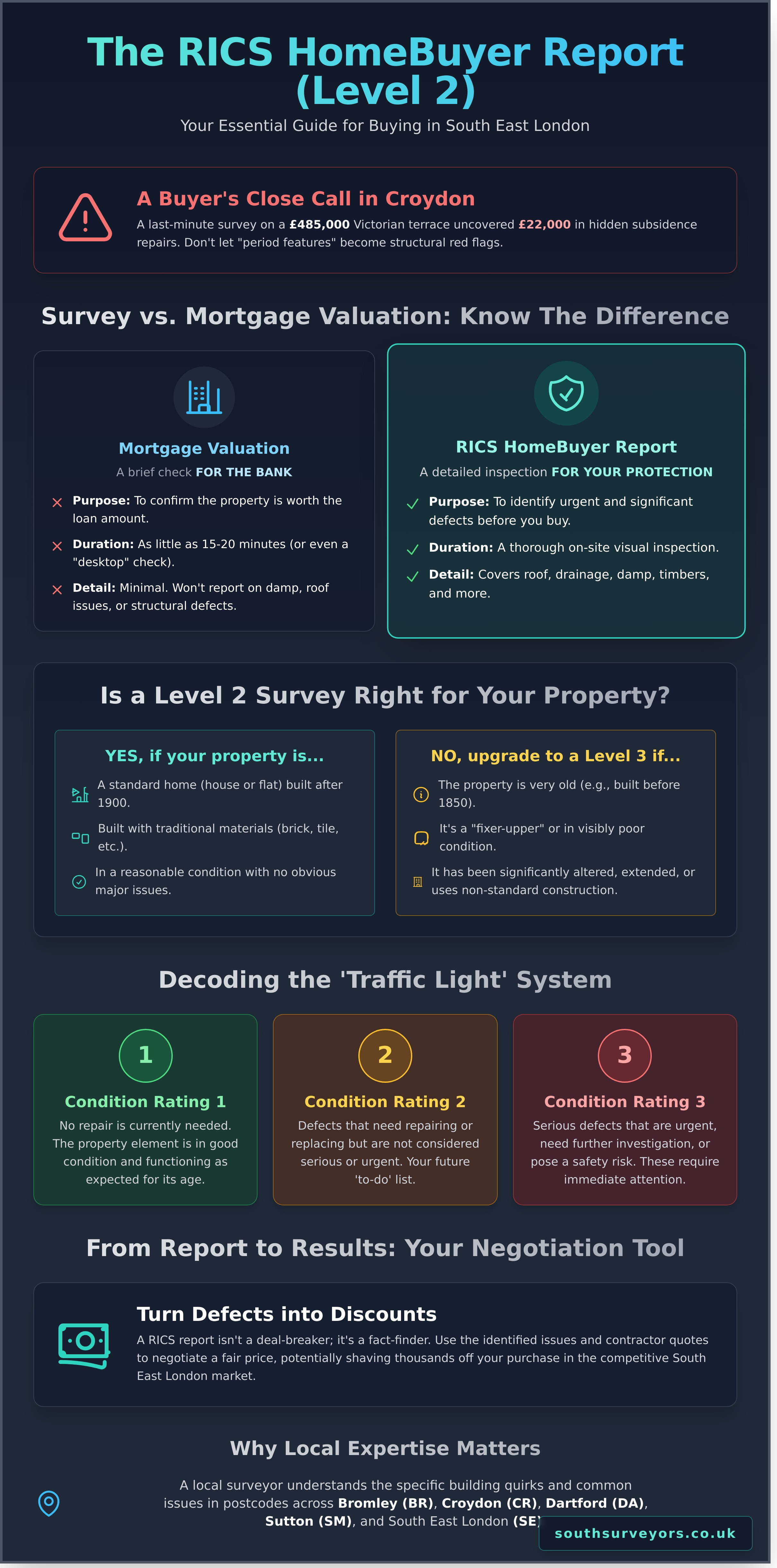
Last March, a buyer in Croydon nearly committed £485,000 to a Victorian terrace, only to discover £22,000 in hidden subsidence during a last-minute inspection. It’s a nightmare scenario that keeps many Londoners awake at night; especially when you’re already stretching your budget to secure a spot in SE19 or CR0. You deserve to know if those “period features” are actually structural red flags before you hand over your deposit. Investing in a professional rics homebuyer report is the only way to ensure your dream home in South East London doesn’t become a financial burden.
We promise to demystify the process so you can stop guessing and start making informed decisions. By the end of this guide, you’ll understand exactly how to use a Level 2 survey to negotiate a better deal or walk away from a bad investment with your peace of mind intact. We are going to decode the confusing traffic light ratings, explain the terminology in plain English, and show you why this specific report is the essential tool for any savvy buyer looking at properties across Bromley, Sutton, and Dartford.
Key Takeaways
- Understand why the rics homebuyer report remains the gold standard for standard-construction homes in 2026, even with updated RICS naming conventions.
- Learn how to decode the “traffic light” condition ratings without the panic, distinguishing between minor maintenance and the red flags that require immediate attention.
- Discover if a Level 2 survey is the right fit for your specific South London property, whether it’s a classic SE22 Victorian terrace or a modern BR apartment.
- Master the art of turning survey defects into a powerful negotiation tool to potentially shave thousands off your purchase price in the competitive South East market.
- Find out why local expertise in postcodes like CR and SM beats a national call centre when it comes to spotting neighborhood-specific building quirks.
Decoding the RICS HomeBuyer Report (Level 2) in 2026
We’ve moved into 2026, yet the terminology around property surveys still causes a bit of a head-scratch for many. While the Royal Institution of Chartered Surveyors (RICS) officially shifted to the “Level 2” naming convention back in 2021, most buyers searching in Bexleyheath or Bromley still use the classic term: rics homebuyer report. It remains the industry’s “gold standard” for standard-construction homes. Think of it as a detailed health check-up for your potential new home. It’s designed to give you clarity and confidence before you sign that life-changing contract.
This report isn’t just a tick-box exercise. It’s a thorough visual inspection that identifies “urgent” and “significant” defects. Unlike the Level 1 Condition Report, which is essentially a basic summary, or the Level 3 Building Survey, which is a deep-dive structural autopsy, the Level 2 hits the sweet spot for the majority of properties in the DA and SE postcodes. It covers everything from damp proofing and drainage to the condition of the roof timbers. Our goal is to act as your knowledgeable friend, pointing out the bits that need attention so you don’t face a £5,000 repair bill three months after moving in.
HomeBuyer Report vs. Mortgage Valuation: The Great Misconception
Don’t mistake your lender’s valuation for a proper survey. A mortgage valuation is for the bank, not for you. In fast-moving markets like Dulwich or Bromley, a valuer might spend as little as 15 to 20 minutes on-site. They might even perform a “desktop valuation” without even visiting the street. They only care if the house is worth the loan amount. They won’t tell you if the chimney stack is leaning or if there’s active woodworm in the loft. Designing Buildings Wiki explains what a HomeBuyer Report is to help you understand why a professional inspection is vital for your own peace of mind. A mortgage valuation is a commercial assessment for a bank’s security, whereas a survey is a private contractual inspection for a buyer’s protection.
Who is the Level 2 Survey Actually For?
The rics homebuyer report is the perfect match for homes built after 1900 that appear to be in reasonable condition. If you’re eyeing up a 1930s semi-detached house in Bexleyheath or a Victorian conversion flat in Peckham, this is your best friend. It’s tailored for properties using standard construction methods. It is the ideal choice for:
- Post-1900 houses and flats in the SE and DA postcode areas.
- Properties in “reasonable” condition without obvious structural failure.
- Buildings made from traditional brick, mortar, and tiled roofs.
You should stop and upgrade to a Level 3 Survey if the property is a total wreck, has been significantly extended, or features “non-standard” elements like a thatched roof or timber framing. If the house has been standing since 1850 or is a “fixer-upper” in DA7 that needs more than just a lick of paint, the Level 2 won’t go deep enough. Stick to the Level 2 for your standard London suburban gems to ensure you aren’t buying a money pit. This level of detail provides the real confidence you need to proceed with your purchase.
The ‘Traffic Light’ System: Reading Your Report Without the Panic
When you open your rics homebuyer report, the first thing you’ll notice isn’t a wall of dense text. It is a color coded summary designed to give you instant clarity. RICS uses a traffic light system because, let’s face it, buying a house in Bexleyheath is stressful enough without needing a dictionary for every paragraph. This system categorizes every part of the property into three distinct ratings, helping you prioritize what matters and what can wait until next summer.
Condition Rating 1 (Green) means the property is in good nick. No repairs are currently needed. While we all want a sea of green, it’s actually quite rare in South East London. If you’re looking at a Victorian terrace near the DA6 postcode, expecting a perfect score is optimistic. Most older homes have character, which is usually a polite way of saying they have age related quirks. A green rating means the component is performing exactly as it should for its age.
Condition Rating 2 (Amber) is the middle ground. These are defects that aren’t considered urgent or significant but will need attention eventually. Think of these as your “to-do” list for the next 24 months. Condition Rating 3 (Red) is the one that makes buyers’ hearts skip a beat. These are serious defects that need urgent repair, further investigation, or are safety hazards. However, a red light doesn’t always mean the deal is dead; it just means you need to pause and get the facts.
Decoding the Red Lights: What’s a Dealbreaker?
In the DA and BR postcode areas, red lights often pop up for three usual suspects: damp, timber rot, and ancient electrics. A 2023 study found that roughly 22 percent of older UK homes suffer from some form of penetrating damp. If your surveyor flags a “Red 3” for the walls, it might be a simple guttering fix or a more complex damp proof course issue. This is where the rics homebuyer report becomes more than just a document. We always recommend a quick follow up call after you’ve read the findings. Our surveyors often spend 15 minutes on the phone explaining whether a red light is a “fix it and move on” situation or a genuine reason to reconsider your offer.
The Secret Value of Amber Lights
Don’t view an Amber rating as a failure. View it as your five year financial roadmap. If you’re buying a 1930s semi in Sidcup, an Amber rating on the roof tiles tells you that while the house is dry today, you should probably start a “roof fund” for 2028. These ratings are also fantastic tools for keeping estate agents grounded. When an agent claims a house is “immaculate,” your Amber ratings provide the evidence needed to discuss a more realistic price. It’s about making informed decisions rather than guessing. If you want to see how these ratings look in practice, you can view our sample reports to get a feel for the level of detail we provide.
By categorizing issues this way, the report moves from being a scary list of problems to a professional maintenance guide. It allows you to approach the purchase with real confidence, knowing exactly where your money will need to go after you’ve picked up the keys. Whether it is a flat in the SE area or a detached home in Bromley, understanding these colors is the key to a smooth transaction.
Is a Level 2 Survey Right for Your South London Property?
Choosing the right survey is about matching technical depth to the specific quirks of South London’s varied housing stock. If you are eyeing a classic Victorian terrace in SE22, a rics homebuyer report is often the sweet spot. These properties are frequently over 130 years old. They have lived through a lot. If they haven’t been structurally altered or left to rot, a Level 2 provides the clarity and confidence you need to proceed. However, if that East Dulwich pad has a massive new rear extension or a complex loft conversion, we might suggest stepping up to a full structural survey instead.
In places like Croydon and Sutton (CR and SM postcodes), we pay extra attention to the ground beneath your feet. South London soil is famously heavy on London Clay. This soil expands when wet and shrinks when dry. When we see a hairline crack in a Wallington semi-detached, we don’t just note it. We look for patterns of seasonal movement. Roughly 18% of the properties we inspect in these postcodes show signs of minor movement related to this clay shrinkage. A professional eye can distinguish a harmless settlement crack from a serious structural failure that could cost you £15,000 in underpinning.
Even modern developments in Greenwich and Lewisham aren’t immune to issues. You might think a flat built in 2015 is perfect, but we often find “snagging” issues that have evolved into genuine defects. These include poorly installed balcony drainage or failing window seals that lead to internal damp. Don’t assume that “new-ish” means “problem-free.” A professional eye is still your best defense against unexpected repair bills.
Common Issues We Find in BR and DA Postcodes
Bromley and Dartford represent the heartland of 1930s to 1950s suburbia. These builds are generally robust, but they come with their own “greatest hits” of defects. We frequently find original lead piping in DA1 properties or bowing walls in 1930s BR2 semis where the wall ties have finally succumbed to corrosion after 85 years. Then there are the “DIY disasters.” We see at least three botched “home improvement” jobs a week where a previous owner tried their hand at structural work without a permit. Our local knowledge ensures we spot these without under-investigating a potentially risky home.
The Leasehold Layer: Surveys for London Flats
Buying a flat in a modern block adds a layer of complexity. A Level 2 survey focuses on the interior of your specific unit, but a rics homebuyer report also includes a visual assessment of the communal areas and the building’s exterior. If we spot a “Condition Rating 3” on the roof of a block, it is a massive red flag for your future service charges. Understanding these liabilities is vital. You can learn more about the nuances of Freehold vs Leasehold in a Peckham Flat to see why the legal structure of your home changes your survey needs.
Our goal is to ensure you aren’t walking into a financial trap. Whether it’s a 1950s semi in Bromley or a sleek apartment by the Thames, we provide the meticulous detail required to negotiate better deals or walk away when the numbers don’t add up. We believe every buyer deserves peace of mind before they sign on the dotted line.
From Report to Results: How to Use Your Survey to Negotiate
Receiving your rics homebuyer report marks the moment you stop being an anxious spectator and start being the lead negotiator in your own property story. It’s common to feel a flicker of panic when you see “Condition Rating 3” in red, but this document is actually your greatest ally. It shifts the power balance. You’re no longer just a buyer with a crush on a house in DA6; you’re an informed investor with a factual roadmap of the building’s health. This clarity turns a stressful “maybe” into a confident “yes, at the right price.”
Step one is all about quantifying the defects. If your surveyor flags a damp issue in a Victorian terrace near Welling, don’t guess the repair cost. Get three quotes from local contractors across the DA and SE postcodes immediately. Having a real figure, like £3,400 for a new damp-proof course, makes your request for a price reduction impossible to dismiss as a “cheeky ask.” It grounds the negotiation in reality.
When you talk to the seller or agent, adopt the “Knowledgeable Friend” approach. It isn’t a battle; it’s a business transaction. Use the report to explain that while you love the property, the technical findings mean the current valuation doesn’t quite align with the required immediate investment. This keeps the relationship warm while you’re being firm on the numbers. Remember, a RICS-certified report carries significant legal and professional weight. A seller might ignore your “mate who’s a builder” saying the roof looks dodgy, but they can’t ignore a regulated professional documenting specific failures in a rics homebuyer report.
Mastering the art of the retraction is your final step. You need to decide whether to ask for a price drop or ask the seller to fix the issues. Usually, a price reduction is safer. It gives you control over the quality of the repairs. If a seller in Sidcup rushes a “fix” just to close the deal, they might choose the cheapest, quickest option rather than the most thorough one. Taking the money off the top lets you hire the experts you trust.
Real-World Negotiation Examples
Success often comes down to the evidence you bring to the table. In one recent case, a £500 HomeBuyer Report identified significant timber rot that led to a £5,000 price reduction for a buyer in the local area. When speaking to agents, use precise language: “Based on the RICS Level 2 findings, we’ve identified structural issues that require a £4,000 adjustment.” This is far more effective than vague complaints. You can see similar results in this case study: How a Level 3 Survey Saved a Buyer £20k.
When the Seller Says No
If a seller refuses to budge, you have to assess your risk tolerance. Some defects might already be “priced in” if the house was significantly cheaper than others in the BR or DA postcodes. This is where the surveyor’s post-report consultation becomes your secret weapon. A quick 15-minute call with your surveyor can help you decide if a “Red” light is a deal-breaker or a manageable project in a rising market. They provide the perspective you need to walk away or double down with confidence.
Ready to negotiate with total clarity? Book your professional RICS survey today.
Why Clarity and Confidence Start with South Surveyors
Buying a property in Bexleyheath shouldn’t feel like a high stakes gamble. You’re making one of the biggest financial commitments of your life, so you deserve more than a generic checklist from a surveyor who couldn’t find the Broadway on a map. We bring professional substance with a touch of hipster flair to the table. We know these neighborhoods because we’re part of them. We aren’t a national call centre; we’re local experts who spend our days inspecting everything from 1930s semis in DA7 to modern apartments near the station. Our team lives and works across the SE, BR, and CR postcodes, giving us a distinct South London edge that national firms simply can’t match.
We believe that communication is the antidote to property stress. There is nothing worse than waiting in silence after an inspection. That’s why our surveyors make it a priority to call you as soon as they’ve finished on site. We give you the headlines immediately, so you aren’t left in agony for days. When you choose us for your rics homebuyer report, you’re getting a partner who values your time and your sanity. We translate complex building issues into plain English, ensuring you have the “clarity and confidence” needed to sign those contracts or renegotiate the price.
The South Surveyors Signature Process
Our process is designed to be seamless from the moment you hit the booking button. Once the inspection is complete, we don’t just disappear. You’ll receive a detailed, easy to read PDF report that highlights exactly what needs your attention. Our RICS-certified experts, including lead surveyors like Jazz Ettienne, bring a combined track record of over 15 years in the local market. We ditch the dense jargon for actionable property insights. Whether it’s a damp issue in a SE18 terrace or roofing concerns in a BR1 cottage, we provide the facts without the fluff.
Ready to Move Forward in South London?
The London property market moves fast, but that’s no reason to rush into a bad investment. A thorough rics homebuyer report is your best defense against unforeseen repair costs that could surface months after you’ve moved in. Don’t let the pressure of a fast paced sale lead to a costly mistake. We’ve helped hundreds of buyers across SE, BR, DA, CR, and SM postcodes secure their dream homes with total peace of mind. Our mission is to ensure you know exactly what you’re buying before you commit your hard earned deposit.
Stop guessing and start planning with a team that knows South London inside out. It’s time to get the expert perspective your new home deserves. Get your tailored HomeBuyer Report quote now and take the first step toward a stress free move. Whether you’re buying in Bexleyheath, Bromley, or Croydon, we’ve got your back with the local expertise and professional integrity you need.
Take the Stress Out of Your South London Property Purchase
Moving into a new home in SE10 or BR1 should feel like a massive win, not a stressful gamble. By 2026, the local property market moves faster than ever, but a professional rics homebuyer report remains your best tool for seeing past a fresh coat of paint. You now know how the traffic light system works and why a Level 2 survey is the sweet spot for most modern London terraces and flats. It provides the facts you need to negotiate a better price or avoid “money pit” repairs that could cost thousands of pounds.
South Surveyors has helped over 100+ South London buyers move with real confidence, earning 5-star reviews across the SE, DA, and CR postcodes. As a firm regulated by RICS, we don’t just send a document and hope for the best. Every survey includes a direct phone consultation with your surveyor to talk through the findings. Whether you’re eyeing a conversion in SM or a family home in DA, we’ll ensure you have total clarity before you exchange.
Book your RICS HomeBuyer Report with South London experts to secure your investment today. You’re almost home.
Frequently Asked Questions
How long does a RICS HomeBuyer Report take to complete?
A standard RICS HomeBuyer Report usually takes between 90 minutes and 4 hours to complete on-site. The exact time depends on whether you’re buying a compact terrace in DA6 or a larger semi-detached home near Bexleyheath Broadway. Our RICS-certified professionals take the time to be thorough, ensuring every accessible nook and cranny gets a proper look. It’s about providing you with real confidence before you sign that contract.
Is a Level 2 survey enough for a 100-year-old house in South London?
Probably not, as houses built before 1945 generally require the deeper dive of a Level 3 Building Survey. If you’re eyeing a Victorian gem in SE2 or an Edwardian property in Bexleyheath, a Level 2 might miss structural nuances hidden behind aged masonry. For properties over 80 years old, we recommend the more comprehensive option to ensure you aren’t met with unforeseen repair costs after moving in.
What is the average cost of a HomeBuyer Report in 2026?
In 2026, you can expect to pay between £550 and £950 for a professional survey in the DA postcode area. Prices fluctuate based on the property’s market value and size. Investing this amount now provides peace of mind and often pays for itself. If we find a £5,000 roofing issue in a Welling terrace, you can use our detailed report to negotiate a better deal with the seller.
Can a HomeBuyer Report fail? What happens if it does?
A survey doesn’t actually “fail” like an MOT; it’s a factual health check of the building. If the report highlights “Condition Rating 3” issues, such as serious damp or structural movement, it means urgent repairs are needed. When this happens, you have the clarity and confidence to either ask the seller to fix the problems, negotiate the price down, or walk away from the deal entirely.
Do surveyors check for damp and subsidence in a Level 2 survey?
Yes, checking for damp and signs of subsidence is a core part of any RICS HomeBuyer Report we conduct. We use moisture meters on walls and look for tell-tale cracks in the brickwork of your potential Bexleyheath home. While we don’t dig holes to check foundations, our expert eyes are trained to spot the 4 or 5 key signs that suggest a property is moving or holding water.
Will the surveyor go into the loft or under the floorboards?
We will definitely head into the loft if there’s safe access, but we won’t be pulling up your floorboards. The Level 2 survey is designed to be non-invasive, meaning we don’t move heavy furniture or disturb carpets. If you’re buying a 1930s house in the BR or DA areas, we’ll check the roof timbers for rot and look under the hatches, but we keep the tools in the bag.
Can I use a HomeBuyer Report for a flat in a high-rise building?
A RICS HomeBuyer Report isn’t the best fit for high-rise flats or complex converted buildings. For a flat in a modern block or a large Victorian conversion in SE18, the standard format might not cover the communal structural elements properly. In these cases, we suggest a tailored approach that looks at the specific risks associated with managed blocks and shared maintenance responsibilities to keep you protected.
How soon after the survey will I receive my report?
You’ll typically receive your digital report within 3 to 5 working days after our visit. We know the South East London property market moves fast, so we aim for a quick turnaround without sacrificing our trademark thoroughness. Our surveyors often call you as soon as they finish on-site to give you a quick verbal rundown, ensuring you have immediate clarity before the full document arrives.