

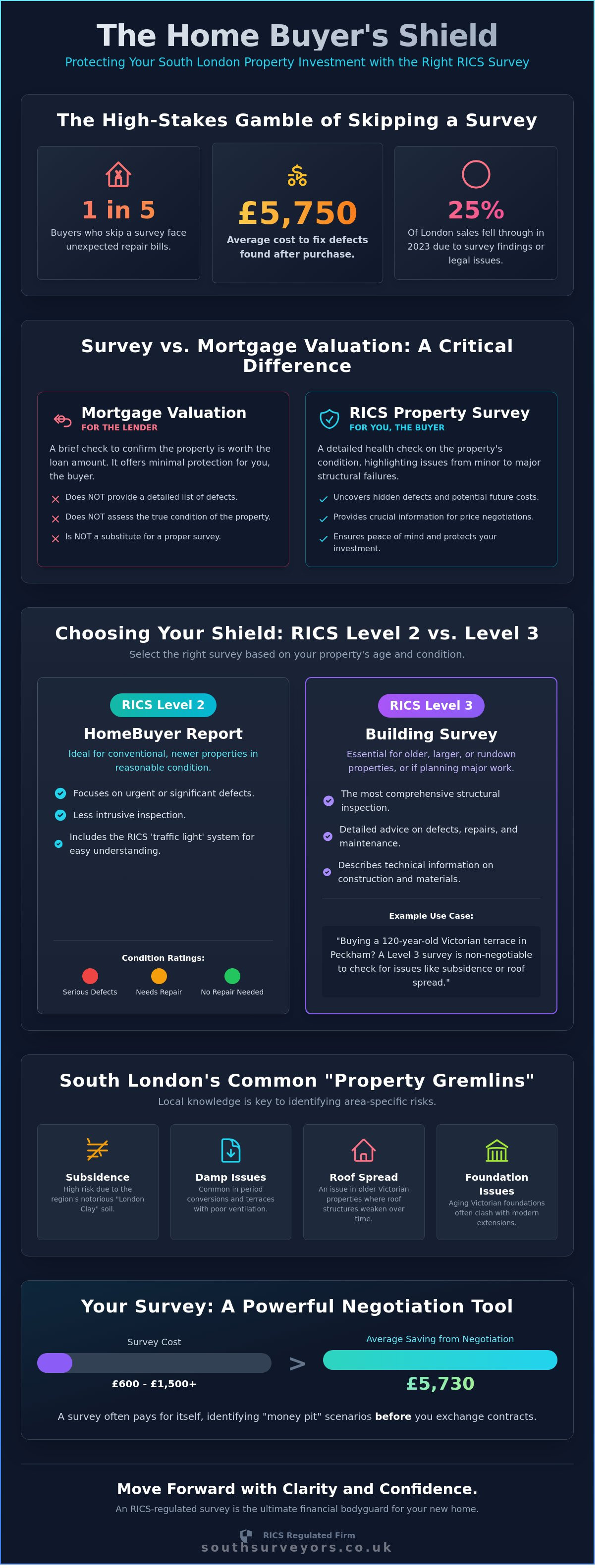
Did you know that 1 in 5 home buyers who skip a professional property survey later face average repair bills of £5,750 for defects they didn’t see coming? You’ve likely spent years saving every penny to step onto the South London property ladder, and it’s natural to feel anxious about the conveyancing process. The fear that your new Victorian terrace might hide expensive structural issues is enough to keep any buyer awake at night. In a market where every pound counts, you cannot afford a “money pit”. Your investment matters.
This guide will show you how to choose the right RICS-certified survey to protect your investment. We’ll give you the tools to identify defects before you exchange contracts, ensuring you have the clarity and confidence needed to negotiate a price reduction. We will explain the different RICS levels in plain English and provide a clear roadmap for the local market. You’ll gain the peace of mind that your new roof is secure and your future is protected.
Key Takeaways
- Understand the vital distinction between a bank’s mortgage valuation and a RICS-certified health check to ensure your financial interests are fully protected.
- Learn how to select the appropriate RICS Level 2 or Level 3 report based on your property’s age and construction to avoid overlooked structural defects.
- Discover how a comprehensive property survey acts as a powerful negotiation tool, often paying for itself by identifying “money pit” scenarios before you exchange contracts.
- Identify specific “property gremlins” common in South London postcodes, such as subsidence risks linked to the region’s notorious London Clay.
- Gain the clarity and confidence needed to navigate the local market by following an expert-led process that prioritises clear communication and professional insight.
Demystifying the Property Survey: Your Financial Bodyguard in South East London
Buying a home in South East London is likely the most significant investment you’ll ever make. A property survey acts as a detailed health check for that investment, providing a comprehensive assessment of a building’s structure and condition. This inspection is conducted by a RICS-certified professional who looks beyond the surface to identify potential risks. What is a building survey? It is a technical evaluation that uncovers hidden defects, from minor damp issues to major structural failures that could cost thousands to rectify. In a market as competitive as London’s, where 25% of property sales fell through in 2023 due to survey findings or legal complications, having this level of clarity is vital.
Skipping a survey is a high-stakes gamble that often leads to buyer’s remorse. You wouldn’t purchase a used car without checking the engine, yet many buyers overlook the “engine” of their home. A professional report provides the peace of mind needed to proceed with a purchase or, in some cases, the hard evidence required to walk away before signing a contract. By identifying issues early, you gain the upper hand in negotiations. Statistics from RICS suggest that buyers who commission their own property survey save an average of £5,730 in repair costs by negotiating the purchase price down after the results are in.
Survey vs. Valuation: The Crucial Difference
Many first-time buyers in areas like Dulwich or Peckham mistake the lender’s mortgage valuation for a comprehensive inspection. This is a dangerous assumption. A valuation is a brief check performed solely for the bank’s benefit to confirm the property is worth the loan amount. It won’t tell you if the bay window in your West Norwood terrace is pulling away from the main structure. Think of a valuation as a basic MOT that confirms a car is road-legal; a property survey is a full mechanical inspection that tells you if the gearbox is about to fail. Relying on a valuation for your own protection is a risk that rarely pays off.
The RICS Standard: Why Regulation Matters
The Royal Institution of Chartered Surveyors (RICS) is the gold standard of the surveying industry. This regulation protects you through strict codes of professional conduct and mandatory indemnity insurance. RICS is the governing body that ensures your surveyor is a qualified expert rather than just a bloke with a ladder. When you hire a RICS-regulated firm, you’re guaranteed a level of service that meets the highest industry standards. This accountability is essential in a complex urban environment like South London, where Victorian foundations and modern extensions often clash.
- Professional Indemnity: RICS members must hold insurance, protecting you if a defect is missed.
- Strict Ethics: Surveyors must act with integrity and transparency throughout the process.
- Local Expertise: A RICS surveyor understands specific local issues, such as the heavy clay soil common in South East London which can lead to subsidence.
- Standardised Reporting: You receive a clear, easy-to-follow report that uses a traffic light system to highlight the urgency of repairs.
Ultimately, the goal is clarity and confidence. Whether you are eyeing a period conversion in Crystal Palace or a new-build apartment in Greenwich, a professional report ensures you make an informed decision. In 2023, the average cost to rectify unforeseen structural issues in London properties reached £12,000. Investing in a survey now prevents these nasty surprises from becoming your financial burden later. It’s about more than just bricks and mortar; it’s about protecting your future financial health.
RICS Level 2 vs. Level 3: Choosing the Right Shield for Your Home
Every home in South London tells a unique story, and your choice of property survey should reflect that history. While the Royal Institution of Chartered Surveyors (RICS) defines three distinct levels, most buyers find their perfect match between Level 2 and Level 3. Selecting the wrong one can lead to expensive oversights. If you buy a 120 year old terrace with a basic report, you might miss £15,000 in hidden subsidence or roof spread. Conversely, ordering a full structural deep dive for a five year old flat is often an unnecessary expense.
The official government home buying guide emphasises the importance of professional advice to avoid being caught out by unexpected costs. At South Surveyors, we use our “Clarity and Confidence” framework to help you map the survey level to the property’s specific risks. This decision usually rests on the building’s age, construction type, and your own appetite for DIY projects.
The Level 2 Condition Report: Ideal for Modern South London Flats
This report is the most popular choice for properties built after 1990 that appear to be in reasonable condition. If you are eyeing a standard 1990s apartment in Bromley (BR1) or a modern townhouse in Croydon, a Level 2 property survey provides the necessary peace of mind without overcomplicating the process.
It uses a logical “traffic light” system to categorise the condition of different parts of the building. Green means no action is required; Amber suggests repairs are needed but aren’t urgent; Red signals serious defects that require immediate attention. It’s a professional “once-over” that identifies damp, drainage issues, or thermal bridging without dismantling the floorboards. It’s perfect for buyers who want to move in quickly and don’t plan on major structural renovations.
The Level 3 Building Survey: The Deep Dive for Period Properties
For homes in areas like East Dulwich (SE22) or Herne Hill, where Victorian and Edwardian architecture dominates, a Level 3 Building Survey is essential. These older properties often hide secrets behind their ornate facades. A Level 3 report provides a comprehensive analysis of the building’s structure and fabric.
Our surveyors look specifically for “hidden” issues common in South London’s older stock, such as:
- Timber decay or woodworm in original joists.
- Structural movement caused by the area’s notorious London Clay.
- Dampness resulting from breached original slate damp-proof courses.
This level includes estimated costs for repairs and a timeline for when work should be completed. In complex cases, a surveyor might recommend further material analysis; to see what this involves, you can visit The Testing Lab PLC. We also strongly recommend this for any property, regardless of age, that has been significantly altered, extended, or converted into flats. Understanding these costs early allows you to negotiate the purchase price with hard data rather than guesswork.
The Clarity and Confidence Framework: Making Your Choice
Deciding between levels comes down to your risk tolerance. If you are a first-time buyer with no renovation experience, the detailed guidance of a Level 3 report offers a safety net that a Level 2 simply cannot match. If you are buying a 2018 build with a remaining NHBC warranty, the Level 2 is usually sufficient. We believe every buyer deserves a report they actually understand. By matching the level of scrutiny to the specific postcode and property type, you ensure your investment is protected by an expert shield.
The “Is It Worth It?” Debate: Calculating ROI on Professional Insight
You have likely seen the recurring threads on Reddit or local community forums. First-time buyers in Southwark or Lambeth often ask if a property survey is a luxury they can skip to save a few hundred pounds. When your deposit is already stretched thin, an extra fee feels like a burden. However, viewing this as an optional cost rather than a hedge against financial ruin is a significant mistake. In the volatile London market, professional insight is your best financial defence.
A RICS-certified survey often pays for itself before you even pick up the keys. Consider a 2024 instruction we managed in Herne Hill. A client commissioned a Level 3 survey on a charming Victorian terrace. While the house looked pristine, our surveyor identified subtle structural movement masked by recent cosmetic plastering. This expert evidence allowed the buyer to renegotiate the purchase price down by £20,000. The survey didn’t cost them money. It earned them a five-figure windfall and prevented a “money pit” scenario.
Beyond the numbers, there is the “Peckham Peace of Mind” factor. Moving into a new home should be a milestone, not a source of chronic anxiety. You don’t want to spend your first night in a SE15 loft wondering if that faint tide mark on the ceiling is a minor leak or a £6,000 roofing disaster. Clarity and confidence are tangible benefits. Knowing your roof is sound and your timber is dry allows you to settle into your new community without looking over your shoulder.
Turning Defects into Discounts
Your survey report is a professional tool designed for negotiation. When you present an estate agent with a list of “red light” defects, you move the conversation from subjective haggling to fact-based adjusting. Common renegotiable issues include rising damp, failing chimney flashings, and outdated electrical systems. Sellers are often unaware of these problems and will lower the price to keep the sale on track. Use the “Hipster Flair” tip: approach the seller with transparency and a smile. Explain that you still want the home, but the price must reflect the £4,000 needed for urgent repairs. This collaborative approach, backed by RICS data, is far more effective than making corporate demands.
The Cost of the Unknown: What You Save by Not Guessing
The average cost of a property survey ranges from £500 to £1,200 depending on the property’s age and size. While this feels like a hit to your moving budget, it is a fraction of the cost of major repairs. In 2026, the average cost of repairing major structural defects in London properties exceeds £12,000 per instance. Skipping the survey is a high-stakes gamble. For a first-time buyer, an unexpected £15,000 bill for underpinning or a full roof replacement can be financially crippling. Our tailored reports identify these risks early, ensuring you never buy a property with your eyes closed. We provide the technical detail you need to make an informed, safe investment in your future. For a detailed breakdown of current rates across different property types and postcodes, check out our comprehensive guide to house survey cost in South London for 2026.
South London Postcodes and Property Gremlins: What to Look For
South London’s geography is a patchwork of clay, sand, and historic marshland. This variety means two houses on the same street can face entirely different structural risks. A professional property survey provides the clarity needed to understand if those hairline cracks are cosmetic or a sign of the infamous London Clay shifting beneath your feet. Our surveyors know that a Victorian terrace in East Dulwich requires a completely different lens than a 1950s semi-detached home in Sidcup.
Postcode Watch: Common Issues by Area
- SE Postcodes (Peckham, Dulwich, Greenwich): These areas are famous for Victorian and Edwardian terraces. A frequent issue here is “roof spread.” This occurs when original slate tiles are replaced with heavier modern concrete tiles without reinforcing the timber roof structure. Over time, the weight pushes the tops of the walls outward. We also look for rising damp, as many pre-1900 homes were built without an effective damp-proof course.
- CR and SM Postcodes (Croydon, Sutton): You’ll find many post-war homes here, including those built with “Wimpey No-Fines” concrete. While these structures are generally solid, they often suffer from poor thermal performance. Without modern internal or external insulation, these properties can develop significant condensation and black mould issues, impacting both health and energy bills.
- BR and DA Postcodes (Bromley, Dartford): The 1930s suburban boom defined these areas. We often find “blown” brickwork in Bromley, where the faces of the bricks flake off due to decades of frost damage. Many of these homes also retain original galvanised steel water tanks in the loft or outdated rubber-coated wiring that hasn’t been replaced since the 1960s.
The “Hipster Flair” Guide to Period Home Defects
Subsidence is a word that often strikes fear into buyers, but it is essentially the ground being a bit too dramatic with the London weather. Because South East London sits on expansive clay, the soil acts like a sponge. During dry spells, it shrinks; during wet winters, it swells. This movement causes the foundations to shift. In areas like Penge or Crystal Palace, we often see stepped cracks in the brickwork. It isn’t always a reason to walk away from a deal, but it does require a professional eye to determine if the movement is historic or active.
If you’re eyeing a period property in a conservation area, such as the Greenwich West or Blackheath zones, you must consider the maintenance of timber-framed windows. Local planning authorities are incredibly strict about these. You can’t simply swap them for uPVC. A single bespoke timber sash window replacement can cost upwards of £2,500 in 2024. During a property survey, we check the condition of the sills and sash cords to ensure you aren’t inheriting a five-figure repair bill immediately after moving in.
Local expertise is the difference between a generic report and a tailored roadmap for your new home. A surveyor who understands the specific street-level history of South London can distinguish between a minor settling crack and a serious structural flaw. This level of detail ensures you move forward with real confidence and peace of mind.
Get the clarity you need before you exchange contracts by booking a comprehensive property survey with our RICS-certified team.
Moving Forward with South Surveyors: Clarity and Confidence
Choosing the right property survey isn’t just a box-ticking exercise for your mortgage lender; it’s the most significant safety net you’ll have during the London buying process. At South Surveyors, we’ve built our reputation on bridging the gap between cold, technical data and the practical reality of owning a home. We combine the rigorous standards of RICS-certified expertise with a communication style that feels like advice from a knowledgeable friend who happens to be an expert in Victorian terraces and modern South London developments.
Our RICS-certified surveyors don’t just look for problems. They look for solutions. We understand that seeing “Category 3” on a report can be daunting, so we prioritise context. If we find a damp issue in a Brixton basement, we won’t just list it; we’ll explain why it’s there and what it likely costs to fix. This approach ensures you aren’t just informed, but empowered to negotiate or plan your renovation budget with precision.
The Personal Touch: More Than Just a Report
Experience shows that the biggest stress for buyers is the “silence” between the inspection and the report. We’ve eliminated that. Our surveyors, including senior experts like Jazz Ettienne, make it a point to call you as soon as they’ve locked the front door of the property. This 15-minute debrief gives you the “headlines” immediately, so you aren’t left worrying over the weekend. We encourage every “silly” question you might have because if it matters to you, it matters to the integrity of the purchase. For more guidance on finding the right fit for your needs, read our guide on How to Choose a Chartered Surveyor in South London.
We’ve ditched the 100-page jargon-fests that many traditional firms still produce. Instead, we focus on high-quality photography and clear, plain-English summaries. Our reports are designed to be read in one sitting, highlighting urgent repairs versus long-term maintenance. This clarity is why 98% of our clients report feeling “significantly more confident” in their purchase after reading our findings.
Booking Your Survey: A Stress-Free Start
Starting your property survey journey is straightforward. Once you provide the property details, we handle the heavy lifting by contacting the estate agent to organise access. You don’t need to play middleman. We typically operate on a 3-5 working day turnaround from the moment of inspection to the digital delivery of your report. This speed is vital in the fast-moving South London market where delays can lead to gazumping or lost interest rates.
Once you receive your report, your next step is to share the “Summary of Repairs” section with your solicitor. They’ll use our professional findings to raise specific enquiries with the seller’s legal team. If we’ve identified a £5,000 roofing issue, that report becomes your primary tool for price renegotiation. Ready to buy with real confidence? Get a tailored survey quote today and take the first step toward a secure investment.
Secure Your South London Investment with Confidence
Buying a home is your most significant financial commitment. You don’t want to discover structural issues or hidden “property gremlins” after you’ve already moved in. Selecting the correct RICS Level 2 or Level 3 report provides the professional shield you need to avoid expensive repair bills. A comprehensive property survey acts as your financial bodyguard; it offers the leverage required to negotiate a fairer price based on hard evidence rather than guesswork.
We’ve earned over 100 5-star reviews from buyers across South London because we prioritise clarity and detail. As a firm regulated by RICS, we maintain the highest standards of professional integrity. We also believe in a personal touch. That’s why every report includes a one-on-one phone consultation to answer your specific questions. You’ll gain the expert insight needed to proceed with your purchase or walk away from a bad deal with total peace of mind.
Ready to protect your future home? Get your tailored RICS survey quote and buy with confidence today. Your new chapter in South London deserves a foundation of certainty.
Frequently Asked Questions
Is a property survey legally required when buying a house in London?
No, a property survey isn’t a legal requirement in England or Wales. However, failing to commission one means you’re buying the property “as seen” and taking on all future risks. RICS data shows that 20% of buyers who didn’t get a survey later found serious defects costing an average of £5,750 to repair. Investing in a professional inspection provides the clarity and confidence you need to avoid these unforeseen costs.
How much does a RICS Level 3 building survey cost in South East London?
You should expect to pay between £800 and £1,500 for a RICS Level 3 building survey in South East London. For a typical Victorian terrace valued at £600,000, the fee usually sits around £950. These costs vary based on the property’s size, age, and location. This comprehensive report is essential for older homes to identify structural issues before you exchange contracts.
Can I change my mind about buying a house after a bad survey report?
Yes, you can legally withdraw from the purchase or renegotiate the price at any point before the exchange of contracts. If your RICS-Certified surveyor identifies £10,000 worth of damp proofing needs, you’re in a strong position to ask for a price reduction. Most buyers use the report as a tool to ensure they’re paying a fair price for the property’s actual condition.
How long does a surveyor take to inspect a three-bedroom house in Bromley?
A thorough RICS Level 3 inspection of a three-bedroom house in Bromley typically takes between 3 and 4 hours. If the property is a newer build and you’ve opted for a Level 2 HomeBuyer report, the site visit might only take 2 hours. Our surveyors spend this time meticulously checking the roof space, floors, and external boundaries to ensure nothing is missed.
What is the most common defect found in South London Victorian homes?
Penetrating damp and timber decay are the most frequent issues found in Victorian properties across South London, affecting roughly 45% of older homes we inspect. These defects often stem from blocked gutters or bridged damp-proof courses. Identifying these early through a property survey prevents rot from spreading to floor joists, which can cost upwards of £4,000 to replace.
Does a property survey include a valuation for my mortgage lender?
No, a standard RICS Level 2 or Level 3 survey doesn’t include a mortgage valuation. Your lender’s valuation is a brief check to ensure the house provides security for the loan; our comprehensive reports focus on the building’s condition. You can often add a formal RICS valuation to your survey for an additional fee of approximately £150 to £250.
Can I attend the property survey while the surveyor is working?
We generally advise against attending the survey as it can distract the surveyor during their methodical 200-point inspection. Instead, our RICS-Certified experts prefer to call you immediately after the visit. This 15-minute debrief provides instant peace of mind and allows you to ask specific questions about any urgent defects found on site while the details are fresh.
What happens if the surveyor finds subsidence in a Croydon property?
If your surveyor identifies signs of subsidence, such as diagonal cracks wider than 3mm, they’ll recommend a specialist structural engineer’s report. In Croydon’s clay-heavy soil, this is a known risk for 15% of period properties. A specialist report costs roughly £500 and determines if the movement is historic or active, which is vital for securing building insurance and your mortgage.