

Buying a property is one of the most significant financial commitments you’ll ever make, yet it’s a process often filled with uncertainty and complex jargon. How can you be sure your dream home isn’t hiding costly secrets within its walls? This is where the expertise of a professional chartered surveyor becomes invaluable, providing the critical, impartial assessment needed for true peace of mind. But with different survey types and specialists to choose from, understanding your options can feel overwhelming.
This essential guide is designed to give you clarity and confidence. We will walk you through everything you need to know, from the fundamental role of a surveyor to the key differences between survey levels. You’ll learn how to find a reliable, RICS-certified expert and what crucial questions to ask before making a decision. By the end, you’ll be fully equipped to choose the right professional, helping you avoid unforeseen repair bills and invest in your new property with complete assurance.
Key Takeaways
- Understand why the ‘Chartered’ title, regulated by RICS, is your guarantee of the highest professional and ethical standards in property expertise.
- Discover how a surveyor acts as your impartial expert, uncovering potential issues that can save you thousands in unforeseen repairs and strengthen your negotiating position.
- Follow a simple checklist to confidently select the right chartered surveyor for your specific property needs, ensuring you receive the tailored advice you require.
- Learn what to expect from the survey process, from the initial instruction to receiving your comprehensive report, for a smooth and stress-free experience.
What is a Chartered Surveyor (and Why ‘Chartered’ Matters)?
When you’re navigating a property purchase, one of the most important professionals you’ll encounter is your surveyor. But not all surveyors are equal. In simple terms, a chartered surveyor is a highly qualified professional providing expert, impartial advice on property and construction. The key word here is ‘Chartered’-a protected title that can only be used by individuals who are members of the Royal Institution of Chartered Surveyors (RICS), the global professional body that enforces the highest standards in the industry. For a deeper dive, you can explore the question of What is a Chartered Surveyor? on Wikipedia for a comprehensive background.
To better understand the different specialisms within the profession, this helpful video provides a clear overview:
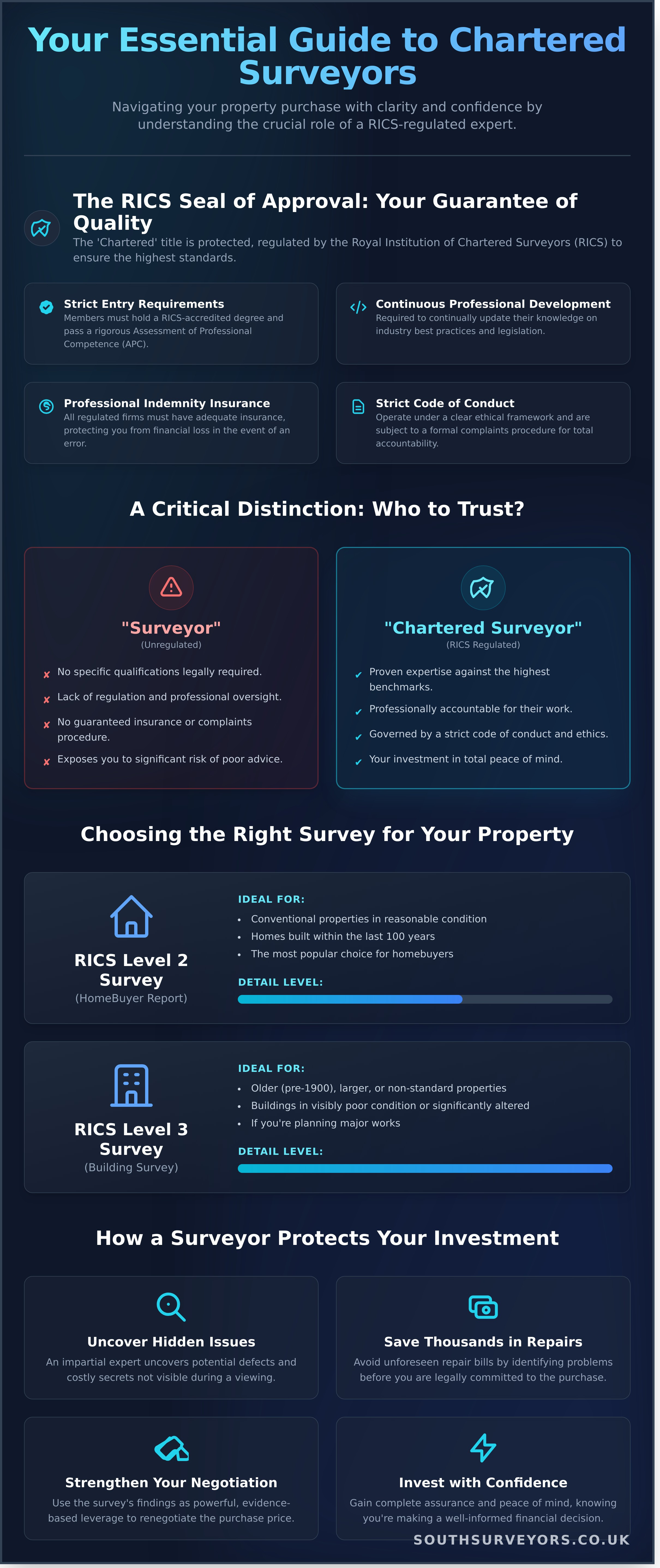
The RICS Seal of Approval: Your Guarantee of Quality
Choosing a RICS-regulated professional is your assurance of quality, expertise, and reliability. This status isn’t easily earned; it’s a testament to a surveyor’s commitment to excellence and client protection. This guarantee is built on several key pillars:
- Strict Entry Requirements: Members must hold a RICS-accredited degree and complete a rigorous Assessment of Professional Competence (APC) to prove their skills.
- Continuous Professional Development (CPD): They are required to continually update their knowledge to stay current with industry best practices and legislation.
- Professional Indemnity Insurance: All RICS-regulated firms must have adequate insurance, protecting you from financial loss in the unlikely event of an error.
- A Strict Code of Conduct: They operate under a clear ethical framework and are subject to a formal complaints procedure, ensuring total accountability.
Surveyor vs. Chartered Surveyor: A Critical Distinction
It’s a crucial point that anyone in the UK can technically call themselves a ‘surveyor’ without specific qualifications or oversight. This lack of regulation can expose you to significant risk, from inaccurate reports to poor advice.
Think of it like the difference between an accountant and a ‘Chartered Accountant’. While one may have experience, the other has proven their expertise against the highest industry benchmarks and is professionally accountable for their work. By choosing a RICS-certified professional, you are investing in peace of mind, ensuring you have the thorough, reliable information needed to proceed with clarity and confidence.
What Does a Chartered Surveyor Do? Key Services Explained
A RICS-regulated chartered surveyor is an impartial property expert, providing clarity and confidence at crucial stages of buying, selling, or managing a property. Their primary role is to conduct a thorough inspection and deliver an expert, evidence-based report on a property’s condition and value. This professional assessment is vital for making informed decisions and avoiding unforeseen repair costs, serving both residential homeowners and commercial property investors across the UK.
The work of a surveyor can be broadly categorised into three key areas: pre-purchase surveys, formal valuations, and other specialist advisory services.
Property Surveys for Home Buyers (RICS Levels 2 & 3)
A pre-purchase survey is designed to give you a comprehensive understanding of the property you intend to buy, highlighting any potential defects or issues before you are legally committed. This insight is crucial for proceeding with confidence, renegotiating the price, or even walking away from a problematic purchase.
- RICS Level 2 Survey (HomeBuyer Report): The most popular choice, ideal for conventional properties built within the last 100 years and in reasonable condition. It provides a summary of the property’s condition and flags significant issues.
- RICS Level 3 Survey (Building Survey): A more detailed and comprehensive inspection suitable for older, larger, or non-standard properties, or any building that is visibly in poor condition or has been significantly altered.
For a detailed comparison, please see our dedicated pages on the RICS Level 2 Survey and RICS Level 3 Survey.
RICS Property Valuations
Distinct from a survey, a RICS Property Valuation is a formal, legally recognised opinion of a property’s market value on a specific date. This is required for various financial and legal purposes, including probate, matrimonial proceedings, Help to Buy loan redemption, and shared ownership schemes. This expertise is so fundamental that government bodies like the UK’s Valuation Office Agency employ surveyors for tax-related assessments. Crucially, a RICS Valuation is for your benefit, unlike a mortgage valuation which is a brief assessment conducted solely for the lender.
Other Specialist Areas
Beyond standard surveys and valuations, a chartered surveyor can provide expert advice on a range of specific property matters. This includes Party Wall awards for when you or a neighbour are carrying out works near a shared boundary, specific defect analysis to investigate issues like damp or subsidence, and reinstatement cost assessments to ensure your property is adequately insured.
The Crucial Role of a Surveyor in Your Property Journey
When buying a property, you assemble a team of experts: a solicitor for the legalities and a mortgage advisor for the finances. A chartered surveyor is the crucial third pillar, responsible for assessing the physical health and condition of your potential home. Their role is to provide you with the clarity and confidence needed to proceed with one of life’s biggest purchases. Regulated by RICS, these professionals adhere to the highest industry standards, and the official definition of a chartered surveyor underscores their extensive qualifications and ethical obligations. They provide an impartial, expert evaluation before you are legally committed, making them an indispensable ally in your journey.
Before You Buy: Uncovering Potentially Costly Defects
A property viewing shows you the potential of a home, but a survey reveals its reality. An expert surveyor is trained to identify serious issues that are often invisible or downplayed during a viewing. These can include:
- Subtle signs of damp or timber decay
- Structural movement and subsidence
- Hidden roofing problems and poor insulation
- Issues with drainage or services
By uncovering these defects early, a comprehensive survey report protects you from discovering unforeseen repair bills amounting to thousands of pounds after you have moved in, providing essential peace of mind.
Protect your investment with a RICS-certified survey.
After the Offer: Gaining Powerful Negotiation Leverage
A survey report is more than just a list of potential problems; it is a powerful negotiation tool. If the survey uncovers significant defects, you are in a strong, evidence-based position to go back to the seller and renegotiate the agreed price. For example, if your report identifies a need for £8,000 of roof repairs, you can use this expert information to request a price reduction. This process frequently saves buyers far more than the initial cost of the report, proving that a professional survey is truly an investment, not just a cost.
How to Choose the Right Chartered Surveyor: A 5-Step Checklist
Selecting the right professional for your property survey is a crucial step, but it doesn’t have to be complicated. By performing some straightforward due diligence, you can ensure you instruct an expert who will provide the clarity and confidence you need to proceed. This simple checklist will guide you to finding a reliable chartered surveyor who protects your investment.
Step 1: Verify Their Professional Accreditation
The single most important check is professional accreditation. A genuine chartered surveyor will hold recognised industry qualifications and adhere to stringent professional standards. Always ensure they can provide proof of their chartered status and demonstrate their commitment to upholding the highest ethical and professional benchmarks. Never instruct anyone who cannot clearly prove their accredited status.
Step 2: Prioritise Local Expertise
A surveyor with in-depth local knowledge is invaluable. They will be familiar with the common property types, building materials, and potential issues specific to the area, such as subsidence related to London clay or regional flood risks. This local insight not only leads to a more thorough inspection but also ensures any property valuation is accurate and reflects the current market conditions.
Step 3: Review Sample Reports and Testimonials
Before committing, ask to see a sample report. A good report is comprehensive yet easy to understand, using clear language, photographs, and a summary of key findings. This gives you confidence in the quality of their work. Also, check for recent, genuine reviews on independent platforms like Google or Trustpilot to see what previous clients have said about their experience and the surveyor’s communication.
Step 4: Ask These Key Questions Before Instructing
A professional firm will be happy to answer your questions and provide complete transparency. Be sure to ask:
- What is your availability and when can the survey be done?
- What is included in the fee and are there any potential extra costs?
- How long will it take to receive the final report after the inspection?
- Will I be able to speak with the surveyor directly to discuss the findings?
Our friendly team is ready to answer your questions.
Step 5: Understand the Fee and Service Scope
While cost is a factor, the cheapest quote is not always the best value. Ensure you receive a clear, written quote that details exactly what is included in the service. A comprehensive survey from an experienced professional can save you thousands of pounds in unforeseen repair costs, making it a worthwhile investment for your peace of mind.
Preparing for Your Survey: What to Expect
Once you’ve instructed your chartered surveyor, the process is designed to be straightforward and provide you with complete clarity and confidence. Understanding what happens next helps manage expectations and removes uncertainty from a crucial stage of your property purchase. From the on-site inspection to your final report, the goal is to empower your decision-making. Typically, the inspection is scheduled within a week, with your comprehensive report delivered 3-5 working days after that.
The Day of the Inspection
On the scheduled day, the surveyor conducts a thorough but non-invasive visual inspection. This means they will assess all accessible parts of the property-from the roof and chimneys down to the drains-without causing damage. They use professional tools like damp meters and binoculars to identify potential issues, but they will not lift floorboards or drill into walls. To ensure the surveyor can focus fully, it is standard practice for the buyer not to attend.
Understanding Your Survey Report
Your survey report is a detailed document, structured for clarity. Most professional reports use a simple ‘traffic light’ system to help you prioritise findings:
- Red: Serious defects requiring urgent investigation or repair.
- Amber: Issues that need attention but are not critical.
- Green: Elements that are in acceptable condition.
Beyond the ratings, the report contains key sections covering the property’s general description, a detailed breakdown of all issues, and professional advice on the next steps. We recommend reading the executive summary first, then focusing on any ‘Red’ rated items to grasp the most significant findings.
The Post-Survey Conversation
One of the most valuable parts of the service is the opportunity to speak directly with your surveyor after you have reviewed the report. This follow-up call is your chance to ask specific questions, understand the context behind certain comments, and discuss the potential implications of the findings. A professional, client-focused chartered surveyor will always take the time to talk you through the report, ensuring you have the real confidence to proceed, renegotiate, or walk away. This commitment to personal, expert guidance is central to the peace of mind we provide at South Surveyors.
Your Next Step to a Confident Property Purchase
Navigating the property market can be complex, but as this guide has shown, your most powerful tool is expert knowledge. Remember that the ‘Chartered’ designation is your assurance of the highest professional and ethical standards, and a thorough survey is a crucial investment that protects you from costly future surprises. By carefully selecting a chartered surveyor, you equip yourself with the critical insights needed to make a truly informed decision, turning uncertainty into confidence.
At South Surveyors, we are committed to providing that clarity and peace of mind. As your local experts in South London and the surrounding areas, our team is regulated by RICS, ensuring you receive a clear, comprehensive report that empowers your next move. We provide the detailed understanding you need to negotiate effectively and invest wisely.
Get a free, no-obligation quote from our RICS Chartered Surveyors today. Let us help you secure your property investment and proceed with the assurance you deserve.
Frequently Asked Questions About Property Surveys
How much does a chartered surveyor cost?
The cost of a property survey in the UK varies depending on the property’s value, size, and the level of survey required. A RICS Home Survey Level 2 typically starts from around £400, while a more comprehensive RICS Home Survey Level 3 (Building Survey) can cost £700 to over £1,500. While this is an upfront expense, investing in a professional survey provides the clarity and confidence needed to proceed, and can potentially save you thousands in unforeseen repair costs.
How long does a property survey take to complete?
The on-site inspection itself can take anywhere from two to eight hours, depending on the size, age, and condition of the property, as well as the survey level. A Level 2 survey on a standard three-bedroom house might take 2-3 hours. After the inspection, your RICS-Certified surveyor will compile their findings into a detailed report. You can typically expect to receive this comprehensive report within 3-5 working days, giving you a clear picture of the property’s health.
What’s the difference between a mortgage valuation and a survey?
This is a crucial distinction. A mortgage valuation is a brief check conducted for your lender to confirm the property is worth the amount you are borrowing. It is not a survey. A property survey, on the other hand, is a thorough inspection carried out for your benefit. It details the condition of the property, highlights any defects, and provides the expert advice you need to make an informed decision and proceed with peace of mind.
Can a chartered surveyor advise on the value of a property?
Yes, absolutely. While the primary function of a survey is to assess condition, most RICS Home Surveys (both Level 2 and Level 3) can include a professional market valuation as part of the service. A qualified chartered surveyor will assess the property against current market conditions to provide an accurate valuation. This expert insight is invaluable for confirming you are paying a fair price and can be a powerful tool for negotiation.
What happens if a chartered surveyor misses a significant problem?
All RICS-regulated surveyors must adhere to the highest industry standards and carry comprehensive Professional Indemnity Insurance. This is your protection. In the unlikely event that a surveyor’s negligence leads to them missing a significant issue that they should have reasonably identified, you may be entitled to compensation. Choosing an RICS-Certified professional ensures accountability and gives you confidence that the inspection will be thorough and reliable.
Should I get a survey on a new-build property?
We strongly recommend it. Even brand-new homes can have defects, ranging from minor cosmetic “snagging” issues to more serious structural problems. An independent survey from a professional surveyor provides an impartial assessment of the build quality before you complete your purchase. This gives you a professionally compiled snagging list to present to the developer, ensuring your new home meets the standards you expect and deserve.
Do I need to be present during the property survey?
It is not usually necessary for you to be present during the inspection. In fact, it allows the surveyor to work methodically and without distraction, ensuring a thorough assessment of the entire property. A key part of our service is communication; your surveyor will typically offer a follow-up call after the inspection to discuss their key findings, answer your questions, and provide the clarity you need to move forward with confidence.