

That charming Victorian terrace in Peckham or the perfect family semi in Bromley… it looks like the dream, right? But what if beneath the fresh paint and Farrow & Ball colour scheme lies a nightmare of damp, dodgy wiring, or structural gremlins just waiting to drain your savings? The fear of inheriting a money pit is real, especially with the high stakes of South London’s property market. This is precisely where a professional building survey transforms from an expense into your most powerful investment protection tool.
Forget the confusion and anxiety. This guide is your key to navigating the entire process with clarity and confidence. We’ll demystify the difference between a Level 2 and a Level 3 survey, reveal what to look out for in properties from Croydon (CR) to Sutton (SM), and show you exactly how to use your report’s findings to gain ultimate negotiation leverage. Get ready to turn uncertainty into empowerment and secure your dream home with total peace of mind.
Key Takeaways
- Discover why your lender’s mortgage valuation isn’t for your protection and what a real property health check actually involves.
- Confidently choose the right RICS survey level for your property, whether it’s a modern Bromley semi or a period terrace in Peckham.
- Learn to spot the common ‘gremlins’ in South London homes, from damp to subsidence, and understand what a professional building survey uncovers.
- Turn your survey report into your most powerful negotiation tool, giving you the evidence to potentially save thousands on your purchase price.
What is a Building Survey (and why isn’t a valuation enough?)
Think of a building survey as a comprehensive health check for what is likely the biggest purchase you’ll ever make. It’s like bringing along a knowledgeable friend-one who happens to be a RICS-certified expert-to lift the floorboards, check the attic, and uncover any secrets the property might be hiding. It’s not about passing or failing; it’s about giving you the clarity and confidence to make a truly informed decision.
A detailed survey can uncover a whole range of issues, some of which, like party wall matters, have their own specific processes. To see the kind of detail involved, this video from fellow Chartered Surveyors explains:
The difference between a Survey and a Valuation
This is where many buyers get caught in the ‘Mortgage Valuation Trap’. Your lender’s valuation is a brisk, 15-minute check designed for one purpose: to ensure the property is worth the money they’re lending you. It protects their investment, not yours. A ‘clean’ valuation won’t tell you if the roof on that dream terrace in Croydon is about to fail. A survey, on the other hand, is a deep dive into the property’s condition for your benefit. It’s a detailed report, regulated by RICS (the Royal Institution of Chartered Surveyors)-the gold standard in property assessment. While we focus on the structure you’re buying, if you want to understand the fundamentals of what surveying is in a broader sense, it’s a fascinating field of measurement and assessment.
Why South London properties need a closer look
South London’s property landscape is wonderfully diverse, but every era has its quirks. From the charming Victorian gems in East Dulwich (SE22) to the modern new-builds popping up in Croydon (CR0), each comes with a unique set of potential issues. Much of the area is built on London Clay, a type of soil notorious for shrinking and swelling, which can lead to subsidence. That’s why local expertise is non-negotiable. A surveyor who knows the common pitfalls in Bromley (BR) or Dartford (DA) postcodes can spot regional trends that a generalist might miss. Skipping a thorough building survey can be a costly mistake-the average repair bill for hidden defects discovered after purchase often runs into thousands of pounds.
RICS Level 2 vs. Level 3: Choosing your property’s ‘Deep Dive’
Once you’ve found a property that feels like ‘the one’, the next step is crucial: choosing the right survey. Think of it as a health check for your future home. The RICS framework offers two main options for buyers, and picking the right one gives you the clarity and confidence to proceed. It’s about matching the level of inspection to the property’s character, age, and condition.
Many people still ask for a ‘Structural Survey’, which is the old-school term for what RICS now officially calls a Level 3 Building Survey. It’s the most comprehensive inspection you can get, but it isn’t always necessary. Let’s break down which survey suits which South London home.
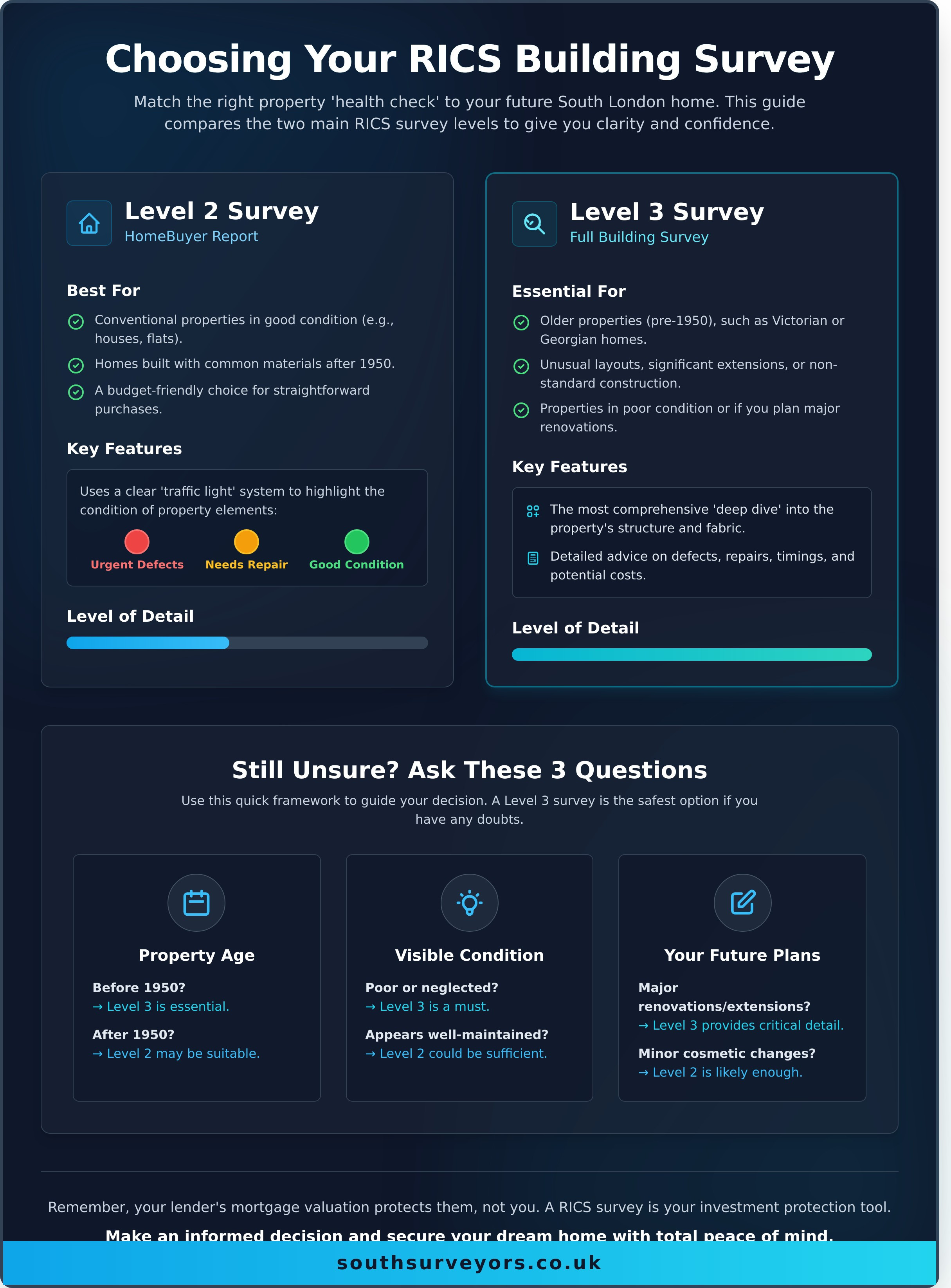
When to choose a Level 2 (HomeBuyer) Report
A Level 2 survey is the perfect fit for conventional properties in good condition, like a post-war semi in Sidcup or a modern flat in Croydon. It’s ideal for homes built after 1950 with standard construction. The report uses a clear ‘traffic light’ system to highlight urgent defects, making it the budget-friendly way to get professional substance and peace of mind on a straightforward purchase in areas like Bromley.
The Full Level 3 Building Survey: For the serious buyer
This is the ‘deep dive’. A Level 3 report is essential for older properties, homes with unusual layouts, or anything that looks like a ‘fixer-upper’. If you’re eyeing a Victorian terrace in Dulwich or a Georgian gem in Greenwich that’s seen a few extensions, this is your non-negotiable tool. Our RICS-certified surveyors provide an in-depth analysis of the property’s structure and fabric, complete with detailed advice on repairs, timings, and potential costs. This comprehensive building survey empowers you to negotiate effectively or plan your future works with real confidence.
Still unsure? Here’s a quick framework to help you decide:
- Property Age: Was it built before 1950? Its character and older materials warrant a Level 3 inspection.
- Condition: Is it visibly in poor condition or has it been empty for a while? A Level 3 will uncover the full story.
- Your Plans: Are you planning significant renovations, extensions, or structural changes? The detailed insights from a Level 3 building survey are invaluable.
Common ‘Gremlins’ in South London Homes: What we look for
Every period property has a story, and sometimes that story includes a few unwelcome characters. From the charming Victorian terraces of the SE postcodes to the 1930s semis in Morden, each home has potential quirks. A thorough building survey is designed to distinguish between charming character and costly complications, giving you the clarity and confidence to proceed.
Damp and Condensation in Period Properties
One of the most frequent concerns we address is damp. It’s crucial to differentiate between rising damp, which requires professional intervention, and simple lifestyle condensation, common in older homes. We favour a holistic approach: understanding why a wall is wet is better than just injecting it with chemicals. We focus on breathability and ventilation-and we always get under the floorboards to check for timber rot, a silent budget-killer in many South London houses.
Structural Movement and Subsidence
The phrase ‘structural movement’ can sound terrifying, but it’s not always a deal-breaker. South London’s infamous ‘London Clay’ soil, especially prevalent in CR and SM postcodes, shrinks in dry summers, which can affect foundations. Our expert surveyors distinguish between historic settling cracks (often just ‘character’) and active movement that requires a follow-up with a structural engineer. This is a critical part of any comprehensive building survey.
Beyond the foundations, we always look up. The original slate roofs on older properties in areas like Penge and Crystal Palace are often nearing the end of their lifespan. We meticulously inspect the roof covering, structure, and loft space for signs of leaks, failing timbers, or inadequate insulation that could lead to future problems.
Finally, we investigate the issues you can’t see-the hidden gremlins that often lurk in older homes:
- Asbestos: Commonly found in textured coatings (Artex), insulation boards, and floor tiles in properties renovated before 2000.
- Lead Pipes: Still present in many pre-1970s homes, potentially affecting the water supply.
- Dodgy Wiring: Outdated electrical systems, especially from the 1970s, can lack modern safety features like RCD protection and may require a complete rewire.
You’ve got the report-now how do you use it?
The report lands in your inbox, and your heart sinks. A long list of defects, from ‘timber decay’ to ‘potential subsidence’. First, take a breath. No property is perfect, not even that immaculate Victorian terrace in East Dulwich. An RICS Level 3 Building Survey is designed to be exhaustive; its job is to find everything. Think of it less as a list of problems and more as a powerful instruction manual for your potential new home.
Mastering the Art of the Renegotiation
This report is your single most powerful tool for negotiation. Instead of approaching the estate agent with vague concerns, you now have impartial, expert evidence. The key is to be firm but fair. Focus on the significant, unexpected issues-things a typical buyer wouldn’t spot. For instance, a recent client used their report to highlight £25,000 of essential roof and structural repairs on a property in Herne Hill (SE24). Armed with this RICS-backed evidence, they successfully negotiated a £20,000 price reduction. This isn’t about being difficult; it’s about paying a fair price for the property in its true condition.
Creating your 10-year maintenance roadmap
Beyond the purchase, your report is a roadmap for future homeownership. It helps you distinguish between urgent fixes and long-term plans, allowing you to budget effectively. Your surveyor will typically use a traffic-light system to prioritise issues:
- Condition Rating 3 (Red): These are your ‘fix now’ problems. Serious defects demanding urgent attention.
- Condition Rating 2 (Amber): Defects needing repair but not critical. Plan for these in the next 1-5 years.
- Condition Rating 1 (Green): Routine maintenance. No immediate action is needed.
This prioritised list is invaluable. Proactive maintenance on a roof in a DA postcode is always cheaper than an emergency call-out for a leak during a winter storm. Use the detailed descriptions in your building survey to get precise, comparable quotes from trusted South London tradespeople, ensuring you never overpay for repairs. Remember, the goal is to empower you to proceed with clarity and confidence. If you have any questions about a report’s findings, our expert team is always here to help.
Why South Surveyors is your ‘Knowledgeable Friend’ in London
Choosing a surveyor in London can feel like another hurdle in an already stressful process. At South Surveyors, we’re here to change that. We combine the rigorous, professional standards of being RICS-Certified with a genuine passion for South London’s unique architecture. We’re not just here to inspect a property; we’re here to be your knowledgeable friend, giving you the clarity and confidence to make one of life’s biggest decisions.
We believe a comprehensive building survey should empower you, not confuse you. That’s why our reports are written in plain English, designed for real people buying homes, not just for solicitors to file away. And our support doesn’t end when you receive the document. The personal touch is key to our service-our surveyors make a point of picking up the phone to walk you through the findings, patiently answering your questions until you feel completely confident about the property’s condition.
Our Local Footprint: From Islington to Croydon
Our team lives and breathes London. This deep-rooted knowledge of the housing stock across SE, BR, DA, CR, and SM postcodes means we understand the specific challenges of a Victorian terrace in Herne Hill versus a post-war build in Sutton. We deliver a more insightful building survey because we know the area. For a closer look at our approach, check out our RICS Level 3 Building Survey details.
Get your tailored quote today
We provide simple, transparent pricing with no hidden ‘London extras’ to worry about. In a fast-moving market, we also know that speed is crucial. Our efficient service and fast turnaround times are designed to ensure you don’t lose out on that dream flat in Peckham. Ready to move forward with real peace of mind? Contact us for a tailored survey quote and let’s get your South London move off to a confident start.
Your Compass Out of the Property Jungle
Navigating the South London property market, from a Victorian terrace in Crystal Palace to a modern build in Bromley, can feel like an expedition. But as we’ve explored, you’re now equipped with the essential map. The key takeaways are simple: a valuation isn’t a survey, choosing the right RICS level is crucial, and your report is a powerful tool for negotiation and decision-making.
Ultimately, a comprehensive building survey is your single greatest asset for turning uncertainty into empowerment. It’s about buying with your eyes wide open. As RICS-Certified professionals who specialise in South London postcodes (SE, BR, DA, CR, and SM), we’ve provided that clarity for over 500 property purchases, helping new owners proceed with genuine confidence. If you’re a first-time buyer, it’s also worth understanding how first time buyer stamp duty changes in 2026 might affect your budget alongside your survey costs.
Ready to trade property anxiety for peace of mind? Let us be your knowledgeable friend on this journey. Get Clarity and Confidence with a South Surveyors Quote today and take the most important step towards your new home.
Frequently Asked Questions About Building Surveys
Is a building survey really worth the money?
Absolutely. Think of it as a small investment to protect a much larger one. Uncovering a hidden damp issue in a Victorian terrace in East Dulwich or potential subsidence in a Greenwich property before you commit could save you tens of thousands of pounds. A comprehensive survey provides the clarity and confidence to negotiate the price or even walk away from a potential money pit. It’s essential for your peace of mind.
How long does a RICS Level 3 building survey take to complete?
The on-site inspection for a RICS Level 3 survey typically takes between four to eight hours, depending on the property’s size, age, and condition. A larger period property in Bromley will naturally take longer than a modern flat in Croydon. Afterwards, our RICS-Certified surveyor meticulously compiles their findings into a detailed, easy-to-understand report, which you will usually receive within 5-7 working days. We believe in being thorough, not just fast.
Does a building survey cover gas and electricity safety?
While our surveyors are trained to spot visual red flags with services-like old wiring or a dated boiler-a building survey is not a substitute for a certified gas or electrical safety check. The surveyor will assess the general condition and recommend further investigation by a qualified Gas Safe engineer or NICEIC electrician if they have any concerns. This ensures you get a specialist’s opinion where it’s most needed for your safety.
What happens if the survey uncovers serious structural issues?
First, don’t panic. This is precisely why you get a survey! Discovering a serious issue in a Beckenham semi-detached gives you power. Our detailed report will outline the problem and recommend next steps, such as getting quotes from specialists. You can then use this expert evidence to renegotiate the asking price with the seller or, if the issues are too severe, confidently withdraw your offer, saving you from a costly mistake.
Can I attend the building survey with the surveyor?
To ensure our RICS-Certified surveyor can conduct a thorough and uninterrupted inspection, we generally recommend you don’t attend the full survey. However, we’re big believers in clear communication. Many of our surveyors are happy for you to meet them towards the end for a brief summary. We always provide a post-survey phone call to walk you through the key findings and answer any questions, ensuring you get that essential personal touch.
How much does a building survey cost in South London (2026)?
While it’s difficult to give a fixed price for 2026, a RICS Level 3 building survey in South London currently ranges from £900 to over £1,500. The final cost depends on the property’s size, age, and value. For example, surveying a large, older Victorian house in Clapham will cost more than a smaller, modern build in Sutton. Always seek a tailored quote, as the cheapest option is rarely the most comprehensive or reliable. For detailed pricing information and to understand what affects house survey cost in 2026 across South London postcodes, it’s worth getting a comprehensive breakdown before you commit.
Is a building survey the same as a structural engineer’s report?
That’s a great question, and no, they are different. A RICS Level 3 building survey provides a comprehensive ‘health check’ of the entire property, from the roof to the drains. If our surveyor identifies a specific, significant structural concern-like a major crack-they will then recommend you commission a structural engineer’s report. The engineer will perform a deep-dive investigation into that single issue, providing detailed calculations and repair specifications.
Will a survey tell me if the property is worth the asking price?
A RICS Level 3 Survey focuses on the property’s condition, not its market value-that’s the job of a RICS Valuation, which is a separate service. However, the survey findings are your most powerful tool for determining if the price is right for you. By revealing the cost of necessary repairs, our report gives you the critical information needed to decide if the property is a sound investment and provides the evidence to potentially renegotiate.