

On 31 March 2025, the current £425,000 threshold for first time buyer stamp duty is scheduled to drop back to £300,000, potentially adding a £6,250 tax bill to your South London home purchase overnight. It’s enough to make anyone scouting for a Victorian conversion in Crystal Palace or a family starter in Bromley feel a bit lightheaded. You’ve spent years saving every penny, only to find the goalposts are moving just as you’re finally ready to make an offer. We know the “cliff edge” talk from banks and solicitors sounds intimidating, but it doesn’t have to stall your plans.
We’re here to give you the clarity and confidence to master the 2026 rules and potentially save thousands on your first property. This guide breaks down exactly how the new thresholds affect your specific budget, which postcodes from SE25 to CR0 still offer the best tax value, and how to navigate the jargon like a pro. Whether you’re looking in Bexley or Sutton, you’ll finish this article with a clear figure for your move and the peace of mind that comes from being properly prepared by local experts who know the South London market inside out.
Key Takeaways
- Understand the 2026 “magic numbers” for first time buyer stamp duty, including how the £300,000 relief threshold helps you keep more of your hard-earned deposit.
- Master the South London postcode strategy to identify “sweet spot” properties in SE, BR, and CR that fall within the most tax-efficient price brackets.
- Learn to sidestep expensive pitfalls like the “fixtures and fittings” mistake and navigate the unique SDLT rules for shared ownership homes with total confidence.
- Discover why a professional South Surveyors survey is your best insurance policy, ensuring your tax savings aren’t immediately swallowed up by hidden property defects.
- Gain the expert clarity needed to move from “clueless” to “key-holder,” turning complex 2026 regulations into a straightforward roadmap for your first home.
Table of Contents
- What is First-Time Buyer Stamp Duty and Why Does it Exist?
- Calculating the Cost: Stamp Duty Thresholds and Relief in 2026
- The South London Postcode Strategy: Tax Efficiency in SE, BR, and CR
- Common Stamp Duty Pitfalls and How to Avoid Them
- Beyond the Tax: Securing Your Investment with a RICS Survey
What is First-Time Buyer Stamp Duty and Why Does it Exist?
Stamp Duty Land Tax (SDLT) is essentially the government’s slice of your property purchase. Think of it as a one-off “entry fee” paid to HMRC when you buy a home or land worth more than a specific amount in England. While it might feel like a punch to the wallet, this tax helps fund public services. For most people moving into a Victorian terrace in Hither Green (SE13) or a modern flat in Croydon (CR0), it represents one of the largest “hidden costs” alongside your legal fees and a professional RICS-certified survey.
The government offers a “First-Time Buyer Relief” to help people get onto the ladder. This is a discounted rate that makes the first time buyer stamp duty significantly lower than the standard rates paid by movers or investors. It’s designed to give you a competitive edge against landlords in areas like Bromley (BR1) or Sutton (SM1), effectively keeping more cash in your pocket for those inevitable post-move IKEA trips.
Am I Officially a First-Time Buyer?
HMRC’s definition is strict; you must have never owned a residential property anywhere in the world. This includes freehold and leasehold interests. A common trap involves “accidental” ownership. If you inherited a 5% share of your grandmother’s cottage in Ireland or were put on the title of a flat in Dartford (DA1) years ago, you likely won’t qualify for the relief. If you’re buying with a partner, both of you must meet these criteria. If one person has owned before, the entire transaction usually reverts to the standard, more expensive rates.
The 2026 Landscape: Why This Year is Different
The 2026 market is operating in a new reality following the threshold changes that kicked in during March 2025. The nil-rate band for first-time buyers dropped from £425,000 back to £300,000, meaning many buyers in South East London now face tax bills they wouldn’t have seen two years ago. Waiting for house prices in Peckham (SE15) to dip is a risky game; any small saving on the purchase price can quickly be swallowed by these higher tax obligations. Buying in 2026 requires a meticulous budget that accounts for these settled, higher tax rates from day one to ensure real peace of mind.
When you’re calculating your “move-in” fund, remember that SDLT is just one part of the puzzle. We always recommend balancing your tax bill with the cost of a comprehensive survey. Saving £5,000 on stamp duty is great, but it won’t help if you discover £20,000 of structural issues after you’ve picked up the keys.
Calculating the Cost: Stamp Duty Thresholds and Relief in 2026
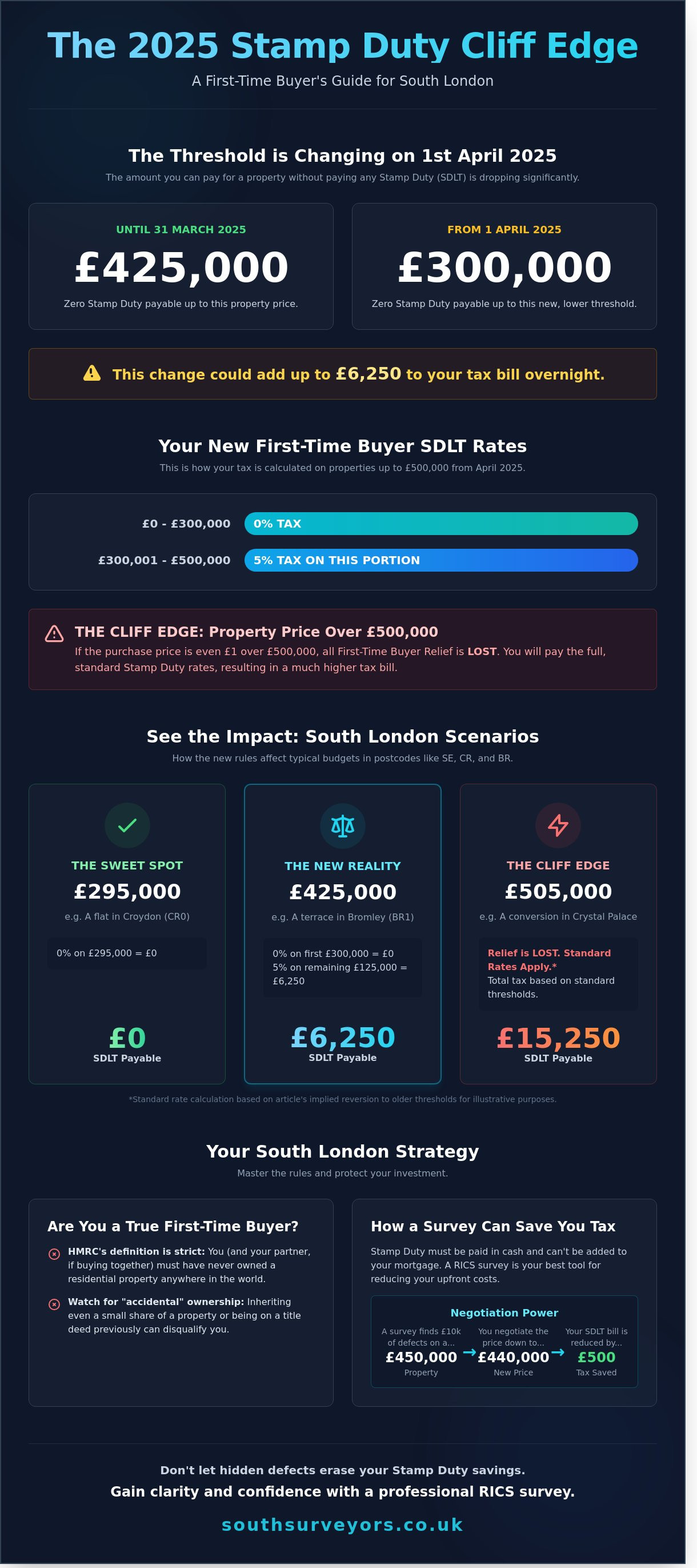
The landscape for first-time buyers shifted significantly on 1 April 2025. While the previous years enjoyed a generous tax holiday, 2026 marks a return to the traditional thresholds. If you’re hunting for a flat in Crystal Palace or a terrace in Dartford, you need to be precise with your numbers. The first time buyer stamp duty relief now only applies to properties priced up to £500,000. If your purchase price climbs even a pound over that limit, the relief vanishes entirely, and you’ll pay standard rates from a much lower starting point.
It’s a sliding scale system, which is kinder than the old “slab” tax. You only pay the specific percentage on the portion of the price that falls within each bracket. However, your mortgage lender won’t let you roll this cost into your monthly repayments. They view the loan as a percentage of the property value alone. This means your tax bill must be ready in cash, sitting in your savings account alongside your deposit and legal fees. Getting clarity and confidence through an early RICS survey can help you negotiate the price down if issues are found, potentially saving you thousands in both repairs and tax.
The 2026 SDLT Rate Breakdown
- 0% on the first £300,000: This is the sweet spot for many starters in postcodes like CR0 or SM1.
- 5% on the portion between £300,001 and £500,000: You only pay this on the amount above the £300k mark.
- The Cliff Edge: Properties priced over £500,000 lose all first-time buyer relief. You’ll pay standard rates starting from the £125,000 threshold instead.
Worked Examples for South London Budgets
Let’s look at how this hits your wallet in the local SE and BR markets. If you pick up a stylish one-bed flat in Croydon (CR0) for £295,000, you’ll pay £0 in first time buyer stamp duty. It’s the ultimate win for your housewarming budget.
If you’re looking at a Victorian terrace in Bromley (BR1) for £425,000, the math changes. You pay 0% on the first £300,000 and 5% on the remaining £125,000. That leaves you with a tax bill of £6,250.
The “Danger Zone” is real in spots like Blackheath (SE3). Imagine finding a home for £505,000. Because you’ve crossed the £500,000 ceiling, you lose all relief. Instead of paying around £10,000, your bill jumps to £15,250 based on standard 2026 rates. That extra £5,000 on the purchase price actually costs you over £10,000 in total cash outlay. Always keep that £500k ceiling in mind during negotiations.
The South London Postcode Strategy: Tax Efficiency in SE, BR, and CR
Your choice of street isn’t just about the nearest sourdough bakery; it’s a calculated financial move. For first-time buyers in 2026, the first time buyer stamp duty relief threshold will stand at £300,000. In South London, strategically choosing your location can significantly impact your upfront costs. It’s about finding that “sweet spot” where property value minimises your tax burden without sacrificing your lifestyle.
- The Boundary Trick: Moving from SE22 (East Dulwich) to SE15 (Peckham) or SE23 (Forest Hill) can shave £40,000 off an asking price. This often pulls the property into a lower stamp duty bracket,
Common Stamp Duty Pitfalls and How to Avoid Them
Buying your first pad in Peckham or a Victorian conversion in Bromley is a massive milestone. However, the excitement of picking out paint swatches can quickly be dampened by a surprise tax bill. One of the most frequent blunders involves ‘Fixtures and Fittings’. You might feel tempted to shave £10,000 off the purchase price by claiming it covers the seller’s high-end kitchen island or fitted wardrobes. HMRC views this as price manipulation. Unless the items are genuinely ‘chattels’ like free-standing fridges or curtains, you risk a stiff penalty. Keep your transaction transparent to ensure your first time buyer stamp duty relief remains valid and undisputed.
Your solicitor is your primary line of defence, but they aren’t infallible. They often juggle dozens of completions across the SE and CR postcodes simultaneously. Mistakes happen. Always ask for a clear breakdown of the calculations well before completion day. If you’re moving into a property in Sutton (SM1) or Dartford (DA1), double-check that they’ve applied the correct thresholds. Since the 2022 mini-budget, these rules have shifted, and being proactive can save you thousands in overpaid tax.
Shared Ownership and SDLT
Shared ownership is a popular route for buyers in areas like Croydon and Sidcup, but the tax rules are unique. You must choose between a ‘Market Value Election’ or paying in stages. Making a Market Value Election means you pay the first time buyer stamp duty on the full property value immediately. This is often cheaper in the long run if property prices in South East London continue to climb. If you pay in stages, you might face a larger bill later when you ‘staircase’ to 100% ownership. Accurate RICS valuations are vital here; they provide the factual basis for your tax calculations and prevent you from overpaying the Revenue.
The Deadline Dash
The final weeks of a property chain in Lewisham or Bexley can be chaotic. Chains often stall because of slow local authority searches or mortgage delays. If you’re banking on a specific tax relief that has an expiry date, missing your completion by just 24 hours could cost you upwards of £5,000. Stamp Duty Land Tax must be paid within 14 days of completion.
Ready to move forward with total peace of mind? Book a professional RICS survey with South Surveyors to ensure your new home is a sound investment.
Beyond the Tax: Securing Your Investment with a RICS Survey
You’ve spent months obsessing over the first time buyer stamp duty thresholds and finally found a spot that fits your budget. While saving thousands on tax is a massive win, it’s a drop in the ocean if you accidentally buy a “money pit” in Croydon (CR) or Dartford (DA). A mortgage valuation is essentially a box-ticking exercise for your lender. It doesn’t tell you if the joists are rotting or the electrics are a fire hazard. To get real clarity and confidence, you need a RICS-certified pro to poke around the property properly.
Level 2 vs Level 3: Which Does Your First Home Need?
Choosing the right survey depends on your target postcode. If you’ve set your sights on a sleek, modern flat in Sutton (SM), a Level 2 HomeBuyer Report is usually plenty. It covers the essentials and flags obvious issues. However, if you’re falling for a drafty Victorian conversion in Crystal Palace (SE19) or a 1930s semi in Bromley (BR), you need a Level 3 Building Survey. This is a deep structural dive. At South Surveyors, we act as that knowledgeable friend who explains the report in plain English, ensuring you aren’t left staring at a 50-page PDF of jargon. We often spend 15 to 20 minutes on the phone after the inspection to make sure you understand every detail.
The Negotiation Power of a Professional Survey
A professional survey isn’t just a cost; it’s a powerful bargaining chip. If our RICS-certified experts find £5,250 worth of urgent roof repairs or damp issues, you can take that report straight to the seller. Asking for a price reduction based on facts is much easier than haggling over “vibes”. In some cases, knocking £10,000 off the price can even pull your purchase price back under a specific first time buyer stamp duty threshold, saving you money twice over.
- Identify hidden defects before they become £20,000 headaches.
- Use evidence-based reports to justify a lower asking price.
- Gain peace of mind that your SE London investment is structurally sound.
Don’t gamble on your biggest ever investment. Get a tailored survey quote for your South London home today and buy with your head as well as your heart. Whether it’s a terrace in SE postcode or a flat in SM, we provide the local expertise you need to move in with total confidence.
Turn Your South London Property Goals into Reality
Navigating the 2026 property market doesn’t have to feel like a high-stakes gamble. While the first time buyer stamp duty landscape has evolved, savvy buyers in postcodes like BR1 or SE22 can still find incredible value. You now have the strategy to calculate your tax bill and avoid the common traps that catch out the unprepared. A tax saving only matters if the house itself is a sound investment. Don’t let a hidden damp issue in a Croydon terrace or a structural quirk in a Bromley semi-detached ruin your finances.
Our team of RICS-Certified Professionals brings hyperlocal expertise to every corner of the SE, BR, DA, CR, and SM postcodes. We’ve earned over 100 five-star reviews by providing the clarity and confidence buyers need to sign on the dotted line. When you’re ready to move from scrolling Rightmove to picking up the keys, ensure you have a meticulous expert in your corner. Book your RICS survey with South Surveyors for total peace of mind. Your new home is a huge milestone; let’s make sure it’s built on solid ground.
Frequently Asked Questions
Can I add stamp duty to my mortgage in 2026?
You can technically add stamp duty to your mortgage if your loan-to-value (LTV) ratio is low enough to accommodate the extra debt. Most lenders in 2026 will be cautious about this because it increases your monthly interest and eats into your equity immediately. If you’re buying a flat in Crystal Palace (SE19) for £450,000, adding the tax to your loan could cost you an extra £4,500 in interest over a 25 year term. It’s usually better to pay it upfront to keep your mortgage rates competitive.
What happens to stamp duty if I’m buying a shared ownership property?
You have two distinct options for shared ownership: pay the tax on the full market value upfront or pay in stages as you buy more shares. Making a “market value election” on a new build in Bromley (BR1) means you won’t pay any more tax even if the property value increases by 15% later. Most buyers who start with a 25% share of a £400,000 home choose to pay in stages to keep their initial costs lower, though this can be more expensive in the long run.
Is stamp duty different for first-time buyers in London compared to the rest of England?
The rates for a first time buyer stamp duty are exactly the same across England, but the high property prices in South London mean you’re more likely to hit the tax thresholds. Currently, you pay nothing on the first £425,000, but this is scheduled to drop to £300,000 after 31 March 2025. In postcodes like SE22 (East Dulwich), where 80% of properties exceed the relief limit, Londoners often face higher bills than buyers in the north of England who stay under the threshold.
Do I pay stamp duty on a property worth exactly £300,000?
You won’t pay any stamp duty on a property priced at exactly £300,000 if you qualify for first-time buyer relief. This is the specific “zero tax” limit that the government intends to return to for everyone from April 2025. Whether you’re looking at a studio in Croydon (CR0) or a terrace in Dartford (DA1), keeping your purchase at this price point saves you £5,000 compared to a buyer who has owned property before.
What if I’ve owned a property abroad but never in the UK?
You lose your first-time buyer status if you have ever owned a residential property anywhere in the world. HMRC is incredibly strict on this rule; if you inherited a small apartment in Italy or bought a flat in Dubai, you’ll pay the standard residential rates. This could add over £6,000 to your moving costs when buying a Victorian conversion in Sutton (SM1) compared to a genuine first-time purchaser who has never held a deed.
How long do I have to pay the stamp duty bill after I get the keys?
You must file your Stamp Duty Land Tax (SDLT) return and pay the full amount within 14 days of completion. Your solicitor typically handles this on the day you move into your new home in Lewisham (SE13) to ensure you don’t miss the deadline. If you fail to pay within this 14 day window, HMRC will issue an automatic £100 penalty and start charging interest on the debt, which is a headache you don’t need while unpacking.
Can a RICS survey help me pay less stamp duty?
A professional RICS survey can help you pay less by providing the evidence needed to negotiate a lower purchase price, which in turn reduces your first time buyer stamp duty. If our surveyors identify £12,000 of structural issues in a Bexley (DA5) semi-detached, and you use that report to drop the price from £430,000 to £418,000, your tax bill could drop significantly. This approach provides real confidence that you aren’t overpaying for the property or the taxman.
What are the stamp duty rates for non-UK residents buying their first home?
Non-UK residents are required to pay a 2% surcharge on top of the standard stamp duty rates. If you haven’t lived in the UK for at least 183 days during the 12 months before your purchase in Sidcup (DA14), this extra charge applies. For a £500,000 home, this means an additional £10,000 bill, though you can often claim this back if you stay in the UK for 183 days in the year following your purchase.