

Last Tuesday, a buyer in SE15 stood on the doorstep of a Peckham terrace ready to exchange, only to find that a “minor” damp patch was actually a £14,500 structural headache hidden by a clever furniture arrangement. It’s the classic South London property nightmare that leaves even the most seasoned buyers feeling vulnerable. You need a professional house survey to ensure your dream home in Bromley or Croydon doesn’t turn into a financial sinkhole.
We understand that the local market moves at a breakneck pace, and the pressure to skip the details in BR or DA postcodes can be overwhelming. You deserve peace of mind before committing your life savings. This guide will help you identify which RICS-certified survey you actually need, how to spot London-specific defects like subsidence or Victorian drainage issues, and how to use your report to negotiate like a seasoned pro. We’re going to demystify the levels of reporting so you can move forward with real confidence and clarity.
Key Takeaways
- Understand why your lender’s quick valuation isn’t a substitute for a detailed structural check-up and how to avoid the common “Mortgage Valuation” trap.
- Decipher the RICS hierarchy to choose the right house survey level, whether you’re eyeing a modern Croydon apartment or a period terrace in Dulwich.
- Identify South London-specific “property gremlins,” including the “London Clay” subsidence risks in SE and CR postcodes and hidden damp issues in Victorian homes.
- Learn how to decode “Red Light” alerts in your report and use professional findings to negotiate thousands off your purchase price with total confidence.
- Discover why a personal follow-up call with your RICS-certified surveyor is the ultimate tool for turning technical jargon into clear, actionable peace of mind.
More Than a Checklist: Why a House Survey is Your Property Survival Tool
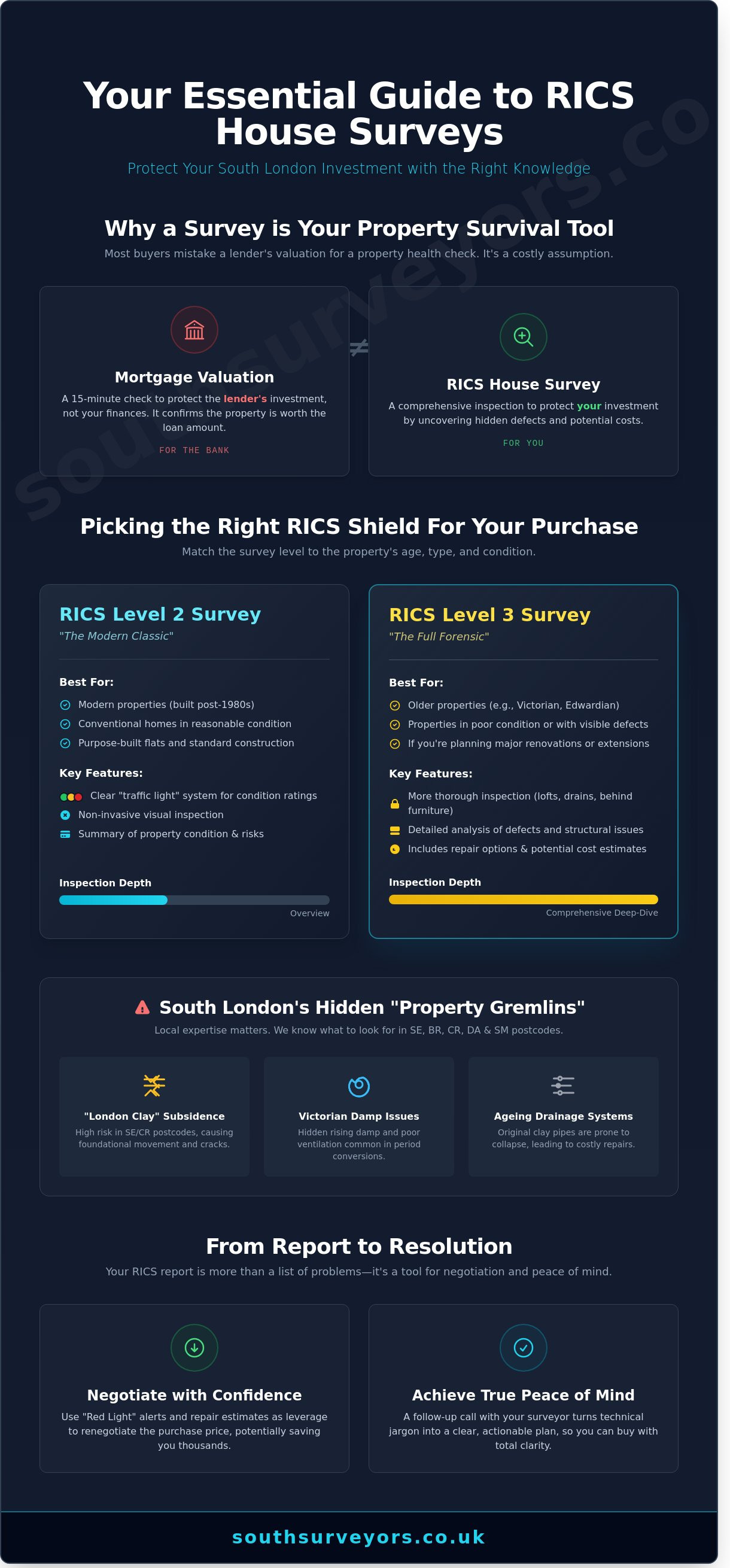
Buying a home in Carshalton or anywhere across the SM postcode area is likely the biggest financial leap you’ll ever take. It’s easy to get swept up in the aesthetic of a Victorian terrace in Bromley or a sleek flat in Peckham, but the real story of a building lives behind the fresh paint. Most buyers mistake the bank’s mortgage valuation for a proper health check. It isn’t. That valuation is a 15-minute tick-box exercise designed to protect the lender’s investment, not your bank balance. If the bank thinks the house is worth the loan, they’re happy, even if the roof is held together by hope and duct tape.
A RICS survey is a comprehensive physical inspection of a property’s condition by a qualified professional. While global standards vary regarding what is a home inspection, the UK system relies on RICS-certified experts to spot the “silent killers” like asbestos or structural movement. Investing in a detailed house survey is your ultimate survival tool, shifting you from a state of property panic to one of clarity and confidence. You deserve to know exactly what you’re signing up for before you exchange contracts.
Why ‘Good Enough’ Isn’t Enough in 2026
By 2026, the cost of building materials and specialist labour has climbed significantly; a major structural issue can now easily set you back 25% more than it would have a few years ago. Spending £500 to £1,000 on a professional house survey today is the smartest insurance policy you can buy against a £20,000 roof failure or a hidden rising damp issue. Whether you’re eyeing a semi-detached in Bromley or a period conversion in the CR postcode, peace of mind is the goal. We ensure you sleep soundly by providing reports that meet RICS regulation, the gold standard for consumer protection in the UK property market.
Surveyor vs. ‘That Mate Who Knows About Houses’
We all have a friend who “knows a bit about DIY,” but a casual walk-through isn’t a substitute for a professional eye. During a 20-minute viewing, you’re looking at the kitchen island; a surveyor is looking at the hairline fracture in the brickwork that suggests the foundations are complaining. There are several reasons to choose a pro:
- The Loft Test: You probably won’t climb into a dusty, cramped loft in your work suit, but a surveyor will.
- Technical Gear: We use moisture meters and high-reach cameras to see what the naked eye misses.
- Legal Weight: A RICS-certified report is a legal document that can be used to renegotiate the purchase price or request repairs.
- Local Expertise: We understand the specific soil conditions and common building quirks found in SE, BR, DA, CR, and SM postcodes.
A professional surveyor sees the “bones” of the building. We don’t just tell you there’s a problem; we explain why it’s there and what it will cost to fix. This level of detail is what transforms a risky gamble into a sound investment, ensuring your move to South East London is the start of a dream, not a financial nightmare.
Level 2 vs. Level 3: Picking the Right RICS Shield for Your Purchase
Choosing a survey shouldn’t feel like a high-stakes game of Sudoku. The Royal Institution of Chartered Surveyors (RICS) keeps things logical with a tiered system. These levels are designed to match the age and “personality” of the property you’re eyeing up in Carshalton or the wider SM5 area. Think of it as the difference between a quick GP check-up and a full-body MRI scan. Both are professional, but one goes significantly deeper into the bones of the building.
The RICS Level 2 Condition Report: The Modern Classic
This is the “go-to” choice for roughly 80% of modern property transactions. If you’re looking at a purpose-built flat in Greenwich or a semi-detached 1990s house in Bexleyheath, a Level 2 house survey is usually your best bet. It provides a professional overview of the property’s condition without getting bogged down in the microscopic details of every single brick.
The standout feature here is the traffic light system. A green rating means everything is fine, amber suggests a repair is needed but isn’t urgent, and red indicates a serious defect requiring immediate attention. It’s a non-invasive inspection. We won’t be lifting floorboards or drilling into walls, but we will give you a clear, RICS-certified snapshot of the property’s health. It’s built for homes in reasonable condition where the structure is predictable and the history is well-documented.
The RICS Level 3 Building Survey: The Full Forensic
When a property has a bit of “character,” a Level 2 report might leave you with more questions than answers. For those stunning Victorian terraces in Dulwich or a quirky converted loft in the SE postcode, you need the Full Forensic. A Level 3 house survey is essential for any property built before 1900 or any home that has undergone significant structural changes, like a basement conversion or a wrap-around extension.
This report is incredibly thorough. We look into the loft, check behind the hatches, and scrutinize the fabric of the building for hidden gremlins like timber rot or structural movement. You also get a “Repair Diary,” which includes estimated costs for necessary works. Knowing that a roof repair in Carshalton might cost you £5,400 before you exchange contracts gives you incredible leverage. It turns a “maybe” into an informed “yes” or a strategic “let’s renegotiate.”
If you’re unsure which level matches your potential new home, you can view our breakdown of services to see which report offers the clarity you need.
Which one fits? A quick mental flowchart
Deciding doesn’t have to be a headache. You can usually find the right fit by asking three simple questions about the property’s history:
- How old is it? If it was built before the 1920s, go Level 3. If it’s a 2015 new-build in Croydon, Level 2 is your winner.
- What’s the condition? If the walls are peeling and the floors feel like a bouncy castle, you need the depth of a Level 3.
- Are you planning a renovation? If you want to knock down walls or add a floor, the Level 3 provides the structural data you’ll need for your architect.
Ultimately, the goal is peace of mind. Whether you’re buying a sleek apartment in SE1 or a family home in the CR postcode, being RICS-certified means we provide a report that lenders and solicitors actually respect. It’s about buying with real confidence, knowing exactly what lies beneath the surface before you commit your hard-earned deposit.
South London Secrets: Common Property Gremlins from Croydon to Greenwich
London Clay is the invisible architect behind many structural headaches in our corner of the city. In SE and CR postcodes, this specific soil type acts like a geological sponge; it expands significantly when wet and shrinks during dry spells. This erratic movement causes 80 percent of subsidence claims across the UK, often showing up as diagonal cracks around window frames or doors that suddenly refuse to close. The specific geology of South London, particularly the shifting clay layers found on the steep slopes of Crystal Palace, creates a high risk of “heave” or subsidence that can compromise the integrity of older foundations over time.
Victorian and Edwardian homes in Dulwich (SE21) offer undeniable charm, but they come with built-in moisture challenges. Most houses constructed before the Public Health Act of 1875 lack a physical damp proof course. You’ll often find that decades of “DIY” landscaping or rising pavement levels have blocked the original sub-floor air bricks. This lack of ventilation leads to timber decay in the floor joists, a common find during a professional house survey in these leafy neighbourhoods. Keeping an eye on the “tide mark” on interior walls is a vital part of your viewing process.
Around Bromley (BR1) and Sidcup (DA14), the 1950s post-war building boom introduced different risks. These properties were often built quickly using “non-traditional” methods to solve the housing crisis. Some utilized pre-cast reinforced concrete (PRC) frames which are susceptible to carbonation. This is a chemical process where the internal steel mesh rusts and expands, eventually cracking the concrete from the inside out. If you’re looking at a 1950s build, you need to know exactly which construction system was used to ensure it’s still mortgageable in 2024.
Postcode-Specific Red Flags
- CR0 and CR2 (Croydon): Many large Victorian villas here were converted into flats during the 1980s. We often find these “cowboy conversions” lack adequate fire separation between floors or have compromised structural walls to make way for open-plan living.
- SM Postcodes (Sutton/Carshalton): The 1930s suburban semis in this area are reaching an age where original clay roof tiles are failing. These tiles typically have a 60 to 90-year lifespan, meaning many Carshalton roofs are now at the end of their natural life.
- SE Postcodes (The Heart of South London): High-density living in Peckham or Greenwich makes Party Wall nuances a major factor. Any structural work requires legal agreements with neighbours, which can add £1,500 to £3,000 to your renovation budget before you even pick up a hammer.
The ‘Hipster Flair’ Property Check
Converted industrial spaces in SE1 or SE16 are the ultimate South London dream, but they weren’t designed for domestic comfort. Surveyors look specifically for “cold bridging” in these trendy warehouses. This happens when original steel beams transfer outside temperatures directly into the home, causing persistent condensation and mould growth behind expensive kitchen units. It’s the classic “Renovation Dream” versus “Structural Nightmare” scenario; a polished concrete floor looks great, but if there’s no insulation beneath it, your heating bills will be astronomical.
Choosing a surveyor who knows the specific street names in Penge or the history of the marshes in Thamesmead is far better than hiring a national firm. Local expertise allows us to identify why one side of a street in Sydenham might be prone to movement while the other side stays rock solid. A detailed house survey provides the clarity you need to negotiate with confidence, ensuring your South London investment doesn’t turn into a financial sinkhole. We pride ourselves on delivering reports that are thorough, easy to understand, and backed by RICS-certified standards.
Decoding the Red Tape: How to Use Your Report to Save Thousands
Opening a 50 page report full of red traffic light ratings can feel like a punch to the gut, especially when you’ve already fallen in love with a Victorian terrace in Carshalton or a 1930s semi in the CR0 postcode. Take a breath. Most properties in South London have issues; it’s the nature of older housing stock. Your house survey isn’t a “no” from the universe. It’s a strategic playbook designed to give you clarity and confidence before you sign that contract.
The first step is simple: don’t panic at the red lights. These indicators highlight items that need urgent attention or further investigation, but they don’t always mean the house is falling down. Often, it’s a prompt to address safety standards that didn’t exist when the property was built. Once you’ve read through, it’s time for the “Phone-a-Friend” moment. At South Surveyors, we don’t just email a PDF and disappear. We encourage a follow-up call to discuss the findings. Speaking with an expert for 15 minutes can often demystify a scary-looking paragraph and help you understand which repairs are “move-in” essentials and which can wait until next summer.
Armed with this professional insight, your next move is gathering quotes. Take the specific wording from your report to local tradespeople in Sutton or Wallington. When a builder sees a RICS-certified report, they know you’re informed. This prevents “estimate creep” and ensures the figures you’re looking at are grounded in reality. You aren’t just guessing that a roof repair costs £5,000; you have the evidence to back it up.
Presenting these findings to an estate agent requires a delicate touch. You don’t want to be a “deal-breaker,” but you do need to be firm. Use the report as a neutral third party. Instead of saying “I want money off,” try “The RICS surveyor identified several urgent issues that weren’t apparent during the viewing.” This shifts the conversation from an emotional demand to a logical business adjustment. Finally, make your decision. Whether you walk away, renegotiate the price, or proceed with your eyes wide open, you’re doing so with total peace of mind.
The Art of the Renegotiation
Language is your most powerful tool during a price haggle. Phrases like “structural defect” or “remedial damp proofing” carry far more weight with sellers than saying the walls look a bit flaky. By leveraging the cost estimates provided in a Level 3 house survey, you can justify a lower purchase price based on objective data. For example, one of our clients recently used their survey findings to save £20,000 on a property in Herne Hill (SE24) after identifying significant timber decay that the seller’s agent had overlooked.
Understanding ‘Further Investigations’
When a surveyor recommends a specialist, it’s a professional safeguard, not a cop-out. In the fast-moving South London market, issues like collapsed Victorian drains or outdated electrical consumer units in SM5 homes are common. A CCTV drain survey or a gas safety check provides the final layer of protection. Managing these extra steps quickly is vital to keeping your purchase on track while ensuring you aren’t buying a financial black hole.
Ready to turn your survey report into a powerful negotiation tool? Book your professional RICS survey with South Surveyors today and buy with absolute confidence.
Clarity and Confidence: The South Surveyors Way
Buying a property in Carshalton should be an exciting milestone, not a descent into a spiral of structural anxiety. When you discover asbestos or any other property defect, you don’t need a cold, corporate entity reciting building codes at you. You need a knowledgeable friend who knows the difference between a minor snag and a genuine deal-breaker. That is where we step in. We combine the rigorous standards of RICS-certified professionals with a personal touch that is increasingly rare in the property industry.
We actually answer our phones. It sounds simple, but in an era of automated queues, it’s a bit of a revolution. Our surveyors, like Jazz Ettienne, are known for calling clients the moment they step off-site to give an immediate verbal debrief. We understand that waiting for a house survey report can feel like an eternity when your mortgage offer is on the line. Our commitment to the South London community spans the SE, BR, DA, CR, and SM postcodes, ensuring we bring deep local context to every inspection we conduct.
The South Surveyors Difference
Our approach blends old-school local expertise with modern technology. We use high-spec equipment to catch what the naked eye misses, yet we deliver our findings in a format that makes sense. You won’t find any jargon-heavy sentences that read like a 1980s VCR manual here. Instead, you get a tailored report with clear, actionable advice. We have successfully completed over 1,500 surveys across South London, maintaining a 4.9-star rating from clients who value our transparency.
- No London Premiums: Our pricing is transparent and reflects the actual work involved. We don’t add hidden fees just because you’re in a sought-after CR postcode.
- Speed Without Shortcuts: We aim for a 72-hour turnaround on digital reports following the physical inspection.
- Real People: You can speak directly to the surveyor who walked through your potential home. They will spend the time needed to answer every question, whether it takes five minutes or thirty.
Ready to Move with Confidence?
The path from “offer accepted” to “keys in hand” is often paved with paperwork and stress. We aim to clear that path. Our booking process is streamlined to take under 120 seconds. Once you provide the property details, we handle the rest, including liaising with estate agents in Carshalton or Sutton to arrange access. This means you can focus on your move while we handle the technical due diligence.
After your house survey is booked, our timeline is predictable. We usually conduct the site visit within 5 working days. You’ll receive a verbal update shortly after the visit, followed by your comprehensive PDF report. This document becomes your strongest negotiation tool, potentially saving you thousands in unforeseen repair costs. Don’t leave your biggest investment to chance or a basic mortgage valuation that barely scratches the surface. You deserve a team that treats your potential home with the same care they would their own.
Take the next step toward a stress-free purchase. Get your tailored survey quote today and move forward with the clarity you need.
Secure Your Slice of South London with Total Peace of Mind
You’ve seen how a Level 3 survey can unmask hidden gremlins in a Victorian terrace in SE10 or a 1930s semi in BR1. Picking the right RICS shield isn’t just a box-ticking exercise. It’s your primary defense against unexpected £10,000 repair bills. Whether you’re eyeing a flat in Greenwich or a family home in Croydon, your report is the ultimate negotiation tool to ensure you don’t overpay. It’s the difference between a dream home and a financial headache.
Investing in a professional house survey is the smartest move you’ll make before exchanging contracts. It turns uncertainty into action by providing the hard facts about your future home’s structural health. As a RICS-Regulated firm with hundreds of 5-star local reviews, we specialize in the unique quirks of South London period properties across the DA, SM, and CR postcodes. We’ll give you the clarity you need to sign that contract with real confidence.
Get Clarity and Confidence-Book Your South London Survey Now
Your future self will thank you for being this prepared. You’ve got this.
Frequently Asked Questions
How much does a house survey cost in South London in 2026?
A house survey in South London for 2026 typically ranges from £550 for a standard flat to £1,650 for a large Victorian terrace. Prices in the CR and SM postcodes reflect the current 4.2% annual inflation in professional property services. While it costs more than a few craft beers, it’s a tiny fraction of the average £520,000 property price in Carshalton. Investing in a RICS-Certified report gives you the clarity to negotiate or walk away.
Do I need a survey for a new-build property in Croydon?
You absolutely need a professional snagging survey for a new-build in Croydon to protect your investment. Even though the CR0 skyline is full of shiny new towers, a 2024 study showed that 91% of new homeowners reported defects upon moving in. Our team identifies issues from cosmetic scuffs to serious structural oversights. Getting an expert eye on your property before you sign ensures the developer fixes the mess on their dime, not yours.
How long does it take to get the survey report back?
You will usually receive your comprehensive report within 3 to 5 working days after the site visit is completed. We know the South East London property market moves at lightning speed, so we don’t keep you hanging. Our surveyors often call you on the same day to provide an immediate verbal summary of the findings. This quick turnaround gives you the confidence to make informed decisions without losing your dream home in the SE postcode shuffle.
Can a house survey fail? What happens if it does?
A house survey cannot technically fail because it’s a factual assessment rather than a pass or fail test. However, if it reveals serious issues like asbestos or subsidence, it might feel like a failure for the sale. In 2025, approximately 65% of buyers used survey findings to renegotiate the sale price or request essential repairs. If the report uncovers a deal-breaker, you have the factual evidence needed to pull out of the transaction safely.
Is a RICS Level 2 survey enough for a 1930s semi in Bromley?
A RICS Level 3 Building Survey is usually the better choice for a 1930s semi-detached home in Bromley. While a Level 2 covers the basics, these BR postcode classics often have hidden extensions or aging roof structures that require a deeper dive. The Level 3 provides a more thorough analysis of the property’s condition. It’s about getting real peace of mind that your suburban dream isn’t hiding a nightmare under the floorboards.
What is the difference between a structural survey and a building survey?
The main difference is that “structural survey” is simply the old-school name for what RICS now calls a Level 3 Building Survey. Many people in the DA postcode area still use the traditional term, but the modern version is far more comprehensive. It covers everything from the chimney pots to the foundations. If you’re buying a fixer-upper or an older property, this is the tailored report that ensures you won’t face unforeseen repair costs later.
Will the surveyor check for Japanese Knotweed in South East London gardens?
Yes, our surveyors specifically look for Japanese Knotweed during every house survey in South East London. This invasive plant affects roughly 5% of properties in the SE and CR areas, and it can be a total headache for mortgage approvals. We check the garden and immediate surroundings for any visible signs of the weed. If we spot those heart-shaped leaves, we’ll flag it immediately so you can seek specialist treatment quotes before committing.
Do I need to be present at the property during the house survey?
You don’t need to be present while the surveyor works their magic, as we usually arrange access directly with the estate agent or vendor. In fact, it’s often easier for our experts to focus without distractions during the inspection. However, we love a good chat afterwards. We make it a point to call you once the inspection is finished to discuss the main findings. This personal touch ensures you get clarity before the report arrives.