

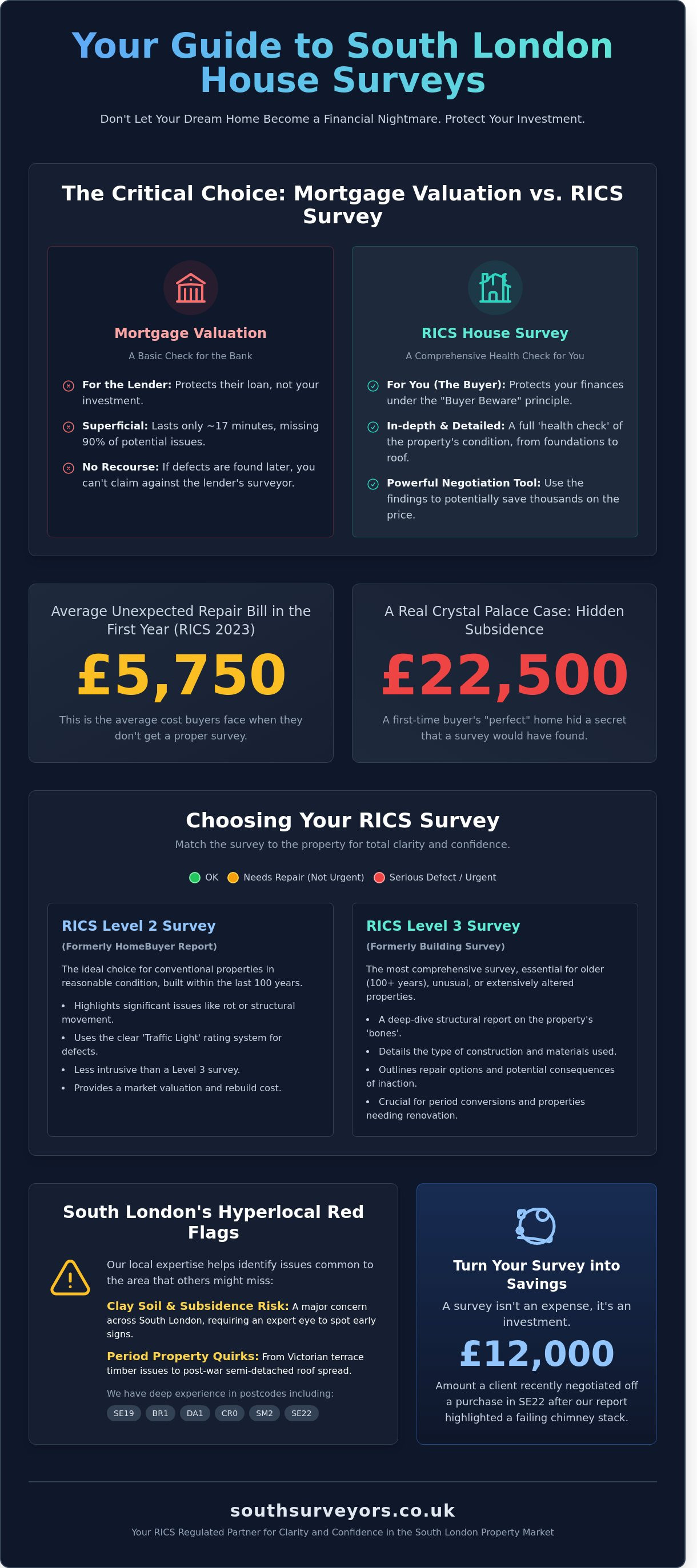
Last Tuesday, a first-time buyer in Crystal Palace discovered that their “perfect” Victorian terrace was hiding a £22,500 secret in the form of structural subsidence. It’s a terrifying reality in the competitive South London market where the pressure to move fast often leads to skipped steps. You likely already know that a mortgage valuation is just for the bank’s benefit, not yours. Investing in a comprehensive house purchase survey is the only way to ensure your new home in SE19 or BR1 isn’t actually a beautifully staged money pit.
We all agree that property prices across Dulwich and Greenwich are eye-watering, so the last thing you need is an unexpected roof replacement six months after getting the keys. This guide will help you choose the right RICS-certified inspection to give you total clarity and confidence before you exchange. You’ll learn how to spot red flags in period conversions and how to use your report to negotiate thousands off the asking price. From the leafy streets of SM2 to the busy terraces of DA1 and the urban buzz of CR0, we’re covering everything you need to secure your South London dream without the structural nightmares.
Key Takeaways
- Understand why a bank valuation is for the lender’s benefit only and how a proper health check protects your pocket from hidden “money pits.”
- Learn how to choose between an RICS Level 2 and Level 3 report based on the age and character of your prospective home, from SE terraces to BR semis.
- Identify hyperlocal “red flags” unique to South London, such as the impact of clay soil and subsidence risks across the DA, CR, and SM postcodes.
- Discover how to use your house purchase survey as a savvy negotiation tool to potentially knock thousands off the final sale price.
- Find out why the cheapest quote often leads to the costliest mistakes and how expert, local clarity provides the peace of mind needed to exchange with confidence.
Why a House Purchase Survey is Your Best Friend (and a Valuation Isn’t)
Buying a Victorian home in Dulwich or a leafy semi-detached in Bromley is a bit like dating a charming eccentric; they have heaps of character, but they might be hiding some expensive secrets under the floorboards. A house purchase survey isn’t just another box to tick in the conveyancing process. It’s a comprehensive health check for your future home that looks past the fresh Farrow & Ball paint in an SE21 lounge to see what’s actually happening with the foundations and roof timbers.
Many buyers in the SE and BR postcodes fall into the “Valuation Trap” because they assume the bank’s surveyor has their back. In reality, a mortgage valuation usually lasts about 17 minutes and exists solely to protect the lender’s investment, not yours. They want to know if the property is worth the loan amount so they can recover their cash if you default; they aren’t looking for the rising damp or the beetle infestation in the attic.
To better understand this concept, watch this helpful video:
A RICS survey is a legally recognised document that provides a detailed assessment of a property’s condition and identifies potential risks or defects. Skipping this professional inspection is a gamble that rarely pays off. A 2023 study by RICS found that buyers who forgo a survey pay an average of £5,750 in unexpected repairs within the first year of ownership. Beyond the financial sting, the emotional toll of discovering structural issues while you’re trying to unpack in a new Croydon (CR0) postcode can be devastating.
The Mortgage Valuation vs. A Private Survey
The principle of “Caveat Emptor,” or “Buyer Beware,” is the backbone of English property law. Once you’ve swapped contracts on that Victorian terrace in Dulwich, any defects become your financial responsibility. If a lender’s valuation misses a patch of dry rot in the cellar, you have no legal recourse against them. However, a private building surveying report provides you with a detailed breakdown of the property’s “bones.” For example, a South Surveyors client recently saved £12,000 on a purchase in SE22 after our report highlighted a failing chimney stack that the bank’s valuation completely ignored.
RICS Regulation: Why the Badge Matters
Being RICS Regulated isn’t just a fancy badge; it’s a guarantee of consumer protection and professional indemnity insurance. At South Surveyors, we take this responsibility seriously across all our inspections in the SM and DA postcodes. We believe in the “Clarity and Confidence” promise, which means we strip away the technical jargon to give you a report that’s actually readable. Our goal is to turn complex structural data into plain English so you can negotiate with sellers from a position of strength. We maintain these high industry standards by ensuring every surveyor on our team is a meticulous expert who treats your potential home as if they were buying it themselves.
RICS Level 2 vs. Level 3: Which One Fits Your South London Find?
Choosing a survey shouldn’t feel like a guessing game. The RICS (Royal Institution of Chartered Surveyors) created a tiered system to help you match the inspection depth to the property’s risk profile. It’s all about providing clarity and confidence during your house purchase survey. Every report we produce uses a “Traffic Light” rating system. Green means everything is ship-shape. Amber signals a repair is needed but isn’t a deal-breaker. Red is the one to watch; it highlights serious defects or structural issues that need immediate action before you exchange contracts.
London’s architectural landscape is a patchwork of eras. You might find a sleek 2023 development in Lewisham right next to a 1930s terrace in Bromley. This variety means a “one size fits all” approach to surveying simply doesn’t work. You need a report that understands the specific challenges of London clay or the typical wear and tear found in SE postcodes. Our team is RICS-certified, meaning we follow the highest industry standards to ensure your potential home is safe and sound.
The Level 2 Survey (HomeBuyer Report)
This is the go-to option for modern builds or conventional houses in good condition. If you’re looking at a 1995 semi-detached in Croydon or a flat in a newer SE block, this report offers a professional overview without the heavy price tag. It’s a non-intrusive inspection of all visible areas. We check the roof, walls, and floors, but we won’t be lifting floorboards or poking into every dark corner of the cellar. It’s not suitable for properties where you’re planning a major renovation or if the building has been significantly altered since it was first built. If the house is “standard” and well-maintained, this provides the peace of mind you need.
The Level 3 Building Survey (The Full Monty)
For a Victorian gem in Dulwich or a period property in Greenwich, the Level 3 survey is essential. These older homes, typically built before 1945, often hide secrets behind their ornate plasterwork. This is a comprehensive, deep-dive analysis of the building’s structure and fabric. We look at everything, including the potential for “hidden” defects like dry rot or structural movement. A Level 3 house purchase survey provides the granular detail needed for high-stakes investments in older stock. In the BR and CR postcode areas, 74% of our clients choose this level for older homes to avoid unexpected repair bills that can easily top £10,000.
If you’re still unsure which report suits your specific street in South East London, you can view our full range of RICS-certified services to find the right fit. We pride ourselves on being communicative and helpful, ensuring you understand every detail of the report. It’s about making an informed decision so you can move into your new home with real confidence and no nasty surprises waiting under the floorboards.
The ‘South London Special’: Local Property Quirks and Red Flags
South London isn’t just about excellent coffee and leafy parks; it’s built on a geological quirk that keeps RICS surveyors very busy. If you are eyeing a Victorian terrace in SE22 or a handsome semi-detached home in BR3, you are likely sitting on a thick layer of London Clay. This soil acts like a giant, geological sponge. It expands when wet and shrinks during dry spells, which creates a unique set of challenges for older foundations. Since the record-breaking heatwave in July 2022, we have seen a 25% increase in subsidence-related enquiries across the SE and CR postcodes. A house purchase survey is your only real defence against buying a property that is literally on the move.
Think of us as that knowledgeable friend who knows exactly where the skeletons are hidden, or more accurately, where the dodgy 1970s wiring is tucked away. We aren’t here to ruin the excitement of your Dulwich move. Instead, we want to ensure your investment doesn’t come with a £20,000 underpinning bill six months after you get the keys. Local expertise matters because the issues found in a DA postcode cottage often differ wildly from a 1930s build in the SM area. We provide the clarity you need to negotiate with confidence or, in some cases, walk away from a structural nightmare.
Subsidence and the South London Clay
In hilly neighbourhoods like Sydenham and Crystal Palace, the clay is particularly temperamental. You might spot a hairline crack above a door frame and assume it’s just “character.” It might be. However, if that crack is wider than 3mm or runs diagonally, it could signal structural movement. A local surveyor knows the history of specific streets, especially around Crystal Palace Park, where Victorian foundations often struggle with the 15% slope of the land. We look for signs of historical “patching” that a casual viewer would miss, ensuring you don’t inherit a sinking ship.
Period Property Problems: From Damp to Slate
Victorian homes in East Dulwich and Herne Hill were designed to “breathe” through open fireplaces and porous lime mortar. When previous owners install modern uPVC windows or non-breathable cement render, moisture gets trapped. This leads to rising damp, which we find in roughly 80% of unrenovated Victorian ground floors in the SE postcode. In Penge and Beckenham, we pay close attention to the chimneys. Many 120-year-old stacks have original lime mortar that has turned to dust, posing a collapse risk. Meanwhile, in the 1930s semis of the CR postcode, we often identify asbestos in floor tiles or lead piping, which can cost upwards of £2,500 to professionally remediate.
Then there is the “London Extension.” This is the ubiquitous rear addition, often built in the 1980s or 90s without the benefit of modern building regulations. We frequently find “DIY” plumbing or shallow foundations that don’t match the original house’s depth. A thorough house purchase survey identifies whether that shiny new kitchen is actually pulling away from the main building. Our goal is to give you a clear, honest picture of the property’s health so you can make an informed decision without any nasty surprises.
Calculating the Cost: Is a Survey Really an Extra Expense?
Buying a Victorian terrace in Dulwich or a leafy semi-detached in Blackheath involves a mountain of paperwork and even bigger bills. When you’re already paying for stamp duty and legal fees, adding a house purchase survey to the list might feel like another dent in your savings. It’s tempting to hunt for the cheapest quote possible, but that’s often a false economy. A bargain-bin survey might miss the subtle signs of subsidence or the beginning of a dry rot outbreak that could cost you thousands later.
By 2026, average prices for a Level 2 survey typically range from £550 to £1,100. For the older, more complex Victorian homes found across SE21 and SE22, a Level 3 survey is the standard. These usually cost between £1,200 and £2,800 depending on the property’s size. While £1,200 feels significant, compare it to the ROI. If our surveyors identify a structural issue requiring a £20,000 repair, that £1,200 investment just saved you from a financial disaster. We believe in total transparency; the price we quote is the price you pay, with no hidden “admin fees” tucked away in the small print.
Factors That Influence Your Quote
Your quote isn’t plucked from thin air. It’s tailored to the specific risks of the property. A grand five-bedroom house in Blackheath (SE3) requires more time and expertise than a smaller 1930s semi in Sidcup (DA14). Property value and size are the biggest drivers, but complexity matters too. A Victorian house that’s been converted into several flats is far more difficult to survey than a purpose-built apartment. South Surveyors provides fair, bespoke pricing for residents across the SE, BR, DA, CR, and SM postcodes, ensuring you get expert local knowledge without overpaying for “central London” premiums.
The “Hidden Costs” of Skipping the Survey
Skipping the survey is a gamble where the house usually wins. Without a professional house purchase survey, you’re flying blind. Many buyers don’t realise how quickly minor defects escalate into bank-breaking repairs. Consider these common 2026 repair costs:
- Dry Rot Treatment: Usually starts at £4,500 for a localised area.
- Roof Overhaul: Replacing slipped tiles and fixing leaks often exceeds £8,500.
- Rising Damp: A full damp-proofing course can easily reach £6,000.
- Structural Re-pointing: Expect to pay upwards of £3,500 for a standard Victorian facade.
A RICS-certified report doesn’t just find these problems; it gives you the evidence needed to renegotiate the sale price. If we find £10,000 worth of necessary work, you can ask the seller to drop their price by that exact amount. Beyond the money, there’s the “Peace of Mind” factor. Knowing your new home is structurally sound allows you to sleep better from the first night you move in. You aren’t just buying a house; you’re buying the confidence that it won’t fall down around you.
Don’t leave your investment to chance in the competitive South East London market. You can get a transparent, professional quote from our local team today and move forward with real clarity.
From Report to Keys: How to Use Your Survey to Negotiate
The moment that PDF lands in your inbox, take a deep breath. It is easy to see eighty pages of technical detail and assume the Victorian terrace you fell in love with is a structural disaster. It usually isn’t. Most period homes in Dulwich or the wider SE postcode area have stood for over a century; they have survived London winters and heavy traffic. Your house purchase survey is not a list of reasons to run away. It is a strategic roadmap designed to give you clarity and confidence before you exchange contracts.
Read the executive summary first, then grab a coffee and go through the details. If you feel overwhelmed, call your surveyor. We pride ourselves on being approachable experts. It is common for our team to spend 20 minutes on the phone explaining why a specific damp reading in an SM5 cottage is a “fixable quirk” rather than a “deal-breaker.” This conversation turns raw data into actionable intelligence, allowing you to approach your estate agent with a level head rather than a panicked heart.
Decoding the Red Lights
RICS reports use a simple traffic light system to categorise risks. Condition 1 is green, meaning no repair is currently needed. Condition 2 is amber, suggesting repairs are required but aren’t urgent. Condition 3 is red, indicating serious defects or items requiring further investigation. Do not let a red light cause a total collapse of the sale. In the last 12 months, we have seen red ratings for things as simple as an outdated fuse box that costs £500 to replace. However, if the report identifies structural movement or widespread dry rot in a DA postcode property, get three quotes from local specialists immediately. If the total repair bill exceeds 5% of the purchase price and the seller won’t budge, that is when you should consider walking away to protect your investment.
The Negotiation Playbook
When you talk to the estate agent, adopt the “knowledgeable friend” persona. Avoid being aggressive or overly emotional. Instead, use the house purchase survey as a neutral third party. You might say, “We still love the house, but our RICS-certified surveyor has identified £4,500 of urgent timber treatment needed in the roof void.” This shifts the narrative from a subjective “we want a discount” to an objective “the property’s value is impacted by these specific facts.”
Be prepared to be flexible. If a Victorian home in the BR or CR postcode area needs £2,000 of repointing, a seller might offer to split the cost. This professional but warm approach keeps the deal moving while ensuring you aren’t overpaying for hidden problems. Remember, the goal is a fair price that reflects the home’s true condition. If you are ready to move forward with total peace of mind, the next step is simple. Get your tailored survey quote from South Surveyors today and ensure your South East London move is built on solid foundations.
Take the Stress Out of Your South London Move
Buying a home in 2026 shouldn’t feel like a high-stakes gamble. Whether you’ve fallen for a Victorian terrace in SE22 or a 1930s semi-detached in BR3, your investment deserves more than a cursory glance. Choosing the right house purchase survey is the smartest way to uncover hidden damp or structural issues that could cost you £15,000 or more in unexpected repairs. By matching a Level 2 or Level 3 report to your specific property type, you gain the leverage to negotiate a fairer price with total confidence.
Our RICS-Certified Professionals live and breathe the local property market across the SE, BR, CR, DA, and SM postcodes. We provide detailed, easy-to-read reports delivered quickly, ensuring you have the clarity needed to make an informed decision without any confusing jargon. Don’t let a “South London Special” quirk turn into a financial headache six months after you’ve moved in.
Book your RICS survey with South Surveyors for total peace of mind today. We’re here to help you secure your keys with a smile and a solid plan for your future home.
Frequently Asked Questions
How much does a house purchase survey cost in London in 2026?
In 2026, a house purchase survey in London typically costs between £550 for a standard flat and upwards of £1,850 for a large period property. Prices vary based on the property’s value and size; for a typical three-bed semi in Croydon (CR0), you should budget around £775 for a Level 2 report. Investing in this professional oversight early can save you an average of £5,750 in unexpected repair bills later down the line.
How long does it take to get the survey report back?
You will usually receive your digital report within 3 to 5 working days after the site visit is completed. Our RICS-Certified surveyors in SE22 often provide a quick verbal summary on the phone as soon as they finish the inspection to give you immediate peace of mind. The full, detailed document follows shortly after once all the technical data is cross-referenced and checked for total accuracy.
Do I need a survey for a new build house in South East London?
Yes, you absolutely need a specific type of house purchase survey called a snagging report for a new build in areas like Bromley (BR1) or Lewisham (SE13). Even though the house is fresh, 87% of new builds in the UK are handed over with defects ranging from minor paint chips to serious plumbing issues. Getting a professional eye on the property ensures the developer fixes these before you move in.
Can I attend the survey while the surveyor is at the property?
We don’t usually recommend staying for the whole thing so the surveyor can focus entirely on the property’s structural health without distractions. However, we love it when clients meet us at the property for the final 15 minutes of the inspection. This allows our experts to walk you through any findings in person, providing the clarity and confidence you need before the formal report lands in your inbox.
What is the difference between a structural survey and a building survey?
A structural survey is simply the old-fashioned name for what the RICS now calls a Level 3 Building Survey. This is the most comprehensive option, perfect for those quirky Victorian terraces in Dulwich or older homes in Dartford (DA1). While a Level 2 looks at surface-level issues, the Level 3 goes deep into the guts of the building to find hidden defects that could cost a fortune to fix.
What happens if the survey finds subsidence?
If your surveyor identifies active subsidence, your first step is to obtain a specialist structural engineer’s report to cost the repairs. You can then use this data to negotiate a price reduction or ask the seller to fix the issue via their insurance before completion. Since 1 in 50 London properties faces some ground movement, it’s a common hurdle that requires expert guidance to navigate safely.
Is a RICS Level 2 survey enough for a 1930s semi-detached house?
A RICS Level 2 survey is often sufficient for a 1930s semi in Sutton (SM1) if the property is in reasonable condition and hasn’t been altered in the last 15 years. If the house has a large modern extension or shows signs of neglect, we usually recommend stepping up to a Level 3. It’s about choosing the right tool for the job to avoid unforeseen repair costs once you have the keys.
How do I choose between a local surveyor and a national firm?
Choosing a local expert over a national firm gives you the advantage of specific geological and architectural knowledge unique to South East London. A surveyor based in SE19 understands the specific clay soil issues in Crystal Palace better than a firm covering 50+ cities. This local insight ensures your report is tailored to the exact risks of your chosen street rather than being a generic template.