

Last Tuesday, a buyer in SE15 fell head over heels for a Victorian conversion, only to realize they had no idea if the damp in the ground floor bay window was their problem or the upstairs neighbour’s responsibility. It’s a classic South London story. Whether you’re eyeing a charming brick-fronted beauty in Bromley or a sleek split-level in Croydon, the lines of ownership are often as tangled as the ivy on an old garden wall. Securing a professional RICS survey for a maisonette is the only way to cut through the confusion before you commit your hard-earned deposit.
We know you’re likely feeling a mix of excitement and genuine anxiety about those “hidden” leasehold costs and who actually fixes the roof when the British weather does its worst. You deserve to move into your new home with total clarity and confidence, not a looming sense of dread about shared repairs. This guide promises to demystify the unique complexities of South London property ownership, from decoding service charges to picking the right survey level for an older conversion. We will break down exactly what your surveyor looks for, how to interpret shared structural responsibilities, and how to use your RICS report to negotiate a price that reflects the true state of the building.
Key Takeaways
- Learn why an RICS survey for a maisonette is your best defense against the unique structural and legal quirks of South London’s “property chameleons.”
- Identify whether a standard Level 2 report or a comprehensive Level 3 survey is right for your specific postcode, from modern SM blocks to older SE conversions.
- Understand the “shared responsibility” trap and how to spot potential roof and damp issues before they become your financial burden.
- Gain hyperlocal insights into specific hazards like subsidence and soil types affecting maisonettes in Bromley (BR1), Croydon (CR0), and Dartford (DA1).
- Discover how to decode professional jargon and use your surveyor’s findings as a powerful tool to negotiate a fair price with total clarity and confidence.
What is an RICS Survey for a Maisonette (and Why is it Different?)
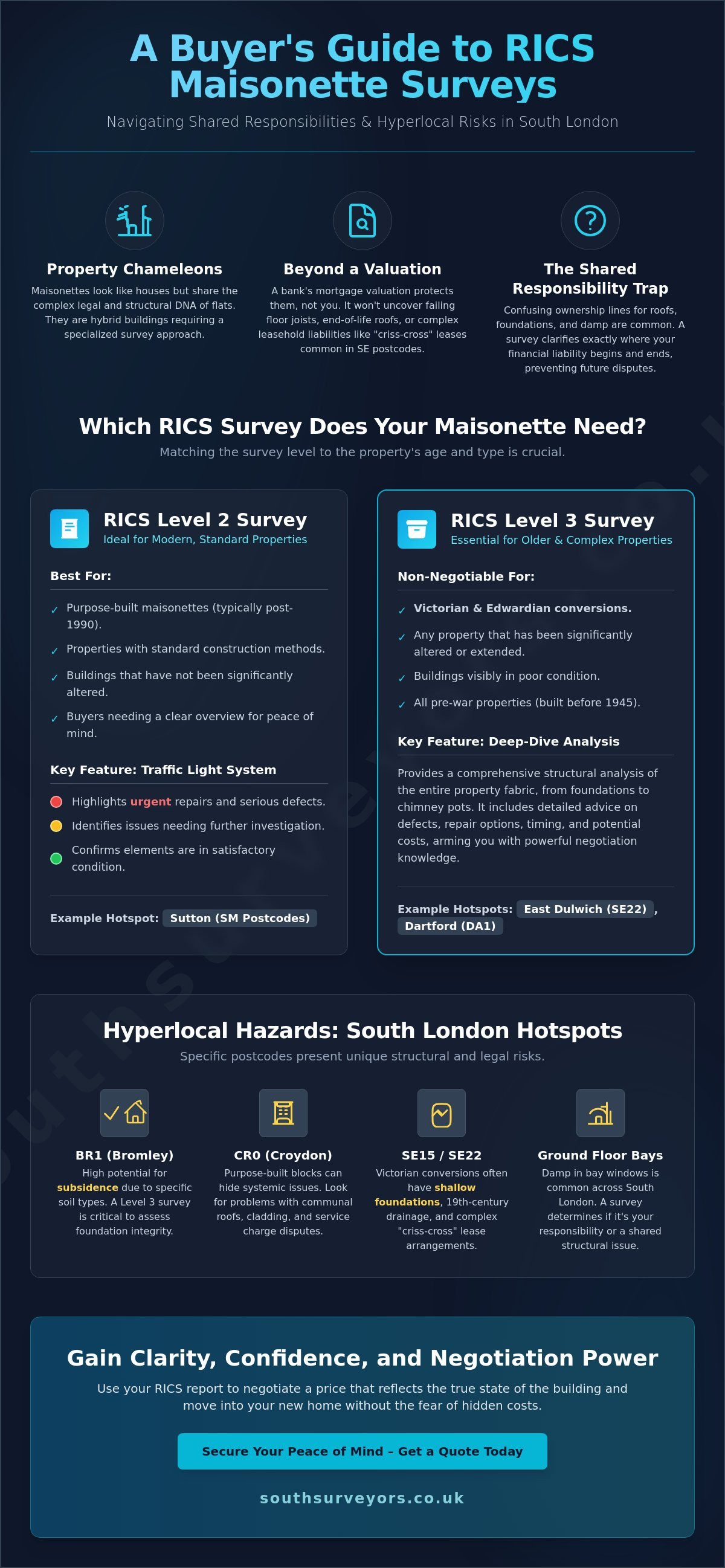
Buying a maisonette in 2026 feels like a savvy move. You get that coveted “own front door” vibe without the eye-watering price tag of a detached house in Chislehurst. However, maisonettes are the chameleons of the South London property market. They look like houses but often share the legal and structural DNA of flats. An RICS survey for a maisonette isn’t just a box-ticking exercise; it’s your protection against the hidden quirks of these hybrid buildings.
Don’t fall into the trap of thinking a mortgage valuation is enough. If you are eyeing a conversion in Bromley (BR1) or a purpose-built block in Croydon (CR0), remember that the bank’s valuation is for their benefit, not yours. It won’t tell you if the Victorian floor joists are failing or if the roof has reached the end of its life. A professional survey provides the clarity and confidence you need before you commit your life savings.
Our work is anchored in the high standards set by the Royal Institution of Chartered Surveyors (RICS). This global professional body ensures that every inspection meets rigorous benchmarks. In a market where UK construction material costs have risen by approximately 4.5% year-on-year since 2024, knowing the exact condition of your potential home is essential for your long-term financial health.
Maisonette vs. Flat: The Surveying Distinction
The main difference lies in the “shell” of the building. In a standard flat, a management company usually handles the exterior. In a maisonette, the lines are often blurred. You might be responsible for your own roof or a specific section of the foundations. Many South London maisonettes share structural elements with terraced houses, meaning an issue next door is often an issue for you. A maisonette survey serves as a hybrid inspection of private and communal elements, ensuring you understand exactly where your liability starts and ends.
Why South London Buyers Need Specific Maisonette Insights
South East London is a hotspot for unique legal and structural arrangements. In postcodes like SE22 (East Dulwich) or SE15 (Peckham), “criss-cross” or Tyneside leases are common. These arrangements mean you might own the freehold to your neighbor’s space while they own yours. Victorian conversions in these areas often hide specific risks, from shallow foundations to 19th-century drainage systems that are struggling to cope. We focus on providing peace of mind, ensuring your dream home in the SE or CR postcode isn’t a “money pit” in disguise. We aim to be your knowledgeable friend on the ground, helping you navigate these local complexities with ease.
Level 2 vs. Level 3: Which Survey Does Your Maisonette Need?
Choosing between a Level 2 and Level 3 survey shouldn’t feel like a high-stakes gamble. It’s really about matching the report to the property’s age and architectural quirks. For a RICS survey for a maisonette, the decision usually boils down to how the building was originally put together. Don’t let the “maisonette” label fool you; these properties can be more complex than a standard semi-detached house because of shared structural elements and unique leasehold responsibilities.
When to Choose a Level 2 Survey
If you’re eyeing a purpose-built maisonette in a modern development in the SM postcode area, like Sutton or Morden, a Level 2 Survey is often your best bet. These properties, typically built after 1990, use standard construction methods that our surveyors know inside out. This report uses a clear “traffic light” system to highlight urgent repairs and safety issues without getting bogged down in the history of the brickwork. It’s a great tool for peace of mind. You can find more detail in our guide on The RICS Level 2 Survey Explained.
When a Level 3 Building Survey is Non-Negotiable
South London is famous for its Victorian and Edwardian conversions. If you’re buying a split-level home in SE22 (East Dulwich) or an older terrace conversion in DA1 (Dartford), you need the “deep dive”. A Level 3 Building Survey is essential for pre-war properties or anything that’s been structurally altered. It provides a thorough analysis of the building’s fabric and offers specific advice on repair options and timing. Check out The RICS Level 3 Building Survey: A Complete Guide for Home Buyers to see why this level of detail is vital for older South London stock.
Think of the survey as a financial safety net. While a Level 3 might cost more than a Level 2, it’s a small price to pay to avoid a £10,000 bill for hidden damp or roof rot. According to the property survey timeline, getting your own inspection is the only way to truly understand what you’re buying before you’re legally committed. At South Surveyors, we don’t just tick boxes. We tailor every RICS survey for a maisonette to account for things like shared roof responsibility and communal entrance maintenance. We want you to move in with clarity and confidence. If you’re unsure which report fits your potential new home, you can chat with our local experts for a bit of friendly advice.
- Level 2: Best for modern builds (post-1990) and properties in good condition.
- Level 3: Essential for older conversions, fixer-uppers, or properties with visible cracks.
- The Goal: Spending a few hundred extra now to save thousands in unforeseen repairs later.
The ‘Shared Responsibility’ Trap: Structural Risks in Maisonettes
Buying a maisonette in South London isn’t quite the same as buying a house or a standard flat. You’re stepping into a “shared responsibility” zone where the lines between your property and your neighbour’s can get blurry. Whether you’re eyeing a Victorian conversion in SE15 or a purpose-built block in CR0, understanding these structural overlaps is vital. A professional RICS survey for a maisonette acts as your early warning system, spotting issues that could lead to expensive legal disputes or repair bills later.
One of the biggest headaches is the roof dilemma. If you’re in a top-floor maisonette in Bromley (BR1) and the roof starts leaking, you might assume it’s your problem alone. However, the lease often dictates that the ground-floor owner must contribute to the cost. Conversely, ground-floor maisonettes in areas like Croydon or Sutton (SM1) often face rising damp because of the heavy London Clay soil. If the damp-proof course has failed, the structural integrity of the entire building is at risk, not just your floorboards.
Surveyors also look out for “flying freeholds.” This happens when part of your maisonette extends over or under a neighbour’s property. In tightly packed South London streets, these overlapping boundaries are common but can cause legal-structural nightmares if one party refuses to maintain their section. In post-war developments across the DA and BR postcodes, we pay close attention to communal walkways and concrete balconies. These access points are often prone to “carbonation,” where the steel reinforcement inside the concrete rusts and expands, creating a serious safety hazard.
Roofs, Gutters, and External Walls
Your surveyor will cross-reference the physical state of the building with your lease terms to identify who is liable for what. Shared chimney stacks and parapet walls are frequent hotspots for defects, often showing signs of weathered pointing or unstable masonry in older SE London properties. Each owner typically holds a legal duty of care to maintain shared structural elements that protect the integrity of the entire building. If the gutters are blocked on the top floor, the resulting damp will eventually hit the ground floor, making it a collective priority.
Internal Alterations and ‘Dodgy’ Conversions
Many maisonettes in South East London have been modernised to create open-plan living spaces. During an RICS survey for a maisonette, we check if load-bearing walls were removed without installing the correct steel beams (RSJs). We also see many “DIY” loft conversions in top-floor units that lack proper building regulations approval; these are often structural “death traps” that lack adequate fire separation. Soundproofing is another hidden issue. Most older conversions don’t meet modern Part E Building Regulations, meaning you might hear every footstep from the neighbour above if the floor hasn’t been properly insulated.
Hyperlocal Hazards: South London Maisonette Hotspots
South London isn’t a monolith. A maisonette in Crystal Palace faces entirely different structural demons than a purpose-built block in Sutton. When you book a RICS survey for a maisonette, you aren’t just paying for a checklist; you’re hiring a property detective who knows how the local geography and history conspire against your brickwork. From the shifting clays of SE22 to the post-war concrete experiments in CR0, every postcode carries a unique set of “house-buying headaches” that require a trained eye to spot.
London Clay and Subsidence in SE22 and SE23
Dulwich and Forest Hill are famous for their leafy streets, but those trees and the underlying London Clay create a volatile mix. This soil type is “shrink-swell” prone, meaning it expands when wet and retracts during dry spells. If your potential home is a Victorian terrace split in East Dulwich, we look for tell-tale signs like stepped cracking in the external masonry or internal doors that suddenly refuse to close. For a deeper dive into what these defects mean for your purchase, check out our Home Survey: A Complete Guide for UK Home Buyers in 2026.
Post-War Purpose-Built Risks in CR and SM
Moving over to Croydon (CR0) and Sutton (SM1), the landscape shifts toward 1930s blocks and 1950s-70s developments. These properties offer great space for your money, but they come with specific technical baggage. Concrete fatigue and historical cladding choices are high on our priority list. In these low-rise blocks, we also scrutinize communal services and fire safety compliance. Since any property built before 2000 has a high probability of containing asbestos in ceiling coatings or floor tiles, we ensure these risks are clearly flagged before you exchange contracts.
The SE, BR, DA, CR, and SM postcodes each tell a different story. In Bromley (BR1) and Dartford (DA1), the soil variety can lead to localized subsidence that might not be obvious to the untrained eye. Meanwhile, the Edwardian splits across South East London often suffer from “DIY-gone-wrong” syndrome, where previous owners removed load-bearing walls without proper structural support. A RICS survey for a maisonette ensures you don’t inherit these expensive mistakes.
- SE Postcodes: Focus on timber decay in Victorian floor joists and roof spread in converted lofts.
- BR and DA Postcodes: Monitoring for foundation movement caused by varying soil moisture levels.
- CR and SM Postcodes: Inspecting flat roof integrity and communal drainage systems in purpose-built blocks.
Local expertise is the difference between a generic report and a document that gives you real leverage. Our surveyors live and breathe these streets, knowing exactly which roads in SE23 are prone to movement and which blocks in SM1 have historical maintenance issues. We provide the clarity you need to move forward with confidence.
Clarity and Confidence: Getting the Most from Your Report
Once your RICS survey for a maisonette lands in your inbox, it’s easy to feel overwhelmed by the technical detail. This document is your most powerful tool in the final stages of a South London property purchase. It transforms vague worries into a clear, actionable roadmap. Instead of guessing if that damp patch in a Bromley conversion is a disaster, you’ll have the facts needed to move forward with real confidence.
One phrase that often causes unnecessary panic is “further investigation recommended.” In surveyor-speak, this doesn’t mean the building is falling down. It usually means the issue falls outside the standard RICS scope, such as a complex electrical system or a specific drainage concern that requires a camera. We don’t want you losing sleep over a potential “red light” when a simple specialist quote could clear the path to exchange.
The Art of the Post-Survey Negotiation
In competitive markets like Herne Hill or Crystal Palace, having a professional report gives you the leverage to talk numbers without sounding like you’re just haggling. If your survey identifies £4,500 worth of urgent roof repairs on a Victorian maisonette, you have a factual basis to ask for a price reduction. Estate agents in the SE24 or BR1 postcodes are far more likely to advise their sellers to accept a lower offer when it’s backed by a RICS-certified professional’s findings.
However, you also need to know when to walk away. While most issues are fixable, major structural subsidence or widespread Japanese Knotweed can be genuine deal-breakers. Your report helps you draw that line in the sand. Using the repair estimates provided, you can decide if the investment still makes sense or if it’s time to keep looking in Croydon or Sutton.
Why Choose South Surveyors for Your Maisonette?
We believe that a survey shouldn’t just be a list of problems; it should be a conversation. South Surveyors prioritises direct communication because we know that a 15-minute phone call can provide more clarity than fifty pages of text. Our team of RICS-certified experts lives and works across the SE, BR, and CR postcodes. We understand the specific quirks of South London maisonettes, from the converted lofts of Dulwich to the purpose-built blocks of Orpington.
Our commitment to “Clarity and Confidence” means we strip away the corporate robot act. We provide thorough, easy-to-understand reports that empower you to make informed decisions. We’re the knowledgeable friend you want in your corner during the most expensive purchase of your life. Ready to take the next step toward your new home? Book your RICS maisonette survey today for total peace of mind.
Secure Your South London Investment with Confidence
Buying a maisonette in areas like Bromley or Croydon isn’t quite the same as a standard flat. You’re dealing with shared roofs and complex structural boundaries that need a sharp eye. Whether you’re eyeing a Victorian conversion in SE19 or a purpose-built gem in SM6, choosing between a Level 2 or Level 3 inspection is the difference between a savvy investment and a money pit. An RICS survey for a maisonette gives you the hard facts you need to negotiate or walk away before you’re tied into expensive repairs. We’ve seen too many buyers in DA1 and CR0 get caught out by shared responsibility traps that a professional should have flagged.
As RICS-regulated experts across the SE, BR, DA, CR, and SM postcodes, we provide the clarity and confidence you need to sign that contract. Our reports are thorough but easy to read, acting as your secret weapon in the competitive South London property market. Don’t leave your future to chance when local expertise is just a click away.
Get a tailored RICS survey quote for your South London maisonette
You’ve done the hard work of finding the perfect place. Now, let’s make sure it’s as solid as it looks.
Frequently Asked Questions
Is an RICS survey for a maisonette more expensive than a flat survey?
The short answer is yes, you can usually expect to pay about 10% to 15% more for a maisonette than a standard purpose-built flat. This is because maisonettes often have their own private entrances, gardens, and individual roof responsibilities that require extra time to inspect. While a flat in a large block shares many structural risks, an RICS survey for a maisonette requires a more detailed look at these specific external features to give you total peace of mind.
Do I need a Level 3 survey for a Victorian conversion maisonette?
If you’re eyeing up a gorgeous Victorian conversion in Crystal Palace (SE19) or Bromley (BR1), don’t skimp here. You definitely need a Level 3 survey for any property built before 1900 or one that has undergone significant structural changes. Data from RICS suggests that 20% of buyers who only get a basic valuation regret not uncovering hidden defects like timber decay or damp before they moved in.
What happens if the survey finds issues with a shared roof?
This is where things get a bit spicy with the lease, but your surveyor will clearly flag the defect and its urgency. Since maisonettes usually share maintenance costs, you’ll need your solicitor to check if the repair bill is split 50/50 or based on your floor area. Spotting a £5,000 roof repair early gives you the clarity and confidence to negotiate the price down before you’re legally committed to the purchase.
Can a surveyor check the loft space in a top-floor maisonette?
Yes, our surveyors will always try to inspect the loft if there’s safe access and it’s not packed to the rafters with boxes. In top-floor maisonettes across Croydon (CR0) or Sutton (SM1), the loft is a prime spot for catching roof leaks or identifying a lack of insulation. If the loft is demised to your property in the lease, checking its condition is vital for your long-term maintenance planning.
How long does it take to get a maisonette survey report back?
We know the South London property market moves at lightning speed, so you’ll typically receive your comprehensive digital report within 3 to 5 working days. Our RICS-certified experts often give you a quick call on the same day as the inspection to chat through the main highlights. This ensures you aren’t left biting your nails while waiting for the full technical breakdown to land in your inbox.
Will the survey cover communal areas like shared gardens or hallways?
The surveyor will perform a visual sweep of communal areas to spot major red flags that could lead to high service charges later. If a shared hallway in a Dartford (DA1) conversion shows signs of movement or neglect, it affects your wallet even if it’s outside your front door. We look at the big picture to make sure you aren’t hit with unexpected communal repair bills shortly after picking up the keys.
Does a maisonette survey include a property valuation?
A standard RICS survey doesn’t include a valuation by default, but it’s a very popular optional extra you can add to the service. Many buyers in the SE postcode find this helpful to ensure they aren’t overpaying in a competitive market. It provides an evidence-based “market value” using recent sales data from the Land Registry for similar properties in your specific neighbourhood.
What if the maisonette has a ‘flying freehold’?
Your surveyor will flag this if a part of your maisonette extends over or under a neighbour’s property without a supporting structure directly beneath it. About 1% of UK properties have this quirk, and while it’s not a deal-breaker, it can make some mortgage lenders a bit twitchy. We’ll provide the technical details your solicitor needs to ensure the right legal protections and covenants are in place for your investment.