

Meta Title: Can I Trust an Online Property Valuation? South London Truths
Meta Description: Wondering “can I trust an online property valuation” for your South London home? Learn why algorithms miss the mark in postcodes like SE and BR and how to get a RICS-ready figure.
What if the £750,000 figure flashing on your smartphone is actually £60,000 wide of the mark? It’s a common worry for homeowners in SE15 or BR1 who find themselves staring at three different prices from three different websites. You’re right to ask, “can I trust an online property valuation?” when making life-changing financial decisions. While these tools are a fun starting point, they often struggle with the unique character of South London streets where one house has a high-spec extension and the neighbor’s remains a time capsule from the seventies.
We know how stressful it feels to worry about overpricing your home while London listings have jumped 16% since March 2026. This guide explains why algorithms miss the mark and how a professional RICS valuation provides the solid number you need for legal or financial peace of mind. You’ll learn the crucial difference between a marketing “asking price” and a formal RICS value, giving you the clarity and confidence to negotiate like a pro in postcodes from DA to SM.
Key Takeaways
- Learn how Automated Valuation Models rely on Land Registry data that is often months out of date, making them better for curiosity than serious calculations.
- Discover why you should ask “can I trust an online property valuation” when your home has unique features, like a high-spec extension, that algorithms are programmed to ignore.
- Understand the hierarchy of property estimates and why a RICS-certified valuation is the only figure you can actually take to the bank for legal or financial decisions.
- Identify why South London’s varied architecture in postcodes like SE and BR requires a human expert to distinguish between a “fixer-upper” and a local gem.
The Allure of the Instant Valuation: How Online Tools Actually Work
We’ve all done it. It’s 11 PM on a Tuesday in Crystal Palace, and you’re scrolling through property sites wondering if that new kitchen finally pushed your home into a higher price bracket. The promise of an instant number is hard to resist. But before you start spending that imaginary equity, you need to ask: can I trust an online property valuation? These tools offer speed and convenience, yet their efficiency is often their biggest weakness when dealing with the nuanced streets of South East London.
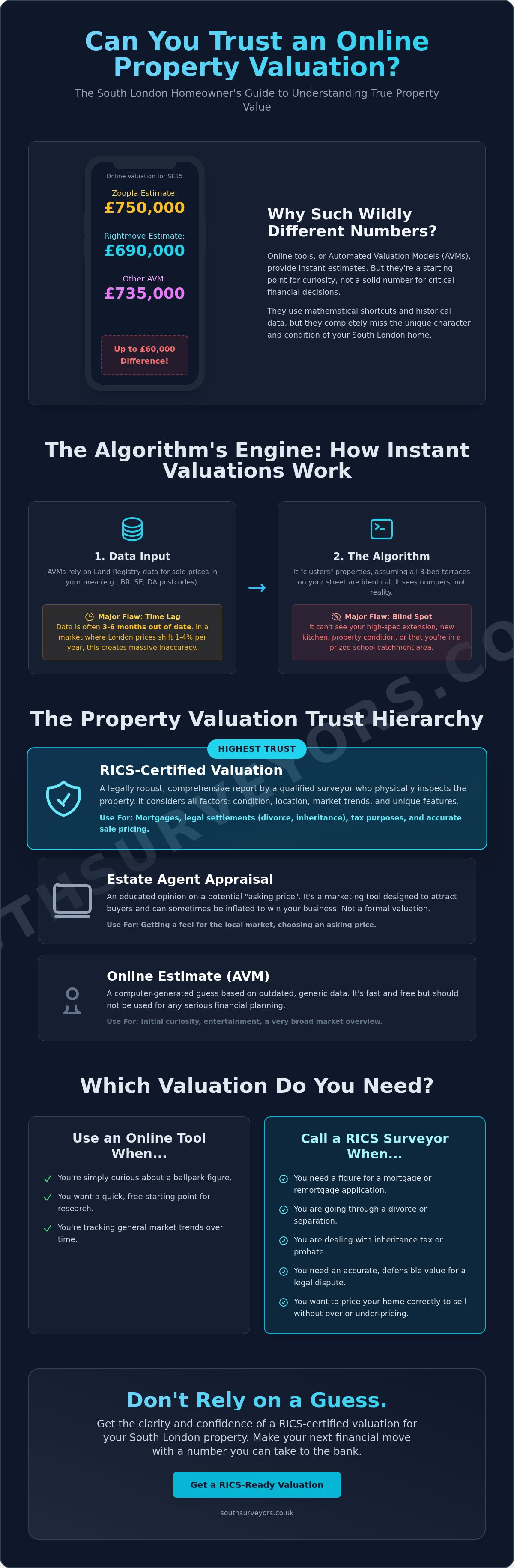
These websites function using a mathematical shortcut known as an Automated Valuation Model (AVM). In simple terms, AVMs are statistical estimates based on historical trends that crunch massive amounts of data without ever stepping foot inside your hallway. They are great for a broad overview, but they don’t know if your SE19 terrace has a damp basement or a designer loft conversion.
To better understand who actually has the authority to value your home, watch this helpful video:
The Data Sources: Land Registry and Postcode Averages
The main fuel for these bots is Land Registry data. While this is the “gold standard” for sold prices, it has a massive Achilles’ heel: the time lag. It typically takes 3 to 6 months for a sale to be registered and appear in the system. In a fast moving market like we’ve seen in early 2026, where London listings rose by 16% year on year by March, three month old data is practically ancient history. If prices are shifting by 1% to 4% as forecasted for this year, that lag can represent thousands of pounds in missed accuracy.
Algorithms also tend to “cluster” properties. They might look at everything in the BR3 or DA1 postcodes and assume a three bed semi on a quiet cul-de-sac is the same as one on a busy main road. They see numbers, not the reality of the school catchment area or the specific desirability of a street in Beckenham. This lack of context is why you’ll often see wildly different estimates for the same front door across different platforms.
Why We Love (and Fear) the Zoopla Estimate
There is a definite psychological rush in seeing a high estimate. It feels like winning the lottery without buying a ticket. Property voyeurism has turned us all into amateur speculators, but there’s a danger in taking these “marketing estimates” as gospel. Estate agency portals use these numbers to drive engagement and keep you on their site, not to provide a figure you can use for a mortgage application or a legal settlement.
When you ask yourself, “can I trust an online property valuation for my divorce or inheritance tax?”, the answer is almost always no. You need a RICS-certified professional who looks at bricks and mortar, not just pixels and patterns. A marketing estimate might help you daydream, but it won’t help you in a courtroom or a bank manager’s office.
The Algorithm Blind Spot: Why Your South London Terrace Confuses the Bots
Algorithms love patterns, but South London streets are anything but predictable. If you live in a Victorian terrace in SE23 or a 1930s semi in BR3, you know that your home’s character is its biggest asset. Unfortunately, that character is exactly what pixel-pushing bots struggle to understand. When asking “can I trust an online property valuation?”, you have to remember that the computer treats every house on the street as an identical unit. It doesn’t know if your home has been lovingly restored or if it’s currently held together by wallpaper and hope.
While publications like Business Matters have discussed the accuracy of online tools, the reality for Londoners is often a “postcode lottery.” For instance, a house in CR0 might be valued similarly to one in SE25 by a bot, yet the micro-markets in these areas can behave very differently based on specific street desirability. Bots see a map; they don’t see the neighborhood soul.
The Renovation Gap: What the Computer Can’t See
Your £60,000 kitchen extension in Dulwich or a high-spec loft conversion in Bexleyheath is effectively invisible to a standard algorithm. Bots assume “average condition” for every property. This means if you’ve spent years perfecting your home, the online estimate will likely undervalue your hard work. Conversely, if a property has hidden issues like subsidence or the damp often found in older SE postcodes, the bot will blissfully ignore them. This gives you a dangerously inflated figure. A computer can’t smell damp or spot a structural crack. It only sees the “sold” data from three doors down.
Hyperlocal Nuance: From Bromley to Bexleyheath
The value of a home in South London is often dictated by things a bot can’t map. In BR2, being 100 yards inside a specific school catchment area can add significant value that an algorithm simply misses. Similarly, proximity to commuter hubs like East Croydon or Dartford station is a massive value driver, but so is the “quiet factor.” A bot doesn’t know if your garden overlooks the serene greenery of Crystal Palace Park or a noisy four-lane main road.
This is where local expertise becomes irreplaceable. A RICS surveyor understands the “why” behind the numbers, providing clarity and confidence that a line of code never could. We don’t just look at data points. We look at the actual bricks, the structural integrity, and the specific street-level demand that defines the London market in 2026.
The Trust Hierarchy: Online Estimates vs. Agents vs. RICS Valuations
Think of property valuations like a tiered system. At the bottom, you have the “curiosity” tier. This is where you find yourself at 1 AM wondering if your house in Bromley is worth more than your neighbor’s. When you ask, “can I trust an online property valuation?” at this stage, the answer is: sure, for a bit of fun. But as you move up the hierarchy toward actually selling or making legal moves, the need for professional substance outweighs the allure of a free algorithm.
The hierarchy moves from automated guesses to marketing appraisals, finally reaching the gold standard of professional assessment. In a market where London listings have hit an eight year high in early 2026, getting your position right in the hierarchy is the difference between a smooth move and a stressful stalemate.
Estate Agents: The “Asking Price” Trap
Next up are estate agent appraisals. If you’ve invited three agents to your semi in Sidcup or your flat in Greenwich, you’ve likely seen a wild range of figures. Agents want your business, and sometimes they use “flattery pricing” to get it. They suggest a high asking price to tempt you into signing an exclusive contract. The danger is real. If the price is too high, your home sits on the market in SE or DA postcodes while buyers move elsewhere. Even worse, if you find a buyer at that high price, the mortgage lender’s own surveyor might “down-value” it later, causing the whole chain to collapse. To understand how a property’s physical state impacts these figures, it helps to see The RICS Level 2 Survey Explained.
RICS Chartered Surveyors: The Professional Standard
At the top of the hierarchy is the RICS Property Valuation. This isn’t a marketing tool; it’s a formal document. Being “Regulated by RICS” means we follow the “Red Book” standard, which is the global benchmark for valuation accuracy. We don’t guess. We use hard evidence from comparable sales and current market conditions as of May 2026. Because we don’t sell houses or earn commission on the sale price, we have no incentive to inflate the number.
This impartiality is exactly why a RICS valuation is the only one accepted for probate, shared ownership, or capital gains tax calculations. At South Surveyors, we prioritize clarity and confidence. We tell you the truth about your property’s value, even if it isn’t the “mansion tax” figure you were hoping for. It’s the difference between a guess and a guarantee. So, if you’re still wondering “can I trust an online property valuation” for your legal paperwork, the answer is a definitive no. Whether you’re in Croydon or Bexleyheath, having a figure you can actually take to the bank is the ultimate peace of mind.
When to Trust the Tech (and When to Run for a RICS Pro)
Technology is a brilliant servant but a terrible master. If you’re just killing time on a rainy Sunday in Sutton, scrolling through local listings to see what the neighbors’ place went for, an online tool is a perfectly fine companion. It gives you a ballpark figure to play with. However, once you move from the “what if” stage to the “what now” stage, the stakes change. When you’re dealing with a £500,000 asset, being “roughly right” could mean losing tens of thousands of pounds. At this point, you have to ask: can I trust an online property valuation for my actual financial future?
The danger of relying on “desktop valuations” or automated guesses is particularly high with South London’s complex period properties. A bot might see two similar sized homes in Sidcup, but it won’t notice that one has a crumbling roof while the other has been retrofitted with the latest ESG sustainability features required by 2026 standards. In a market where London listings have jumped 16% since March 2026, buyers have more choice and are far more likely to negotiate hard on condition.
The “Curiosity” Phase vs. The “Commitment” Phase
Use Zoopla or Rightmove data to inform your initial budget or to get a feel for the market in postcodes like SM or DA. This is the curiosity phase. It’s helpful for deciding if you can afford that extra bedroom or a garden. But when you find “the one” and prepare to make an offer, you need to switch to the commitment phase. This involves moving beyond a screen and getting a professional to look at the actual bricks and mortar. For a deeper dive into the buying journey, check out our Home Survey: A Complete Guide for UK Home Buyers in 2026.
Specialist Valuations: Shared Ownership, Probate, and Help to Buy
There are certain moments where online tools aren’t just inaccurate; they are legally useless. If you are handling a Help to Buy redemption or a shared ownership “staircasing” deal, the housing association or lender will mandate a RICS valuation. They won’t accept a screenshot of a website estimate. Similarly, when dealing with probate for a family home in Bromley (BR1), the Valuation Office Agency (VOA) requires a formal, evidence-based figure. With the new “Mansion Tax” surcharge targeting homes over £2 million based on April 2026 values, having an accurate RICS report is vital to avoid overpaying on tax or facing future legal headaches.
South Surveyors provides the independent expertise and peace of mind you need for these critical filings. We ensure you have a figure that stands up to scrutiny from banks, courts, and HMRC. If you need a figure you can actually take to the bank, it’s time to book a RICS property valuation with our local team.
Clarity and Confidence: Why a South Surveyors Valuation Beats the Bot
Algorithms are great for finding a new playlist or suggesting a movie, but they shouldn’t be the final word on your biggest financial asset. When you finally decide that the answer to “can I trust an online property valuation” is a firm “not for the big stuff,” you need a partner who knows the difference between a Victorian villa in Dulwich and a modern high-rise in Croydon. Pixel-crunching bots can’t replicate the boots-on-the-ground reality of South London life. They see a data point; we see a home.
Our surveyors, including experts like Jazz Ettienne, combine rigorous RICS expertise with a deep understanding of local market rhythms. We don’t just look at what the house next door sold for in January 2026. We look at the structural integrity of your specific property. We check for the subsidence issues common in London clay or the botched DIY “improvements” that an algorithm would mistakenly label as added value. This meticulous approach gives you a report that isn’t just a number, but a detailed explanation of the “why” behind that figure.
Local Expertise Across the SE, BR, and CR Postcodes
South London is a patchwork of micro-markets. A flat in a regenerated pocket of Croydon (CR0) behaves differently than a period home in the leafy streets of Beckenham (BR3). We live and work in these postcodes, meaning we understand the nuances that drive value, from the “quiet factor” of a specific cul-de-sac to the impact of the latest transport upgrades.
We also believe in the personal touch. Property transactions are inherently stressful, and a cold PDF from a website doesn’t help. That’s why we spend time on the phone with our clients, patiently answering questions and explaining how we reached our conclusion. This transparency provides the clarity and confidence you need to negotiate with real power, whether you’re challenging a low mortgage offer or setting a fair price for a family probate matter.
The South Surveyors Guarantee
Choosing a RICS-certified professional means you are protected by the highest industry standards. We are committed to accuracy and accountability, helping you avoid the “money pits” that often hide behind a fresh coat of paint. In a market where London house price growth is forecasted to be a modest 1% to 4% through the end of 2026, every pound matters.
Don’t leave your financial security to a line of code that hasn’t been updated since last quarter. Get a figure that stands up to scrutiny from lenders, solicitors, and tax authorities alike. If you’re ready to move forward with a number you can actually take to the bank, it’s time to Get a RICS Property Valuation you can trust and secure your peace of mind.
Take Control of Your Property Decisions
Your home is likely your biggest investment, and in a market where London listings have surged 16% since March 2026, precision matters more than ever. We’ve explored how lagging Land Registry data and invisible renovations create a “valuation gap” that algorithms simply can’t bridge. While tech is great for late-night scrolling, the question of can I trust an online property valuation for your legal or financial commitments has a clear answer. You need a human expert who understands the specific charm of a SE23 terrace or a BR1 semi.
At South Surveyors, our RICS-Certified Professionals provide the clarity and confidence you need to negotiate with real power. We combine meticulous industry standards with hyperlocal South London expertise to ensure your report is both accurate and useful. You’ll even have direct access to your surveyor to talk through the details, giving you peace of mind that a bot never could. Don’t leave your equity to chance. Get a RICS Property Valuation you can actually trust and move forward with total certainty. You’ve got this.
Common Questions About South London Property Valuations
How accurate are online property valuations in 2026?
Online valuations are generally accurate within a 10% to 20% margin for standard homes but often fail with unique properties. Since Land Registry data lags by 3 to 6 months, these tools miss real-time shifts in the London market. With listings rising by 16% in early 2026, relying on ancient data can lead to a figure that is thousands of pounds away from reality.
Why is my Zoopla estimate so different from my estate agent’s valuation?
Zoopla uses a mathematical model based on averages, while agents use marketing appraisals to win your business. Algorithms don’t see your high-spec kitchen in SE19, and agents might quote a high “asking price” to tempt you into a contract. This gap exists because one is a data-driven guess and the other is a sales tactic.
Can I use an online valuation for a Help to Buy redemption?
No, online estimates are legally invalid for Help to Buy redemptions or shared ownership staircasing. Lenders require a formal report from a RICS-certified professional to ensure the figure is independent and evidence-based. If you’re wondering, “can I trust an online property valuation for legal filings?” the answer is always a firm no, as they lack professional standing.
What do RICS surveyors look at that algorithms miss?
We inspect the physical health of the building, including structural integrity, damp, and roof condition. While an algorithm assumes every home in Bromley is in “average condition,” a surveyor identifies specific defects or luxury improvements. These physical details often sway the final value by 5% to 15%, which a computer simply cannot see from a distance.
Is it worth paying for a RICS property valuation?
It is essential if you are making legal decisions like probate or settling a divorce in postcodes like DA or BR. A professional assessment prevents you from accepting a low offer or overpaying on tax. With the 2026 Mansion Tax surcharge targeting homes over £2 million, an accurate RICS report is a vital tool for protecting your wealth.
How often do online valuations “down-value” a property?
Online tools don’t technically “down-value” homes, but they often set unrealistic expectations that mortgage lenders later reject. Roughly 25% of London sales face a professional down-valuation because the initial online estimate was too optimistic. This causes chains to collapse when the bank’s surveyor provides a more conservative, evidence-based figure than the website suggested.
What is the “Red Book” valuation standard?
The “Red Book” is the mandatory RICS professional standard that ensures every valuation is objective and transparent. It requires surveyors to follow strict rules regarding market evidence and conflict of interest. This is why a Red Book valuation is the only standard accepted by HMRC, major banks, and courts for official financial and legal matters.
Which postcodes in South London are hardest for algorithms to value?
Postcodes with massive architectural variety like SE21 and BR1 are the most difficult for bots to crunch. Because these areas mix sprawling Victorian villas with modern flats, the “postcode average” rarely reflects an individual home’s worth. When you ask, “can I trust an online property valuation in a diverse neighborhood?” the answer is usually no; unique streets require human eyes.