

Did you know that in 2024, eight of the ten local authorities with the highest damp and mould complaints in England were right here in London? If you’re eyeing a Victorian terrace in Lewisham or a charming semi in Bromley, that statistic probably hits home. It’s completely normal to worry that your dream house might be a “money pit” masked by a fresh lick of paint. You’re likely asking, what does a building survey check for damp to ensure you aren’t inheriting a structural nightmare?
We know that the stress of negotiating a price reduction while deciphering technical jargon is enough to keep any buyer awake. This guide promises to demystify the surveyor’s process, from the specialist tools we use to the unique damp issues found in South London’s clay-rich postcodes like SE, CR, and SM. You’ll discover how to use your report as a powerful tool for transparency and empowerment. We’ll preview the difference between a simple ventilation fix and a major project, ensuring you make an informed decision with total confidence.
Key Takeaways
- Learn exactly what does a building survey check for damp, from inspecting the external damp proof course to scanning internal walls with specialist moisture meters.
- Identify the specific moisture “culprits” common in South London, including why groundwater levels in SE and BR postcodes often lead to rising damp in period properties.
- Discover the professional toolkit used during a RICS Level 3 Building Survey to uncover hidden moisture that a simple visual inspection might miss.
- Use your survey findings to move from panic to power by understanding how to negotiate price reductions for necessary repairs before you exchange.
- Gain the confidence to distinguish between minor condensation issues and structural nightmares, saving you from accidentally buying a costly “money pit.”
The Damp “Boogeyman”: Why Surveyors Take Moisture So Seriously
In the competitive world of South London property, damp is the ultimate uninvited guest. Whether you’re falling in love with a Victorian terrace in Camberwell or a leafy semi in Chislehurst, moisture is often the number one red flag we find in our reports. But what exactly is it? At its core, Structural dampness is simply unwanted moisture that has found its way into the fabric of a building. If left unchecked, it doesn’t just peel your wallpaper; it can lead to serious structural decay and health risks for your family.
When clients ask us, “what does a building survey check for damp?” they’re usually worried about the invisible stuff. Our job isn’t just to point at a wet patch and call it a day. We’re here to be your property detectives, identifying the root source of the moisture rather than just the surface symptoms. Identifying whether a damp spot is a minor condensation issue or a failing damp proof course is the difference between a quick fix and a structural nightmare.
To better understand how moisture can be misdiagnosed in these older homes, watch this helpful video:
The Financial Impact of Damp on Your Purchase
Damp isn’t just an aesthetic problem; it’s a financial one that can derail your mortgage application. Lenders in postcodes like SE22 or BR1 take moisture very seriously. If a surveyor flags significant damp, a bank might withhold a portion of your loan until remedial works are carried out. This is where the “money pit” fear becomes reality. The cost of fixing a leaking roof or replacing rotten floor joists can run into thousands, often far exceeding the initial purchase price if you haven’t budgeted for it. By uncovering these issues early, you gain the power to negotiate a price reduction or ask the seller to fix the problem before you sign.
RICS Standards: Level 2 vs. Level 3 Damp Checks
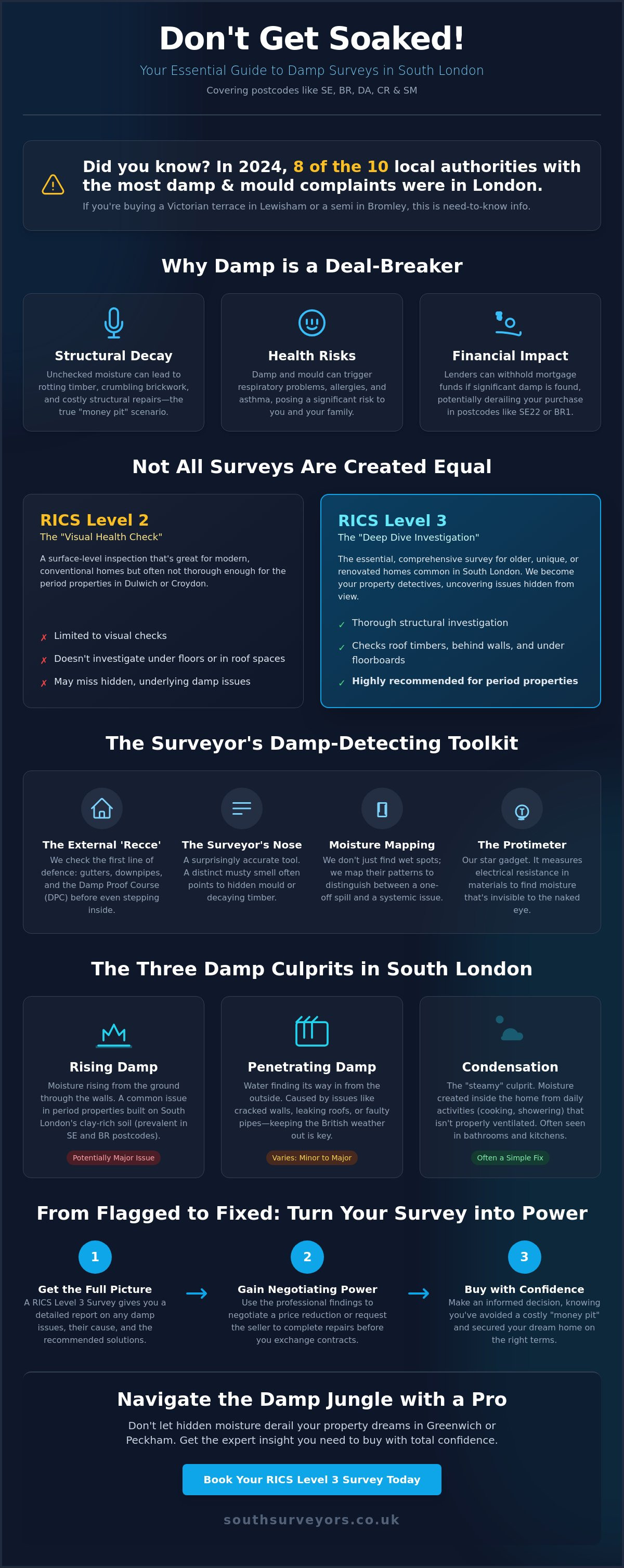
Not all surveys are created equal. A RICS Level 2 Condition Report is essentially a visual health check. It uses surface-level moisture readings but doesn’t go deep into the building’s skeleton. For the period properties found in Dulwich or the sprawling Edwardian homes in Bromley, a Level 2 survey usually isn’t enough. A RICS Level 3 Building Survey is the deep dive you need. It involves a much more thorough investigation of the property’s structure, looking behind the scenes to find where moisture might be hiding in the floorboards or roof timbers. This level of detail is essential for older homes where decades of “quick fixes” might be masking deeper issues.
Behind the Scenes: How a Surveyor Checks for Damp (The Toolkit)
When we arrive at a property in Peckham or a leafy street in Greenwich, the investigation starts before we even step through the front door. We call this the “external recce.” We’re looking at the building’s first line of defence: the gutters, downpipes, and the damp proof course (DPC). If a downpipe is cracked or a gutter is overflowing onto the brickwork, it doesn’t matter how dry the inside looks today; moisture is coming for those walls. So, what does a building survey check for damp when we’re actually on-site? We look for the “plumbing” of the house to ensure the British weather stays exactly where it belongs: outside.
Once inside, we rely on more than just high-tech gadgets. A surveyor’s nose is a surprisingly accurate tool. That distinct, musty smell often points us toward hidden mould or decaying timber long before the visual signs appear. We don’t just look for isolated wet spots; we map the moisture. By identifying patterns, we can tell if a damp patch in a Croydon terrace is a one-off spill or a systemic issue. If you’re feeling a bit overwhelmed by the technicalities of a potential purchase in the SE or BR postcodes, a professional RICS survey is the best way to get the full story without the stress.
The Protimeter: Your Surveyor’s Best Friend
The star of the show is the Protimeter. This handy little device measures electrical resistance in the wall to estimate moisture levels. You’ll often see us scanning walls and watching the display flicker between green, amber, and red. While a “red” reading sounds like a disaster, it’s rarely that simple. High readings can sometimes be caused by conductive salts or foil-backed wallpaper rather than actual wetness. This is why expert interpretation is vital for diagnosing the causes of dampness correctly. We use the meter to find the “danger zones,” but we use our experience to tell you what they actually mean for your wallet.
Visual Clues and Hidden Evidence
We’re also on the hunt for “efflorescence.” These are white, salty deposits that appear on brickwork or plaster when moisture evaporates, leaving minerals behind. They’re a classic calling card for penetrating damp. In older properties across the CR and SM postcodes, we pay close attention to the “tide marks” on skirting boards. These faint lines are often the only visible evidence of rising damp. We aren’t afraid to get our hands dirty either; we’ll check behind heavy furniture and peek under loose floorboards to ensure no “money pit” surprises are lurking in the shadows of your potential new home.
Rising, Penetrating, or Just Steamy? The Three Damp Culprits in South London
Understanding damp in South London is a bit like learning the local bus routes; it’s all about knowing the terrain. When you’re curious about what does a building survey check for damp, you’re essentially asking which of the three main culprits is squatting in your potential new home. In areas like Bromley or Dulwich, the “London Clay” soil plays a massive role. This heavy, moisture-retaining soil stays damp for longer, putting constant pressure on older foundations and contributing to building movement. This movement often creates tiny cracks in the masonry that act as an open invitation for moisture, particularly in the SM and DA postcodes where the ground can shift significantly between a wet winter and a dry summer.
Rising damp is the classic groundwater climb, often found in period homes across the SE postcodes. It’s moisture literally being sucked up the wall like a sponge, usually stopping at about a metre high and leaving a salty “tide mark” in its wake. Penetrating damp, on the other hand, is when the horizontal British weather finally wins a battle against the brickwork in Peckham or East Dulwich. This is usually caused by a specific defect, like a slipped roof tile or a cracked chimney stack, that lets water soak through the external envelope. Then there’s condensation, the “lifestyle” damp that looks scary but often has a much simpler fix than structural failure.
The Victorian Terrace Struggle (SE, BR, and CR postcodes)
Period properties in South East London were built to breathe. These solid brick walls work by absorbing moisture and then letting it evaporate naturally. Problems start when modern “improvements” get in the way. We often see Victorian terraces in the CR postcode where someone has retro-fitted a hard cement render or non-breathable masonry paint. This acts like a plastic bag over the house, trapping moisture inside and forcing it into the internal plaster. We also pay close attention to suspended timber floors. If the air bricks are blocked by a new driveway or flower bed, those beautiful original floorboards can quickly succumb to rot because the air can’t circulate underneath.
Condensation: The Misunderstood Villain
It’s easy to panic when you see black mould in the corner of a bedroom. However, modern life in an old house is often the cause. If you’ve installed tight-fitting PVC windows in a 19th-century cottage without adding trickle vents, you’ve essentially created a sealed box. When we check for damp, we’re looking to see if the moisture is coming from “wet air” (condensation) or “wet walls” (structural ingress). Distinguishing between the two can save you from a massive, unnecessary damp-proofing bill for a problem that could be solved by simply opening a window or installing a better extractor fan in the bathroom.
From Flagged to Fixed: What Happens if Your Survey Finds Damp?
Finding damp in a survey report feels like finding a spider in your bedroom; it’s unsettling, but it doesn’t mean you have to burn the house down. If your report comes back with a few red flags, the first rule is simple: don’t panic. Most moisture issues in South London are entirely solvable with the right expertise and a bit of pragmatism. While we’ve already covered exactly what does a building survey check for damp, the real value of that report is how you use it to protect your bank balance before you exchange contracts.
Think of your survey report as your “poker hand” for the final stages of the purchase. If we’ve identified penetrating damp in a Sidcup semi or rising moisture in a Morden terrace, you now have documented evidence of a liability. Before heading to your solicitor, you’ll need at least three detailed estimates for the repair work. These quotes turn a vague “damp issue” into a concrete financial figure that you can take to the negotiating table. To ensure you’re getting the most thorough investigation possible for your potential home, book a RICS Level 3 Building Survey with our team today.
The “Specialist Damp Report” Trap
Sometimes, we’ll suggest a further “specialist damp report” if the issue looks complex. Be careful here. Many “free” damp surveys offered by contractors are little more than thinly veiled sales pitches for expensive chemical injection treatments. These companies often have a vested interest in finding a problem they can charge you to “fix.” Always look for an independent, CSRT qualified damp surveyor who doesn’t sell the remedial works themselves. Remember, a RICS surveyor is an independent expert; a damp-proofing contractor is a businessman with a product to sell.
Negotiating the Purchase Price in South London
When you present your findings to the estate agent, stay calm and factual. In competitive markets like East Dulwich or Bromley, you might feel pressured to “just get on with it,” but ignoring a £10,000 damp problem is a fast track to a money pit. You have two main routes: asking for a direct price reduction or requesting a “retention,” where a portion of the purchase price is held back by solicitors until the work is completed. However, if the survey reveals systemic structural damp combined with rotting timbers and a failing roof, it might be time to walk away. Some nightmares simply aren’t worth the mortgage.
Navigating the Damp Jungle with a South Surveyors RICS Level 3 Survey
Buying a home in South London is a bit of a marathon, and by the time you’re looking at surveys, you’ve probably already survived the stress of offer letters and estate agent phone calls. Whether you’re chasing a fixer-upper in Forest Hill or a polished 1930s semi in Bexley, you need an expert in your corner who knows the local quirks as well as you know your favourite coffee shop. When clients ask us, “what does a building survey check for damp?” they often expect a dry, technical list of moisture levels. We prefer to think of it as a moisture biography of the house, telling the story of how the building has breathed, aged, and survived the London weather.
At South Surveyors, we’ve built our reputation across the SE and BR postcodes by being the “knowledgeable friend” you can actually talk to. We don’t hide behind corporate jargon or vague disclaimers. Our Level 3 Building Survey: A Complete Guide for Home Buyers explains exactly how we dig into the details that others might miss. We adhere to the highest RICS standards, ensuring that every report we produce is a pillar of trust and reliability for your financial future. It’s about more than just finding wet walls; it’s about providing the emotional security that comes with knowing exactly what you’re buying.
Bespoke Advice for South London Property
Our expertise is rooted in the specific building stock of South East London. We understand the unique challenges of Victorian and Edwardian terraces, as well as the robust 1930s semi-detached homes that define many of our local neighbourhoods. These buildings have personality, but they also have specific ways of handling moisture in the heavy London Clay soil. We don’t just send you a PDF and disappear into the night. One of our signature voice markers is the personal touch; you can actually chat with your surveyor after the inspection to demystify any red flags we’ve found. This direct communication empowers you to make a confident decision on your next home, rather than feeling overwhelmed by a document you don’t fully understand.
Ready to Book Your Peace of Mind?
Our team provides thorough, bespoke inspections across the SM, CR, and DA postcode regions, bringing a meticulous eye to every property we visit. We’ve designed our booking process to be as simple and stress-free as possible, matching the needs of busy Londoners who want professional substance without the corporate robot attitude. If you’re ready to stop worrying about what does a building survey check for damp and start planning your move with total clarity, we’re here to help. Get an instant quote for your RICS Level 3 Survey today and take the first step toward a secure, damp-free future in your new South London home.
Secure Your South London Investment with Confidence
Navigating the property market in postcodes like SE22 or BR1 is a massive achievement, and you’re almost at the finish line. By now, you know that understanding what does a building survey check for damp is about more than just spotting wet patches; it’s about uncovering the hidden history of a home. Whether it’s distinguishing between simple condensation and structural ingress or using a surveyor’s findings to negotiate a fairer price, you are now equipped to avoid the dreaded “money pit.”
Don’t let the fear of hidden moisture dampen your excitement. As an RICS Regulated Firm specializing in South London period properties, we provide jargon-free, bespoke reports that put the power back in your hands. We’re the knowledgeable friends you need to demystify the process and ensure your investment is sound. Ready to move forward with total peace of mind? Book your RICS Level 3 Building Survey with South London’s local experts and get the clarity you deserve. Your future home is waiting, and we’re here to help you step through the front door with a smile.
Frequently Asked Questions
Does a standard RICS Level 2 survey check for damp?
Yes, a RICS Level 2 survey includes a visual inspection and moisture meter readings on all accessible walls. It is designed to identify surface-level issues in modern homes across postcodes like SM or CR. However, it is less invasive than a Level 3 survey and might not uncover deep-seated moisture issues hidden within the structural skeleton of an older property.
Will a surveyor move furniture to check for damp?
Surveyors generally do not move heavy furniture or lift fitted carpets due to health and safety and insurance restrictions. We are property detectives, not a removal crew. We will peek behind wardrobes where there is a gap and use our experience to spot clues in the surrounding area. If we suspect a “money pit” is hiding behind a sideboard in a Greenwich terrace, we will flag it as a limitation in your report.
What is the most common cause of damp found in South London surveys?
Condensation and penetrating damp are the most frequent culprits we encounter during our inspections. When people ask what does a building survey check for damp, they are often surprised to learn that blocked gutters or cracked downpipes in Bromley are more common than actual rising damp. Modern living in older, non-breathable buildings often creates “wet air” that looks like a structural failure but is actually a ventilation issue.
Can I get a mortgage on a house with damp?
You can usually get a mortgage on a property with damp, but your lender might place a “retention” on the loan. This means they withhold a portion of the funds until you prove the damp has been professionally fixed. Lenders in the DA and BR postcode areas are particularly cautious about moisture, so having a clear RICS report helps you manage their expectations and secure your financing without a hitch.
How much does it cost to fix damp found in a survey?
The cost of fixing damp varies wildly depending on whether the solution is a £50 gutter clearance or a £5,000 structural repair. A simple condensation problem might cost nothing more than a new extractor fan. However, replacing rotten floor joists in a Peckham Victorian home is a significant investment. We recommend getting three independent quotes for any remedial works flagged in your survey before you exchange contracts.
Is a “damp-proof course” check included in a building survey?
Yes, checking for a damp-proof course (DPC) is a standard part of our inspection process. We look for physical evidence of a DPC on the external brickwork and check its height relative to the ground level. In many South London period properties, the DPC might be bridged by a new patio or simply non-existent, which is a key detail we highlight to help you avoid future structural decay.
What is the difference between a damp survey and a building survey?
A building survey is a holistic health check of the entire property, while a damp survey is a narrow, specialist inspection. When considering what does a building survey check for damp, remember that we look at moisture in the context of the whole house, including the roof and drains. A specialist damp surveyor only focuses on moisture and often works for a company that sells the remedial treatments, which can lead to a conflict of interest.
How do I know if the damp is rising or penetrating?
Rising damp usually leaves a distinct “tide mark” salt band up to about one metre high on ground floor walls. Penetrating damp is less predictable and appears in patches anywhere on the wall or ceiling, often following a heavy South London downpour. If you see damp patches around windows in East Dulwich or high up on a chimney breast, it is almost certainly penetrating moisture rather than groundwater climbing up.