

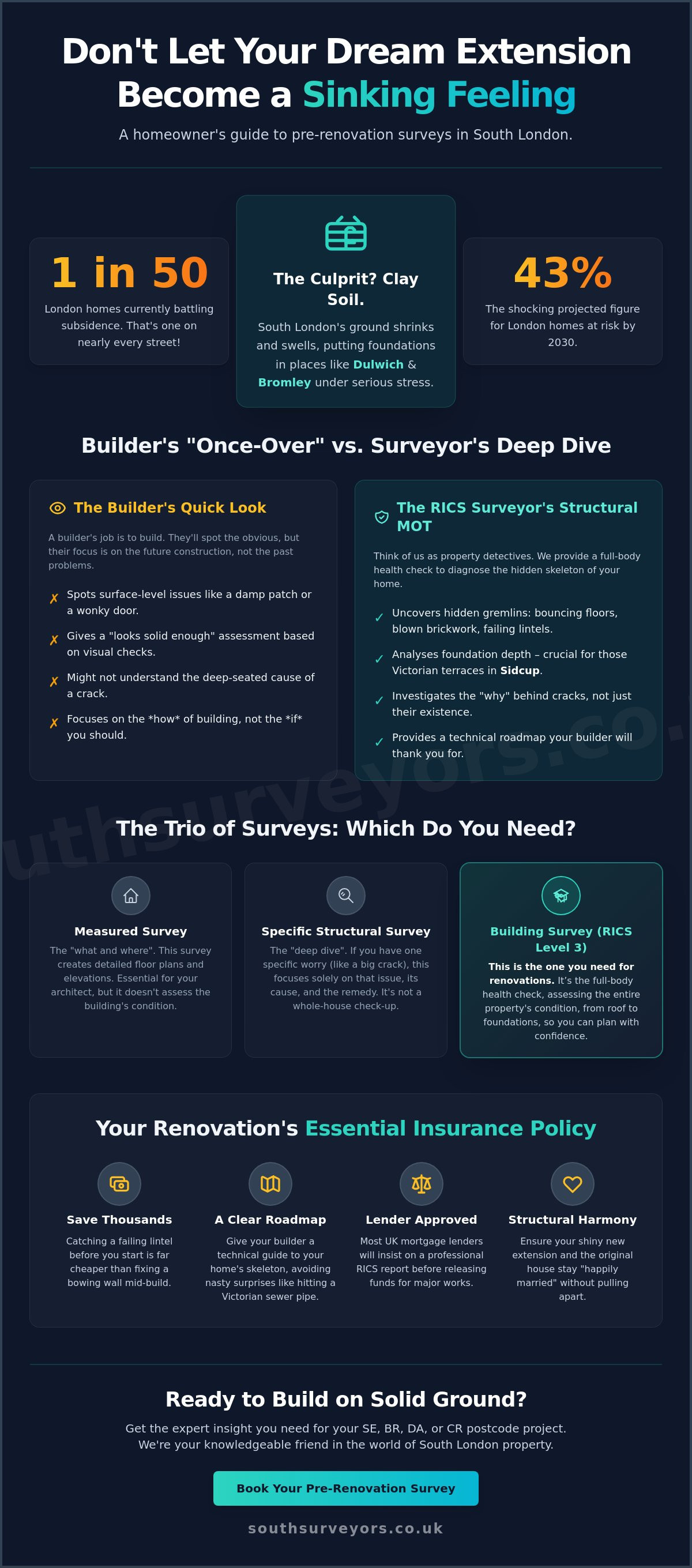
Did you know that one in 50 houses in London is already battling subsidence, with that figure projected to hit 43% by 2030? If you’re dreaming of a sleek glass extension for your Victorian terrace in SE22 or a spacious loft conversion in Bromley, the fear of your home literally sinking or cracking under the pressure is very real. We get it; the last thing you want is for your renovation budget to vanish into a literal hole in the ground. Investing in a building survey for renovation project is less about red tape and more about securing an essential insurance policy for your biggest asset.
We’ve helped plenty of homeowners across the SE, BR, and CR postcodes turn their property dreams into reality without the structural nightmares. You’ve likely heard horror stories about unexpected costs or planning permission hurdles, but we’re here to provide the peace of mind you need. This guide breaks down why a structural assessment is your best friend when dealing with South London’s notorious clay soil. We’ll explore the differences between survey levels, how to satisfy building control, and exactly what you need to ensure your home remains standing strong for another century.
Key Takeaways
- Learn why a builder’s quick “once-over” isn’t enough and why a RICS-regulated health check is the only way to safeguard your Victorian terrace.
- Discover how a building survey for renovation project identifies hidden structural gremlins like bouncing floors or blown brickwork before they become expensive disasters.
- Clarify the confusion between measured, structural, and building surveys to ensure you’re booking the right expert for your specific SE or BR postcode project.
- Get the lowdown on how South London’s unique clay soil affects foundation depth in neighbourhoods from Sidcup to Greenwich.
- Understand how professional accreditation acts as your safety net, ensuring your extension is built on a solid, legally compliant foundation.
Do You Actually Need a Structural Survey for Your Extension?
You’ve found the perfect Victorian terrace in Dulwich or a charming semi in Sidcup, and you’re already picturing the bi-fold doors and the kitchen island. Your builder might have given the place a quick once-over and said it looks “solid enough,” but a builder is there to build, not to diagnose the hidden skeleton of your home. A building survey for renovation project is effectively a full-body health check for your property. It’s the difference between assuming your house is healthy and actually knowing it can handle the structural surgery you’re about to perform.
While a builder might spot a damp patch or a wonky door frame, a Chartered Building Surveyor looks beneath the surface to assess the structural integrity. They don’t just look for cracks; they investigate the “why” behind those cracks. In South East London, where the ground is notoriously temperamental, understanding whether a crack is a settled Victorian quirk or a sign of active movement is vital. We provide the technical expertise that a visual inspection simply cannot match, ensuring your project starts on firm ground.
To better understand this concept, watch this helpful video:
It’s not just about aesthetics; it’s about load-bearing capacity. If you’re adding a heavy new kitchen or a second storey, your existing walls and foundations need to take that extra weight. Without a professional building survey for renovation project, you risk the “pulling away” effect. This happens when your shiny new extension starts detaching from the original house because the two structures are moving at different rates or the original foundations are failing under the new pressure. We ensure the “old” and “new” stay happily married for decades to come.
The Insurance Policy for Your Renovation
Think of this survey as your renovation’s essential insurance policy. Identifying a failing lintel or a shallow foundation before you start can save you thousands in emergency structural fixes mid-build. It’s much cheaper to adjust your plans now than to stop work when the walls start bowing. If you’re borrowing extra cash for the project, many mortgage lenders in the UK will insist on a professional RICS report before they sign off on the funds for major works.
Extension Potential vs. Structural Reality
Those gorgeous Victorian homes in Dulwich were built to the standards of the 1800s, not the 2020s. We assess whether those 19th-century foundations can actually support a modern double-storey addition without buckling. A structural survey is a comprehensive diagnostic tool for property health. We look at the specific quirks of your SE or BR postcode property to ensure your architectural dreams don’t outpace your home’s physical reality.
What a Structural Survey Uncovers (And Why Your Builder Will Thank You)
A builder’s worst nightmare is hitting a Victorian sewer pipe or discovering a foundation that’s only three bricks deep halfway through a dig. By commissioning a building survey for renovation project, you’re handing your contractor a technical roadmap for the property’s skeleton. We look at the integrity of the timber in your roof to see if it can handle the weight of modern insulation or new slate. We also map out those subterranean no-go zones; knowing where your drainage runs before the digger arrives in your SE18 garden can save you a fortune in rerouting costs.
In areas like Sidcup (DA) or Croydon (CR), we often find “blown” brickwork or bouncing floors that tell a story of past moisture issues. These aren’t just cosmetic quirks. They are vital indicators of how the building will react when you start knocking through walls. If you’re ready to clear the path for your build, exploring our professional survey options will give you the clarity you need to proceed with confidence.
Load-Bearing Walls and Hidden Steel
Identifying which walls are structural is a high-stakes game. In Bromley (BR) terraces, DIY wall removals are a common disaster waiting to happen. We provide the precise data your structural engineer needs to design the perfect RSJ (steel beam). It’s also vital to check if you need official permission for structural alterations, especially if your property has specific legal charges or was purchased under certain government schemes.
The Red Flag List for South London Homes
London has the highest shrink-swell clay hazard in the UK, and with one in 50 houses already affected by subsidence, we keep a sharp eye out for tell-tale movement. We also hunt for the silent killers of an extension budget: Japanese Knotweed and timber rot. In postcodes like SM and SE, identifying these structural gremlins early prevents your extension footprint from becoming a legal or financial quagmire.
The Trio of Surveys: Measured vs. Structural vs. Building
Let’s clear the air. Your architect has probably mentioned a “measured survey,” and while that’s essential, it’s only half the battle for a successful build. A measured survey is purely about the “where”-it provides the exact dimensions of your kitchen in Crystal Palace or your loft in Sutton so your drawings actually fit the space. It tells you zero about the “how.” It doesn’t care if the wall your architect wants to move is currently crumbling or if the floor joists are riddled with 1930s woodworm. This is why a building survey for renovation project is your MVP; while the measured survey provides the map, the building survey provides the ground report.
Relying solely on measured drawings is a bit like setting off on a hike with a map but no weather forecast. You know where you want to go, but you have no idea if the path is about to wash away. In South East London, where Victorian terraces often hide a century of “creative” DIY from previous owners, you need to know the condition of the fabric before you start adding new loads. We bridge the gap between “it looks nice on paper” and “this will actually stand up.”
Which Survey Fits Your Project?
If you’re doing anything more than a basic cosmetic refresh, you’re likely looking at an upgrade from a standard report. A Level 2 Condition Report is fine for a modern flat in Greenwich, but for an extension project on an older property, you need the heavy hitter. For a deep dive into the specifics, check out our Level 3 Building Survey: A Complete Guide for Home Buyers. It’s also vital to understand the difference between a Chartered Surveyor and a structural engineer. We diagnose the existing condition and identify structural risks; the engineer then takes our findings to do the heavy-duty math for your steel beams.
Planning Permission and Building Regs
Local councils in Croydon or Bromley aren’t just interested in how your extension looks from the street. Building Control will demand proof that the existing structure can handle the new load. If your drawings are based on a measured survey alone, you might find yourself back at the drawing board when a surveyor discovers your foundations are too shallow for that second storey. A RICS report provides the evidence needed for a Lawful Development Certificate, proving your project is based on structural reality, not just a pretty 3D model. We ensure your plans are “build-ready,” not just “planning-ready.”
South London Specifics: Soil, Subsidence, and Postcode Quirks
If you’re planning an extension in Crystal Palace or a side-return in Penge, you aren’t just building on dirt; you’re building on London Clay. This temperamental soil has a nasty habit of shrinking in dry summers and swelling in wet winters, creating a literal roller coaster for your foundations. London has the highest shrink-swell clay hazard in the UK. This is why a building survey for renovation project in a BR1 postcode looks very different from one in DA1. While national guidelines might suggest foundations at a depth of 1 metre, our local expertise often reveals that you’ll need to go significantly deeper to keep your new kitchen from drifting away.
The structural challenges also shift depending on when your neighbourhood was established. In Greenwich, we’re often dealing with Victorian brickwork that has seen two world wars and a century of settlement. Compare that to Sidcup or parts of the SM postcode, where postwar builds use different materials that come with their own set of “quirks,” such as thinner cavity walls or less robust timber. We also keep a close eye on the leafy suburbs of the SE and BR postcodes. Those beautiful mature oaks are great for your property value, but their roots are thirsty. They can cause “heave,” where the soil swells as roots are removed, or subsidence as they suck all the moisture out of the clay during a heatwave.
The density and moisture-retention of the soil directly dictate whether you can use standard strip foundations or if you’ll need to invest in more expensive piled foundations to keep your extension level. If you want to ensure your project is grounded in reality, book your South London survey today and get the local facts before you dig.
The Party Wall Act in South London
Living in a terraced house in Penge or Morden means your renovation isn’t just your business; it’s your neighbour’s too. Almost every extension in these densely packed areas will trigger the party wall act. Our structural assessment identifies potential risks to the adjoining property before they become legal nightmares. By documenting the condition of the shared wall now, you protect yourself from “fictional” damage claims later, keeping your relationship with the folks next door as sturdy as your new extension.
Subsidence Hotspots: From Croydon to Dartford
With one in 50 houses in London already affected by subsidence, we don’t take movement lightly. In hilly areas like Crystal Palace or parts of Croydon, the risk of “slope instability” is a genuine factor that generic UK-wide guides simply ignore. We distinguish between historic settlement, which is just your house getting comfortable, and active subsidence, which requires urgent intervention. A professional building survey for renovation project ensures you aren’t building a heavy new addition on top of a structure that is already on the move.
Booking Your Survey with South Surveyors: What to Expect
We believe that a building survey for renovation project should feel like a collaboration, not a corporate lecture. Our approach combines professional substance with a personal touch, ensuring you feel empowered rather than overwhelmed by technical data. While some larger firms might treat you like a case number, we prefer to be the knowledgeable friend in your corner. We know the streets of SE London and the leafy suburbs of Bromley as well as our own backyards, which means we bring genuine local context to every structural assessment we perform.
Trust is the foundation of any successful build, and ours is built on the fact that we are strictly regulated by the Royal Institution of Chartered Surveyors (RICS). This accreditation is your ultimate safety net. It means we adhere to the highest industry standards of accountability and excellence, providing a level of protection that unregulated inspectors simply cannot offer. You get the peace of mind that comes with professional oversight, delivered with the approachability you would expect from a local South London expert who actually cares about your home.
When we visit your property, the process is thorough but respectful. You don’t need to worry about us pulling up all your expensive parquet flooring or hacking into your Victorian plasterwork. We use non-invasive techniques to assess the property’s health, looking for those structural indicators we discussed in previous sections. Once our site visit is complete, you won’t receive a thick binder of technical jargon that requires a structural engineering degree to decipher. Instead, you will get a clear, jargon-free roadmap that highlights exactly what your project needs to succeed.
Transparent Communication, No Robot Talk
We pride ourselves on being accessible. If you have a question about a specific finding in your report, we are just a phone call away. We don’t do “robot talk”; we explain things clearly so you can make informed decisions about your investment. We also speak the language of your architect and builder. By providing a building survey for renovation project that they can actually use, we help align everyone on the same page from day one, reducing the risk of mid-build friction or costly misunderstandings in postcodes from DA to SM.
Your Next Steps to a Successful Extension
Preparation is key to a smooth surveyor visit. Ensure we have clear access to the loft space, the boiler, and any areas where you have spotted historic cracks or damp. Once you have our report in hand, use it as your ultimate negotiation tool. It allows you to get pinpoint-accurate quotes from builders because they will know exactly what structural challenges they are bidding on. If you are ready to lay the groundwork for a stress-free build, get a bespoke quote for your structural survey today and let’s get your South London project moving on solid ground.
Ready to Ground Your Extension in Reality?
Building an extension is a significant investment, and it’s easy to get caught up in the excitement of architectural drawings and interior finishes. However, the structural health of your original home is the real foundation of your project’s success. Whether you’re dealing with the temperamental London Clay of SE22 or the historic quirks of a Victorian terrace in Bromley, understanding your building’s integrity is vital. A professional building survey for renovation project isn’t just another box to tick; it’s the essential insurance policy that prevents your dream home from becoming a subsidence nightmare.
As an RICS Regulated Firm with hyperlocal expertise across the SE, BR, DA, CR, and SM postcodes, we provide the clarity you need to build with confidence. Our 5-star rated personal communication ensures we are always here to demystify technical details and support your decision-making process. Book your RICS structural survey with the South London experts today to ensure your renovation is built on fact, not guesswork. Your future home deserves a solid start, and we’re here to help you lay that first stone with total peace of mind.
Frequently Asked Questions
Is a structural survey the same as a structural engineer’s report?
No, they serve different purposes in your renovation journey. A structural survey, technically known as a RICS Level 3 Building Survey, provides a comprehensive overview of the property’s entire health and condition. A structural engineer’s report is a more narrow, technical document focused on specific calculations for elements like steel beams or foundation loads. You’ll usually start with our survey to identify the “what” and “why,” then bring in an engineer for the “how” of the new design.
How much does a structural survey for an extension cost in London?
London surveys typically carry a 10% to 20% premium over the UK average due to higher property values and operational costs. While a RICS Level 3 Building Survey nationally can range from £630 to £1,500, expect prices to sit towards the higher end of that scale in postcodes like SE or BR. Investing in a building survey for renovation project early on prevents you from facing much larger, unbudgeted costs once the builders start digging.
Will a structural survey help me get planning permission in Bromley?
Yes, it provides the technical evidence often required for a Lawful Development Certificate. While the planning department focuses on aesthetics and local impact, building control officers in Bromley need assurance that your 1930s semi can actually handle the new load. Having a professional report proves your extension is based on the structural reality of your site rather than just optimistic drawings, helping you clear the path for a successful application.
Do I need a structural survey for a small kitchen extension?
Yes, because even a small footprint can trigger significant issues in South East London’s notorious clay soil. A kitchen extension in a place like Penge might seem minor, but if it causes the original house to shift or crack, the repairs will far outweigh the initial survey cost. It’s a vital health check that ensures your small project doesn’t cause a massive structural headache for the rest of your home later.
How long does it take to receive the survey report?
You can generally expect to receive your detailed report within three to five working days after our site visit. We know you’re eager to get those builders on-site in Croydon or Dartford, so we prioritize clear, prompt communication. Our reports are designed to be thorough yet jargon-free, giving you a ready-to-use roadmap for your architect and contractor to follow without any unnecessary delay.
Can a surveyor tell if my foundations are deep enough without digging?
A surveyor uses visible clues like the age of the property, local soil conditions, and signs of movement to make a professional assessment. However, to be 100% certain of the exact depth, “trial pits” are required. Our building survey for renovation project will tell you if the risk level justifies the extra step of excavating to check those foundations before you commit to a heavy new addition.
What happens if the survey finds a major structural problem?
Finding a major problem isn’t the end of your project; it’s a chance to protect your budget. If we discover active subsidence or failing lintels in your Sutton fixer-upper, you can use that information to renegotiate the purchase price or ask your builder for a more realistic quote. It’s much better to know about a structural fix now than to find it halfway through your build when the costs spiral.
Do I need a Party Wall survey as well as a structural survey?
Yes, you will likely need both if you share a boundary with a neighbour. A structural survey assesses the health of your building, while a Party Wall survey is a legal requirement to protect you and your neighbours during construction. If you’re in a terraced house in Morden or Greenwich, you’ll need both to ensure your project is structurally sound and legally compliant with the folks next door.