

Last Tuesday, Sarah in Bromley (BR1) spotted a hairline crack above a Victorian bay window and immediately braced for a £20,000 repair bill. It’s a common story across South East London; you’re probably scrolling through search results for a structural engineer near me while eyeing that suspicious gap in the masonry with genuine dread. You aren’t alone in feeling that the shifting London clay beneath your floorboards is out to get you. Whether you’re in a Peckham terrace or a Croydon semi, the fear of subsidence and the headache of technical jargon can make any property transaction feel like a total minefield.
We’re here to give you some clarity and confidence before you commit your life savings. You’ll discover exactly when you need a RICS-certified surveyor and when it’s time to call in a specialist structural engineer for your specific postcode. We’ll break down the local risks from SE to SM, helping you avoid unnecessary fees while ensuring your future home is actually solid. From decoding “movement” to spotting red flags in Dartford, here’s your guide to hiring the right expert for your peace of mind, based on the same advice we’ve given to over 450 local homeowners this year.
Key Takeaways
- Learn to distinguish between a structural engineer for complex load-bearing calculations and a RICS surveyor for a comprehensive “big picture” health check of your property.
- Understand why “London Clay” makes subsidence a common concern in SE and CR postcodes, and how to tell the difference between minor settlement and serious structural issues.
- Get up to speed on 2026 pricing for site visits and RICS Level 3 surveys to ensure you’re budgeting accurately for your South London home move or renovation.
- Discover how to find a qualified structural engineer near me by verifying essential credentials like MIStructE and checking for specific local experience in areas like Croydon or Sutton.
- Find out how South Surveyors provides professional, RICS-certified clarity for homeowners across the BR, DA, and SM postcodes with a refreshingly personal touch.
Structural Engineer vs. Building Surveyor: Who Is Your Property Hero?
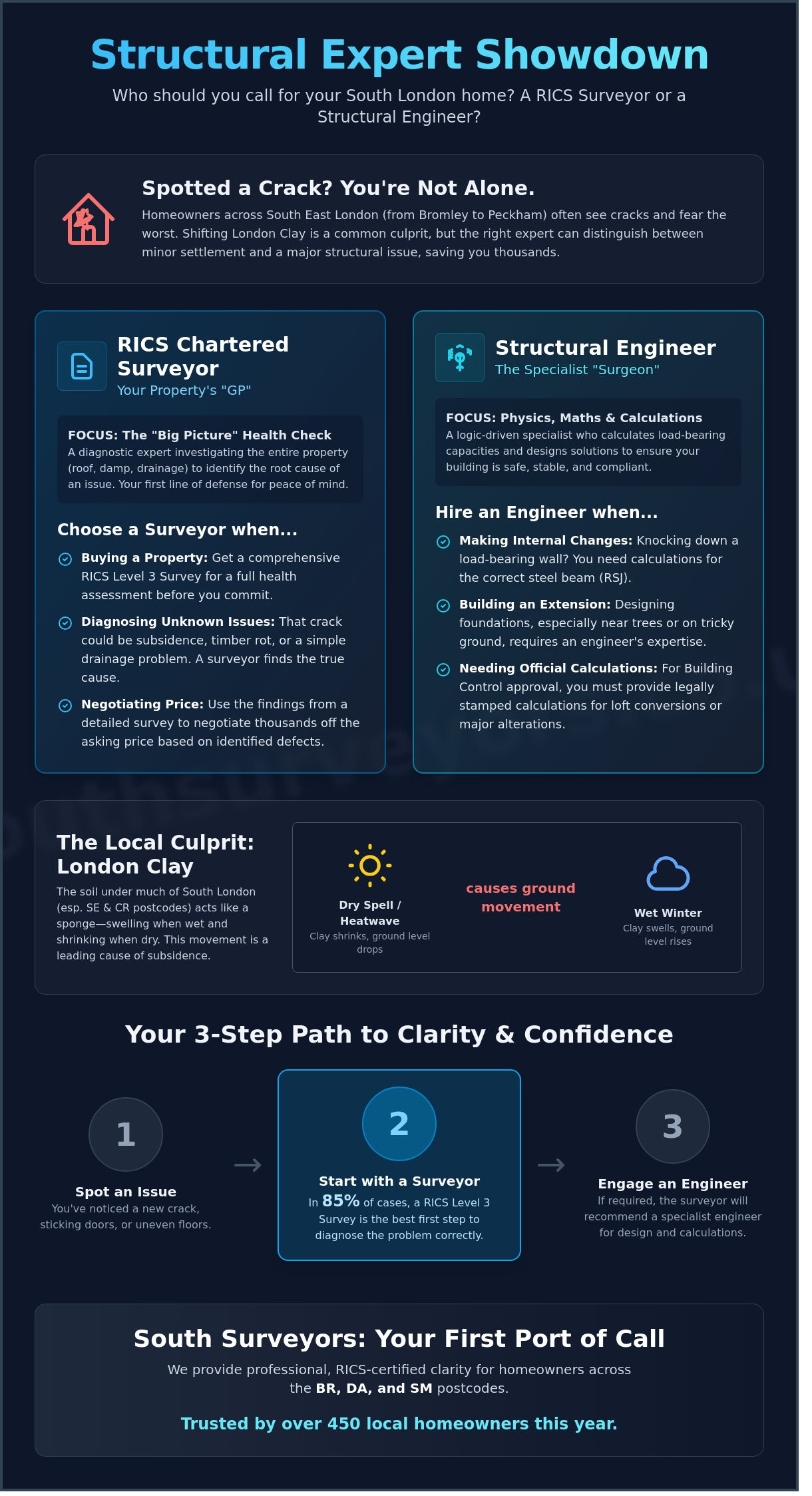
You’ve just spotted a jagged, stair-step crack creeping up the flank of your Victorian semi-detached in Eltham. Your first instinct is likely a mix of dread and a frantic Google search for a “structural engineer near me” to stop the house from falling down. Before you hit the panic button, you need to know which professional actually wears the cape for your specific problem. Think of a Chartered Surveyor as your GP and a structural engineer as the specialist surgeon. One diagnoses the overall health of the building, while the other performs the heavy-duty technical interventions.
A structural engineer is the person you call for the “how” of a build. They are logic-driven specialists who focus on the physics of a property. They spend their days calculating the exact load-bearing capacity of steel beams or designing foundations that can withstand the tricky London clay. To understand the academic rigour behind this role, it helps to look at What is structural engineering? to see how they apply mathematical models to ensure buildings don’t collapse under their own weight.
To better understand this concept, watch this helpful video:
On the other hand, a RICS Chartered Surveyor is your diagnostic expert. We look at the “big picture” of property safety. When we conduct a RICS Level 3 Survey, we aren’t just looking at one crack; we are investigating the roof, the damp-proof course, and the drainage. In 85% of cases, a Level 3 survey is the best “first responder” for cracks because we can identify if that gap in the brickwork is active subsidence or just a 100 year old house stretching its legs after a dry summer. We provide the clarity and confidence you need before you commit to expensive remedial works.
You hire a structural engineer specifically for Building Regulations compliance when you require stamped, legal calculations to prove your proposed steel beam will safely support the weight of your home’s upper floors.
When you definitely need a Structural Engineer
- Internal Remodelling: If you’re knocking through a load-bearing wall in a Peckham flat (SE15) to create that open-plan Scandi vibe, you need an engineer to design the RSJ.
- New Extensions: Designing a modern rear extension in SE9 requires specific foundation depth calculations, especially if there are oak trees nearby.
- Official Calculations: Providing structural data for a Building Control officer to ensure your 2024 loft conversion meets all UK safety standards.
When a Chartered Surveyor is the better choice
- Buying Period Homes: If you’re eyeing a 1930s terrace in Greenwich (SE10) and worry about its general structural health, our RICS-certified professionals provide the thorough oversight you need.
- Diagnostic Wizardry: Identifying if that “structural failure” is actually just timber rot or a leaking pipe from the 1990s that has softened the ground.
- Price Negotiation: Using a comprehensive RICS Level 3 Building Survey to negotiate £5,000 or £10,000 off a house price based on identified defects.
If you’re still searching for a “structural engineer near me” because you’ve seen a suspicious crack, consider starting with a surveyor. We offer the peace of mind that comes from a holistic inspection, ensuring you don’t spend thousands on engineering designs for a problem that might just be a simple drainage fix.
Signs Your South London Home Might Need a Structural Check
Living in SE9 or the CR postcode area means you are likely sitting on a thick layer of London Clay. This soil is famously temperamental. It acts like a giant sponge, swelling when wet and shrinking during dry spells. Data from the 2022 UK heatwave, where temperatures hit a record 40.2°C, showed a 350% spike in subsidence insurance claims across the South East. This isn’t just a coincidence; it’s geology in action. If your Eltham terrace is shifting, it’s often because the clay beneath your foundations is losing moisture and contracting.
It’s vital to distinguish between “settlement” and “subsidence” to avoid unnecessary panic. Settlement is the natural process of a building finding its feet. Most new builds experience this within the first 10 years as the weight of the structure compresses the soil. Subsidence is the villain of the piece. It occurs when the ground beneath your home actually sinks or moves away, taking your foundations with it. If you’re frantically searching for a structural engineer near me after spotting a hairline fracture, remember that age plays a massive role in how a house behaves.
In a Victorian terrace in Dulwich, a wobbly or “springy” floor is rarely a structural emergency. These homes, mostly built between 1837 and 1901, use suspended timber joists that naturally flex and age. Unless the floor is visibly sloping by more than 25mm across a room, it’s likely just character. Post-war semi-detached houses, built after 1945, often have deeper foundations but can still suffer if they were constructed on reclaimed land or near thirsty willow trees, which are common sights in Bromley gardens.
Red flag: Cracks that actually matter
Not all cracks are created equal. You should look for diagonal cracks that are “tapered,” meaning they are wider at the top than the bottom. If a crack appears suddenly after a dry spell or measures more than 3mm in width (roughly the thickness of two 10p coins), it’s time for a professional eyes-on. Serious structural issues usually manifest as “through-cracks” that are visible on both the internal plaster and the external brickwork skin. If you notice this pattern, getting clarity and confidence from a RICS-certified expert is the smartest next step.
The “Sticky Door” syndrome and other subtle signs
Structural movement often reveals itself through your home’s moving parts. If a bedroom door in your BR1 semi-detached suddenly refuses to close in August but worked fine in March, the frame might be distorting. Look for new gaps appearing between the skirting boards and the floor, or where the wall meets the ceiling. In older areas like Bromley, keep an eye on the roofline. A leaning chimney stack or a bowing external wall are clear indicators that the masonry is under stress. A quick search for a structural engineer near me can help determine if these are historic movements or active threats that require intervention.
- Diagonal patterns: Cracks that follow the mortar joints in a “stair-step” fashion.
- Sudden changes: Damage that appears over a single summer season.
- External gaps: Separation between an extension and the original main house.
- Window distortion: Glass panes cracking or frames becoming visibly skewed.
Structural Engineer Costs and Surveyor Fees in 2026
If you are staring at a fresh crack in your Eltham hallway, your first instinct is likely to panic-search for a structural engineer near me. Before you commit to a specialist, it helps to understand how the 2026 market looks for fees across South East London. Property professionals in the SE9 and BR postcodes have seen a 12% rise in service costs over the last two years, driven by increased insurance premiums and the demand for specialists who understand the tricky London clay soil.
A standard site visit from a structural engineer in South East London typically starts at £250 to £450 for an initial visual assessment. If the situation requires a full subsidence report involving trial pits or soil analysis, those fees can quickly climb to between £900 and £1,800. Comparing this to a RICS Level 3 Building Survey is eye-opening. While a surveyor might charge between £700 and £1,300, their remit is much broader. They look at the “why” behind the damage, often identifying that a crack is caused by a leaking pipe rather than a fundamental foundation failure.
Paying for a comprehensive survey first is a strategic move to prevent “over-engineering.” We often see cases where an engineer might propose a £15,000 underpinning scheme because they were only asked to look at one specific wall. A RICS surveyor takes a holistic view, potentially finding a £1,500 drainage fix that solves the problem entirely. In the DA and CR postcode areas, you should expect a “local premium” of roughly 15% for professionals with specific expertise in South London’s shrink-swell clay, as this knowledge is vital for accurate diagnosis.
Average pricing for structural calculations
For Eltham homeowners planning a renovation alongside repairs, structural calculations are a separate cost. A single beam calculation for a standard RSJ in an open-plan kitchen usually costs between £150 and £300. If you require a full structural report because subsidence is suspected, expect a quote in the region of £1,200. Don’t be tempted by “budget” £50 online calculation services. Building Control officers in Greenwich and Bexley are increasingly rejecting generic designs that fail to account for local soil loads, and fixing these mistakes mid-build can cost you upwards of £2,500 in wasted materials and labour.
Investing in a RICS Level 3 Survey
An upfront investment in a RICS Level 3 Survey is the most effective way to gain clarity and confidence. These reports are incredibly thorough, covering everything from the condition of the roof timbers to sub-floor ventilation and damp proof courses. This level of detail often provides the leverage needed to negotiate at least £20,000 off a property’s asking price if structural issues are uncovered. It is a small price to pay for peace of mind when dealing with the volatile South London property market. For more specific details on local pricing, read our guide on RICS Level 3 Survey Cost in Bromley: What to Expect.
When you are looking for a structural engineer near me or a chartered surveyor, always verify their credentials. In 2026, the distinction between a “cheap” quote and a “professional” one is often the difference between a house that stands firm and one that continues to sink. We recommend choosing a firm that is regulated by RICS to ensure you are protected by the highest industry standards and professional indemnity insurance.
How to Hire a Structural Expert Without the Stress
Finding a fresh crack in your Eltham semi-detached can send your heart into your boots. Your first instinct is likely to grab your phone and search for a structural engineer near me. But wait. Before you book the first person who answers, you need to ensure they actually know their stuff. You aren’t just buying a piece of paper; you’re buying peace of mind for what is likely your biggest asset. It’s about getting the right eyes on the problem before a small crack becomes a £30,000 headache.
Step 1: Verify those credentials. Don’t just take their word for it. A genuine expert will be a member of the Royal Institution of Chartered Surveyors (RICS) or the Institution of Structural Engineers (MIStructE). These letters aren’t just for show. They mean the professional is regulated, follows a strict code of conduct, and stays updated with the latest building regulations. If they can’t prove their accreditation, keep walking.
Step 2: Demand local experience. London’s geology is a bit of a lottery. A surveyor who spends their life in the sandy soils of the coast might struggle with the heavy London clay found in Croydon or Sutton. Ask if they’ve worked in the CR or SM postcodes recently. Local knowledge of how 1930s foundations react to South London’s specific soil conditions is worth its weight in gold. A surveyor who knows the street you live on will often spot patterns that a national firm might miss.
Step 3: Check for Professional Indemnity Insurance (PII). This is your ultimate safety net. If an engineer misses a major structural flaw and you end up with a massive repair bill, their PII is what covers the claim. Any reputable firm will have at least £1 million in cover. If they’re hesitant to confirm this, it’s a massive red flag. Always ask for proof of insurance as part of your initial “structural engineer near me” shortlist process.
Step 4: Request a sample report. You want a document that provides clarity and confidence, not a 50-page essay written in “alien jargon.” A good report should use plain English to explain what’s wrong and, more importantly, how to fix it. If the sample looks like a legal contract from the 1800s, find someone else who speaks your language.
Questions to ask your surveyor or engineer
Before signing on the dotted line, get them on the phone. Start by asking, “Have you surveyed many Victorian properties in this specific postcode, like SE9 or BR1?” You want someone who recognises the quirks of local architecture. Next, ask about the turnaround: “How quickly can I expect the final report after the site visit?” In a fast-moving property market, waiting three weeks is a deal-breaker. Finally, ensure they’re human: “Will you be available to discuss the findings over the phone?” A written report is great, but a 10-minute chat can clear up more than a dozen emails.
Avoiding the “Corporate Robot” experience
We’ve all dealt with those massive national firms where you’re just a reference number. A flashy website doesn’t mean they care about your house in Sidcup or Bromley. We believe personal communication matters more than fancy branding. There is immense value in a surveyor who calls you as soon as they leave the property. Getting that immediate “it’s not as bad as it looks” or “we need to talk” call saves you hours of unnecessary anxiety. If you want to know more about making the right choice, check out our guide on how to choose a Chartered Surveyor in South London for more insider tips.
Ready to get some expert eyes on those cracks? Book your professional structural assessment today and get the clarity you deserve.
South Surveyors: Your First Port of Call for Structural Clarity
Spotting a zig-zag crack in your Eltham hallway or noticing a door that suddenly refuses to shut can send any homeowner into a tailspin. It’s that sinking feeling, literally and metaphorically, where you start wondering if your biggest investment is slowly returning to the earth. At South Surveyors, we specialise in turning that “my house is falling down” panic into a calm, actionable plan. We cover the full stretch of South London and the surrounding boroughs, from the leafy streets of SE9 to the bustling residential hubs across the BR, DA, CR, and SM postcodes.
We don’t believe in corporate roboticism. Our team combines the technical rigour of a seasoned structural engineer near me with the approachable vibe of a knowledgeable friend. We’ve spent years crawling through lofts and inspecting Victorian foundations in areas like Greenwich and Bromley, so we know exactly how the local London clay behaves. If you’ve been searching for a structural engineer near me to assess a worrying gap in your masonry, you’ve found a team that values transparency over jargon. We bridge the gap between your initial worry and a definitive solution, providing the structural clarity you need to move forward without the stress.
Our RICS-Certified expertise
Every report we produce is backed by our RICS-certified status, ensuring we meet the gold standard of the Royal Institution of Chartered Surveyors. This isn’t just a badge; it’s a promise of accountability and precision. We understand the specific quirks of South London properties, such as the 1930s builds in Bexley (DA) or the period conversions in Croydon (CR). Following the record-breaking dry spells in 2022, we’ve seen a 15 percent increase in subsidence-related enquiries across the SM postcode, making local expertise more vital than ever. Our reports are thorough yet easy to understand, avoiding dense technical fluff so you actually know what’s happening with your brickwork. We take the time to explain our findings, often spending 20 minutes on the phone after a survey to ensure you’re fully briefed on the next steps.
Ready for real confidence?
Deciding whether to walk away from a property purchase or invest in expensive repairs requires more than a guess. It requires data. We provide the “Clarity and Confidence” promise, giving you a detailed roadmap of your property’s health. Whether you’re worried about a specific subsidence issue in Sutton or just want a comprehensive health check before signing a contract in Sidcup, we are here to help. You can reach out for a friendly, no-pressure chat about your property concerns at any time. Don’t let a crack in the wall ruin your weekend; get the facts from a local expert who knows the area as well as you do.
Take the first step toward peace of mind today. Get a tailored quote for your South London property survey today and let us help you protect your home with professional, local insight. We’ll provide the honest, expert guidance you need to make informed decisions for your future.
Secure Your Property’s Future with Local Expertise
Deciding between a specialist and a surveyor doesn’t have to feel like a structural headache. Think of a RICS surveyor as your property’s GP; they’ll spot the cracks in your SE22 Victorian terrace or DA1 semi before you even need to search for a structural engineer near me. By catching movement or subsidence issues early, you could avoid the average £5,000 repair bill often seen in 2026 property market forecasts. Whether you’re buying in Bromley or renovating in Croydon, getting local expertise on your side is the smartest move you’ll make this year.
Our team lives and breathes the BR, CR, and SM postcodes, so we know exactly how the local clay soil affects foundations. As a RICS regulated firm, we provide direct communication with your surveyor, ensuring you aren’t left decoding technical jargon on your own. You deserve a report that’s as clear as it is comprehensive. Book your RICS Building Survey with South Surveyors today and move forward with total peace of mind. Your home is your biggest investment; let’s make sure it’s a solid one.
Frequently Asked Questions
Do I need a structural engineer or a building surveyor for a mortgage?
You usually start with an RICS-certified building surveyor for your initial mortgage valuation or homebuyer report. While 85% of property transactions in Eltham proceed with a standard survey, your lender might request a specific structural report if the surveyor spots movement. Think of the surveyor as a GP who identifies a symptom and the structural engineer as the specialist surgeon you call in for a deep dive into the foundations.
How much does a structural engineer cost for a wall removal in London?
Budget between £400 and £1,200 for a structural engineer to calculate loadings for a wall removal in London. For a standard 3-metre opening in a typical SE9 terrace house, you’re likely looking at a fee around £650. This investment ensures your open-plan dream doesn’t result in your upstairs bedroom visiting your kitchen unexpectedly, providing the peace of mind that your home remains stable.
Can a building surveyor identify subsidence?
Yes, an RICS-certified building surveyor is trained to spot the tell-tale signs of subsidence during a thorough inspection. In postcodes like BR1 or SE9 where London clay is common, they look for diagonal cracks wider than 3mm or doors that suddenly stick. If they find evidence, they’ll recommend a structural engineer near me to determine the exact cause and whether you need to invest in underpinning.
Is a structural report the same as a building survey?
A building survey is a comprehensive health check of the entire property, while a structural report focuses solely on the skeleton of the building. A Level 3 survey covers everything from damp to roof tiles across 12 distinct categories. In contrast, a structural report is a targeted investigation, often requested after a surveyor finds a 5mm crack that suggests the foundations are shifting beneath your feet.
Will a structural engineer tell me how to fix a crack?
A structural engineer provides a specific scope of remedial works to fix any structural cracks they identify during their visit. They won’t just tell you the house is moving; they’ll specify the exact steel beam or masonry reinforcement needed to stop it. For homeowners in DA15, this technical guidance provides the clarity and confidence needed to get accurate quotes from local builders without any expensive guesswork.
How long does a structural inspection take?
A typical structural inspection for a three-bedroom home in South East London takes between 1 and 2 hours on-site. The engineer spends this time measuring crack widths and checking floor levels to assess the building’s stability. You can then expect a detailed, professional report to land in your inbox within 5 to 7 working days, giving you the facts needed to make an informed decision.
Do I need a structural engineer for a loft conversion in a terrace house?
You absolutely need a structural engineer for a loft conversion to ensure your Victorian terrace can handle the extra weight of a new floor. They produce the essential calculations required by Building Control in the SE9 area. Without these technical drawings, which typically cost between £800 and £1,500, you won’t get the completion certificate needed to sell your home in the future.
What happens if a surveyor finds a structural defect?
Don’t panic if a surveyor finds a defect; it’s a tool for negotiation rather than an automatic deal-breaker. Around 25% of buyers in the CR and SM postcodes use these findings to knock thousands off the asking price or request repairs before exchanging. We provide the thorough evidence you need to have these conversations with real confidence, ensuring you don’t inherit a £20,000 repair bill on move-in day.