

Your Victorian terrace in East Dulwich or that sleek apartment in Bromley is finally ready for the market, but there is one tiny piece of paper standing between you and a completed sale. What if a single letter on a rainbow-colored chart is actually the most important document in your property file? It is easy to feel overwhelmed by the technical jargon of energy efficiency, especially when your 1930s semi-detached in Sidcup is being judged against modern green standards.
We agree that the A to G rating system often feels more like a confusing school report than a helpful tool for homeowners. It is stressful to worry about failing minimum standards or facing the unknown costs of insulation and heat pumps. This guide will give you total clarity on your epc certificate; we will show you exactly why your South East London home needs one and how to boost your score without losing your mind. We are going to cover the legal must-haves for the SE, BR, DA, CR, and SM postcodes, share practical tips to improve your rating, and help you prepare for a professional RICS survey with real confidence.
Key Takeaways
- Understand why an epc certificate is a non-negotiable legal requirement whenever you’re building, selling, or renting out your home in South East London.
- Learn how to decode the A-G energy scale and why a ‘D’ rating is actually the norm for many classic properties in areas like Bromley and Herne Hill.
- Discover the unique energy challenges facing Victorian and 1930s homes across the SE, BR, DA, CR, and SM postcodes, and how to overcome them.
- Identify five practical, low-cost “quick wins” to boost your property’s efficiency rating without needing a massive renovation budget or a PhD in engineering.
- Find out how our RICS-certified experts bridge the gap between standard energy assumptions and real-world observations during your professional home survey.
What is an EPC Certificate and Why is Everyone Talking About It?
If you’re browsing Rightmove for a Victorian terrace in East Dulwich or a sleek new build in Greenwich, you’ve definitely seen those colourful bar charts. They aren’t just there for decoration. An Energy Performance Certificate measures the energy efficiency of your property on a scale from A to G. It provides a snapshot of how much you’ll likely spend on heating and lighting each year, helping you avoid nasty surprises after you move in.
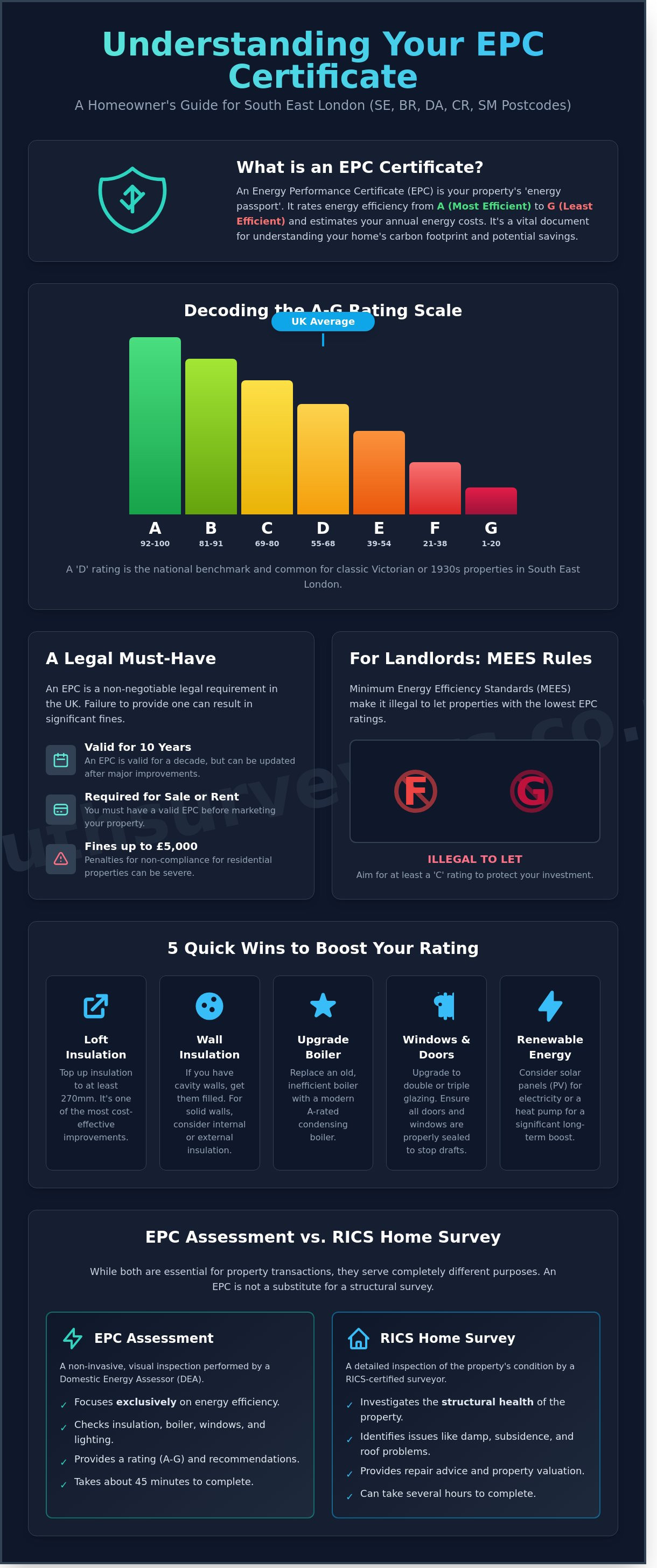
Basically, an epc certificate is your property’s energy passport that ranks efficiency from A (stellar) to G (could do better). It helps you understand the carbon footprint of your home while offering a roadmap for potential improvements to save you money in the long run.
To better understand this concept, watch this helpful video:
The Legal Bits You Can’t Ignore
You need a valid epc certificate before you even think about listing your flat in SE15 or your family home in DA14. Since 2008, UK law mandates this document whenever a property is built, sold, or rented. It stays valid for 10 years. Many homeowners in Sutton or Croydon renew early after installing a new boiler or double glazing to boost their score. Ignoring this rule is a bad move; local authorities can issue fines starting at £500 and climbing to £5,000 for residential non-compliance.
Who Actually Carries Out the Assessment?
A qualified Domestic Energy Assessor (DEA) handles the heavy lifting. They’ll spend about 45 minutes poking around your loft insulation, checking your domestic boiler, and counting your LED lightbulbs. It’s a non-invasive visual inspection, which makes it very different from the RICS Level 2 or Level 3 surveys we provide at South Surveyors. While an EPC focuses purely on energy, a RICS survey investigates the structural health of your South London home. Both are essential for clarity and confidence, but they serve completely different purposes for your peace of mind.
Decoding the A-G Rating: What Your Score Really Means
Think of your EPC rating like the energy sticker on a new washing machine, but for your entire house. It ranks properties on a scale from A, the ultra-efficient eco-warriors, down to G, the energy-hungry draft-fests. While everyone wants that top-tier A, the reality is that the average UK home currently sits at a D rating. If your Victorian terrace in Hither Green or your 1930s semi in Bromley lands a D, you’re in good company; it’s the national benchmark.
Two distinct metrics appear on the page to help you understand your home. The energy efficiency rating focuses on the actual cost of running the property, while the environmental impact rating tracks its carbon footprint. In competitive markets like Greenwich or Blackheath, a higher score is a massive selling point. Savvy buyers look for a solid C rating because it promises lower monthly outgoings from the moment they move in. You can find the formal legalities regarding these scores in the government guidance on EPCs.
The Landlord’s Minimum: The MEES Regulations
If you are renting out a flat in the CR0 postcode or a house in SE13, the Minimum Energy Efficiency Standards (MEES) are vital to your business. Currently, it is illegal to let a property with an EPC rating of F or G. Landlords who ignore this face civil penalties of up to £5,000 per property. While the government recently shifted timelines for future upgrades, the direction of travel is clear. Aiming for a C rating now protects your investment against future legislative shifts and keeps your tenants happy.
Energy Costs vs. Energy Efficiency
Efficiency is always relative to the size of the building. A compact studio in Croydon might achieve a C rating but still cost less to heat than a B-rated mansion in Dulwich. Your epc certificate provides an estimate of annual fuel bills based on typical occupancy rather than your personal habits. You should also examine the “potential” rating column. This shows the score your home could reach with specific upgrades like solar panels or floor insulation. Whether you are looking at a cottage in Bexley (DA) or a modern build in Sutton (SM), chatting with a local expert can help you decide which improvements offer the best return on investment.
Energy Efficiency in South East London: Victorian Terraces vs. Modern Builds
South London isn’t a monolith. You’ve got the grand, drafty villas of Herne Hill sitting just miles from the sleek, airtight glass towers of Lewisham. This architectural diversity means your epc certificate result depends heavily on when your builder first laid the bricks. Properties in the SE and BR postcodes often tell a story of two halves. While a 2022 apartment block in Greenwich is designed for thermal perfection, a 19th-century terrace in Bromley was built to breathe; a polite way of saying it lets the cold in. Solid brick walls, standard in homes built before 1930, lose heat 45% faster than modern cavity walls. Even the local microclimates play a role. The “urban heat island” effect in densely packed areas like Peckham can make your heating bills look very different from a drafty semi in the leafier, windier parts of the CR postcode.
The Period Home Challenge
Traditional sash windows are a classic SE London aesthetic, but they are often the primary enemy of a high score. A single-glazed sash can account for 20% of a home’s total heat loss. Owners in Herne Hill often face a dilemma: preserve the original timber charm or install double-glazed units. Since 2018, RICS-certified surveyors have seen a 15% increase in homeowners opting for slimline double glazing to balance heritage requirements with energy efficiency. If you’re selling a period property, having a valid Energy Performance Certificate (EPC) is a legal requirement that helps buyers understand these specific thermal quirks before they commit.
Post-War and 1930s Properties
Homes in the DA and SM postcodes, particularly the 1930s suburban semis, offer more flexibility for improvement. These properties typically feature cavity walls. Filling these cavities can boost a rating from an E to a D almost instantly. In Sutton, the 2021 surge in “work from home” loft conversions has also shifted the local energy dial. A professionally insulated loft conversion doesn’t just add a bedroom; it caps the 25% of heat that previously escaped through the roof. Adding a modern rear extension with bi-fold doors, a common sight in Croydon, can also improve your overall epc certificate rating if the new build elements exceed current Part L building regulations. These upgrades provide the clarity and confidence buyers need when looking at older stock.
Boosting Your Rating: 5 Practical Ways to Save Energy and Cash
Improving your epc certificate rating isn’t just about ticking boxes for a legal requirement. It is about making your home in Crystal Palace or Bromley actually comfortable to live in during a damp January. Most South London properties, especially those Victorian terraces in SE22 or SE19, lose a staggering 25% of their heat through an uninsulated roof. Here are five ways to stop the bleed.
- Switch to LED lighting: This is the ultimate “quick win” for any homeowner. Replacing 100% of your old halogen bulbs with LEDs costs roughly £3 to £5 per bulb but offers an immediate boost to your score.
- Hit the 270mm insulation target: If your loft has the original 100mm of glass wool from the 1990s, you’re essentially wearing a t-shirt in a blizzard. Topping this up to the current 270mm standard can save the average semi-detached house in the BR or DA postcodes around £200 a year.
- Upgrade that ancient boiler: Old G-rated boilers operate at roughly 60% efficiency. A modern A-rated condensing model hits 92% efficiency or higher. It’s a significant upfront cost, but it’s the single biggest factor in jumping an entire energy band.
- Investigate high-performance glazing: Those drafty sash windows in Dulwich look beautiful, but they’re thermal black holes. Installing double or triple glazing, or even high-quality secondary glazing, drastically reduces heat loss.
- Install smart heating controls: Using a smart thermostat alongside individual Thermostatic Radiator Valves (TRVs) allows you to heat only the rooms you’re using. This level of control is highly valued in modern energy assessments.
Low-Cost Wins for a Better Score
You don’t need a massive budget to see progress. Lagging your hot water pipes and fitting a £15 insulating jacket to your cylinder can pay for itself in months. In period properties across SE15 and CR0, draft-proofing unused chimneys with a “chimney sheep” or simple balloons prevents warm air from escaping. A 2023 analysis showed that these small tweaks, costing under £300 total, can often move a borderline property from an E to a D rating.
The Big Investments: Are They Worth It?
Solar panels and air-source heat pumps are the “hipster flair” of the energy world, but they offer serious substance for homes in the SM and DA areas. For solid-walled homes in Dulwich that can’t have cavity insulation, external wall insulation is a game-changer. Beyond the monthly savings, a 2023 Rightmove study found that improving a home’s rating from D to C can increase its overall value by an average of 3%.
How an EPC Fits Into Your RICS Home Survey
When you book a Level 2 or Level 3 survey with us, your South Surveyors expert doesn’t just look at the bricks and mortar. We pull up your epc certificate before we even step foot in your hallway. This document provides a baseline of what the property is supposed to be doing, but it rarely tells the full story. While an energy assessor might spend 20 minutes on-site, a RICS Level 3 survey can take up to 4 hours of meticulous inspection. This depth is what separates a generic rating from a professional insight.
The biggest trap for buyers is the difference between “assumptions” and “observations.” An EPC relies on software-driven assumptions based on the age and type of the property. If your Victorian terrace in Dulwich (SE22) has no visible record of wall insulation, the software assumes it’s missing. A RICS surveyor uses physical observations. we look for the actual evidence of blown-in insulation or internal linings that a quick energy assessment ignores. This distinction is vital for your long-term renovation budget.
Clarity and Confidence in Your Purchase
A high rating on an epc certificate doesn’t automatically mean a house is structurally sound. We’ve seen properties in Bromley (BR1) and Croydon (CR0) with glowing “B” ratings that hide significant damp issues behind fresh “staging” paint. An EPC assessor won’t use a moisture meter or check the sub-floor voids; we will. We act as your knowledgeable friend, identifying hidden defects like penetrating damp or roof leaks that an energy report simply isn’t designed to catch.
Using these two reports together gives you the ultimate leverage. If the EPC suggests your new home in Dartford (DA1) needs a £4,000 heat pump and our survey reveals the windows are failing, you have concrete data to negotiate a better deal. It’s about moving forward with clarity and confidence rather than crossing your fingers and hoping for the best.
Next Steps for South London Buyers
Before you get too deep into the legal process, take these two steps to protect your investment in the SM or SE postcodes:
- Visit the official GOV.UK register to find the current EPC for the property.
- Book your professional RICS survey the moment your offer is accepted to avoid delays.
Don’t rely on a 10-year-old energy rating to tell you if a house is a good investment. Get the full picture from a local expert who knows the specific quirks of South London architecture. Get a tailored quote for your RICS Level 2 or Level 3 survey today!
Take Control of Your South London Home’s Energy Future
Whether you’re tucked away in a drafty Victorian terrace in Crystal Palace or a sleek modern apartment in Greenwich, understanding your property’s energy performance is vital. Your epc certificate is much more than just a colorful chart for the legal pack; it’s a strategic roadmap to lower utility bills and a higher resale value. Simple upgrades like professional loft insulation can often boost a rating by 10 points or more, which makes a massive difference when you’re competing in the local market. Navigating property in the SE, BR, DA, CR, or SM postcodes requires a sharp eye and genuine local insight.
Our team has provided clear, actionable advice to over 500 homeowners this year, ensuring every report is thorough and easy to understand. As a firm regulated by RICS, we pride ourselves on giving you the peace of mind that comes from expert analysis. If you’re planning a move in Bromley or Croydon, having a professional on your side ensures you won’t face any expensive surprises later on. It’s about making your next move with real confidence.
Book your RICS-certified property survey with South Surveyors
Your future self will definitely thank you for the clarity today.
Frequently Asked Questions
How much does an EPC certificate cost in South London?
You can expect to pay between £60 and £120 for an epc certificate in South London. Prices fluctuate based on the size of your property and its location, whether you are in a Victorian terrace in SE19 or a modern flat in Bromley. Booking directly with a local assessor often saves you the 25% commission fee that estate agents usually tack on. It is a small price for the clarity and confidence of knowing your home’s energy efficiency.
Can I sell my house in Croydon without an EPC?
No, you cannot legally sell your house in Croydon without a valid EPC. Under the Energy Performance of Buildings Regulations 2012, you must have commissioned an assessment before you even put your CR0 or CR2 property on the market. If you fail to provide one to a buyer, you risk a £200 fine from the local authority. It is best to get this sorted early to ensure your sale proceeds with real confidence.
Is a D rating on an EPC bad?
A D rating isn’t bad as it is the current UK average for existing homes. Most period properties in areas like Dulwich or Greenwich naturally sit in this bracket due to their age and construction. While it is perfectly fine for selling, you might want to consider upgrades to reach a C rating. This could potentially increase your property value by up to 14% according to government data from 2023.
What is the minimum EPC rating for renting a property in 2026?
The current legal minimum EPC rating for renting a property is an E. While the government previously proposed a move to a C rating by 2026, these specific plans were scrapped in September 2023. However, aiming for a C is still a smart move for landlords in SM1 or BR3. Higher ratings attract tenants looking for lower bills and help you stay ahead of any future legislative shifts.
How long does an EPC assessment take?
A standard assessment typically takes between 45 and 90 minutes to complete. Our surveyors will need access to every room, including the loft, to inspect your insulation, heating systems, and windows. If you have got a larger property in Chislehurst or a complex layout in DA1, it might take slightly longer. You will usually receive your digital certificate within 24 hours of the site visit.
Can I appeal an EPC rating if I think it is wrong?
Yes, you can appeal your rating if you believe the assessment contains factual errors. Your first step is to contact the original assessor to discuss your concerns. If you are still not satisfied, you can lodge a formal complaint with the accreditation scheme listed on your certificate. Providing evidence, such as invoices for floor insulation or window specifications, often helps resolve these disputes quickly and ensures your report is thorough.
What happens if my Victorian house can’t reach an E rating?
If your Victorian home in SE22 cannot reach an E rating despite spending £3,500 on improvements, you can apply for an “All Relevant Improvements Made” exemption. This lasts for 5 years and protects you from fines while letting you rent the property out legally. Many period homes in South East London struggle with modern standards. Registering this on the PRS Exemptions Register provides the peace of mind you need.
Do I need a new EPC if I have installed a new boiler?
You don’t legally need a new epc certificate just because you have installed a new boiler. Your current certificate remains valid for its full 10 year term regardless of any upgrades. However, a modern A-rated boiler can significantly boost your score. If you are planning to sell your home in Sutton or Bexley, getting a fresh assessment is a great way to showcase your home’s efficiency to savvy buyers.