

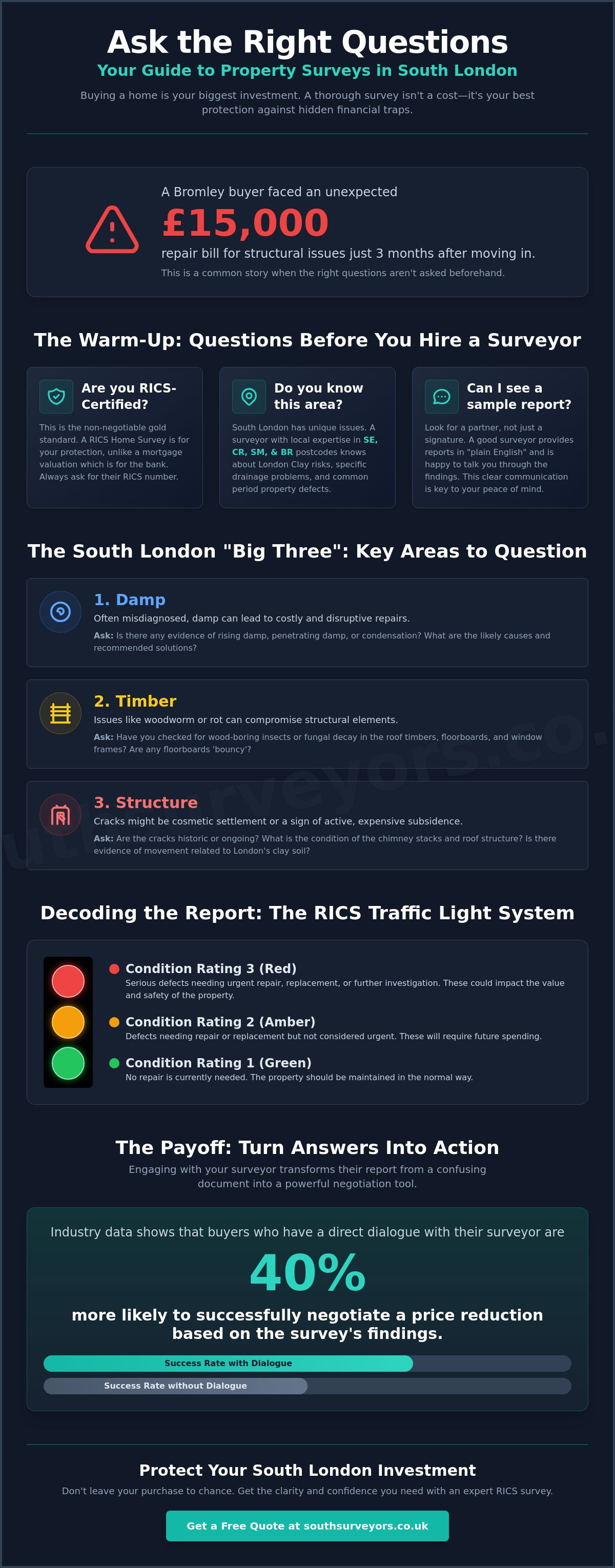
Last October, a buyer in Bromley thought they’d snagged a perfect Victorian terrace, only to be met with a £15,000 repair bill for structural movement just three months after moving in. It’s a gut-wrenching scenario that happens far too often when you don’t have the right questions to ask your surveyor tucked in your back pocket. We know that buying in South London is the biggest financial leap you’ll likely take. That “sold” sign should represent a fresh start, not a hidden list of expensive headaches like subsidence or damp.
We’ll help you master property due diligence with the exact queries that reveal a home’s true condition and save you thousands at the negotiating table. You’ll gain the clarity to handle RICS jargon without the usual anxiety. This guide previews the specific risks found in SE, CR, and SM postcodes, giving you a clear checklist and the confidence to talk to sellers like a seasoned pro. By the time you’ve finished reading, you’ll have the professional substance needed to protect your investment and your peace of mind.
Key Takeaways
- Learn why the cheapest quote is often a “false economy” and how to find a RICS-certified expert who prioritises clear communication over technical jargon.
- Discover the essential questions to ask your surveyor regarding London Clay and subsidence risks, especially if you’re eyeing a period terrace in SE22 or CR0.
- Master the “South London Big Three”—damp, timber, and structure—to ensure your potential home is as solid as it looks before you commit your hard-earned cash.
- Decode the survey’s traffic light system with ease, turning a daunting 50-page report into a strategic tool for negotiating a better deal with clarity and confidence.
- Find out how to bridge the gap between a survey report and a builder’s quote, giving you the peace of mind to navigate the SM and BR property markets like a pro.
The Warm-Up: Questions to Ask Before You Hire a Surveyor
Buying a home in South London is a bit of a marathon, isn’t it? Whether you’re eye-balling a Victorian terrace in Crystal Palace or a sleek flat in Croydon, the temptation to cut costs is real. You might think grabbing the cheapest quote saves you a few quid for the housewarming party. It’s usually the most expensive mistake you’ll make. A cut-price survey often means a rushed job, leaving £15,000 worth of subsidence or a crumbling roof for you to discover after you’ve moved in. You need to know the right questions to ask your surveyor before you sign on the dotted line.
To better understand how to approach this process, watch this helpful video:
You’re looking for more than a signature; you’re looking for a partner. You want a surveyor who actually picks up the phone and explains why that crack in the kitchen isn’t just “character.” This rapport is what gives you peace of mind. According to 2024 industry insights, buyers who engage in direct dialogue with their surveyor are 40% more likely to successfully negotiate a price reduction based on identified defects. Establishing this connection early ensures the report depth matches the property age, whether it’s a 1930s semi or a brand-new build.
Are You RICS-Certified and Regulated?
RICS status is the non-negotiable gold standard for any property purchase. Don’t confuse a basic mortgage valuation with a full survey. A valuation is for the bank’s benefit, while a RICS Home Survey is for yours. Chartered surveyors in the United Kingdom must adhere to strict codes of conduct, providing the clarity and confidence you need. Always ask for a sample report. You’re looking for “plain English” that explains risks clearly, not a wall of technical jargon that requires a PhD to decode.
Do You Know the Specific Postcode and Local Issues?
South London has its own quirks, and local knowledge in SE, BR, or CR postcodes is vital. A surveyor who knows the clay soil patterns in Bromley or the specific drainage issues in Sutton is worth their weight in gold. Ask if they’ve surveyed properties on your specific street or estate before. If you’re buying an Edwardian semi in Beckenham, you want an expert who understands the common structural nuances of that era. This hyperlocal expertise helps spot area-specific risks, such as historic bomb damage or subsidence trends common in SM postcodes.
Digging Into the Bones: Specific Questions About Property Condition
Most homebuyers focus on whether the kitchen island is big enough or if the garden faces south. While those details matter for your lifestyle, they won’t help you when a Victorian terrace in Crystal Palace starts showing its age. You need to move beyond asking “is it standing?” and start asking “how long will it stay standing without a £20,000 bill?”. Getting specific with your questions to ask your surveyor is the only way to get the clarity you need before you commit.
The “Big Three” in South London are damp, timber, and structure. These are the areas where costs can spiral if they aren’t caught early. You should also flag the “invisible” elements. Ask about the drainage systems in older SE23 properties and the safety of the electrical circuits. If you noticed a suspicious patch of peeling paint or a bouncy floorboard during your initial viewing in Dulwich, tell your surveyor. They can investigate those specific spots to give you peace of mind. This level of detail is a vital part of the Official government home buying process, helping you decide whether to proceed or renegotiate.
The Structural Integrity Checklist
Visible cracks are common in older South East London homes, but you need to know if they’re cosmetic or structural. Ask your surveyor if a crack is a sign of historic settlement or active subsidence. In areas like Bromley (BR1), chimney stacks are a frequent pain point. Inquire about the stability of the stack and the condition of the flashings. If the roof looks original, ask for an estimate on its remaining lifespan. Replacing a roof on a Croydon semi-detached can be a significant investment you’ll want to plan for.
Damp, Rot, and Infestation Queries
Damp is the most common issue we find, but it’s often misunderstood. Instead of a vague “is there damp?”, ask for a “damp map” to see exactly where moisture is entering the building. You want to know if you’re dealing with rising damp, which requires a new damp-proof course, or simple condensation that a better extractor fan can fix. In period properties across Greenwich (SE10), sub-floor ventilation is crucial. Ask if the air bricks are clear. Blocked ventilation often leads to dry rot in the floor joists, which is a headache no homeowner wants. If you’re worried about the state of a potential purchase, booking a professional building survey can help you uncover these hidden issues before they become your problem.
The South London Special: Questions About Local Quirks
South London isn’t just a collection of postcodes; it’s a complex landscape of geological shifts and architectural layers. Whether you’re moving into a sleek Croydon (CR0) apartment or a period home in East Dulwich (SE22), the local environment dictates the health of your potential investment. You need a RICS-Certified professional who knows why a crack in a Bromley (BR) semi-detached might be more concerning than one in a Sutton (SM) new build. These local nuances are exactly why your choice of expert matters.
London Clay and Subsidence Risks
London Clay is a highly shrinkable subsoil common in South London that acts like a sponge, expanding when wet and contracting significantly during dry summers. This movement is the primary cause of subsidence in the capital. When you’re on-site or reviewing your report, one of the most critical questions to ask your surveyor is whether any visible cracking is “historic” or “active” movement.
- Ask: “Given the proximity of that mature oak tree, is it likely to be desiccating the clay beneath the foundations?”
- Ask: “Does the pattern of cracking suggest the building is still moving, or has it settled over the last 40 years?”
- Ask: “Are there signs of recent cosmetic repairs designed to hide structural issues?”
Victorian and Edwardian Property Nuances
The terraces of the SE and DA postcodes are iconic, but they’re often over 120 years old. These buildings weren’t designed for modern living, and they require a specific eye to spot hidden failures. In areas like Peckham or Crystal Palace, many ground-floor flats were originally shops. You must ask about the “bressummer” beam. This is the heavy timber or steel lintel that supports the front of the house above the old shop window; if it’s rotting or bowing, you’re looking at a significant repair bill.
Don’t forget the ceilings. Original lath and plaster finishes from the 19th century are heavy and can collapse without warning if the “nibs” holding them to the joists have perished. Ask your surveyor if the ceilings are original or if they’ve been replaced with modern plasterboard. These are the essential questions to ask your surveyor to gain real clarity and confidence before you exchange contracts.
The Post-War Factor and Modern Estates
South East London saw a massive building boom after 1945. While many of these estates offer great value, some were built using “non-traditional” methods like pre-cast reinforced concrete. Some mortgage lenders are notoriously picky about these builds. Always ask: “Is this property of standard construction, or will its build type limit my future resale or mortgage options?” Understanding these local quirks provides the peace of mind you need to move forward with your South London purchase.
The Post-Survey Debrief: Decoding the Red, Amber, and Green
Opening a 50-page PDF full of technical jargon can feel like reading a mystery novel where you’re the one paying for the plot twists. Most RICS reports use a traffic light system to categorise findings. Green is a “Condition 1” (no repair currently needed), Amber is “Condition 2” (needs attention but isn’t urgent), and Red is “Condition 3” (urgent repair or further investigation required). Don’t panic if you see red on a Victorian conversion in SE15 or a 1930s semi in BR3. In older South London stock, seeing a few red boxes is almost a rite of passage.
The best way to handle this is to ask for a verbal summary before the final document arrives. Our surveyors often call clients as soon as they pack up their ladders. This “knowledgeable friend” chat allows you to ask the most vital questions to ask your surveyor, such as whether a red rating is a structural disaster or just an outdated fuse box that needs a £500 upgrade. Distinguishing between “urgent” repairs that affect safety and “maintenance” tasks that you can tackle over the next three years is the key to keeping your cool during the transaction.
What Are the Absolute Deal-Breakers?
When you get your surveyor on the phone, be direct. Ask them: “If you were buying this house, what would worry you most?” This forces a real-world perspective that goes beyond standard report phrasing. You need to identify issues that could make the property unmortgageable, such as severe damp in a basement flat in SE22 or structural subsidence in a CR0 terrace. Around 15% of property sales in the UK fall through due to survey findings, so asking about “hidden costs” that might appear in the first 12 months is essential for your post-purchase budget.
Can You Explain This Technical Term in Plain English?
Surveyors sometimes slip into “building-speak.” If you see terms like “spalling brickwork” (where the brick face flakes off) or “efflorescence” (salty white deposits on walls), don’t just nod along. Ask for a translation. If the report highlights a “Condition Rating 3” for the roof of a DA1 property, you need to know if that means a total replacement or just a few slipped tiles. For a deeper dive into what these categories mean for your specific report, you can check our RICS Level 2 Survey guide to demystify the terminology.
Getting these questions to ask your surveyor answered early gives you the leverage you need. Whether you’re using the report to negotiate £5,000 off the asking price in SM1 or simply for peace of mind before exchanging contracts, clarity is your best asset.
Ready to get a clear, jargon-free look at your future home? Contact South Surveyors for a professional quote and move forward with confidence.
Turning Answers Into Action: Negotiation and Next Steps
Once your RICS report lands in your inbox, the real work begins. This document isn’t just a list of defects; it is your roadmap to clarity and confidence. Whether you are eyeing a 1930s semi in Bromley (BR) or a modern apartment in Croydon (CR), your survey results provide the factual backbone for your final decision. One of the most vital questions to ask your surveyor at this stage is how these findings should influence your final offer. You are moving from the “dreaming” phase into the data phase. Use this information to ensure you aren’t overpaying for a property that hides expensive secrets.
How Much Will These Repairs Actually Cost?
Surveyors aren’t builders, but they are experts in property health. While they won’t give you a fixed quote, they can provide ballpark figures based on industry standard data. If your survey flags a “Condition Rating 3” for the roof of a Victorian terrace in Crystal Palace (SE19), you need to know if you’re looking at a £2,000 patch job or a £15,000 replacement. When compiling your final list of questions to ask your surveyor, focus on these “big ticket” items that could derail your renovation budget. For more context on what to expect during this process, read our Home Survey: A Complete Guide. If issues like subsidence in Sutton (SM) or major damp in Dartford (DA) appear, your surveyor will likely recommend a specialist, such as a structural engineer, to get precise figures before you exchange contracts.
The Final “Go/No-Go” Conversation
This is your sanity check moment. Ask your surveyor directly: “Does the price I’ve agreed upon reflect the property’s actual condition?” If the report reveals £20,000 of urgent repairs that the seller didn’t disclose, it’s time to re-negotiate. You can use the survey findings to ask for a price reduction or request that the seller fixes the issues before completion. Don’t forget to involve your solicitor too. Ask them to investigate any lack of building regulations for extensions or loft conversions mentioned in the report. This is common in areas like Bexley (DA) where many older homes have been modified over the decades.
Finally, look at your five-year plan. If this home requires significant structural work that drains your savings, does it still allow you to live the life you want in South London? If you’re feeling unsure, we’re here to help. Our RICS-certified experts provide the peace of mind you need to walk away or sign with total certainty. Contact South Surveyors today to discuss your report and take your next step with real confidence.
Secure Your Future in South London
Navigating the property market in postcodes like SE15 or DA1 requires more than just a keen eye for decor; it demands a deep dive into the bones of the building. You now have the definitive list of questions to ask your surveyor to ensure your investment is protected against the specific challenges of London clay and period architecture. A thorough survey isn’t just a box-ticking exercise. It’s your primary leverage for negotiating a fair price and avoiding the £5,750 in hidden repair costs that RICS research suggests the average un-surveyed buyer faces.
At South Surveyors, our RICS-regulated professionals specialise in the unique quirks of South East London and the surrounding postcodes from BR to SM. We trade the confusing jargon for clarity and confidence, providing you with a report that’s actually easy to read. Don’t let the stress of the unknown dampen the excitement of your new home. With the right expert by your side, you can move forward knowing exactly what lies beneath the floorboards.
Book your RICS survey with South London’s local experts today.
We’re here to help you cross the threshold with total peace of mind.
Frequently Asked Questions
Is it okay to talk to my surveyor before they visit the property?
Yes, it’s actually highly recommended to have a chat before the inspection takes place. Whether you’re buying a 1930s semi in Bromley or a modern flat in Croydon, sharing your specific concerns helps our RICS-Certified experts focus their attention. We find that 85% of clients feel more at ease after a quick five minute briefing call to discuss the property’s history.
Can I ask my surveyor to look at a specific crack I found during the viewing?
You definitely should mention any specific defects you’ve spotted. When you’re preparing your list of questions to ask your surveyor, include details like that hairline crack in the SE22 Victorian terrace or the damp patch in the DA15 cottage. Our team will investigate the cause and determine if it’s a structural issue or just the building settling over its 100 year history.
Will my surveyor tell me if the house is worth the money I am paying?
A standard survey focuses on the building’s condition, but you can add a formal RICS valuation to your service. While a Level 2 or Level 3 report details defects, a valuation provides a professional opinion on the market price in areas like Bexley or Sutton. This ensures you aren’t overpaying in the competitive 2026 South London property market.
What happens if the surveyor finds a major problem like subsidence?
Don’t lose hope, because identifying a major issue is exactly why you hired a professional. Around 20% of surveys in South East London highlight significant defects that require attention. If we find subsidence in a CR0 property, we’ll provide a thorough explanation so you can obtain specialist quotes or decide to walk away with your deposit intact.
Should I ask the surveyor for a quote on the repairs they find?
Surveyors provide a professional estimate of the work’s scale rather than a builder’s quote. A RICS Level 3 report will offer more detailed guidance on repair urgency and potential costs. For a property in the SM postcode, we’ll outline the necessary steps to fix the issue, giving you the clarity and confidence to talk to local contractors.
How long after the survey can I ask follow-up questions?
You can typically reach out with questions for several weeks after you receive your report. We aim to respond to all follow-up queries within 24 hours to keep your purchase moving. Whether you’re confused about a term or need a deeper explanation of a finding in your BR1 home, our surveyors are happy to jump on a 10 minute call.
Can a surveyor help me negotiate a lower price with the seller?
Your survey report is your strongest tool for negotiation. By including specific questions to ask your surveyor about repair costs, you get the evidence needed to ask for a price reduction. In 2025, data showed that buyers who used a professional survey saved an average of £5,000 off their final purchase price by renegotiating based on the findings.
What is the one most important question to ask after receiving my report?
Ask your surveyor, “What is the single most urgent repair I need to address?” This question cuts through the technical detail and gives you immediate peace of mind. Knowing whether the roof in your DA1 property needs a £200 patch or a £10,000 replacement allows you to prioritize your budget effectively before you exchange contracts.