

Meta Title: How to Read a Survey Report Traffic Lights: South London 2026 Guide
Meta Description: Master the RICS traffic light system with South Surveyors. Learn how to read a survey report traffic lights to negotiate like a pro in SE, BR, and DA postcodes.
Yesterday, a couple in Lewisham nearly pulled the plug on their dream conversion after seeing a flash of red in their RICS report. It is a heart-sink moment that every buyer in the SE and DA postcodes dreads. We agree that the stress of a potential money pit is enough to turn any house hunt into a horror show, especially when you are trying to decode technical jargon while the estate agent is breathing down your neck.
You’re about to master the RICS framework so you can understand your property report and negotiate like a pro. We’ll show you exactly how to read a survey report traffic lights, turning those scary-looking boxes into a clear roadmap for your South London investment. From spotting the difference between a minor maintenance quirk in Bexleyheath and a major structural deal-breaker, this guide ensures you move forward with your eyes wide open and your deposit protected.
Key Takeaways
- Learn how the 2026 RICS updates simplify complex building jargon into a visual system that helps you scan for risks in seconds.
- Master how to read a survey report traffic lights to distinguish between minor maintenance and the serious structural issues often found in South London’s period housing stock.
- Understand the “NI” (Not Inspected) rating and why blocked loft hatches or heavy furniture in a Croydon terrace could be hiding important information.
- Discover a professional strategy for using Condition Rating 3 (Red) flags to renegotiate your purchase price or create a realistic post-move repair budget.
- Find out why a RICS (Level 3) Building Survey is the gold standard for assessing the unique character and hidden risks of older homes in Greenwich and Blackheath.
The RICS Traffic Light System: Why Your Survey Looks Like a School Report
The 2026 update to the RICS Home Survey Standard represents the most significant change to residential surveying in over a decade. It’s designed to replace dense, dusty blocks of text with a visual language everyone understands. Whether you’re eyeing a Victorian terrace in Bromley or a sleek conversion in Greenwich, the traffic light system is there to help you cut through the noise. Understanding how to read a survey report traffic lights is the difference between a smooth purchase and a sleepless night.
To better understand this concept of visual signaling in property reports, watch this helpful video:
Seeing a “Condition Rating 3” (Red) on your potential home in Dartford or Croydon can feel like a punch to the gut. It’s a psychological hurdle, but it shouldn’t be a deal-breaker. Surveyors use these colours to bridge the gap between technical structural analysis and the practical needs of a buyer. While a RICS (Level 2) Condition Report uses these ratings to highlight surface-level issues, a RICS (Level 3) Building Survey goes deeper. It uses the same traffic lights but provides essential context on why that damp patch in your SE22 kitchen is a Red and exactly what it will take to fix it.
The Purpose of Condition Ratings
Condition ratings are about urgency and risk, not just a simple “good or bad” verdict. A Condition Rating is a standardized RICS metric of repair urgency. These ratings aren’t just for your benefit, either. Mortgage lenders and insurers use these summaries to gauge their own exposure. With the average two-year fixed mortgage rate sitting at 5.42% as of April 2026, lenders are more selective than ever. They want to know if a property in the SM or CR postcode is a secure asset or a liability before they sign off on your loan.
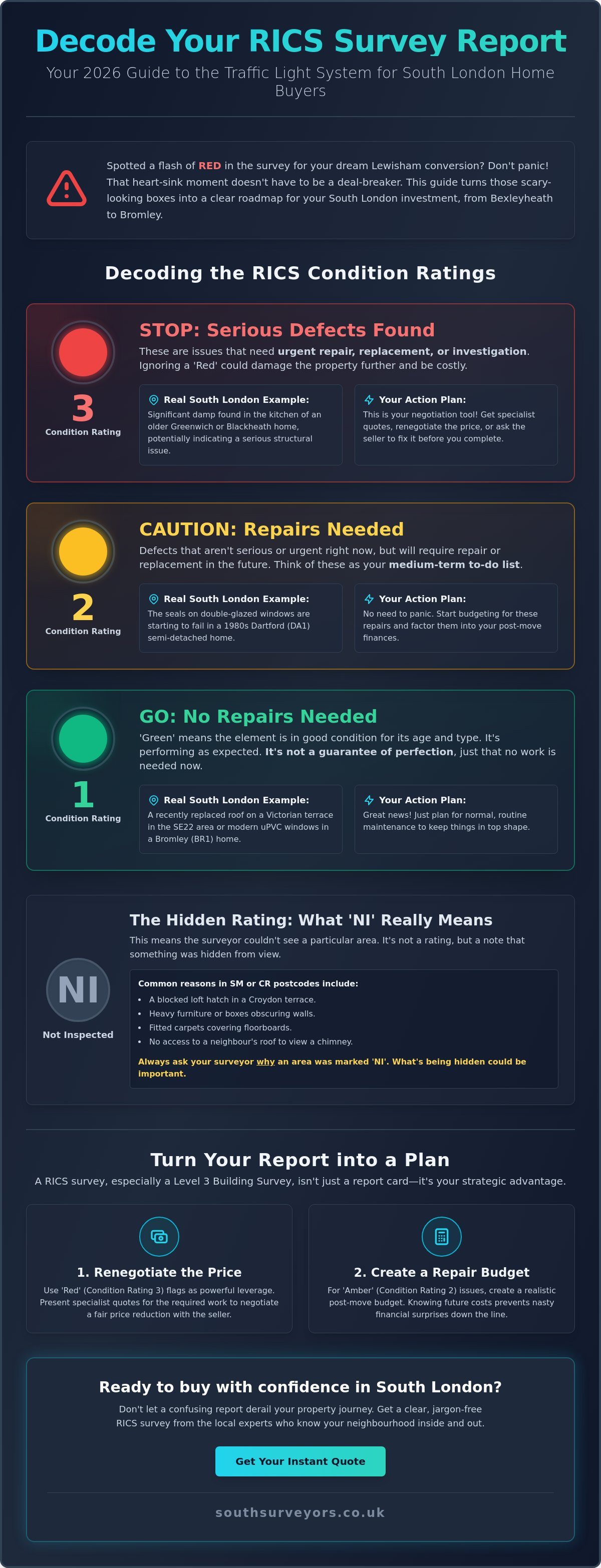
The system breaks down into three distinct categories:
- Green (Rating 1): No repair is currently needed. The property is performing as expected for its age.
- Amber (Rating 2): Defects that aren’t considered serious or urgent but will eventually require attention.
- Red (Rating 3): Serious defects that need urgent attention, investigation, or repair to protect the building.
Standardized vs. Bespoke Reporting
All RICS-regulated firms, including South Surveyors, adhere to this specific framework to ensure consistency across the industry. This means you get the same high standard of scrutiny whether you’re buying a cottage in DA1 or a flat in SE10. The recent shift toward “Plain English” in modern surveying means we spend less time talking about “hygroscopic salts” and more time explaining why your wall is wet. This standardized approach empowers you to compare different properties on a level playing field. For a deeper dive into the documentation, check out our guide on Understanding Your RICS Home Survey.
Decoding the Colours: What Red, Amber, and Green Really Mean
Opening your report and seeing a sea of green is a massive relief, but it is vital to understand the nuance behind each shade. Learning how to read a survey report traffic lights is less about finding a perfect house and more about understanding the timeline of your future expenses. These ratings help you prioritize what needs fixing before you move into your new home in South East London.
Condition Rating 1: Routine Maintenance
In a Bromley (BR1) semi-detached, modern double glazing usually earns a Condition Rating 1. This means the windows are performing exactly as they should for their age. However, Green isn’t a synonym for perfect. It simply means no repair is currently needed. We often advise clients that understanding the condition ratings means looking at the maintenance notes even for Green items. Regular upkeep, like clearing debris from window tracks or repainting timber frames, ensures they stay in this category for years to come.
Condition Rating 2: Future Repairs
Amber is the middle ground that often catches buyers off guard. Imagine you’re buying a 1930s house in Croydon (CR0) with original cast iron gutters or a flat in Sidcup (DA14) with twenty year old wiring. These might be functional today, but they are nearing the end of their life. You should budget for these repairs within your first five years of ownership. If you ignore an Amber rating, like a small leak in those Croydon gutters, it will inevitably turn into a Red rating once damp sets into the masonry.
Condition Rating 3: Serious Defects
This is where the real work begins. If your surveyor finds wet rot in a Dulwich (SE21) loft or significant structural cracks in an Eltham (SE9) extension, they will issue a Condition Rating 3. This rating usually comes with a “further investigation” requirement. We might suggest a specialist damp or gas engineer to pinpoint the exact cost of the fix. Don’t let a Red rating scare you off. In a market where London house prices saw a 1.7% decrease in the year leading up to January 2026, these findings are your strongest tools for price negotiation.
If you are feeling overwhelmed by a specific rating in your report, our experts are always available to discuss your survey findings in detail to help put your mind at ease.
The “Hidden” Ratings: NI and Common South London Red Flags
While the colours are the stars of the show, there is a quiet, often overlooked rating that deserves your full attention: “NI” or Not Inspected. When learning how to read a survey report traffic lights, many buyers skip over these sections, assuming the surveyor just forgot to look. In reality, an NI rating usually means something was physically blocking the way. Whether it is a locked garden shed in a Sidcup garden or a massive mahogany wardrobe in a Peckham bedroom, these gaps in the report can hide significant issues. If a surveyor cannot access a roof because it is covered in fragile tiles or a basement is packed to the rafters with the seller’s vintage vinyl collection, they have to mark it as NI.
In South East London, these “hidden” areas are often where the most expensive problems live. Victorian terraces in Herne Hill are notorious for damp and timber issues that only reveal themselves when you get close to the floorboards. If you see an NI on a report for a house with an average price of £557,000, you are essentially flying blind on a high-stakes investment. It is always better to ask the seller to clear the space for a re-inspection than to discover a dry rot colony after you have already moved in. Understanding how to read a survey report traffic lights means knowing that an NI is sometimes just as important as a Red rating.
When “Not Inspected” is a Warning Sign
Don’t be afraid to be the “annoying” buyer. If an area is marked NI, ask the seller to provide access. This is especially true for South London basements, which are often hotspots for rising damp. A temporary covering, like a fresh lick of paint or a strategically placed rug, can mask defects that a surveyor would otherwise flag. We always recommend getting eyes on every corner of the property before exchange. If the seller refuses to move furniture or unlock a door, you have to ask yourself what they are trying to hide.
Postcode-Specific Red Flags
South London’s geography plays a huge role in your survey results. The British Geological Survey projects that climate-related subsidence could affect 43% of London properties by 2030, largely due to the way London Clay shrinks and swells. If you are buying in the BR postcode, you might face different structural risks than someone on the hilly terrain of Crystal Palace. You should also keep an eye out for Japanese Knotweed, which loves the rail corridors running through SE postcodes. For more detail on what to look for, see our guide on Spotting Property Defects in South London Homes.
Turning Ratings into Action: Renegotiating and Repair Planning
Once you have mastered how to read a survey report traffic lights, the next step is transforming those coloured boxes into a strategic action plan. A survey is not just a list of faults; it is a powerful tool for your purchase strategy. We recommend starting by creating a “Repair To-Do List” that separates your immediate priorities from long-term maintenance. In a buyer’s market where housing supply in London was up 16% year-on-year at the start of 2026, you have more leverage than you might think. Use your Condition Rating 3 items as the foundation for your conversation with the seller.
Your solicitor plays a vital role here, too. While they handle the legal transfer, they rely on your survey to raise specific enquiries about building regulations or indemnity insurance for flagged defects. For example, if a Red rating appears for a recent extension in a DA or SM postcode, your solicitor can demand proof of planning permission before you proceed. This collaborative approach ensures that you are not just buying a house, but securing a sound investment with all the facts on the table.
The Renegotiation Roadmap
The key to a successful renegotiation is data, not emotion. If your report highlights urgent repairs in Sutton or Dartford, get two or three quotes from local contractors to establish the actual cost of the fix. Present these findings to the estate agent calmly. A Red rating provides a factual basis for price reduction. You might also consider a “retention,” where a portion of the purchase price is held back by solicitors until the seller completes a specific repair to a professional standard.
When to Walk Away
Sometimes, the most empowering choice is to say no. Deal-breakers usually involve severe structural failure, uninsurable risks, or repair costs that far exceed the property’s potential value. With London house prices showing a 1.7% decrease in the year to January 2026, you must be careful not to overcapitalize on a “money pit.” If the “Red” items involve foundational issues that could affect your future resale, it might be time to look elsewhere. We always encourage a post-report sanity check with your surveyor to discuss whether the risks align with your budget and appetite for renovation.
If you have received a report that feels overwhelming, our team can help you discuss your survey findings and plan your next move with confidence.
Beyond the Colours: Why the Personal Touch Matters
While mastering how to read a survey report traffic lights is a vital skill for any savvy buyer, the visual ratings are really just the executive summary. The real gold is buried in the text descriptions. A Red rating for damp in a Blackheath Georgian townhouse sounds terrifying on paper, but the surveyor’s notes might reveal it is a simple ventilation fix rather than a structural catastrophe. This is why we tell our clients that the traffic lights are the starting point, not the final verdict. You need the context to know if you are looking at a deal-breaker or a weekend DIY project.
For those falling in love with period properties in Greenwich or along the leafy streets of Blackheath, a RICS (Level 3) Building Survey is indispensable. These older homes have unique personalities and quirks that a simple colour code cannot fully capture. A Level 3 report provides the depth needed to understand how these buildings breathe, move, and age. It moves beyond the “what” and explains the “why,” giving you a bespoke roadmap for your future home that a standard checklist simply cannot match.
The South Surveyors Difference
We are deeply committed to the SE, BR, DA, CR, and SM communities because we live and work here too. We don’t just send you a PDF and disappear. We actually encourage you to pick up the phone after you’ve had a chance to digest your traffic lights. Whether you’re confused about a specific rating in Croydon or worried about a “Not Inspected” area in Sidcup, we are here to demystify the scary parts. We combine the rigorous professional substance of RICS standards with a conversational approach that treats you like a person, not a transaction number. Our experts are accessible and ready to provide the one-on-one consultation that demystifies complex documentation.
Next Steps for Your Property Journey
Your property journey in South London should be exciting, not exhausting. Whether you need a RICS (Level 2) Condition Report for a modern build in Dartford or a comprehensive RICS (Level 3) Building Survey for a Victorian gem in Peckham, we’ve got you covered. Our goal is to provide the mental ease you need to make an empowered decision about your high-stakes transaction. Don’t let technical jargon or a flash of Amber light stand between you and your dream home. Get a quote from South Surveyors today and take the next step with total confidence and expert support.
Take Control of Your South London Property Purchase
Securing your spot in the 2026 property market requires more than just a keen eye for decor. It demands a clear strategy. By mastering how to read a survey report traffic lights, you’ve moved from being a worried buyer to an empowered negotiator. You now understand that a Red rating in Eltham or an NI in a Bromley basement isn’t a dead end. It’s a signal to dig deeper and protect your investment. Whether you’re dealing with London Clay or Victorian damp, you have the tools to separate minor maintenance from true deal-breakers.
As a RICS Regulated Firm with hyperlocal South London expertise and 4.9/5 star client feedback, we pride ourselves on turning complex data into clear advice. We don’t just provide a report; we provide peace of mind for buyers across the SE, BR, and DA postcodes. If you’re ready to proceed with total transparency, book your RICS survey with South Surveyors. Your future home is a major milestone. We’re here to make sure you step over the threshold with confidence and a solid plan in place. Happy house hunting.
Frequently Asked Questions
What is the most serious rating in a RICS survey?
Condition Rating 3, represented by the colour red, is the most serious rating you’ll encounter. It indicates defects that are either serious, urgent, or require further investigation to protect the building. When you’re learning how to read a survey report traffic lights, seeing a Red rating on a property in Dartford or Sutton means you need to stop and seek specialist advice before exchanging contracts to avoid expensive surprises.
Can a house fail a RICS survey?
Technically, a house cannot fail a survey because it isn’t a test with a pass mark. Instead, it’s a factual assessment of condition at a specific point in time. Even a property in Crystal Palace with several Red ratings hasn’t “failed”; it just has significant issues that you need to account for in your budget. The survey gives you the transparency needed to decide if the property’s condition matches its price tag.
Do I have to fix everything rated “Amber” immediately?
You don’t need to reach for your toolkit the day you move into your new SE postcode home. Amber (Condition Rating 2) items are defects that aren’t considered urgent but will require repair or replacement in the future. We suggest budgeting for these within the first few years of ownership. Ignoring them could lead to more serious damage, potentially turning an Amber guttering issue into a Red damp problem down the line.
What should I do if my survey has multiple “Red” ratings?
The first step is to stay calm and request quotes from local specialists to understand the true cost of repairs. Multiple Red ratings are common in South London’s older housing stock, especially in areas like Herne Hill. Use these findings to renegotiate the purchase price or ask the seller to address the issues. Your surveyor can help you prioritize which defects are deal-breakers and which are manageable renovations.
Does a “Green” rating mean the house is worth the asking price?
A Green rating (Condition Rating 1) confirms that an element is in good order for its age, but it doesn’t automatically justify the asking price. Market value depends on many factors beyond physical condition, including local demand and school catchments. If you’re unsure about the price, a RICS Property Valuation provides an independent assessment of whether that £557,000 average price for South East London actually applies to your specific home.
What does “NI” stand for in a property report?
NI stands for “Not Inspected” and it appears when the surveyor couldn’t access a specific part of the property. This often happens if a loft hatch is blocked by heavy boxes or a basement door is locked. While it’s not a colour-coded warning, an NI is a gap in your knowledge. You should always ask the seller to clear access so every corner of your potential home is properly reviewed during the process.
How much can I renegotiate for a “Red” rated defect?
There isn’t a fixed percentage, but you should aim to reduce the price by the estimated cost of the repair. If a specialist quote says it’ll cost several thousand pounds to fix a structural issue in Croydon, that’s your starting point for negotiation. In a market where London house prices saw a 1.7% decrease in the year to January 2026, sellers are often more willing to be flexible when presented with factual evidence.
Will my mortgage be declined if there are “Red” ratings?
A Red rating doesn’t mean an automatic “no” from your lender, but it might lead to a mortgage retention. This is where the bank holds back some of the loan until specific repairs are finished. With average two-year fixed mortgage rates at 5.42% as of May 2026, lenders are being more cautious. They want to ensure the property is a safe asset, so they may require certain Condition Rating 3 issues to be resolved first.