

What if the very home improvements you’ve sweated over in your Peckham flat actually ended up costing you thousands extra when you tried to buy more of it? It’s a frustratingly common fear for shared owners across South London, from the leafy streets of Bromley to the high-rises of Croydon. You’ve worked hard to turn your property into a home, and the last thing you want is a surveyor penalizing you for your own hard work or a ticking clock making your paperwork expire.
Mastering the staircasing valuation for shared ownership is about more than just getting a number; it’s about strategic timing and expert RICS insights. In this guide, we’ll show you exactly how to navigate the process, protect your equity with the “disregard rule,” and manage the strict three-month validity window. Whether you’re in an SE, BR, or CR postcode, we’ll help you transition to owning a larger share while lowering your monthly rent, positioning you as the true boss of your property journey.
Key Takeaways
- Understand how a staircasing valuation for shared ownership sets the price for your next equity share and why an independent RICS assessment protects you from overpaying.
- Learn how to use the “disregard rule” to ensure you aren’t charged for the value of home improvements you’ve already funded yourself.
- Identify whether your lease requires a formal RICS valuation or if you can use the House Price Index (HPI) for smaller “micro-staircasing” steps.
- Master the 90-day validity window to ensure your valuation doesn’t expire before your legal work is completed in postcodes like SE1, BR1, or CR0.
- Discover why hyperlocal knowledge of South London’s specific streets and property trends is vital for an accurate, fair market assessment.
What is a Staircasing Valuation and Why Does it Feel Like the Property Boss Level?
Think of your property journey like a classic video game. You’ve successfully cleared the “Initial Purchase” stage and survived the “Moving In” level. Now, you’re staring down the Boss Level: the staircasing valuation for shared ownership. This isn’t just another bit of admin; it’s a formal RICS assessment that pinpoints the current market value of your home. Whether you’re living in a leafy street in SE22 or a high-rise in SE19, this specific number dictates exactly how much your next 10%, 25%, or 50% share will cost you. It is the final gatekeeper between you and a significantly smaller rent bill.
Before you start crunching the numbers on your calculator, it’s a good idea to learn about the basics of shared ownership to understand how your lease structure impacts your long-term goals. Getting this valuation right is the difference between a smooth transition to more equity and feeling like you’ve been unfairly penalized for the rising prices across South London’s vibrant neighbourhoods.
To better understand this concept, watch this helpful video:
The Goal: Buying Your Way to 100% Ownership
Staircasing is the process of increasing your stake in your home until you eventually own it outright. For many homeowners in high-value pockets like East Dulwich, this is a strategic move to slash monthly outgoings. Every extra percentage point you buy is a chunk of rent you’ll never have to pay again. There’s a massive psychological shift that happens when you realize you own more of your front door than the housing association does. It’s about moving from being a tenant-owner to a full freeholder or 100% leaseholder, giving you total control over your most valuable asset.
Why You Need a RICS Registered Valuer (No, an Estate Agent Won’t Do)
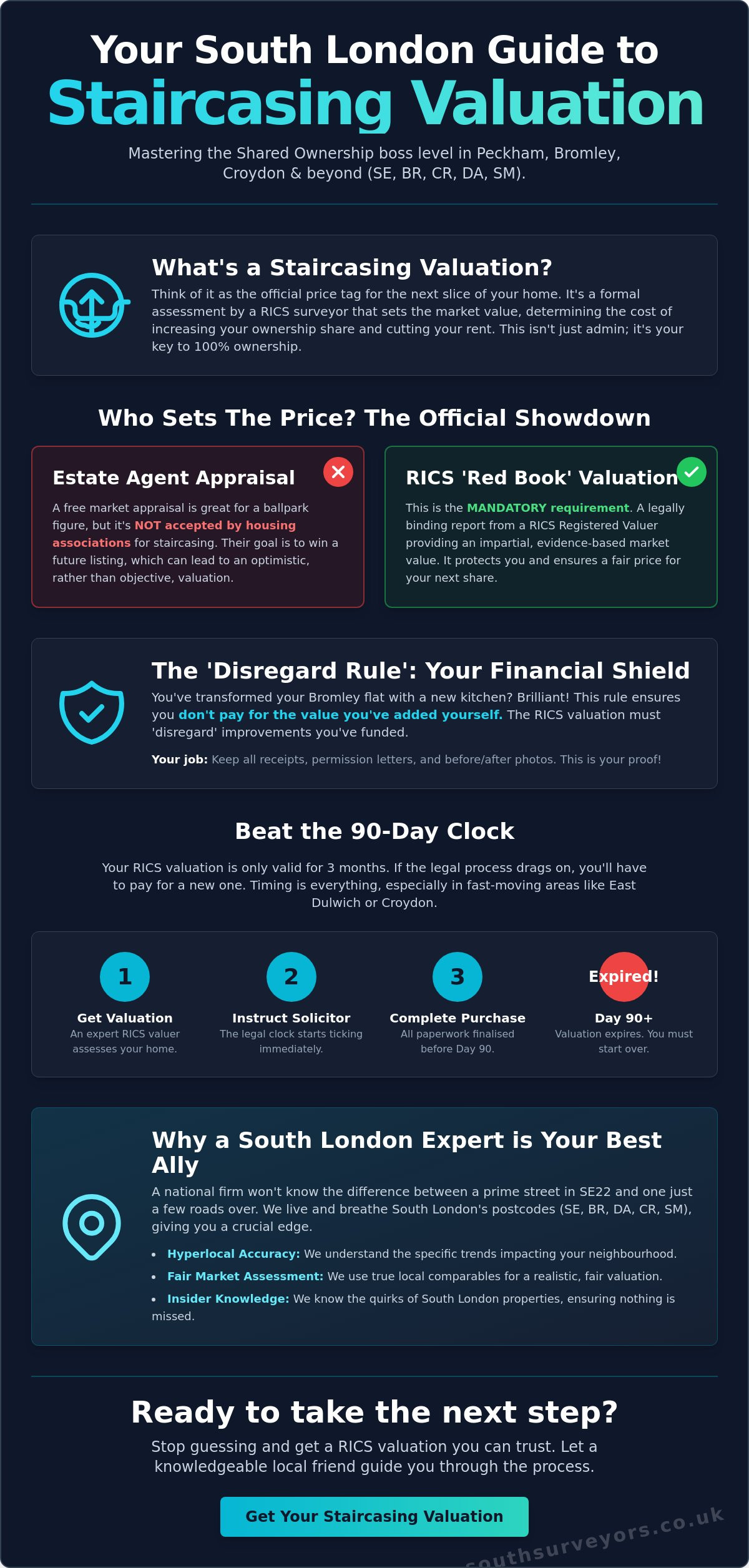
You might be tempted to ask a local estate agent for a quick market appraisal, but your housing association won’t accept it. They mandate a RICS “Red Book” valuation. This is a legally binding document produced by a RICS Registered Valuer that follows strict global standards. While an agent might give you an optimistic number to win a potential listing, a surveyor provides an objective, evidence-based figure. At South Surveyors, we combine this professional rigour with a deep understanding of South London’s quirky property pockets, ensuring your staircasing valuation for shared ownership is both accurate and fair.
Decoding the RICS Red Book: The Disregard Rule and Your Home Improvements
Imagine you’ve spent the last three years turning a tired flat in Bromley into a Pinterest-worthy sanctuary. You’ve ripped out the avocado bathroom suite and replaced it with sleek, modern tiles. When it’s time for your staircasing valuation for shared ownership, the last thing you want is for the housing association to profit from your hard work. This is where the RICS Red Book’s “Disregard Rule” becomes your financial shield. The Disregard Rule is a legal protection that prevents you from paying twice for your own upgrades by excluding their added value from the final purchase price.
According to the official government guidance on staircasing, the valuation must reflect the property’s state without those tenant-funded improvements. If you’ve been busy DIY-ing in Croydon or hiring contractors in Bexley, keeping a meticulous paper trail is your best defensive strategy. Receipts, before-and-after photos, and signed permission letters from your landlord are gold dust when sitting down with a surveyor. It’s about proving exactly what you’ve changed since you first picked up the keys.
What Actually Counts as an Improvement?
Not every change you make adds “valuation value.” It’s vital to distinguish between keeping the place ticking over and actually increasing its market worth. Improvements usually involve significant capital expenditure that changes the property’s spec. These include:
- Installing a completely new, high-specification kitchen or bathroom.
- Adding double glazing or upgrading an old, inefficient heating system.
- Structural changes, such as removing a wall to create an open-plan living space in SE15.
- Adding a conservatory or an extension, provided you have the required permissions.
Maintenance, however, is simply expected of you as a homeowner. Painting the walls, replacing a broken tap, or buying a designer rug from a boutique in Peckham won’t move the needle on your valuation. These are considered “re-decoration” or “chattels” and are generally ignored during the process. We focus on the fixed elements that would stay with the building if you moved out.
The Surveyor’s “X-Ray Vision”: Valuing the Property as it Was
When we walk through your front door, we use what we like to call “X-ray vision.” Our job is to look past your beautiful new finish and see the “base” property. We calculate the current market value of a home like yours in your specific South London neighbourhood, then we mentally subtract the specific value your improvements have added. It isn’t as simple as just subtracting the cost of the kitchen; it’s about assessing how much that kitchen actually increased the home’s worth in the eyes of a hypothetical buyer. This methodical approach ensures you aren’t priced out of your own home by your own ambition.
If you’re feeling nervous about how your recent renovations might affect your next step, it’s worth chatting with a professional who knows the local postcodes inside out. You can always book a RICS property valuation to get a clear, expert perspective on where you stand before you start the formal process with your housing association.
RICS Valuation vs. HPI: Which One Actually Saves You Money?
Deciding how to increase your stake in your home often feels like a choice between a quick algorithm and a deep dive. If you’ve got a newer lease, you might have heard of the House Price Index (HPI) route. It’s essentially a mathematical shortcut. However, for a standard staircasing valuation for shared ownership where you’re buying a larger chunk, the HPI simply won’t cut it. While the HPI uses broad regional data, it’s a blunt instrument. It doesn’t know that your specific street in Sidcup just got a shiny new park or that local demand in DA postcodes is bucking the wider London trend.
In a market where London house prices saw a 2.1% annual decrease as of March 2026, relying on a broad index can be risky. An in-person RICS valuation provides the nuance that a spreadsheet misses. It captures the reality of your four walls and the immediate vicinity, ensuring you’re paying a price based on actual local sales, not just a city-wide average. Algorithms don’t walk your halls; surveyors do.
Gradual Staircasing: The 1% Rule
If your lease was issued after 2021, you likely have the option for “micro-staircasing.” This allows you to buy just 1% of your property each year for a 15-year period. The big draw here is that you avoid the formal RICS fee because the price is pegged to the HPI. It’s accessible and keeps the momentum going without a large upfront cost. However, keep an eye on the numbers. If local prices in areas like SM or CR are falling faster than the national index suggests, you might still be better off pivoting to a larger block purchase with a bespoke valuation to lock in a fairer price.
Standard Staircasing: Moving in 5% Blocks or More
For most people on older leases or those looking to make a significant dent in their rent, buying in 5% blocks or more is the standard path. This requires the “Red Book” treatment every single time. A professional RICS Valuation is essential here to plan your finances with certainty. We use a “Hierarchy of Evidence,” looking at the most recent, comparable sales in your specific SE London neighbourhood. We don’t just look at what’s for sale; we look at what actually sold. It’s about justifying the price with hard facts, ensuring that your transition to owning a larger share is based on the most accurate data available today.
Beating the 3-Month Clock: Timing and Preparing Your Home for the Survey
In the fast-moving South London property market, 90 days can vanish in the blink of an eye. A staircasing valuation for shared ownership isn’t a permanent fixture; it’s a snapshot in time with a strict three-month expiry date. If your legal paperwork or mortgage application drags on past this window, your valuation becomes a pumpkin at midnight. While some housing associations allow a “desktop extension,” which is a quick update from your surveyor to refresh the value without a second visit, it’s always better to hit the ground running to avoid extra fees and delays.
Before you even think about booking your survey, ensure you have your mortgage Agreement in Principle (AIP) ready. There’s no point paying for a valuation in Bexley or Dartford if the bank isn’t ready to play ball. Having your financing lined up keeps you firmly within that 90-day window and prevents the stress of a looming deadline. We’ve seen too many homeowners in postcodes like SE18 or BR1 lose their valuation validity because they started the process in the wrong order. Timing is everything.
The Staircasing Timeline: A 5-Step Process
To keep your journey to more equity on track, follow this logical flow:
- Step 1: Check your lease for any specific staircasing rules and secure a mortgage “Agreement in Principle.”
- Step 2: Instruct your South London RICS valuer. This is where we come in to provide your formal Red Book report.
- Step 3: Submit the valuation to your Housing Association immediately. Don’t let it sit in your inbox.
- Step 4: Instruct your solicitor once the price is agreed and the Housing Association issues the offer.
- Step 5: Complete the transaction before the 3-month mark to ensure your valuation remains valid.
Preparation Tips for a Smooth Inspection
A RICS valuation isn’t a “viewing” in the estate agency sense. We aren’t looking at your choice of scatter cushions or your taste in art. However, a tidy house helps the process move faster. Ensure we have easy access to every room, including lofts, basement storage, and cupboards containing boilers or water cylinders. If you’re in a compact flat in SM or a larger terrace in CR, clearing a path to the fuse box and meters is greatly appreciated by your surveyor.
Have your list of “Disregarded Improvements” typed up and ready to hand over during the visit. Since we discussed exactly what counts as an improvement in the previous section, having your receipts and permissions organized will ensure nothing is missed. This level of preparation helps us provide a more accurate report and gives you peace of mind that you’re being treated fairly. If you’re ready to start the clock, book your RICS property valuation with our team today.
Why a Local South London RICS Expert is Your Best Staircasing Ally
When you’re ready to level up your property game, you don’t just need a surveyor; you need a neighbour who knows the terrain. A staircasing valuation for shared ownership is a precise science, but it’s one that benefits heavily from local intuition. While a national firm might look at a map and see a generic zone, we see the specific character of a street in Crystal Palace compared to a high-rise development in the heart of Croydon. This distinction matters because property values in South London don’t move in a straight line. They fluctuate block by block, and having a surveyor who understands why one side of the tracks in SE19 commands a premium can save you thousands on your purchase price.
At South Surveyors, we pride ourselves on being the “knowledgeable friend” in your corner. We combine professional substance with a friendly, approachable flair, ensuring you feel empowered rather than overwhelmed. We adhere to the most rigorous RICS Red Book standards, but we promise to speak your language. No corporate jargon, no confusing acronyms; just clear, honest advice designed to help you navigate the often-complex requirements of London-based Housing Associations. We know their specific templates and their quirks, which means your report is much less likely to be kicked back for “clarification.”
Expertise Across SE, BR, DA, CR, and SM Postcodes
Our boots have been on the ground across every corner of South London. From the established Victorian terraces of East Dulwich to the sprawling new-build estates in Dartford and Bexley, we’ve seen it all. London-wide firms often miss the nuances of specific boroughs, failing to account for the “micro-climates” of the local market. Our deep familiarity with the SM, CR, and BR postcodes means we aren’t guessing; we’re using real-world data from your immediate vicinity. This commitment to accuracy is why we provide building surveys and valuations that go far beyond just a number on a page. We provide context, clarity, and confidence.
Your Next Step: Getting a Quote
Taking the next step shouldn’t feel like a chore. We believe in total transparency, which is why we offer instant quotes that won’t leave you guessing about the cost of your staircasing valuation for shared ownership. When you call our team, you won’t be met by a corporate robot. You’ll speak to a human who understands the stress of the three-month clock and the importance of getting your “disregarded improvements” right. We’ll walk you through the process, confirm our availability, and get your inspection in the diary before you can say “Peckham Rye.”
Ready to own more of your home? Book your staircasing valuation today.
Ready to Own More of Your South London Sanctuary?
Taking the leap to increase your equity shouldn’t feel like a gamble. By now, you know that timing your application perfectly and documenting every penny spent on your SE15 kitchen or BR1 bathroom is vital. Your staircasing valuation for shared ownership is the most powerful tool in your arsenal; it’s the bridge between being a part-tenant and becoming a full homeowner. Don’t let the 90-day expiry window or a generic price index dictate your financial future when you can have a bespoke assessment that actually understands your street.
As a RICS Regulated Firm and local South London specialists, we provide Red Book compliant reports that housing associations trust. We’ve helped homeowners from Croydon to Dartford navigate this process with ease and transparency. Whether you’re aiming for that next 10% or the full 100%, we’re here to ensure the numbers work for you, not against you. We know the local market nuances that big national firms simply miss.
Book your Shared Ownership Valuation with South Surveyors today and take the next step toward owning your front door outright. You’ve done the hard work making your house a home; let’s make sure the valuation reflects that reality. You’ve got this.
Frequently Asked Questions
How much does a staircasing valuation cost in South London?
Fees for a RICS valuation in South London aren’t one-size-fits-all and depend heavily on your property’s size and complexity. Whether you’re in a compact flat in SM1 or a larger terrace in BR3, factors like the number of bedrooms and the property’s specific type will influence the final quote. It is always best to request a bespoke quote directly to ensure you’re getting a fair price for a professional, Red Book compliant report.
Can I challenge the valuation if I think it is too high?
You can absolutely challenge a valuation if you believe the figure doesn’t reflect the current market reality of your South London street. Most housing associations have a formal appeals process, but you’ll need to provide solid evidence, such as three comparable properties sold nearby in postcodes like SE10 or DA1 within the last six months. We can help you understand the data used in your report to see if an appeal is a viable route for your specific situation.
What happens if my staircasing valuation expires before I complete?
If your legal work isn’t finished within 90 days, your valuation will expire and you’ll likely need a desktop extension or a new report to continue. This is a common hurdle in busy areas like Croydon or Bexley where solicitors can get backed up. A desktop extension is often a quicker, more cost-effective way to refresh the market value for another three months without requiring a full second inspection of your home.
Do I need a full building survey or just a valuation for staircasing?
For the formal staircasing process, you only need a RICS Property Valuation rather than a full building survey. While a Level 2 or Level 3 survey is fantastic for identifying structural issues, the housing association specifically requires a “Red Book” valuation to set the purchase price. However, if you’re worried about the underlying health of your property in SE19, you can always book a separate condition report for your own peace of mind.
How long does the RICS surveyor take to visit and issue the report?
We typically aim to visit your property within a few working days of your instruction and issue the final report shortly after the inspection is complete. The site visit itself usually takes about 30 to 60 minutes, depending on the size of your home in postcodes like CR7 or SM4. Once we’ve gathered our local evidence and crunched the numbers, your formal staircasing valuation for shared ownership will be ready for your housing association.
Will my garden improvements be disregarded in the valuation?
Permanent garden improvements, such as high-quality landscaping, structural walls, or a new patio, are generally disregarded to ensure you aren’t paying for the value you’ve added. Just like the internal upgrades we discussed earlier, these must be fixed improvements rather than “chattels” like garden furniture or potted plants. Keep those receipts from your local garden centre in Bromley or Sidcup to prove the work was funded by you.
Can I use the same valuation for my mortgage lender?
Most mortgage lenders insist on using their own panel of surveyors, so you usually can’t use the same report for your loan application. Your staircasing valuation for shared ownership is specifically designed to satisfy the housing association’s requirements for setting the share price. While the figures might be similar, the two valuations serve different masters: one sets the price you pay, and the other assesses the security of the bank’s loan.
Does the Housing Association choose the surveyor or do I?
You usually have the freedom to choose your own surveyor, provided they are RICS registered and independent of the housing association. Some associations in South London provide a list of “recommended” firms, but you aren’t always restricted to them. It is your right to pick a local expert who knows the nuances of postcodes like SE23 or DA15 to ensure your valuation is as accurate and fair as possible.