

Did you know that projections from the British Geological Survey suggest that 43% of London properties will be at risk of climate-related subsidence by 2030? That is a sobering thought when you’re eyeing up a charming Victorian terrace in SE22 or a leafy semi in Bromley. Much of that risk is driven by our famous South London clay soil, which loves to shift and crack aging pipes, making RICS survey drainage issues a top priority for any savvy buyer in the SM, CR, or DA postcodes.
We understand the pit-of-the-stomach feeling when you see a manhole cover and wonder what’s lurking in the dark. You want a dream home, not a five-figure plumbing disaster waiting to happen. This guide will demystify exactly what your surveyor looks for during their inspection and help you decide if you need a specialist CCTV look before you commit. We’ll give you the clarity to distinguish between Level 2 and Level 3 checks, ensuring you have the confidence to negotiate a fair price or protect your investment from a hidden money pit.
Key Takeaways
- Stop your dream home from becoming a money pit by uncovering the vital link between leaky pipes and South London’s notorious ground movement.
- Get the lowdown on what a surveyor actually sees down a manhole, helping you demystify the RICS survey drainage issues mentioned in your report.
- Navigate the “drainage trap” of Victorian pipes and heavy clay soil that often catches out unsuspecting buyers in the SE, BR, and CR postcodes.
- Learn to decode RICS Condition Ratings like a pro so you can negotiate with total confidence when a “Rating 3” warning pops up.
- Know exactly when to pull the trigger on a specialist CCTV survey to ensure your investment is as solid as it looks on the surface.
The Invisible Dealbreaker: Why Drainage Matters in Your RICS Survey
Buying a home in South London is a whirlwind of emotion and logistics. You are likely checking the natural light in that Dulwich kitchen or calculating the commute from Croydon, but you probably aren’t thinking about what is happening six feet under your feet. Drainage is the ultimate invisible dealbreaker. Just because the toilet flushes and the sinks drain doesn’t mean the system is healthy. In fact, ignoring potential RICS survey drainage issues is one of the quickest ways to turn a solid investment into a financial sinkhole.
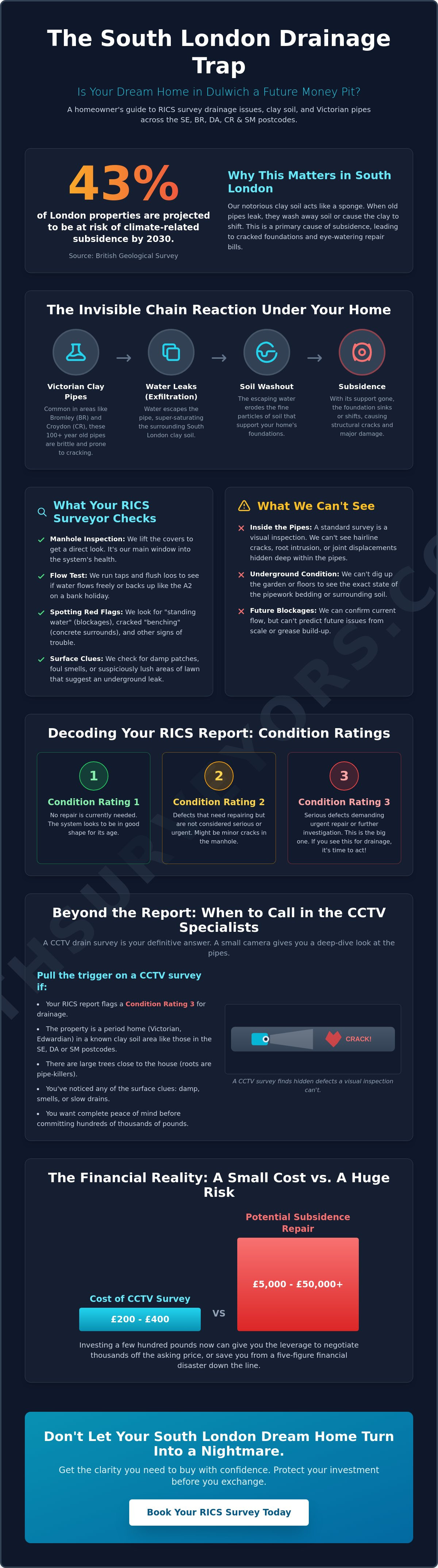
The biggest worry isn’t just a smelly blockage; it’s the dreaded “S-word”: subsidence. Much of South London sits on a thick layer of clay that behaves like a giant, moody sponge. When pipes leak, a process called exfiltration occurs. This escaping water washes away the supporting soil or causes the clay to soften and shift. This leads to structural movement that can terrify mortgage lenders and send insurance premiums through the roof before you’ve even unpacked your first box.
To see how a simple leak can lead to serious structural cracks in your foundations, watch this helpful breakdown:
The Financial Sting of Hidden Pipework
Victorian and Edwardian homes in postcodes like SE22 or BR3 are undeniably gorgeous, but their foundations weren’t designed for the volume of water modern families use. When 100 year old clay pipes crack, the escaping water compromises the ground’s integrity. This isn’t just a minor plumbing fix. If the soil under your bay window starts to migrate, the repair costs can escalate quickly. Being vigilant about RICS survey drainage issues now saves you from a massive financial sting later.
RICS Regulation: Your Shield Against Uncertainty
This is where professional oversight becomes your best friend. Choosing a Chartered Surveyor ensures you aren’t just getting a “mate’s opinion” on the property. At South Surveyors, our RICS-regulated status is the cornerstone of the trust we build with our clients. We provide a level of thoroughness that offers genuine mental ease during the high-stakes exchange process. By following strict industry standards, we demystify complex underground services, giving you the tools for empowered decision-making rather than leaving you to guess what is happening in the dark.
What Your RICS Surveyor Actually Checks (and What They Can’t See)
Some people think a surveyor just wanders around with a clipboard and a hopeful expression. In reality, we are more like property detectives. When it comes to RICS survey drainage issues, our investigation is governed by the “visual inspection” rule. In plain English, this means we examine everything that is “readily accessible.” We won’t be tearing up your floorboards or digging up the garden, but we certainly won’t ignore the clues hidden in plain sight. We look for signs of damp, unusual smells, or lush patches of grass that suggest a pipe is feeding the lawn a bit too well.
The most important part of our ritual is lifting the manhole covers. This is our primary window into the property’s underworld. We aren’t just checking if it’s “yucky” down there; we are looking for technical red flags like “standing water,” which suggests a blockage or a dip in the pipe. We also check the “benching,” which is the concrete haunching that directs waste into the main channel. If the benching is cracked or crumbling, water can seep into the surrounding soil, leading to the subsidence risks we mentioned earlier. While we are at it, we consult the Building Regulations for drains and sewers to ensure the system’s layout isn’t a DIY disaster waiting to happen.
We also perform a “flow test.” This involves running the taps and flushing the loos while an eagle-eyed surveyor watches the inspection chamber. If the water doesn’t appear or moves at the speed of a South London traffic jam, we know there’s trouble downstream. However, we have our limits. We can’t see through solid brick or look 10 metres deep into a pipe without specialized technology. If you want total peace of mind, you can always reach out to us for a chat about your specific property concerns.
Level 2 vs Level 3: The Drainage Divide
The depth of our investigation often depends on the report you choose. A RICS Level 2 survey is usually sufficient for modern, conventionally built homes where the drainage is relatively straightforward. However, for those iconic, complex Victorian homes in Greenwich or older properties in Croydon, a Level 3 Building Survey is essential. It allows us to provide far more detailed advice on defects and repairs, which is vital when dealing with century-old infrastructure.
When Manholes Go Missing
In South London, manholes often go on an accidental holiday. We frequently find them buried under stylish new decking in Peckham or hidden beneath a heavy garden shed in Bromley. If a surveyor “cannot lift the cover” because it’s obstructed, it is a major red flag. It means a huge part of the property’s health remains a mystery. Always check the “limitations” section of your report to see exactly what we couldn’t access; it’s often where the most important warnings live.
The South London Drainage Trap: Clay Soil and Victorian Pipes
If you’ve spent any time in South London, you’ll know our soil is famous for all the wrong reasons. The “London Clay” that sits beneath our feet is essentially a giant, moisture-sensitive sponge. It expands when wet and shrinks during dry spells, putting immense physical stress on anything buried within it. For the beautiful Victorian and Edwardian terraces in SE postcodes like East Dulwich or Hither Green, this movement is a constant threat to aging infrastructure. When the ground shifts, those rigid, century-old pipes often reach their breaking point.
Tree root invasion is another classic South London headache. Those leafy, tree-lined streets that make Dulwich so desirable are a literal minefield for your drainage system. Roots are expert water-seekers. They can detect a tiny hairline crack in a pipe from meters away. Once they find a way in, they grow rapidly, turning a minor leak into a total blockage. This is why RICS survey drainage issues often focus heavily on the proximity of large oaks or planes to your inspection chambers.
Understanding who is responsible for a repair is also key to protecting your investment. Before October 2011, many homeowners were on the hook for shared “private” sewers. Since then, the law changed, and most shared sewers and lateral drains transferred to water companies like Thames Water. However, the section of pipe that serves only your house remains your responsibility. It’s a vital distinction that can mean the difference between a quick call to the utility company and a hefty bill for your own pocket.
Hyperlocal Hazards: Postcode Deep Dive
In the SE postcodes of Southwark and Lewisham, the combination of heavy clay and high-density housing means pipes are often working at maximum capacity. Move out to the BR and CR postcodes of Bromley and Croydon, and you’ll encounter a different beast: pitch-fibre pipes. Popular in the mid-20th century, these “cardboard and tar” pipes are notorious for collapsing as they age. Meanwhile, the SM and DA postcodes often feature 1930s builds where the drainage layouts can be surprisingly complex, requiring a surveyor with local knowledge to untangle the mess.
The “Combined Sewer” Conundrum
Many older South London properties use a “combined” system, where foul water from your loo and surface water from your roof gutters all end up in the same pipe. During heavy rainfall in the “Big Smoke,” these systems can become overwhelmed, leading to back-ups that nobody wants to deal with on a Sunday morning. Vitrified Clay was the standard, brittle material used for these period systems, and while it’s incredibly durable, it doesn’t handle ground movement well. Identifying these RICS survey drainage issues early is the best way to ensure your new home stays dry and functional for the long haul.
Red Flags and Warnings: Deciphering Your Survey Report
Your report lands in your inbox with the weight of a thousand decisions. When you scroll down to the “Services” section, it is time to play a high-stakes game of traffic lights. RICS reports use a simple 1 to 3 rating system. Rating 1 (Green) means everything is behaving. Rating 2 (Amber) suggests things are okay for now but will need a fix soon. Rating 3 (Red) is the “hold your horses” moment. If we spot serious RICS survey drainage issues, they will be flagged with a 3, meaning the defect is serious or needs urgent investigation.
In a South Surveyors report, we don’t just give you a number and leave you guessing. We use specific phrasing to describe the underworld of your potential home. You might see “broken benching,” which means the concrete channels at the bottom of the manhole are crumbling, allowing water to seep into the foundations. “Root ingress” is the polite way of saying the local Sydenham sycamores have turned your pipes into a snack bar. If we mention “back-filling,” it suggests the system is currently overwhelmed, with waste sitting in the pipes rather than flowing away to the main sewer.
The “Further Investigation” Recommendation
Sometimes, we might suggest a specialist CCTV survey even if the toilets are flushing perfectly. Don’t panic. Think of this as a diagnostic tool rather than a deal-breaker. It is the difference between a GP listening to your heart and a specialist ordering an MRI. In neighborhoods like Bexley or Sidcup, where ground movement is common, knowing the internal state of those pipes is vital. It helps you distinguish between a simple maintenance task, like a high-pressure jet wash, and an urgent repair that requires digging up the driveway.
Negotiation Power: Turning Defects into Discounts
This is where the paperwork becomes your superpower. Using your home survey as a tool for empowered decision-making is the smartest move you can make before exchange. If a documented drainage issue comes to light, you have a solid, evidence-based reason to talk to your conveyancer and the seller about a price reduction. Most sellers would rather knock a few grand off the price than see the whole deal collapse. True mental ease comes from having these facts on paper before you sign the contract, ensuring you aren’t inheriting someone else’s expensive headache. Book your professional RICS survey today to get the facts you need.
Beyond the Report: When to Call in the CCTV Specialists
Sometimes, even the most eagle-eyed detective needs a bit of high-tech help. While we pride ourselves on spotting the subtle clues of RICS survey drainage issues from the surface, our eyes can’t see around corners or through ten metres of buried clay pipe. If your report comes back with a “Rating 3” or we suspect hidden damage due to those thirsty Dulwich tree roots, it’s time to call in the CCTV specialists. These pros send a remote-controlled camera down into the depths to give you a “robot’s eye view” of exactly what is happening under your foundations.
A specialist drainage contractor provides a detailed video feed and a technical report that maps out every crack, root intrusion, or structural collapse. We often recommend this step because it removes the guesswork. Instead of wondering if you have a minor blockage or a major pipe failure, you get absolute certainty. Knowing the state of the underworld before you exchange contracts is the ultimate way to secure your financial future and ensure your South London investment doesn’t literally go down the drain.
Throughout this process, South Surveyors acts as your meticulous and dependable expert. We don’t just hand you a report and vanish. We are here to help you interpret the findings, providing the authoritative advice you need to navigate the next steps of your purchase. We believe that professional oversight is the best way to alleviate the stress of a high-stakes move, giving you the mental ease that comes from total transparency.
The South Surveyors Personal Touch
Our local knowledge is what sets us apart. We know the specific quirks of the SE, BR, and CR postcodes, from the heavy clay of Lewisham to the aging pitch-fibre pipes often found in Croydon’s mid-century builds. We are committed to demystifying complex processes for our clients, whether you’re a first-time buyer or a seasoned mover. When you book with us, you’re getting a team that actually knows the difference between a Victorian terrace in Bromley and a 1930s semi in Bexley, ensuring our advice is always bespoke and relevant to your specific street.
Your Next Steps to a Secure Home
Buying a property is likely the biggest financial commitment you’ll ever make. Don’t let the excitement of finding that “perfect” flat in Peckham or a house in Sutton blind you to what’s happening underground. Skipping a survey to save a few pounds now can lead to a five-figure repair bill the moment you move in. RICS regulation is your shield, ensuring that your deposit and your future home are protected by the highest industry standards. Take control of your purchase and get the clarity you deserve. Book your South London RICS survey today and move in with total confidence.
Secure Your South London Investment Today
Navigating the property market in areas like Peckham, Bromley, or Croydon is enough of a challenge without worrying about what’s happening beneath your feet. You now know that while a visual inspection has its limits, it provides the essential clues needed to spot RICS survey drainage issues before they become your financial burden. By understanding the unique relationship between our local clay soil and aging Victorian pipes, you’re already ahead of the average buyer. Knowledge is your best defense against the “S-word” and unexpected repair bills.
At South Surveyors, we combine our status as an RICS Regulated Firm with meticulous expert knowledge of the SE, BR, DA, CR, and SM postcodes. Whether you need a detailed Level 3 Building Survey for a period gem or a Condition Report for a modern apartment, we provide the transparency and empowerment you need to sign that contract with a smile. Don’t leave your future to chance when professional clarity is just a click away. Our team is ready to help you demystify the underworld of your next home.
Get a bespoke quote for your South London RICS survey
We’re here to make sure your new home is as solid as it looks on the surface. Happy house hunting!
Frequently Asked Questions
Does a standard RICS Level 2 survey include a CCTV drain camera test?
No, a standard RICS Level 2 survey does not include a CCTV drain camera test. Our inspection is visual, where we lift accessible manhole covers and run taps to check the flow. If we suspect deeper RICS survey drainage issues, we’ll recommend a specialist to send a camera down the pipes. It’s a bit like a GP referral; we spot the symptoms and tell you when you need a specialist scan.
What happens if the surveyor can’t find the manhole cover during the inspection?
If we can’t find the manhole cover, we record it as a limitation in your report. It’s common in places like Peckham or Bromley to find covers buried under new decking or garden offices. This means a significant part of the property’s health remains a mystery. We’ll advise you to ask the seller to uncover it so we can complete a proper inspection before you commit.
Who is responsible for repairs if a shared drain is blocked outside my property?
Responsibility usually lies with Thames Water for shared sewers outside your boundary. Since the law changed in October 2011, most shared drains and lateral sewers transferred to the water companies. If the blockage is in a pipe serving only your home, it’s your problem. If it’s a shared run in an SE postcode terrace, your neighbors and the water company are likely involved in the repair.
How much does a CCTV drain survey usually cost in South London?
A full pre-purchase CCTV drain survey in London typically costs between £250 and £350 as of June 2026. Basic inspections can start from around £139 plus VAT, though prices vary depending on the size of the property. While this is an extra expense on top of your RICS survey drainage issues investigation, it provides total certainty before you commit to a house in a DA postcode like Sidcup.
Can a surveyor detect a collapsed pipe just by looking in the inspection chamber?
No, we can’t see a collapse through the ground, but we can spot the symptoms in the chamber. If the inspection chamber is full of standing water or heavy silt, it tells us something is wrong downstream. We use our professional deduction to flag potential problems, giving you the heads-up that a specialist camera is needed to confirm if the pipe has actually buckled beneath the surface.
Why does my survey report say the drainage is a “Condition Rating 3”?
A “Condition Rating 3” means the drainage has a serious defect or requires urgent investigation. It’s the surveyor’s way of saying “stop and look closer” before you exchange. In our reports, this often triggers a recommendation for a CCTV test to ensure you aren’t buying a property in Lewisham with a collapsed Victorian pipe that could lead to structural movement or subsidence.
Is a drainage survey necessary for a brand-new house in Croydon?
Yes, even new builds in Croydon can have drainage gremlins. Construction debris like mortar or bricks often ends up in the pipes during the build process, causing immediate blockages. We also check for “misconnections” where foul water accidentally drains into surface water systems. It’s better to catch these early while the developer’s warranty is still active and valid in the CR postcode area.
Will my building insurance cover drainage issues found during a survey?
Building insurance rarely covers drainage issues discovered during a pre-purchase survey. Most policies are designed to cover sudden and accidental damage rather than wear and tear or pre-existing defects. If your surveyor finds a cracked pipe in an SM postcode area like Sutton, the insurer will view this as a maintenance issue you’ve inherited rather than a new claim they need to pay out for.