

Buying a home in the UK is an exciting milestone, but it can also feel overwhelming. The fear of discovering hidden, costly problems after you’ve moved in is a major source of stress, and with confusing jargon like ‘RICS Level 2’ or ‘structural integrity,’ it’s easy to wonder if a professional house survey is truly worth the investment. We’re here to reassure you that it is. A thorough survey is not just another expense; it’s your single most important step towards achieving clarity and real confidence in your purchase.
This comprehensive guide is designed to provide that peace of mind. We will walk you through everything you need to know for 2026, from understanding the key differences between survey types to the typical costs you can expect. Most importantly, we’ll show you how to interpret your survey report, transforming it from a technical document into a powerful tool for negotiating the purchase price and planning for future maintenance. By the end, you’ll be fully equipped to make an informed decision and secure your new home with complete confidence.
What is a House Survey (And Why Is It Essential)?
Think of a house survey as a comprehensive health check for what is likely the biggest investment you’ll ever make. Its purpose is simple yet vital: to provide a thorough, expert assessment of a property’s condition before you are legally committed to buying it. This detailed inspection is carried out by a RICS-accredited Chartered Surveyor, who identifies potential defects, from minor maintenance jobs to significant structural problems. Ultimately, it provides the clarity and confidence you need to proceed, armed with a full understanding of the property’s true state.
Mortgage Valuation vs. House Survey: A Critical Difference
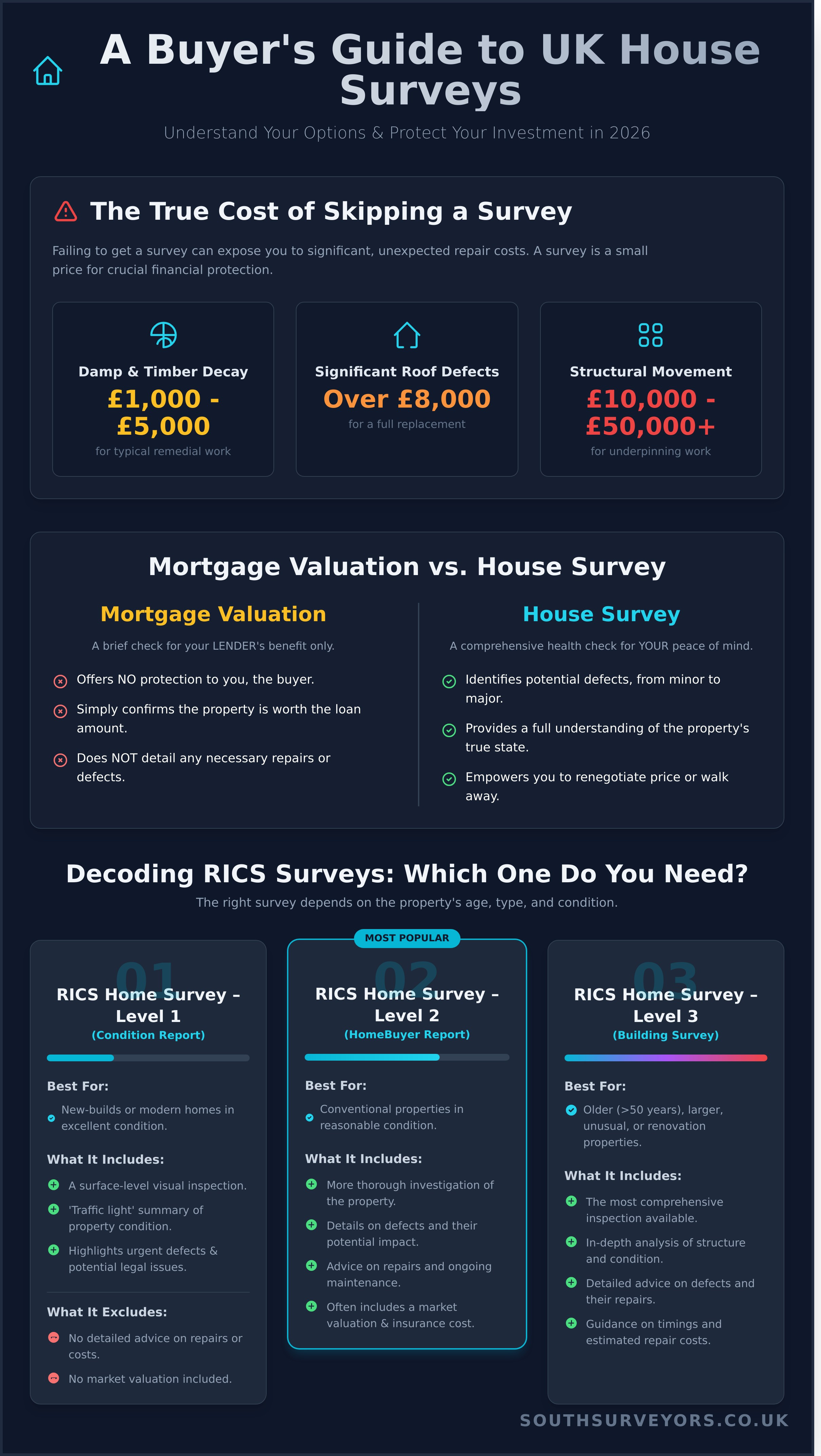
It’s crucial not to confuse your lender’s mortgage valuation with a survey. The valuation is a brief check conducted for the lender’s benefit, confirming the property is worth the amount you wish to borrow against it. It offers no protection to you, the buyer, and will not detail any repairs needed. A professional survey, on the other hand, is a comprehensive report on the property’s condition, conducted entirely for your peace of mind.
The True Cost of Skipping a Survey
The fee for a survey is a small price to pay for financial protection against potentially catastrophic repair bills. Without an expert inspection, you could unknowingly inherit expensive problems. Common hidden issues and their potential costs include:
-
Damp and Timber Decay: Remedial work can easily cost between £1,000 and £5,000.
-
Significant Roof Defects: A full roof replacement on a typical Bexley home can exceed £8,000.
-
Structural Movement (Subsidence): The cost to underpin a property can run from £10,000 to over £50,000.
An independent survey empowers you with the knowledge to either renegotiate the purchase price to cover these costs or, if necessary, to walk away from a poor investment.
Decoding the Types of House Surveys: Which One Do You Need?
Investing in the right professional house survey is a critical step towards purchasing your Bexley home with clarity and confidence. The Royal Institution of Chartered Surveyors (RICS) provides a clear framework to help buyers choose the appropriate level of inspection. The correct choice depends entirely on the age, construction, and apparent condition of the property, ensuring you have the precise information needed to make a sound investment.
RICS Home Survey – Level 1 (Condition Report)
This is the most basic survey, designed to provide a simple ‘traffic light’ summary of the property’s general condition. It is a surface-level inspection that helps flag obvious issues and potential legal problems.
-
Best for: New-builds or conventional, modern homes that appear to be in excellent condition.
-
What it includes: A visual inspection and a summary of key risks and urgent defects.
-
What it excludes: Detailed advice on repairs, cost estimates, or a market valuation.
RICS Home Survey – Level 2 (HomeBuyer Report)
As the most popular choice for UK homebuyers, the Level 2 survey offers a great balance of detail and value. It is a more thorough investigation suitable for the majority of properties that are in a reasonable state of repair.
-
Best for: Conventional properties (houses, flats, bungalows) built within the last 100 years.
-
What it includes: More detail on defects and their potential impact, plus advice on necessary repairs and ongoing maintenance. It often includes a market valuation and an insurance reinstatement cost.
RICS Home Survey – Level 3 (Building Survey)
Formerly known as a "full structural survey," this is the most comprehensive and detailed inspection available. A Level 3 survey is essential for providing complete peace of mind when dealing with complex, older, or potentially problematic properties.
-
Best for: Properties over 50 years old, larger homes, buildings of unusual construction, or any property you plan to renovate or alter significantly.
-
What it includes: An in-depth analysis of the property’s structure and condition, detailed advice on defects, and guidance on repairs, timings, and estimated costs.
In some cases, your RICS surveyor may recommend a further specialist survey. If a specific issue like extensive damp, potential structural movement, or outdated electrics is identified, an expert in that field can provide a more focused assessment, giving you the complete picture before you commit.
The Survey Process Explained: From Booking to Receiving Your Report
Commissioning a property survey can feel like a complex step, but it’s a straightforward process designed to provide you with clarity and confidence. Understanding what happens from the moment you book your house survey to receiving the detailed report helps demystify the experience and empowers you to make an informed decision about your potential Bexley home. Here’s a clear breakdown of what you can expect.
How to Arrange Your Survey
Arranging your survey is the first step towards gaining invaluable insight into your property’s condition. The process is simple and efficient, handled by professionals to give you peace of mind:
-
Step 1: Get Quotes: Contact RICS-regulated firms to ensure you are working with qualified professionals who adhere to the highest industry standards.
-
Step 2: Provide Property Details: You will need to provide the surveyor with the property’s address, the agreed sale price, and any specific concerns you may have.
-
Step 3: Arrange Access: Your surveyor will then contact the estate agent directly to arrange a suitable time for the inspection, removing any administrative burden from you.
Ready to take the first step? Get a free, no-obligation quote from our RICS experts.
What Happens on the Day of the Inspection?
On the day of the survey, a RICS-certified surveyor will visit the property to conduct a thorough, non-invasive visual inspection. Their goal is to assess the condition of all accessible parts of the building. This comprehensive check includes:
-
The roof structure and covering
-
Internal and external walls
-
Floors, ceilings, windows, and doors
-
Visible services such as plumbing and electrics
-
The surrounding grounds, including boundaries and outbuildings
Throughout the inspection, which can take several hours for a Level 3 Survey, the surveyor will take detailed notes and photographs of any defects or areas of concern. This evidence forms the backbone of your final report.
Understanding the Survey Report Format
Your final report is a detailed document designed to be easy to understand. Most RICS reports, including our Level 3 Building Surveys, use a simple ‘traffic light’ system to categorise issues:
-
Condition Rating 1 (Green): No repair is currently needed.
-
Condition Rating 2 (Amber): Defects that need repairing or replacing but are not considered serious or urgent.
-
Condition Rating 3 (Red): Defects that are serious and/or need to be repaired, replaced or investigated urgently.
The report is broken down into sections covering the structure, damp, timber, and more. A crucial part is the summary, which highlights the most significant issues and provides recommended actions. Good reports will always include photographs to clearly illustrate the surveyor’s findings, giving you a complete picture of the property’s health.
Typically, once the physical inspection is complete, you can expect to receive your comprehensive house survey report within 5-7 working days, giving you the critical information you need to proceed with confidence.
Your Survey Report Has Arrived: How to Turn Information into Action
The arrival of your RICS survey report is a pivotal moment in your property purchase. It’s crucial to view this document not as a final judgment, but as a powerful tool designed to give you clarity and confidence. While a long list of observations can seem daunting, remember that almost every property has defects. The key is to understand their significance and potential cost. We recommend starting with the summary to get a clear overview before diving into the detailed sections.
Analysing the Findings and Next Steps
Your report will use a simple traffic-light system to categorise defects. Your immediate focus should be on any issues marked with ‘Condition Rating 3’ (Red), as these are serious and require urgent attention. Your next steps are methodical and designed to turn information into a clear action plan.
-
Identify ‘Condition Rating 3’ defects: These are your priority. They could include issues like structural movement, significant damp, or a roof in need of replacement.
-
Note any further investigations: Your surveyor may recommend specialist reports, such as from a damp-proof contractor or a structural engineer, to fully diagnose a problem.
-
Speak to your surveyor: If any part of the report is unclear, don’t hesitate to contact your RICS-Certified surveyor. A professional will always be happy to talk you through their findings.
-
Obtain repair quotes: Contact at least two or three reputable local tradespeople to get quotes for the necessary repairs. This transforms an abstract problem into a tangible cost in pounds.
Using Your Survey for Price Renegotiation
A comprehensive house survey provides you with impartial, expert evidence-the most effective tool for renegotiating the purchase price. Armed with your report and repair quotes, you can approach the seller from a position of strength. Present the relevant sections of the report and your collected quotes to the estate agent to justify your revised offer. For example, if the survey uncovers that the roof requires £8,000 of repairs, you have a solid basis for requesting a price reduction. This gives you three clear options: renegotiate the price, request that the seller rectifies the major issues before you exchange contracts, or, if the problems are too severe, withdraw your offer with full peace of mind.
Ultimately, your house survey is an investment in making an informed decision. By systematically analysing the findings and understanding the associated costs, you can proceed with your Bexley property purchase with real confidence.
Choosing the Right Surveyor: Why Local Expertise Matters
Once you’ve identified that a comprehensive Level 3 Survey is essential for your potential Bexley property, the next critical step is selecting the right professional for the job. Not all surveyors offer the same depth of experience or insight. Making a well-informed choice here is fundamental to gaining the clarity and confidence you need to proceed with your purchase, ensuring your investment is protected from the outset.
Before you commit, it’s wise to perform your own due diligence. Check for recent, independent online reviews and don’t hesitate to ask a firm for an anonymised sample report. This allows you to see the level of detail and clarity you can expect from your final house survey, ensuring it meets your needs.
The RICS ‘Gold Standard’
The single most important credential to look for is RICS regulation. The Royal Institution of Chartered Surveyors (RICS) sets the benchmark for professionalism and quality in the property industry. Choosing a RICS-regulated firm provides you with invaluable peace of mind because you are guaranteed:
-
Unwavering Professionalism: All members must adhere to strict ethical codes and the highest industry standards, ensuring your report is impartial and thorough.
-
Client Protection: RICS-regulated firms are required to hold professional indemnity insurance, which protects you in the unlikely event of an error.
-
A Clear Complaints Procedure: Should any issues arise, there is a clear and formal process for resolving them, holding the firm accountable.
For complete confidence, always verify that your chosen surveyor is ‘Regulated by RICS’.
The Advantage of Surveying in London
Beyond qualifications, local expertise is a game-changer. A surveyor with extensive experience in Bexley and the wider South London area brings a level of nuanced understanding that a generalist simply cannot match. They will be intimately familiar with the local housing stock, from its Victorian terraces to its post-war semis, and the specific issues common to the region.
This local knowledge means they are better equipped to spot potential problems like historic subsidence related to London’s clay soil, or specific types of damp prevalent in older properties. Furthermore, a local expert will have a trusted network of other professionals, such as structural engineers or damp specialists, whom they can recommend for further investigation if needed. This insight is crucial for a truly comprehensive house survey. Our team has extensive experience across South London.
Proceed with Confidence: Your Final Step in the House Survey Journey
Navigating the UK property market can feel daunting, but as this guide has shown, a professional survey is not a formality; it is your most vital tool for protecting your investment. Understanding the different survey levels and choosing the right local expert are crucial for gaining true insight into a property’s condition, empowering you to avoid costly surprises down the line.
Ultimately, the right house survey provides the clarity and peace of mind you need to proceed. It gives you the power to negotiate effectively and budget for the future with real confidence, turning uncertainty into a clear path forward for your purchase in 2026.
At South Surveyors, our mission is to provide that assurance. As RICS-regulated local experts for South London and the surrounding areas, we deliver the clear, comprehensive reports you need to make an informed decision. Ready to take the next step? Get a free, no-obligation quote for your RICS House Survey today and move forward on your property journey with complete confidence.
Frequently Asked Questions About House Surveys
How much does a house survey cost in the UK?
The cost varies based on the property’s value, size, and the type of survey required. A RICS Home Survey Level 2 typically costs between £400 and £1,000. For older or more complex properties like those often needing a Level 3 survey in Bexley, you can expect to pay from £600 to over £1,500. This investment provides comprehensive insights into the property’s condition, giving you the clarity and confidence needed to proceed.
How long does a house survey take to complete?
The physical inspection can take anywhere from 90 minutes for a small, modern flat to over four hours for a large property requiring a Level 3 survey. Following the inspection, our RICS-Certified surveyor will meticulously compile their findings. You can typically expect to receive your comprehensive, easy-to-understand report within 3-5 working days, allowing you to make timely and informed decisions about your potential purchase.
Do I need a survey for a new-build property?
Absolutely. While new-builds come with a warranty, a professional snagging survey is crucial for identifying issues, from cosmetic flaws to more significant construction defects, before you complete. An independent survey provides an expert, impartial assessment of the build quality. This ensures any problems are rectified by the developer from the outset, giving you true peace of mind and protecting the value of your brand-new home.
What are the most common red flags found in a house survey?
Our expert surveyors frequently identify several key issues. Common red flags include signs of structural movement, such as significant cracking; evidence of damp or timber decay; roofing problems like loose tiles or failing flashing; and outdated electrical wiring or plumbing. Identifying these potential problems early in the process is the primary goal of a thorough house survey, empowering you to negotiate repairs or reconsider your offer with full clarity.
Can a house survey fail?
A survey doesn’t have a "pass" or "fail" outcome. Instead, it is a professional, objective report detailing the property’s condition and highlighting any defects. A report that uncovers serious issues isn’t a failure; it’s a success. It provides you with the critical information needed to make an informed decision, whether that means renegotiating the price to cover repair costs or walking away from a potentially costly purchase.
Who organises the house survey – the buyer or the solicitor?
As the buyer, it is your responsibility to commission and organise the house survey. While your solicitor or mortgage lender may recommend a firm, you are free to choose your own RICS-Certified surveyor. Selecting an independent expert ensures they are working solely in your best interest, providing an impartial and thorough assessment of the property. This gives you complete confidence that the advice you receive is unbiased and tailored to your needs.
Should I be present during the house survey inspection?
It is generally best not to be present during the inspection itself. This allows the surveyor to concentrate fully on their detailed and methodical assessment without distraction. However, we pride ourselves on our client communication. Your surveyor will be happy to arrange a call with you after the inspection to discuss their initial findings and answer any immediate questions you may have, even before you receive the final written report.