

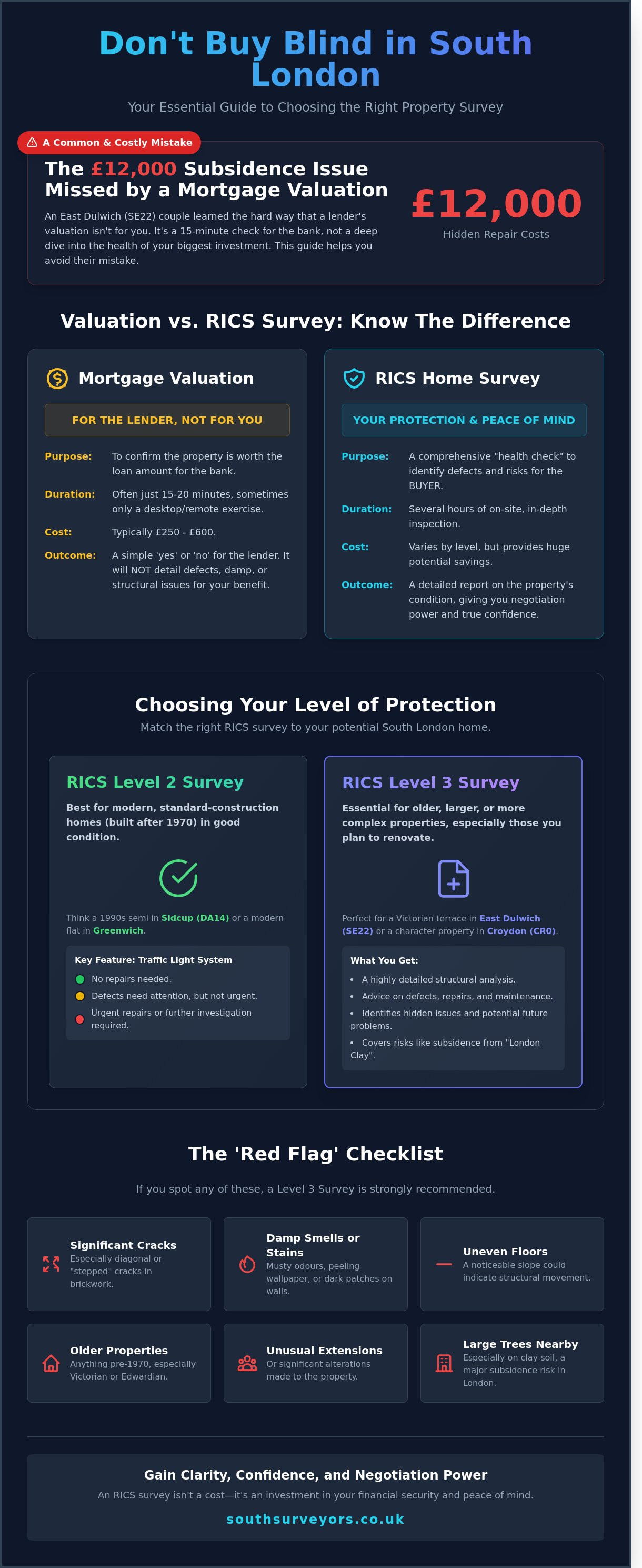
On 14th January, a couple in East Dulwich (SE22) discovered that the “mortgage valuation” they relied on missed a £12,000 subsidence issue that only a professional inspection could catch. It is a common trap for buyers across South London. When you are already stretched by the high cost of living in postcodes like BR1 or CR0, you might wonder when do I need a building survey and if the bank’s tick-box exercise is actually enough to protect you. You have worked hard for that deposit, and it is normal to feel a bit sick at the thought of hidden damp or structural rot lurking behind a fresh coat of paint.
You deserve total clarity and confidence before you exchange. This guide helps you choose the right RICS-certified report to ensure your Croydon cottage or Greenwich grand design is a solid investment rather than a financial drain. We will compare Level 2 and Level 3 surveys in plain English, showing you how to gain negotiation leverage and genuine peace of mind before the moving van arrives.
Key Takeaways
- Understand why a mortgage valuation is strictly for the lender and how a private RICS report provides the actual protection you need when buying in South London.
- Decode the jargon between Level 2 and Level 3 surveys to ensure you choose the right depth of inspection for everything from a modern Greenwich flat to a grand Victorian terrace.
- Discover exactly when do I need a building survey to navigate local risks like “London Clay” subsidence and the hidden structural quirks of period properties in SE and CR postcodes.
- Learn to spot the “red flag” warning signs, such as specific crack patterns and damp smells, that signal it is time to call in the heavy-duty structural experts.
- Gain total clarity and confidence for your purchase by knowing the essential questions to ask your RICS-certified surveyor before they visit your potential new home.
The Property Jungle: Why a Mortgage Valuation Isn’t a Survey
Buying a home in the South London property market often feels like a high-stakes game of Monopoly, especially if you’re looking at a Victorian terrace in East Dulwich or a 1930s semi in Bexley. The biggest myth that trips up buyers is the belief that the ‘bank’s survey’ protects their interests. It doesn’t. That valuation fee you paid, which usually ranges from £250 to £600, is for the lender’s benefit alone. They only want to ensure the bricks and mortar provide enough security for the loan amount before they release the funds.
If you’re wondering when do I need a building survey, the answer is almost always before you commit legally. Relying on a basic valuation means you’re essentially buying blind. You might save a few hundred pounds today, but the emotional cost of discovering a £15,000 subsidence issue in your new SE22 home three months after moving in is a price nobody wants to pay. It’s about protecting your future self from avoidable financial disasters.
To better understand this concept, watch this helpful video:
The Valuation vs. Survey Showdown
A mortgage valuation is frequently a 15-minute ‘glance and go’ or even a remote desktop exercise conducted from an office miles away. It won’t mention the damp patch hidden behind a strategically placed wardrobe in a Croydon lounge or the deteriorating roof tiles on a Bromley cottage. When you research what is a building survey, you’ll find it involves a multi-hour, RICS-certified inspection of every accessible nook and cranny. A building survey is a comprehensive physical health check of a property’s structure that identifies defects, safety hazards, and urgent repairs.
Peace of Mind in the SE Postcode
Competitive markets like Crystal Palace (SE19) or Sidcup (DA14) require quick decisions, but speed shouldn’t come at the expense of certainty. Having a surveyor on your side provides a ‘knowledgeable friend’ perspective, acting as your only neutral ally in a sea of estate agents and sellers. This clarity and confidence changes how you approach the ‘Exchange of Contracts’, turning a stressful gamble into an informed investment. Whether you’re buying in the DA, CR, or SM postcode areas, a professional report acts as your personal insurance policy against the unknown.
Knowing the true state of a property allows you to negotiate a better deal or walk away if the repair costs are too high. If you’re still unsure about the process, start by Understanding Your RICS Home Survey through our plain English guide. Real confidence comes from having all the facts before the 2026 moving trucks arrive at your door. You wouldn’t buy a used car without checking under the bonnet; your South London home deserves the same level of scrutiny.
Level 2 vs. Level 3: Choosing Your Protection Level
Deciding between survey levels shouldn’t feel like a high-stakes exam. It’s about matching the report to the bricks and mortar you’re buying. You might wonder when do I need a building survey that goes beyond the basics. Most South London properties fall into two camps: the modern builds and the “character” homes that have seen a century of history. Getting this choice right ensures you aren’t paying for information you don’t need or, worse, missing a structural flaw that costs thousands later.
RICS Level 2: For the Modern and Modest
If you’re eyeing a standard construction home built after 1970, like a 1990s semi-detached in Sidcup (DA14) or a tidy townhouse in Orpington (BR6), the Level 2 is your best friend. It provides a professional overview of the property’s condition without digging into every single joist. This report uses a clear “traffic light” rating system to help you prioritise:
- Green: No repairs currently needed.
- Amber: Defects that need attention but aren’t serious or urgent.
- Red: Urgent repairs or further investigation required.
It’s a concise way to gain clarity and confidence. You can find more detail in our guide on The RICS Level 2 Survey Explained.
RICS Level 3: For the Grand, the Old, and the Quirky
Properties in East Dulwich (SE22) or Peckham (SE15) often come with period charm and hidden headaches. Whether it’s a Victorian terrace or a complex flat conversion, you need the “deep dive.” People often call this a “Structural Survey,” but that’s a bit of a myth. The RICS Level 3 is the modern, more thorough successor. Determining when do I need a building survey of this depth depends on the age and condition of the property. It’s the gold standard for older homes because it includes:
- In-depth analysis of roof spaces and floorboards where access is possible.
- Identification of specific types of damp, rot, or timber decay.
- Detailed advice on repairs, including estimated timings and costs.
Our RICS-certified surveyors look for the subtle signs of movement that a basic check would miss. Check out our Level 3 Building Survey: A Complete Guide for the full breakdown.
Your choice directly impacts your wallet. A Level 3 report detailing £12,500 in necessary roof repairs is a powerful tool. It gives you the evidence needed to ask for a price reduction or insist the seller fixes the issue before exchange. If you’re unsure which level fits your potential new home, you can chat with our expert team to get a tailored recommendation.
South London Specifics: When Local Architecture Demands a Full Survey
South London’s skyline is a beautiful, chaotic mix of Victorian terraces, Edwardian villas, and post-war experiments. While that character is exactly why we love places like Blackheath or East Dulwich, it presents unique challenges for any buyer. If you’re asking when do I need a building survey, the answer usually lies in the soil beneath the floorboards and the age of the brickwork. In high-value areas like Blackheath, a “recently renovated” tag often acts as a mask. A fresh coat of paint can easily hide the damp patches caused by 120-year-old solid walls that have been sealed with the wrong type of modern plaster.
The “London Clay” factor is a major player in SE and CR postcodes. This soil acts like a giant sponge. It expands when wet and shrinks during dry spells, which is why subsidence is a local celebrity in South East London. Following the record-breaking dry summer of 2022, subsidence claims across London rose by over 20%. Our RICS-certified surveyors look for the subtle cues that a house is moving, providing you with the clarity and confidence to either proceed or renegotiate. We also see a high volume of ex-local authority homes in areas like Peckham and Lewisham. These often feature “non-traditional” concrete construction, which can be difficult to mortgage without a thorough professional assessment.
The Battle with London Clay
Bromley and Croydon are notorious hotspots for seasonal moisture changes. In these areas, we often find “stepped” cracking in the mortar or internal doors that suddenly refuse to latch. Local expertise in the SM and DA postcodes is non-negotiable because the soil profile changes significantly from one street to the next. We help you distinguish between historic movement, which is often harmless settlement, and active subsidence that might require a £25,000 underpinning project. Our goal is to ensure you have real confidence in the ground you’re buying on.
Period Property Pitfalls
The pitched roofs of West Norwood’s period homes frequently suffer from “roof spread,” where the weight of heavy modern tiles pushes the original walls outward. Most homes built before 1919 use solid wall construction, which lacks the cavity found in modern houses. This makes them prone to penetrating damp if the external brickwork isn’t maintained. You should always opt for a Level 3 survey if the property has been significantly altered or extended. We’ve seen many 1930s semis where a DIY loft conversion has put dangerous pressure on the original ceiling joists. Investing in a professional survey now can save you from these hidden, expensive surprises later.
Ready to get a clear picture of your potential new home? Book your RICS-certified survey with our South London experts today for total peace of mind.
The ‘Red Flag’ Checklist: Signs You Definitely Need a Level 3 Survey
Walking through a potential new home in SE15 or BR1 is an emotional rollercoaster. It’s easy to get distracted by a sleek kitchen island or a south facing garden, but your bank balance depends on looking past the staging. Determining when do I need a building survey often comes down to spotting the subtle warnings that a property is hiding expensive secrets. If you notice any of the following issues during a second viewing, upgrading from a Level 2 to a Level 3 Building Survey isn’t just a recommendation; it’s a financial safety net.
Structural Integrity and Movement
Cracks are the most common cause of anxiety for buyers in South East London. While thin, vertical hairline cracks are often just the house “breathing,” you should look for “staircase” cracking that follows the mortar lines. Any gap wider than 3mm, or cracks that are wider at the top than the bottom, suggest active movement. In neighbourhoods like Crystal Palace (SE19) or Sydenham (SE26), the clay soil is notorious for seasonal expansion and contraction. Structural movement in South London is often manageable if caught early by a professional.
Don’t forget to look at the internal walls for signs of removed chimney breasts. If the stack is visible on the roof but missing in the bedroom, you need to know if it was supported with RICS-approved steel beams or “gallows brackets.” An unsupported chimney is a structural ticking time bomb that can cost upwards of £4,500 to rectify safely.
The Hidden Enemies: Damp and Asbestos
Victorian and Edwardian terraces across the SM and CR postcodes were built to breathe, but modern renovations often trap moisture. Many homes built before 1900 lack a physical damp proof course (DPC), relying instead on slate or just thick brickwork. If you spot tide marks on the wallpaper or a musty “old cellar” smell, you’re likely looking at rising damp. A professional chemical DPC injection and associated replastering for a standard terrace can easily reach £3,500.
In mid-century hotspots like Bexleyheath, asbestos is a frequent guest. Before the UK-wide ban in November 1999, asbestos was commonly used in Artex ceilings, floor tiles, and boiler flues. It’s perfectly safe if left undisturbed, but if you’re planning a renovation, professional removal for a single room can start at £1,200. A Level 3 survey provides the clarity and confidence you need to negotiate these costs off the asking price.
- Roofing and Chimneys: Use binoculars to check for slipped slates or “puddling” on flat roofs. A roof replacement in the DA postcode area currently averages between £6,000 and £12,000.
- Dodgy DIY: In Dartford, we frequently see unpermitted “handyman” extensions where 15% of the structural work fails to meet current building regulations.
- Timber Rot: Spongy floorboards or crumbling skirting boards often signal dry rot, which can spread through masonry and cost thousands to eradicate.
If these red flags are popping up on your viewing, it’s time to get a professional eyes-on assessment. You can book a comprehensive RICS Level 3 survey to ensure your South London dream doesn’t become a structural nightmare.
Getting it Right: How to Organise Your RICS Survey with Confidence
By now, you’ve likely stopped asking “when do I need a building survey” and started wondering how to find a surveyor who won’t just send a dry, 80 page PDF and disappear. Moving house in competitive areas like Dulwich (SE21) or Petts Wood (BR5) is high stakes. You need more than a checklist; you need a local ally who understands the specific quirks of South London architecture, from Victorian foundations to mid-century masonry.
Before your surveyor visits the property, be proactive. Ask them if they have experience with specific issues common in the DA or SM postcodes, such as clay soil shrinkage or historic subsidence. A quick five minute chat ensures they’re looking for the things that actually matter to your peace of mind. South Surveyors prioritises this dialogue, ensuring you aren’t left decoding technical jargon on your own.
Choosing a Surveyor Who Speaks Your Language
Technical knowledge is vital, but communication is what saves your sanity. You don’t want a corporate robot; you want someone who combines hipster flair with professional substance. This means a surveyor who knows the best independent coffee spots in Crystal Palace but also holds the highest RICS certifications. It is about having an expert who will actually pick up the phone to explain why a specific damp reading in a Croydon (CR0) terrace isn’t necessarily a deal-breaker.
Our approach is built on clarity. We provide reports that are thorough yet easy to navigate, focusing on what you need to know to move forward. If a report mentions a “Category 3” repair, our surveyors are available to explain exactly what that means for your bank balance. This personal touch is why 92% of our clients report feeling significantly more confident after their post-survey consultation.
Your Negotiation Toolkit
A RICS Level 3 survey is much more than a health check for your home; it is a powerful tool for price adjustment. If our report identifies £7,500 worth of urgent roof repairs or outdated wiring in a Sutton (SM1) property, you have tangible evidence to take back to the estate agent. Presenting these findings doesn’t make you a “difficult buyer.” It makes you an informed one who is paying a fair price based on the property’s actual condition.
When you speak to agents in the SE or BR areas, use the “Estimated Repair Costs” section of your survey as your script. It shifts the conversation from opinion to fact. Most sellers would rather reduce the price by £5,000 than lose a buyer and start the process again. This final step transforms your “maybe” into a “sold” with real, earned confidence. To get started, the logic is simple: Get your tailored RICS survey quote from South Surveyors and take control of your purchase today.
Secure Your South London Sanctuary with Real Confidence
Buying a Victorian terrace in SE22 or a 1930s semi in Bromley is a huge milestone, but it shouldn’t be a gamble. A mortgage valuation is just a bank’s tick-box exercise. It won’t tell you if that charming Greenwich flat has a £15,000 structural headache hiding behind the plaster. Whether you’re choosing a Level 2 or a Level 3 survey, getting professional eyes on the property is the only way to avoid nasty surprises in your new CR or SM home.
If you’re still wondering when do I need a building survey, the rule is simple: if the building is over 50 years old or has visible red flags like damp, you need expert advice. Our RICS-Certified Professionals specialise in South London period properties and understand the local quirks of DA and BR architecture. We’re regulated by the Royal Institution of Chartered Surveyors, ensuring every report meets the highest industry standards. Book your RICS Building Survey with South Surveyors today for clarity and confidence. Your future self will thank you for the peace of mind.
Frequently Asked Questions
Is a building survey worth the money if the house looks new?
Yes, it is absolutely worth it because fresh paint can hide 100 years of structural secrets. Even if a Victorian terrace in East Dulwich (SE22) looks like it belongs in a magazine, our RICS-Certified surveyors often find hidden damp or historical movement behind those polished walls. Spending £600 to £1,200 now provides clarity and confidence, preventing you from inheriting a £15,000 repair bill for a roof that is actually past its prime.
How much does a RICS Level 3 survey cost in South London?
In South London, a RICS Level 3 survey typically costs between £850 and £2,500. The price varies based on the property’s size and its estimated market value. For a standard four-bedroom house in Bromley (BR1) or a larger period property in Croydon (CR0), you will likely pay towards the middle of that range. This investment ensures you get a comprehensive, tailored report that details every nook and cranny of your potential new home.
How long does it take to get my survey report back?
You will receive your full digital report within 3 to 5 working days after the physical inspection is complete. At South Surveyors, we understand that South London’s property market moves fast, so we often provide a verbal summary within 24 hours of visiting the site. This quick turnaround allows you to make informed decisions without delaying your exchange of contracts in competitive areas like Bexley (DA5) or Sutton (SM1).
Do I need a building survey if I am a cash buyer?
Yes, you definitely need a survey because you are taking on 100% of the financial risk without a mortgage lender’s valuation as a safety net. When asking when do I need a building survey, the answer is especially “now” for cash buyers in postcodes like SE1. Without a thorough RICS-Certified inspection, you could find yourself paying the full asking price for a property that requires £20,000 of immediate structural remediation.
Can a surveyor tell me if the property has subsidence?
Our surveyors are trained to spot the tell-tale signs of subsidence, such as diagonal cracks over 3mm wide or sticking doors. Since South London sits on heavy London clay, which is prone to shrinking and swelling, this is a vital part of our assessment. If we find evidence of movement in a property in Sidcup (DA14), we will advise you on whether it is historical and settled or a progressive issue needing a specialist engineer.
What happens if the survey finds major problems?
If we find major issues, you have the power to negotiate the purchase price or ask the seller to fix the problems before you exchange. Data from 2024 shows that 75% of buyers who receive a “poor” survey report successfully reduce the price by an average of £5,000 to £10,000. It gives you the peace of mind to either walk away from a “money pit” or proceed with a deal that reflects the property’s true condition.
Is a building survey a legal requirement when buying a house?
No, a building survey isn’t a legal requirement in the UK, but skipping one is a massive gamble. English law operates on “caveat emptor,” which means “let the buyer beware.” Once you have swapped contracts on that flat in Carshalton (SM5), any structural defects become your financial responsibility. A professional survey is the only way to ensure you aren’t buying a property with expensive, hidden flaws that the seller isn’t legally obliged to disclose.
Should I get a survey for a new build property in London?
Yes, you should get a professional snagging survey because even brand-new homes in developments across Greenwich (SE10) can have significant faults. Recent industry figures suggest that over 90% of new build owners report defects after moving in. A RICS-Certified surveyor will check for everything from poor insulation to plumbing leaks, ensuring the developer fixes these issues under your warranty before you settle into your new South London home.