

What if that charming Victorian terrace in East Dulwich or that stylish 1930s semi in Bromley is actually hiding a £20,000 repair bill behind its freshly painted walls? It is a common worry for buyers across South East London, especially when estate agents are pushing for a speedy exchange. You want to feel excited about your new home in SE15 or CR0, not lose sleep over the possibility of invisible structural issues or rising damp. We understand that the gap between a basic mortgage valuation and a proper inspection can feel confusing and stressful.
This guide explains exactly what does a level 2 survey cover so you can move forward with real confidence. We will show you how a RICS-certified report uses a simple traffic light system to flag urgent repairs, helping you negotiate a better price or walk away if the risks are too high. From the specific challenges of London clay to the common roof defects found in DA and SM postcodes, we are peeling back the layers on what our experts look for to ensure your peace of mind.
Key Takeaways
- Understand why the RICS Level 2 is the “Goldilocks” of surveys, offering the perfect balance of detail for modern homes without the intensity of a full structural report.
- Learn exactly what does a level 2 survey cover, including essential checks for “London Clay” subsidence in Croydon and rising damp in Victorian terraces across East Dulwich.
- Discover the “1890 Rule” to help you decide if a Level 2 report provides enough peace of mind or if the age of your property requires a more robust Level 3 Building Survey.
- Master the RICS “traffic light” rating system so you can easily identify urgent defects and negotiate your purchase price with real confidence.
- Find out how we ditch the “surveyor-speak” for clarity, providing a personal 15-minute phone call to walk you through your report and answer your specific concerns.
Demystifying the RICS Level 2 Survey: Your Property Health Check
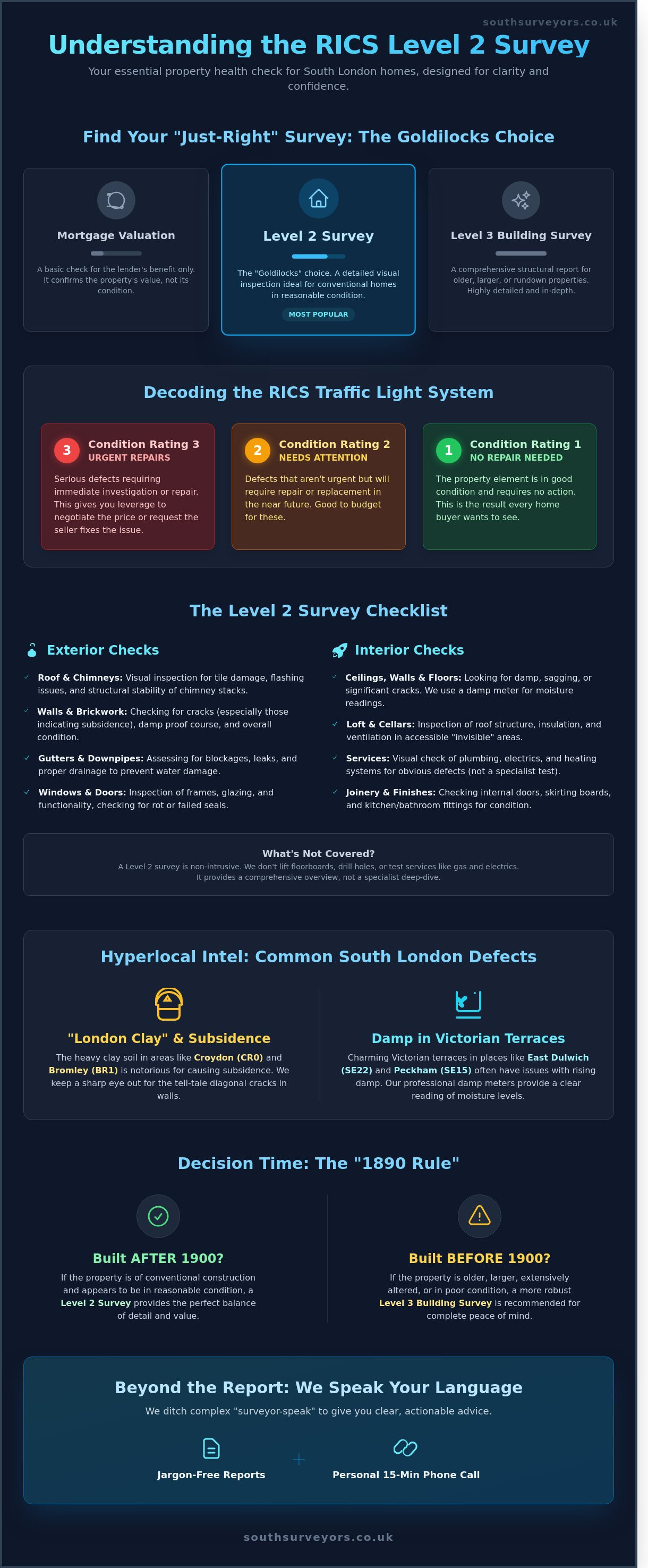
Buying a home in South East London is a bit like dating; everything looks fantastic on the surface until you start looking at the plumbing. Whether you are eyeing a charming Victorian terrace in SE22 or a sturdy 1930s semi in BR3, you need to know exactly what you are signing up for before you exchange contracts. This is where the RICS Level 2 Survey comes in. Think of it as your property’s MOT. It is a detailed health check that goes far beyond the basic valuation your mortgage lender requires. While a valuation is strictly for the bank’s peace of mind, the Level 2 survey is for yours.
We often call this the “Goldilocks” of surveys. It is the just-right option, offering more depth than a valuation but less intensity than a full Level 3 structural report. It is designed specifically for conventional properties built after 1900 that appear to be in reasonable condition. If you are looking at a standard flat in Croydon or a bungalow in Sidcup, this report provides the clarity you need. It focuses on identifying “urgent” and “serious” defects that might affect the property’s value or your safety. To understand the professional standards involved, it helps to look at the role of Chartered Surveyors in the United Kingdom, who follow strict RICS guidelines to ensure every report is consistent and reliable.
To better understand this concept, watch this helpful video:
The “Traffic Light” System Explained
The report uses a simple colour-coded system to help you prioritise repairs without getting bogged down in jargon. Condition Rating 1 (Green) means no repair is currently needed, which is the result every buyer hopes for. Condition Rating 2 (Amber) highlights defects that aren’t urgent but will need attention soon. Condition Rating 3 (Red) is the one to watch. These are serious defects that require immediate investigation or repair. Seeing a red flag on a property in SE15 or DA1 doesn’t always mean you should walk away, but it gives you the leverage to negotiate the price or ask the seller to fix the issue before you commit.
The Scope of the Inspection
So, what does a level 2 survey cover exactly? Our surveyors perform a thorough visual assessment of all main indoor and outdoor features. We don’t just look at the walls; we use a professional damp meter to check moisture levels, which is vital for those older properties in SM2 or CR0. We also check “invisible” areas like loft spaces and cellars, provided they are safely accessible. While we won’t be lifting floorboards or drilling holes, we’ll give you a comprehensive overview of the roof, chimneys, gutters, and joinery. This ensures your new home is a sound investment rather than a money pit.
The Inspection Checklist: What a Level 2 Survey Covers (and What it Doesn’t)
Buying a Victorian terrace in Peckham or a 1930s semi in Bromley is a massive milestone. You want to be sure you aren’t inheriting a money pit. So, what does a level 2 survey cover? Think of it as a comprehensive health check that focuses on everything visible and accessible. It’s designed to give you peace of mind without the need for a sledgehammer.
We start with the exterior. Your surveyor will inspect the roof, chimneys, and gutters from ground level or using a ladder where safe. In South London, we keep a sharp eye on the walls. The heavy clay soil common in postcodes like SE22 and BR1 is notorious for causing subsidence. We look for those specific diagonal cracks that suggest the ground is moving more than it should. We also check for damp proof courses and the general state of the brickwork.
Moving inside, the inspection covers ceilings, floors, and joinery. We look for signs of sagging, springy floorboards, or suspicious “fresh” paint that might be hiding a damp problem. We also give the bathroom fittings a visual check to ensure there aren’t obvious leaks or poor seals that could rot the joists below. For a broader look at how these checks fit into the buying process, this guide on Homebuyer Surveys Explained by the HomeOwners Alliance is a fantastic resource for any UK buyer.
The services section provides a visual overview of the gas, electrics, and water. While we don’t carry out pressure tests or use multimeters, we will flag if the fuse board looks like it dates back to the 1970s or if the lead piping hasn’t been replaced. We also look for legal red flags, such as obvious boundary shifts or extensions that look like they were built without a nod to building regulations.
Outside the Four Walls
The survey extends beyond the main house. We assess the condition of permanent outbuildings and garages, checking for structural stability and roof leaks. In the garden, we are on a mission to spot invasive species like Japanese Knotweed, which can be a real headache in the leafy suburbs of the DA and SM postcodes. We also check boundary walls and fences, as a leaning wall can quickly turn into a costly dispute with your new neighbours.
The Limits of a Level 2 Survey
It’s important to understand the “No-Go” zone. This is a non-invasive survey, meaning we won’t be lifting floorboards, drilling into walls, or crawling into tight crawlspaces. If a seller has a massive wardrobe covering a patch of mould, we won’t see it. If we find something that looks worrying but is hidden from view, we will recommend “further investigation” by a specialist. This ensures you have real confidence before you exchange contracts. If you are eyeing up a property in the CR or SE areas and want a professional pair of eyes on it, you can book a tailored report with our team today.
Hyperlocal Intel: Common Defects in South London Properties
Buying a home in South London is a bit like picking out a vintage leather jacket; it has bags of character, but you really need to check the seams. From the hilly streets of Crystal Palace to the leafy avenues of Bromley, every neighbourhood has its own architectural DNA and, by extension, its own set of common flaws. Understanding what does a level 2 survey cover helps you spot these regional quirks before you’re legally committed to them.
In the DA postcodes of Bexleyheath, we often see specific issues with the “Bexleyheath Bungalow” roof. Many of these 1930s gems still sport their original concrete tiles. These tiles have a natural lifespan of around 60 to 70 years, meaning many are now becoming porous and heavy, putting undue stress on the roof timbers. Meanwhile, if you’re looking at modern riverside flats in Greenwich (SE10) or Lewisham (SE13), the focus shifts to balcony safety and cladding. Our RICS-certified surveyors pay close attention to drainage on these balconies, as standing water can quickly degrade the building’s external fabric.
Subsidence and the South London Soil
The geology of South London is dominated by “London Clay,” a soil type that is notoriously temperamental. In Croydon (CR) and Bromley (BR), this clay acts like a sponge, expanding in the winter and shrinking during dry summers. This movement is why so many Victorian and Edwardian homes in the SM and CR postcodes show signs of cracking. Our role is to help you distinguish between historic movement, which is often decades old and dormant, and active subsidence that requires structural intervention. London Clay movement is a manageable risk with the right expert advice.
Damp, Timber, and Period Charm
In the Victorian terraces of East Dulwich (SE22) and Peckham, rising damp is a frequent guest. These properties were built with solid walls that need to “breathe,” but modern renovations like pebble-dash or non-breathable paints often trap moisture inside the brickwork. It isn’t just the old houses that suffer, though. The 1930s semis in Sutton (SM1) often have issues with condensation and poor ventilation, especially where original air bricks have been covered by new driveways or extensions.
- Woodworm: We frequently identify active infestations in the untreated loft timbers of Victorian villas across the SE postcodes.
- Masonry: High pollution levels near busy South London transport corridors can accelerate the erosion of soft lime mortar and stone detailing.
- Timber Rot: Leaky gutters on period properties often lead to wet rot in the fascia boards and rafter feet.
When you consider what does a level 2 survey cover, it’s these specific, local details that provide the most value. We don’t just look for general wear; we look for the specific ways South London’s environment interacts with its unique housing stock, giving you the confidence to negotiate or plan for future repairs.
Decision Time: Is a Level 2 Survey Enough for Your New Home?
Buying a home in South London is a bit like dating; sometimes you just need a vibe check, and other times you need a full background investigation. Understanding what does a level 2 survey cover is the first step in deciding if your potential home needs a light touch or a deep dive. Choosing between a Level 2 and a Level 3 survey usually boils down to the property’s age and how much “character” (read: hidden structural headaches) it has.
The general industry benchmark is the “1890 Rule.” If the house was built before 1890, it’s almost certainly a candidate for a Level 3 Building Survey. These older Victorian gems in Peckham or East Dulwich (SE15 and SE22) often hide structural quirks that a standard inspection might miss. While you’re asking what does a level 2 survey cover, remember it’s designed for conventional properties in reasonable condition. It won’t dig into the deep structural “why” behind a crack the way a Level 3 report does.
Materials play a huge role too. If you’re looking at a non-standard build, like a timber-framed house or a post-war prefabricated property, you need more depth. These aren’t your standard brick-and-mortar setups. They require a specialist eye to ensure the bones are still solid after decades of South East London weather.
It’s tempting to save a few hundred pounds on the survey fee, but that’s a risky game. Spending £500 now to avoid a £15,000 structural repair later is just smart maths. Think of it as an insurance policy for your peace of mind. We’ve seen buyers in the BR postcode area negotiate thousands off their purchase price simply because a thorough survey identified damp issues that weren’t visible to the naked eye.
When to Stick with Level 2
A Level 2 survey is usually the sweet spot for modern builds in Sidcup or Dartford (DA postcodes). If the property is less than 50 years old, clearly well-maintained, and hasn’t been modified with massive extensions, this report provides ample detail. It gives you a clear “traffic light” rating on the property’s condition without overcomplicating things. You can find more details in our guide on The RICS Level 2 Survey Explained.
When to Upgrade to Level 3
If you’ve found a project in Peckham that’s visibly seen better days, or if you’re planning a massive kitchen extension, go for the Level 3. This is essential for properties in poor condition or those built with unusual materials. It provides a comprehensive analysis of every accessible part of the structure. For a side-by-side breakdown, check out our Level 3 Building Survey: A Complete Guide for Home Buyers.
Ready to get moving with clarity and confidence? Get a professional survey quote from our RICS-certified team to find the right fit for your South London home.
Navigating the Results: Why a South Surveyors Report is Your Best Friend
Receiving a 50-page document full of technical jargon is enough to make anyone reach for a double espresso. We don’t believe in “Surveyor-speak” that leaves you more confused than when you started. Instead, we focus on clarity. Understanding what does a level 2 survey cover is only half the battle; the real value lies in how that information is delivered. We translate complex structural observations into plain English, so you know exactly what’s a “deal-breaker” and what’s just a “weekend DIY project.”
Once you’ve had a chance to digest the report, we set up a 15-minute phone call. This isn’t a corporate formality. It’s your chance to grill your surveyor. Whether you’re worried about a damp patch in a Croydon terrace or the roof ties in a Sidcup semi, we talk you through it personally. This conversation gives you the “real world” context that a PDF simply can’t provide, ensuring you move forward with real confidence.
The Power of Negotiation
In the high-stakes London market, information is your strongest currency. Imagine you’ve found a Victorian gem in Bromley. The survey uncovers £5,000 worth of urgent timber treatment and repointing that wasn’t visible during your initial viewing. Spending roughly £500 on a survey to save £5,000 off the asking price isn’t just smart; it’s essential. We provide the evidence you need to go back to the estate agent with a reasoned, evidence-based lower offer. “A RICS survey isn’t just a report; it’s your leverage in a seller’s market.” By sharing specific sections of the report tactfully, you justify your position without souring the relationship with the seller.
The Personal Touch
We aren’t just names on a certificate. We are your knowledgeable friends in the industry. Our deep roots in the SE, BR, DA, CR, and SM postcodes mean we know the specific “quirks” of South London architecture. We understand the shifting clay soils of Crystal Palace and the specific 1930s builds found in Sutton. This local expertise provides a layer of insight you won’t get from a national firm. Understanding what does a level 2 survey cover helps you prioritise repairs before you exchange contracts, satisfying your mortgage lender and giving you a clear shopping list for local contractors.
Ready for some peace of mind? Book your RICS Level 2 survey with South Surveyors today.
Move Toward Your Move with Real Confidence
Buying a home in South London is a massive milestone, but it shouldn’t feel like a gamble. By now, you’ll know that a Level 2 survey is your best defence against hidden damp in SE22 or structural surprises in a BR3 semi-detached. Understanding exactly what does a level 2 survey cover ensures you aren’t left guessing about the state of your potential new home. You’ve learned that this report focuses on visible defects and maintenance risks, giving you the leverage to negotiate fairly or plan your renovation budget without the stress.
Our RICS-certified professionals live and breathe the local property market across the SE, BR, DA, CR, and SM postcodes. We don’t just send a PDF and disappear. You’ll get direct phone access to your surveyor to chat through the findings, ensuring every detail is clear. Don’t leave your investment to chance when you can have an expert friend in your corner. It’s time to swap the property anxiety for genuine peace of mind.
Get a Tailored Level 2 Survey Quote for Your South London Home
We’re here to help you get those keys with a smile, knowing your future home is as solid as it looks.
Frequently Asked Questions
Is a Level 2 survey enough for an old house in South London?
A Level 2 survey is usually not enough for properties built before 1900 or those with unconventional construction. If you’re buying a Victorian terrace in Crystal Palace (SE19) or a period cottage in Bromley (BR1), we recommend a Level 3 Building Survey instead. While we’ll explain what does a level 2 survey cover during our initial consultation, older homes often have structural complexities that require the deeper, more intrusive analysis of a Level 3 report to give you real confidence.
Does a Level 2 survey include a property valuation?
A standard RICS Level 2 survey doesn’t include a property valuation as a default feature, but it can be added as an optional service. Many buyers in Croydon (CR0) or Sutton (SM1) choose to include this to ensure the purchase price reflects the property’s actual condition. Having this professional figure in black and white provides excellent leverage if you need to negotiate a better deal after defects are found.
How long does it take to receive the Level 2 survey report?
You’ll typically receive your comprehensive digital report within 3 to 5 working days after the physical inspection is complete. We understand that the South East London property market moves at a frantic pace, so we prioritise a swift turnaround. Whether the property is in Dartford (DA1) or Greenwich (SE10), our RICS-certified team ensures you get the clarity you need without unnecessary delays to your exchange date.
Can I attend the Level 2 survey inspection with the surveyor?
We generally ask that clients don’t attend the inspection so our surveyors can maintain total focus on the property’s details. However, we’re definitely not corporate robots who vanish once the job is done. Your surveyor will usually give you a call shortly after leaving the property to discuss the main findings. This personal touch ensures you aren’t left guessing about the condition of your potential new home in Bexley or Sidcup.
What happens if the surveyor finds a Condition Rating 3 (Red) issue?
A Condition Rating 3 indicates a serious defect that needs urgent repair or further investigation before you commit to the purchase. If we find a “red” issue in a house in Orpington (BR6), don’t panic. It’s a prompt to get specialist quotes for the necessary work, which you can then use to renegotiate the sale price or ask the seller to fix the problem. It’s all about making an informed decision rather than facing a nasty surprise later.
Does a Level 2 survey check for asbestos in London homes?
A Level 2 survey includes a visual inspection for suspected asbestos-containing materials, but it isn’t a specialist laboratory test. If our surveyor spots materials common in 1950s to 1980s builds in areas like Lewisham (SE13) or Mitcham (CR4), they’ll flag them in the report. Understanding what does a level 2 survey cover is vital here, as we provide expert guidance on potential risks while recommending a dedicated asbestos survey if high-risk materials are present.
How much does a RICS Level 2 survey cost in 2026?
Based on industry data from 2024, a RICS Level 2 survey generally costs between £400 and £1,000 depending on the property’s size and value. While we can’t predict exact 2026 fees, costs typically rise in line with UK inflation and property market trends. For a tailored quote on a flat in Dulwich (SE21) or a semi in Dartford (DA5), it’s always best to contact us directly for a transparent price that reflects the specific property you’re buying.
Is a Level 2 survey the same as a mortgage valuation?
No, a Level 2 survey is a detailed report for your benefit, whereas a mortgage valuation is a basic check for the lender’s peace of mind. The bank’s valuation only confirms if the property is worth the loan amount and often ignores significant defects. Investing in a professional RICS survey is the only way to get a thorough look at the property’s health, ensuring you don’t inherit expensive repair bills in Carshalton (SM5) or Erith (DA8).