

On 14th October, a first time buyer in Bromley opened their RICS Level 3 report to find three “Condition Rating 3” alerts and a damp issue that looked like it belonged in a Victorian horror novel. It’s that sinking feeling we’ve all felt, especially when you’ve already mentally placed your furniture in that Peckham flat or Sutton semi. You’re likely wondering what happens after a bad survey report and whether your future home is actually a money pit in disguise. Dealing with technical jargon and pressure from estate agents in Croydon or Dartford can feel overwhelming, but we’re here to help you breathe a bit easier.
We believe a “bad” report isn’t a dead end; it’s actually your most powerful tool for securing a fairer price. This guide will give you the clarity and confidence to turn those red flags into a negotiation win. We’ll break down exactly how to read between the lines of RICS terminology, which issues are genuine deal breakers, and how to create a clear action plan so you can move forward with total peace of mind.
Key Takeaways
- Learn how to decode RICS ‘Condition Rating 3’ red flags so you can separate minor maintenance from the true deal-breakers in your South London property.
- Discover exactly what happens after a bad survey report by identifying common SE, BR, and DA postcode issues like damp and subsidence before they drain your bank account.
- Master the art of the “negotiation win” using our framework to decide whether to request a price reduction, ask for repairs, or walk away from a risky investment.
- Get a step-by-step action plan for your post-survey debrief, including how a quick chat with your RICS-certified surveyor provides the clarity you need to move forward.
- Gain the confidence to navigate the CR and SM property markets by leveraging local expert insights that turn scary red flags into total peace of mind.
Don’t Panic: Decoding the ‘Bad’ Survey Report
You’ve finally found that dream flat in Crystal Palace or a charming Victorian terrace in Bromley. Then the report lands in your inbox. Seeing a ‘Condition Rating 3’ splashed across the pages in bright red feels like a gut punch. It’s easy to think the deal is dead, but understanding what happens after a bad survey report starts with realizing that ‘bad’ is a relative term in the world of RICS standards. Before you pull out of the sale, you need to decode what those colors actually mean for your future home in the SE or BR postcodes.
To get a baseline for the process, it helps to understand What is a home inspection? and how it differs from a simple mortgage valuation. While a valuation is for the lender, the survey is for you, designed to highlight every potential pitfall before you commit your life savings.
To better understand this concept, watch this helpful video:
RICS surveyors use a standardized traffic light system to categorize the condition of different elements of the property. This system ensures clarity, but it can look intimidating on paper:
- Condition Rating 1 (Green): No repair is currently needed. The property is performing as expected.
- Condition Rating 2 (Amber): Defects that need repairing or replacing but aren’t considered serious or urgent. Think of this as your “to-do” list for the next year or two.
- Condition Rating 3 (Red): These are serious defects that need urgent repair, replacement, or further investigation by a specialist.
If you’re buying an older property in Greenwich (SE10) or a period home in Croydon (CR0), ‘Red’ and ‘Amber’ ratings are almost guaranteed. These buildings have stood for over a century, and they often lack the modern damp-proofing or electrical standards of a new build in the SM or DA postcodes. A red rating doesn’t always mean the house is falling down; it often means the surveyor is doing their job by highlighting risks that come naturally with age.
Is it really ‘bad’ or just ‘old’?
There is a massive difference between a structural failure and standard maintenance advice. Surveyors are professionally obligated to highlight every minor risk, from a slipped tile to outdated fuse boxes. In a Victorian terrace in Greenwich, “damp” might just be a lack of ventilation rather than a failing damp-proof course. Setting realistic expectations for London’s aging housing stock is the first step in deciding what happens after a bad survey report. Don’t let a list of maintenance tasks scare you away from a solid investment.
The role of your surveyor as your ‘Property Wingman’
Technical jargon can make a minor issue sound like a catastrophe. This is where a quick phone call with your surveyor can provide “clarity and confidence.” We don’t just hand over a PDF and disappear. We want to help you move from “the report says there is damp” to “what does this actually mean for my wallet?” Think of your home survey as a strategic roadmap for your purchase, not a stop sign that ends your home-buying journey.
The Big Three: Common South London Red Flags
South London houses are packed with character, but they sit on a geological drama queen: London Clay. This soil expands and contracts like a literal sponge depending on the weather. When you’re wondering what happens after a bad survey report, it’s usually because this clay has triggered the ‘unholy trinity’ of damp, subsidence, or structural movement. Local knowledge isn’t just a bonus here; it’s essential for deciphering whether a crack is a catastrophe or just a 120-year-old house stretching its legs. Our RICS-certified team knows exactly how these postcodes behave under pressure.
Subsidence and Movement in Bromley (BR) and Sutton (SM)
In BR and SM postcodes, clay soil shrinkage is the most frequent ‘Red’ flag on a report. During dry summers, the soil pulls moisture away from foundations, leading to movement. It’s vital to distinguish between historic settlement, which happened decades ago and has since stabilised, and active, ongoing subsidence. If your report highlights fresh diagonal cracks wider than 3mm, you’ll need a structural engineer for a more granular look. Understanding the surveyor’s legal responsibilities ensures you’re getting a thorough, professional assessment of these foundation risks before you commit.
Damp and Timber Issues in Victorian Dulwich (SE)
The period homes in Dulwich and West Norwood are stunning, but they often suffer from poor ventilation. Many reports flag ‘rising damp’ as a major issue, yet 75% of the time, it’s actually simple condensation or blocked air bricks. The cost of fixing damp early is relatively low, but the cost of ignoring it can be astronomical if dry rot sets in. For example, repairing a typical leaking roof in West Norwood might cost £1,800, while structural timber repairs can easily exceed £12,000. We provide tailored reports that offer real clarity on these issues, helping you understand what happens after a bad survey report without the unnecessary panic.
Hidden Hazards: Asbestos and Lead Piping
Mid-century builds across Bexleyheath and Sidcup (DA) frequently hide asbestos in floor tiles, textured ceilings, or old water tanks. It’s important to remember that ‘presence’ doesn’t always mean ‘danger’ or an unaffordable repair bill, provided the material is undisturbed and in good condition. Managing asbestos risk in residential sales involves identifying the type and condition of the material to ensure it remains encapsulated and safe for occupants. You might also find lead piping in these areas; replacing a lead supply pipe is a common recommendation that ensures your water meets modern health standards without breaking the bank.
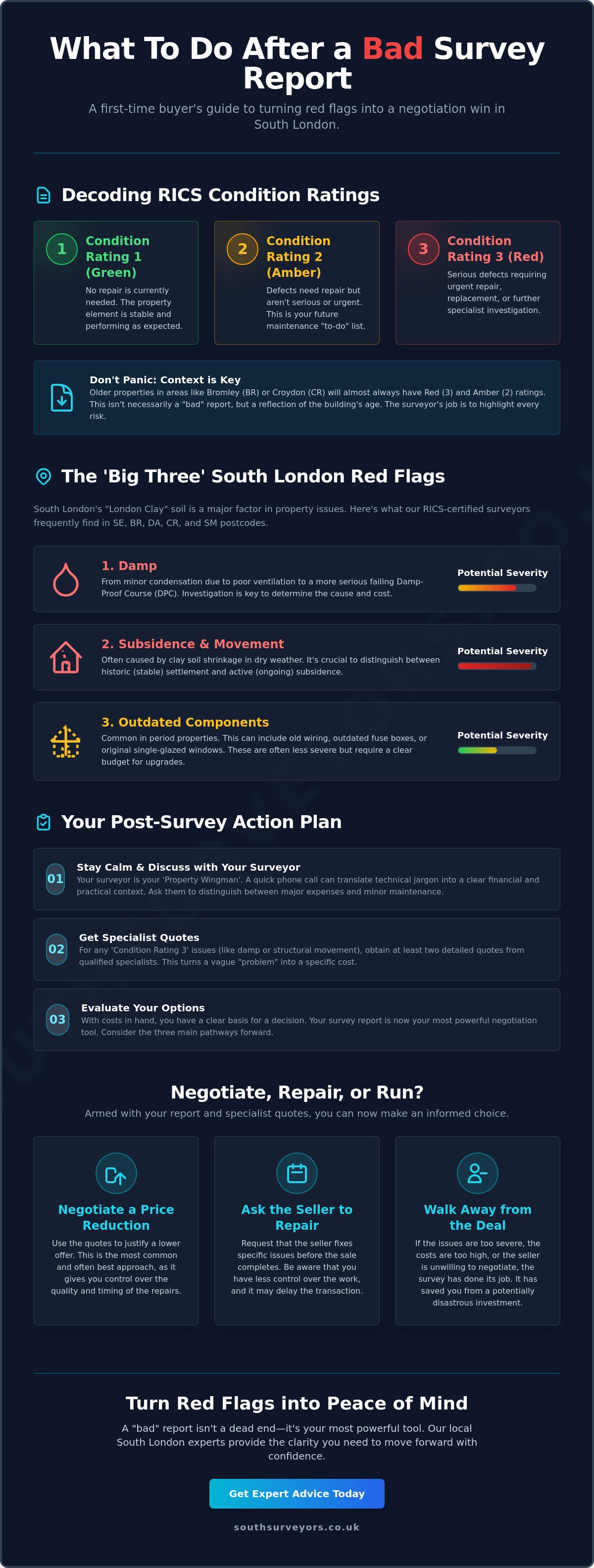
Negotiate, Repair, or Run? Evaluating Your Options
Receiving a thick report full of red-coded defects can feel like a punch to the gut, especially if you’ve already started picking out paint colours for that Victorian terrace in Peckham. Understanding what happens after a bad survey report is about separating the cosmetic “character” from the genuine structural catastrophes. You need a framework to decide if a defect is a deal-breaker or simply a lever to pull during price talks.
Your “Walk Away” criteria should be non-negotiable. If our RICS-certified surveyors identify active subsidence, widespread dry rot, or a roof that’s essentially a glorified colander, these are red flags. Structural integrity and safety aren’t just expensive to fix; they can make a property unmortgageable. If a lender sees a report detailing significant structural movement in a Croydon (CR0) semi, they might issue a “zero valuation” or a heavy retention. This means they’ll withhold part of your loan until the work is finished, which can kill a deal if you don’t have the cash reserves to bridge the gap.
- The Deal-Breakers: Subsidence, invasive Japanese Knotweed, or dangerous “Type 1” electrical issues.
- The Negotiation Levers: Dated boiler systems, minor damp issues in SE postcodes, or old roof tiles nearing the end of their life.
- The “Live With Its”: Cosmetic cracks, peeling paint, or slightly uneven floorboards common in older South London stock.
The Art of the Re-negotiation
Most sellers in areas like Bromley (BR1) or Dartford (DA1) expect some level of movement after the survey. The key is to present the findings via your estate agent without being confrontational. Don’t just demand money off; show them the evidence. It’s usually better to request a price reduction rather than asking the seller to carry out the repairs themselves. Sellers often opt for the cheapest, quickest fix to get the sale over the line, whereas a price reduction lets you control the quality of the repair once you move in.
Getting Specialist Quotes
Never rely on “guesstimates” from the internet or your cousin who “knows a bit about DIY.” You need independent, written quotes from local tradesmen who understand the specific building archetypes of South East London and North Kent. A quote from a local specialist in Sutton (SM1) carries much more weight with a seller than a vague figure plucked from thin air. If you’re dealing with a complex older property, a level 3 building survey provides the detailed evidence and repair advice you need to justify every penny of your lower offer. It turns what happens after a bad survey report from a moment of panic into a strategic business decision, giving you the clarity and confidence to either proceed or move on to a safer investment.
Your Post-Survey Action Plan: Step-by-Step
Receiving a report full of red flags feels like a punch to the gut, especially when you’ve already pictured where your sofa will go in that Greenwich lounge. Take a breath. Knowing what happens after a bad survey report is about shifting from emotional stress to practical action. This is the moment you move from “buyer” to “investigator.”
- Step 1: Read the full report. It’s tempting to skim the summary and panic, but the devil is in the detail. Note every Rating 3 issue. These are serious defects that need urgent attention, whether it’s damp in a Croydon terrace or structural cracks in a Bromley semi.
- Step 2: Have a 15-minute debrief. Our RICS surveyors don’t just send a PDF and disappear. A quick call helps you prioritize. We’ll help you distinguish between a “deal-breaker” and a “negotiation point,” giving you real clarity and confidence.
- Step 3: Source local quotes. Don’t guess the costs. Get 2 or 3 quotes from specialists in SE10, BR3, or DA1. Having a firm £5,000 estimate for roof repairs is much more powerful than a vague “it looks expensive” during negotiations.
- Step 4: Update the professionals. Your solicitor and mortgage broker need to know. If the property value is affected, your lender might change their offer, and your solicitor will need to dig into the legal side of the defects.
- Step 5: Re-open negotiations. Use the documented repair costs to ask for a price reduction or request that the seller fixes the issues before completion.
Communicating with your Solicitor
Your legal team is your biggest ally here. They use the survey findings to raise “enquiries” with the seller’s solicitor. If we found a dodgy loft conversion in Sutton (SM1), your solicitor will demand Building Regulations approval or FENSA certificates for those new windows. If repairs involve shared boundaries, they’ll check if the Party Wall Act has been followed, protecting you from future legal headaches with the neighbours.
Talking to the Estate Agent
Estate agents want the deal to cross the finish line, so they might try to downplay the results. Don’t let “Agent Pressure” rush you. Stay firm on the RICS-certified findings. Being honest about the “bad” survey results actually protects your position. It shows you’re a serious buyer who knows the property’s true value in the current South London market. If the agent knows you have a 15-page list of defects, they’re more likely to advise the seller to be realistic about a price drop.
Need help making sense of a difficult report? You can book a follow-up consultation with our expert team to discuss your next steps with total peace of mind.
South Surveyors: Turning Red Flags into Peace of Mind
Getting a report full of red alerts feels like a punch in the gut, but it’s actually your biggest safety net. At South Surveyors, we don’t think a survey should be a scary document that lives in your “to-do” pile. We see ourselves as your knowledgeable friends in the property jungle. We’re here to help you figure out exactly what happens after a bad survey report so you can stop stressing and start negotiating. Our RICS-certified experts provide the clarity and confidence you need to decide if that Victorian conversion in SE22 is a dream home or a structural nightmare.
Our team knows the SE, BR, and CR postcodes like the back of their hand. We understand why the soil in Bromley behaves differently than the ground in Croydon, and we know the common quirks of period properties in Dulwich. This local expertise means we don’t just spot a crack; we tell you if it’s a standard settling issue or a sign of something more serious. We’re easy to reach and always happy to talk through the findings because we believe everyone deserves a surveyor who answers the phone.
The South Surveyors Difference
We pride ourselves on personalized communication. We don’t just send you a cold PDF and hope for the best. Every report we produce adheres to the highest RICS standards, ensuring your investment is protected by professional accountability. Whether you’re looking at a sleek new build in Greenwich and need a level 2 survey or you’re tackling a grand Level 3 renovation in Chislehurst, we tailor our approach to the specific bricks and mortar in front of us.
- Direct Access: You can call your surveyor to discuss the red flags in plain English.
- Hyperlocal Knowledge: We understand the specific risks associated with DA, SM, and BR postcodes.
- Evidence-Based Advice: Our reports give you the leverage to ask for price reductions or repairs before you exchange contracts.
Ready to move forward with real confidence?
A thorough survey is an investment in your future financial security. Research from RICS shows that buyers who don’t get a survey face an average of £5,750 in unexpected repair costs after moving in. By identifying these “money pits” early, we help you navigate the South London market with your eyes wide open. You aren’t just buying a house; you’re protecting your bank account and your peace of mind.
Don’t let a “bad” report stop your progress. Use it as a tool to get the deal you actually deserve. If you’ve received a report that’s left you with more questions than answers, or if you’re just starting your property journey in South East London, let’s chat. We’ll help you turn those red flags into a clear path forward.
Take the next step toward your new home today.
Contact South Surveyors now to book a follow-up consultation or schedule a new survey for your South London property. We’re ready to provide the professional substance you need with the friendly service you want.
Take the Next Step with Clarity and Confidence
A survey report full of red flags doesn’t have to mean your South London property dream is over. It’s simply the data you need to make a smart, informed decision. Whether you’re looking at a Victorian conversion in SE22 or a leafy semi-detached in the BR or DA postcodes, remember that every issue has a solution. You now have the leverage to negotiate the price down or ask the current owners to handle the repairs before you exchange contracts. It’s about protecting your bank balance and your peace of mind.
Understanding what happens after a bad survey report is about shifting from panic to project management. With over 15 years of local expertise across the CR and SM areas, our RICS-certified team has seen it all and helped thousands of buyers navigate the tricky bits. We don’t just spot problems; we provide the professional substance you need to move forward without the stress. You’ve got this, and we’re here to make sure your new front door opens to a home that’s actually safe and sound.
Book your RICS Building Survey with South Surveyors today and get the expert insight your investment deserves.
Frequently Asked Questions
Can I pull out of a house sale after a bad survey report?
Yes, you’re free to walk away without any legal penalty before the exchange of contracts. In the UK, approximately 30% of property transactions fall through before completion, often because a survey revealed hidden gremlins. Whether you’re eyeing a Victorian conversion in SE22 or a semi in BR3, your offer is “subject to contract.” This means you can exit the deal if the repair costs don’t fit your budget.
Should I share the full survey report with the seller?
You aren’t legally obligated to hand over the whole document, but sharing relevant extracts is usually the smartest move. If your RICS-certified surveyor identifies £5,000 of urgent roof repairs in a DA1 property, the seller will want proof before they agree to a discount. Providing specific pages creates transparency and builds trust, helping everyone reach a fair deal without the usual house-buying friction.
What are the most common ‘deal-breaker’ issues in South London surveys?
Subsidence and rising damp are the most frequent deal-breakers we see across SM and CR postcodes. In South London, where London Clay soil is prevalent, structural movement affects roughly 1 in 50 properties we inspect. If a report identifies active subsidence or a widespread infestation of Japanese Knotweed, these issues can make a property unmortgageable, forcing most buyers to rethink their investment entirely.
How much can I negotiate off the house price after a bad survey?
You can negotiate the exact cost of the required repairs identified in the report. If you’re wondering what happens after a bad survey report in a competitive area like SE15, keep in mind that 67% of buyers successfully negotiate a lower price. Use professional quotes for the remedial work to justify your new offer. This ensures you have the peace of mind that you aren’t overpaying for a “fixer-upper.”
Will my mortgage lender see the survey report?
Your mortgage lender won’t see your private RICS Level 2 or Level 3 survey report. They only focus on the basic valuation they’ve commissioned to ensure the property covers the loan amount. However, if their valuer spots the same issues your expert found, they might retain a portion of the mortgage funds until work is finished. This happens in about 10% of cases involving older South London homes.
Do I need a structural engineer if my survey mentions movement?
You should hire a structural engineer if your RICS surveyor flags specific movement or cracking that requires a deeper investigation. While our surveyors are experts at spotting red flags in BR or DA postcodes, a structural engineer provides the technical calculations needed for structural repairs. Around 15% of older terrace houses in South East London show some historic movement that needs this professional sign-off for insurance.
What happens if the seller refuses to lower the price after a bad survey?
If a seller won’t budge, you must decide if the property is still worth the investment plus the added repair costs. You can ask the seller to fix the issues before completion, though this is only successful in about 25% of negotiations. If the “bad survey” reveals safety risks or high costs that the seller ignores, walking away is often the most dependable way to protect your bank balance.
Is it worth getting a second opinion on a survey report?
It is rarely worth paying for a second general survey, but getting a specialist contractor’s opinion is essential. If your report mentions damp in a CR0 flat, call in a damp specialist to provide a fixed quote for the work. This gives you clarity and confidence rather than just a second set of general observations. Expert-led decisions are always better than guesses when thousands of pounds are on the line.