

Seeing a “Condition 3” red rating on your survey report feels like finding a literal ghost in your dream Victorian terrace in Crystal Palace. You’ve likely spent years saving for a deposit, only to be told the house might be a fire hazard waiting to happen. It’s a terrifying prospect, but before you spiral into panic over a £10,000 rewiring bill, you need to understand exactly what does a building survey check for electrics. A RICS surveyor isn’t there to pull apart the walls; they perform a visual assessment to identify immediate risks and obvious non-compliance with the 18th Edition of the IET Wiring Regulations.
We agree that the technical jargon surrounding consumer units and circuit breakers is enough to make anyone’s head spin. This guide promises to demystify the process, helping you distinguish between a standard survey and a specialized EICR. You’ll discover how to spot electrical “money pits” during a viewing in Bromley or Dartford and feel empowered to negotiate if issues arise. We’ll preview the specific red flags our experts look for, from ancient rubber cabling to those dodgy DIY sockets, so you can make your move across South East London with total confidence.
Key Takeaways
- Understand the vital difference between a surveyor’s visual “health check” and an electrician’s technical EICR test to manage your expectations and your budget.
- Learn exactly what does a building survey check for electrics, focusing on visible hazards like outdated consumer units and dangerous wiring types.
- Discover why a Level 3 Building Survey is the smartest choice for uncovering the “patchwork” electrical history often found in older properties across SE London and the BR postcodes.
- Identify the specific red flags you can spot yourself during a viewing to help you identify a potential “money pit” before you even instruct a surveyor.
- Feel empowered to handle a “Condition 3” red rating in your report, using our expert steps to negotiate repairs or price reductions with the seller.
The Surveyor vs. The Electrician: What a Building Survey Actually Is
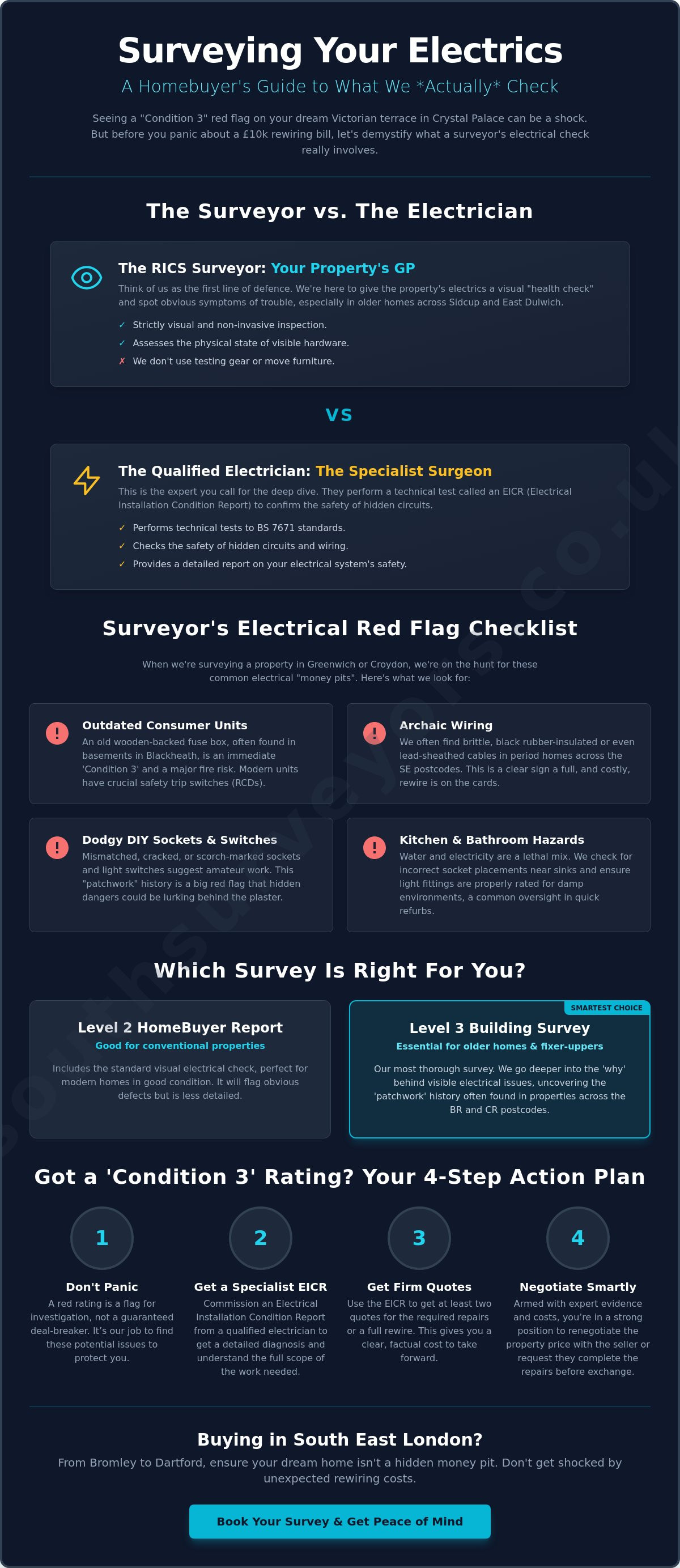
If you’re eyeing up a mid-century semi in Sidcup or a Victorian conversion in East Dulwich, you naturally want to know if the wiring is safe. There is a common misconception about what does a building survey check for electrics. Think of your RICS surveyor as a highly skilled GP. We’re here to check the overall pulse of the property and look for symptoms of underlying trouble. We aren’t the specialist surgeons who come in with a scalpel; that is the job of a qualified electrician.
Our inspection is strictly non-invasive. We aren’t going to start “chasing” wires behind the plaster or pulling up the original floorboards in your potential new Peckham home. Your seller would likely have a minor heart attack if we did, and our professional indemnity insurance certainly wouldn’t cover the fallout. Instead, we use our eyes and years of experience to spot the “tells” of a DIY disaster or a system that has simply reached the end of its life.
To better understand this concept, watch this helpful video:
The “Surface Level” Rule
RICS professional standards define our work as a “visual inspection.” This means we look at what is visible and safely accessible. We don’t use multimeters or complex testing gear because we aren’t testing the flow of electrons; we’re assessing the physical condition of the hardware. If a heavy mahogany wardrobe is blocking the only socket in a bedroom, we won’t move it. We won’t peel back the carpets to find hidden junction boxes either. We’re looking at the consumer unit, the type of switches used, and the visible cables to see if they meet modern UK electrical wiring standards.
Surveyor vs. EICR (Electrical Installation Condition Report)
While we provide a vital overview, we often recommend an Electrical Installation Condition Report (EICR) as a follow-up, especially in older properties across the BR or CR postcodes. An EICR is a technical test performed by a qualified electrician to BS 7671 standards. While we flag the risks, the EICR confirms the safety of the hidden circuits. If you’ve opted for a RICS (level 3) Building Survey, we’ll go deeper into the “why” behind the issues we see, but the visual-only rule remains. If we see a fuse box that looks like it belongs in a museum, we’ll give it a “Condition 3” rating. This doesn’t mean the house is a write-off; it means you need a specialist to tell you if it needs a quick fix or a total rewire.
The Electrical Red Flag Checklist: What We Look For
Walking into a potential new home in Greenwich or Croydon, you might be dazzled by the polished floorboards and the Farrow & Ball walls. But our job is to look past the aesthetics. When asking what does a building survey check for electrics, the answer starts with a systematic hunt for specific danger signs that could cost you thousands of pounds later. We’re essentially looking for the “hidden” history of the property through its wires and switches.
We begin our hunt at the consumer unit, which is the electrical brain of the home. If we find an old wooden-backed fuse box in a basement in Blackheath or Sutton, it’s an immediate “Condition 3” red rating. These are significant fire risks and usually mean the whole system is decades out of date. We also look for specific wiring types. In many SE London period homes, we still find lead-sheathed or black rubber-insulated cables. These materials become brittle and dangerous over time, and their presence is a clear sign that a full rewire is likely overdue.
Bathrooms and kitchens are high-risk zones where water and electricity live in a delicate balance. We check for the proximity of sockets to sinks and ensure light fittings are appropriate for damp environments. We even look at the garden and garage. If that trendy outdoor bar in Chislehurst or Dartford has power cables simply draped over a fence or buried shallowly in the dirt, we’ll flag it as a hazard. If you’re feeling overwhelmed by these technical details, booking a professional RICS survey can provide the clarity you need to move forward with confidence.
The Consumer Unit: The Heart of the Home
A modern consumer unit should be fitted with Residual Current Devices (RCDs). These clever switches cut the power in milliseconds if they detect a fault, potentially saving lives. We also check for a circuit chart; a simple list telling you which fuse controls the kitchen and which does the upstairs lights. If that chart is missing, or if there’s no label showing the last professional inspection date, it suggests the electrics haven’t been maintained to modern standards.
Visible Wiring and Sockets
We keep a sharp eye out for “daisy-chaining”. This is when multiple extension leads are plugged into one another to power a massive home cinema setup in a 1930s semi in Bromley. It’s a major fire hazard. We also look for old-fashioned round-pin sockets or mismatched faceplates that suggest a patchwork repair job. If we see plastic “trunking” stuck onto the surface of walls, it often points to a DIY project that hasn’t been signed off by building control. These small visual clues tell a big story about the property’s safety and the care taken by previous owners.
Level 2 vs. Level 3: Does a “Full Survey” Check More?
Choosing between survey levels is like deciding whether you want a quick health check or a deep-dive diagnostic. If you’re eyeing a relatively modern apartment in Sutton, a Level 2 survey might be exactly what you need. However, for those grand Victorian villas in Dulwich (SE21) or the sprawling 1920s homes in Bromley, the depth of the investigation matters immensely. You might wonder, what does a building survey check for electrics when you upgrade to the “full” version? The answer lies in the time and detail the surveyor spends hunting for clues of systemic failure.
While the visual-only rule still applies to both, a RICS (level 3) Building Survey allows your surveyor to be more of a detective. In a Level 2 report, we might simply note that the fuse box looks old. In a Level 3, we’ll actively look for the consequences of that age, checking for signs of overheating at the consumer unit or identifying if the property has a “patchwork” of wiring from different eras. It’s about providing a narrative of risk rather than just a checklist of parts.
Condition Ratings Explained
RICS reports use a traffic light system to help you prioritize your next steps. Understanding these ratings is the key to managing your stress levels during the exchange process. We break them down like this:
- Condition 1 (Green): No repair is currently needed. The system is modern, compliant, and shows no signs of trouble. This is the dream scenario for any buyer.
- Condition 2 (Amber): These are defects that aren’t considered urgent but will need attention soon. Perhaps a socket is slightly loose or a light fitting isn’t quite right for a bathroom zone.
- Condition 3 (Red): These are serious defects that need urgent repair or further investigation. If we see a wooden fuse box or scorched wiring, it’s a red light. This is your cue to pause and get a specialist involved before you sign.
Why Level 3 Wins for Period Properties
Older homes in South East London often hide a multitude of electrical sins behind their ornate cornicing. A Level 3 survey is designed for these complex structures. We spend more time looking for “hidden” clues that a Level 2 might overlook. For example, we recently surveyed a mid-terrace in Croydon (CR0) where a Level 3 inspection flagged a hidden sub-floor wiring mess. By looking into a small floor hatch, we spotted “rat-gnawed” cables that would have been missed in a standard overview. This discovery saved the buyer from a potentially lethal fire hazard and provided leverage for a significant price reduction.
If you’re still feeling a bit lost in the jargon, check out The Ultimate Guide to Building Surveys to help you navigate the unique challenges of the local property market. Whether you’re in CR0 or SE21, knowing the true condition of your potential home’s heart is the only way to ensure a shock-free move.
South London Special: Wiring Risks in SE, BR, and CR Postcodes
South London isn’t just a collection of postcodes; it’s a living museum of architectural eras. From the grand Victorian terraces of Peckham to the 1930s “Metroland” semis in Bromley, each style brings its own set of electrical quirks. Understanding what does a building survey check for electrics in these specific contexts requires more than just a textbook; it requires boots-on-the-ground local knowledge. We know that a house in East Dulwich (SE22) often tells a very different story under its floorboards than a property in Bexley (DA5).
The “DIY Landlord” effect is another local trend we monitor closely, especially in high-rental areas like Croydon (CR0) and Streatham. Uncertified flat conversions often feature overloaded circuits or “daisy-chained” sockets that were never designed for modern appliance loads. If you want a team that understands the specific electrical DNA of your next home, book your RICS survey with South Surveyors today. We provide the expert local insight you need to avoid a costly “money pit.”
Victorian and Edwardian Challenges
In neighbourhoods like Dulwich and Peckham, we often encounter “patchwork” electrics. These homes have been through multiple renovations over the last century. It’s common to find beautiful, modernized kitchens upstairs while the cellar or basement still houses an original lead-sheathed cable or a 50-year-old fuse board. These “hidden” areas are where we focus our attention in SE postcodes. Lead wiring is particularly brittle. If it’s disturbed during a new renovation, it can easily short-circuit. We look for these historical layers to ensure you aren’t buying a property that looks 2026 on the surface but is 1926 at its core.
The 1930s Suburban Boom
Moving further out to Bromley (BR1) or Sidcup (DA14), the risks shift. The 1930s suburban boom introduced vulcanised rubber insulation (VIR). Over time, this rubber perishes and turns to dust, leaving bare wires exposed inside your walls. We also keep a sharp eye on loft conversions in Morden (SM4). These are often the site of “creative” DIY wiring that hasn’t been properly integrated into the main consumer unit. If you’re looking at a property in Bexley (DA) that has been extended, we strongly advise checking for a recent EICR certificate to verify that the new work meets modern safety standards.
The Report is In: What to Do if the Electrics are Flagged
Opening your survey report to find a “Condition 3” red rating next to the electrical section can feel like a total deal-breaker. You’ve just spent weeks imagining where your sofa will go in that lovely Croydon terrace, only to be told the house might need a complete rewire. Take a deep breath. In the world of RICS reporting, a red rating is incredibly common for older properties across South East London. It doesn’t necessarily mean the house is falling down; it simply means we’ve identified risks that require professional investigation beyond the scope of what does a building survey check for electrics.
Your first step is to ask the seller for a valid Electrical Installation Condition Report (EICR). Since 2020, private landlords have been legally required to have these every five years, and many savvy homeowners keep them too. If the seller can produce a “Satisfactory” EICR dated within the last five years and confirmed to BS 7671 standards, your “Condition 3” might be easily resolved. If they don’t have one, you should instruct a qualified electrician to perform a full test before you exchange. This turns a scary “unknown” into a fixed cost that you can actually manage.
Negotiating the Purchase Price
Once you have a technical report and a quote for any remedial works, you hold a powerful tool for negotiation. If a property in Bromley or Sidcup needs a £5,000 rewire to be safe, it’s perfectly reasonable to ask for a price reduction to cover this cost. This isn’t “gazundering”; it’s a legitimate adjustment based on the physical reality of the building. Sellers are often more receptive to these requests when they’re backed by a RICS-regulated surveyor’s findings. We provide the professional evidence you need to argue that “safety first” isn’t just a catchphrase, it’s a requirement for your mortgage lender and your peace of mind.
Your Next Steps with South Surveyors
We’re here to help you demystify the process and feel empowered during your purchase. Whether you’re navigating the “patchwork” wiring of a Victorian conversion or the aging insulation of a 1930s semi, our experts provide the “knowledgeable friend” advice you need. We don’t just dump a technical report on your desk and leave you to it; we’re available to chat through the scary bits and help you understand the true implications for your budget.
Ready to move forward with total clarity? You can book your RICS Level 3 Survey in South London through our simple online portal. If you have specific concerns about a property in Croydon, Bromley, or beyond, Contact South Surveyors for a bespoke quote. Let’s make sure your new home is a source of joy, not a shock to your system.
Move Toward Your New Home with Total Clarity
Navigating the property market in South East London is an adventure, but you don’t have to do it alone. By now, you should have a clear understanding of what does a building survey check for electrics and why that visual “health check” is so vital for your safety. Whether you’re falling for a Victorian gem in Peckham or a 1930s semi in Bromley, knowing the difference between a minor fix and a major rewire puts the power back in your hands during negotiations.
At South Surveyors, we take pride in being a RICS Regulated Firm with deep roots in the SE, BR, CR, DA, and SM postcodes. We provide detailed, plain-English reports that cut through the technical noise, ensuring you feel empowered rather than overwhelmed. Don’t let a “Condition 3” rating stall your dreams; use it as a roadmap to secure a fair deal and a safe future. Ready to take the next step in your property journey? Book your expert South London Building Survey today and let our hyperlocal experts provide the peace of mind you deserve. You’ve got this, and we’re here to help you cross the finish line safely.
Common Questions About Electrical Surveys
Do surveyors test every plug socket in the house?
No, we don’t plug a tester into every single outlet during our inspection. We perform a visual check of a representative sample of visible sockets and switches to look for signs of damage, scorch marks, or poor DIY installation. If you’re buying a property in Greenwich or Croydon, we’ll check the ones that are easily accessible without moving the seller’s heavy furniture or lifting their carpets.
Will a building survey tell me if the house needs a full rewire?
We can’t give a definitive technical “yes” because we don’t test the hidden circuits, but we can tell you if it’s highly likely. By looking at the age of the consumer unit and the type of visible cabling in places like the cellar or attic, we can identify the red flags of an aging system. If we see original rubber wiring in a Bromley semi, we’ll advise that a rewire is a probable necessity.
What is the difference between a building survey and an EICR?
Think of a building survey as a thorough physical exam by a GP, while an EICR is a specialist diagnostic test. A RICS surveyor looks for visible evidence of wear, age, and risk. An electrician performing an EICR uses specialized equipment to send currents through the wires to check for hidden faults. Both are valuable, but only the EICR provides a technical guarantee of circuit safety.
Does a surveyor check the electrics in the loft or garage?
Yes, we certainly do, provided these areas are safely accessible and not piled high with decades of boxes. Checking the loft is essential for spotting “creative” wiring in Morden loft conversions, while the garage often reveals whether outdoor power was installed professionally. We look for cables that are correctly clipped and protected from physical damage in these secondary spaces.
What should I do if the surveyor gives the electrics a Red (Condition 3) rating?
Don’t panic, but do take it seriously. When asking what does a building survey check for electrics, a red rating usually means we’ve spotted an immediate hazard or a system that is significantly outdated. Your next step is to request an EICR from the seller or instruct your own electrician to provide a quote for the necessary remedial works, which you can then use to negotiate the final purchase price.
Can a surveyor check if the solar panels are wired correctly?
We can’t verify the internal technical wiring of a solar PV system. We will check the visible components for obvious damage and look for any roof leaks caused by the installation in areas like Bexley or Sidcup. However, verifying the inverter’s performance or the system’s compliance with microgeneration standards requires a specialist solar technician rather than a general building surveyor.
Is an electrical check included in a Level 2 HomeBuyer Report?
Yes, an electrical overview is included in a Level 2 report, but it’s less detailed than a Level 3. In a Level 2, we provide a high-level visual summary of the visible parts of the system. For older properties in the CR or SE postcodes that have undergone multiple renovations, the deeper detective work of a Level 3 Building Survey is usually the better choice to uncover hidden risks.
Do I need an electrician if I already have a RICS Building Survey?
You might, especially if our report flags any amber or red condition ratings. Our survey identifies the symptoms of a problem, but an electrician is needed to provide the cure. If we suggest further investigation, it’s because we’ve seen something that worries us. Getting a specialist’s technical report ensures your new home in South East London is safe before you sign that contract.