

What if that jagged line creeping up your hallway wall is actually just your house’s version of a morning stretch? It’s a common moment of property-related panic for many of us living between Greenwich and Croydon: you spot a new fracture and immediately start picturing your foundations dissolving into the Thames. We know the anxiety that comes with South London’s temperamental ground, but before you start researching the cost of a total rebuild, it’s worth taking a deep breath. Most of the time, your home is simply finding its feet in the soil rather than sounding a structural alarm.
We’ve created this guide to help you master the art of identifying structural cracks vs settlement, translating complex “house-speak” into clear, actionable advice. Whether you’re in a Victorian terrace in the SE postcodes or a modern semi in the BR or CR areas, understanding how our local environment affects your walls is the key to peace of mind. We will walk you through the visual clues that matter, explain why our local postcodes have a unique relationship with the earth beneath them, and provide a logical plan for a professional assessment so you can stop guessing and start planning with confidence.
Key Takeaways
- Learn the essential visual cues for identifying structural cracks vs settlement so you can distinguish between harmless “growing pains” and serious red flags.
- Discover why the 10p coin rule is your best friend for a quick home triage and how the direction of a crack signals different levels of structural risk.
- Understand the London Clay factor and why homeowners in SE, BR, and CR postcodes need to be particularly savvy about seasonal soil shifts.
- Get practical tips on DIY monitoring, from simple pencil marks to glass tell-tales, to help you decide when it’s time for a professional RICS assessment.
- Clarify when you need a RICS Chartered Surveyor versus a structural engineer to ensure you’re getting the most reliable advice for your specific property type.
The Great British Crack Panic: Is Your House Falling Down or Just Getting Comfy?
Finding a fresh crack in your plaster is a South London rite of passage. Whether you’re in a leafy Victorian semi in Bromley or a crisp new build in Croydon, the sight of a jagged line can trigger immediate property dread. It’s easy to jump to the worst-case scenario, imagining your home slowly sliding toward the Thames. But before you start looking up the cost of underpinning, take a breath. Every house moves. In our corner of the world, across postcodes like SE, BR, DA, CR, and SM, where the soil is as temperamental as the weather, a little shifting is actually quite normal.
The trick lies in identifying structural cracks vs settlement. While they might look similar to the untrained eye, one is a natural phase of a building “getting comfy” in its surroundings, while the other is a cry for help from the foundations. Professional surveyors see these issues daily, and they’ll tell you that most cracks are just the house stretching its legs. Understanding this distinction is the difference between a £10 tub of Polyfilla from the local DIY shop and a potentially massive insurance claim that keeps you up at night.
To better understand this concept, watch this helpful video:
What Exactly is House Settlement?
Settlement is essentially the building finding its feet. When a house is first constructed, the weight of the bricks, timber, and roof tiles compresses the ground beneath it. What is structural settlement? In professional terms, it is the downward movement of a building as the soil consolidates. This is especially common in new builds as materials like plaster and timber dry out and shrink. This “initial shrinkage” is a standard part of a home’s lifecycle. The good news? Settlement is usually a “one-and-done” event. Once the house has found its balance, the movement stops, leaving behind minor hairline cracks that are purely cosmetic and easily fixed.
When Does it Become a Structural Issue?
A crack shifts from “settlement” to “structural” when the building’s load-bearing capacity is compromised. This isn’t just about the house finding its level; it’s about the frame itself struggling to hold its own weight. If the movement is progressive, meaning the cracks keep widening or reappearing after you’ve filled them, you’re likely looking at a structural issue. This is where the psychological shift happens. It moves from being a nuisance you can hide with a well-placed picture frame to a red flag that requires a professional RICS assessment to protect your property’s value. In areas like East Dulwich or Sutton, where older housing stock is common, spotting these signs early can save you a fortune in the long run.
The Anatomy of a Crack: Visual Clues to Tell Settlement from Structural Damage
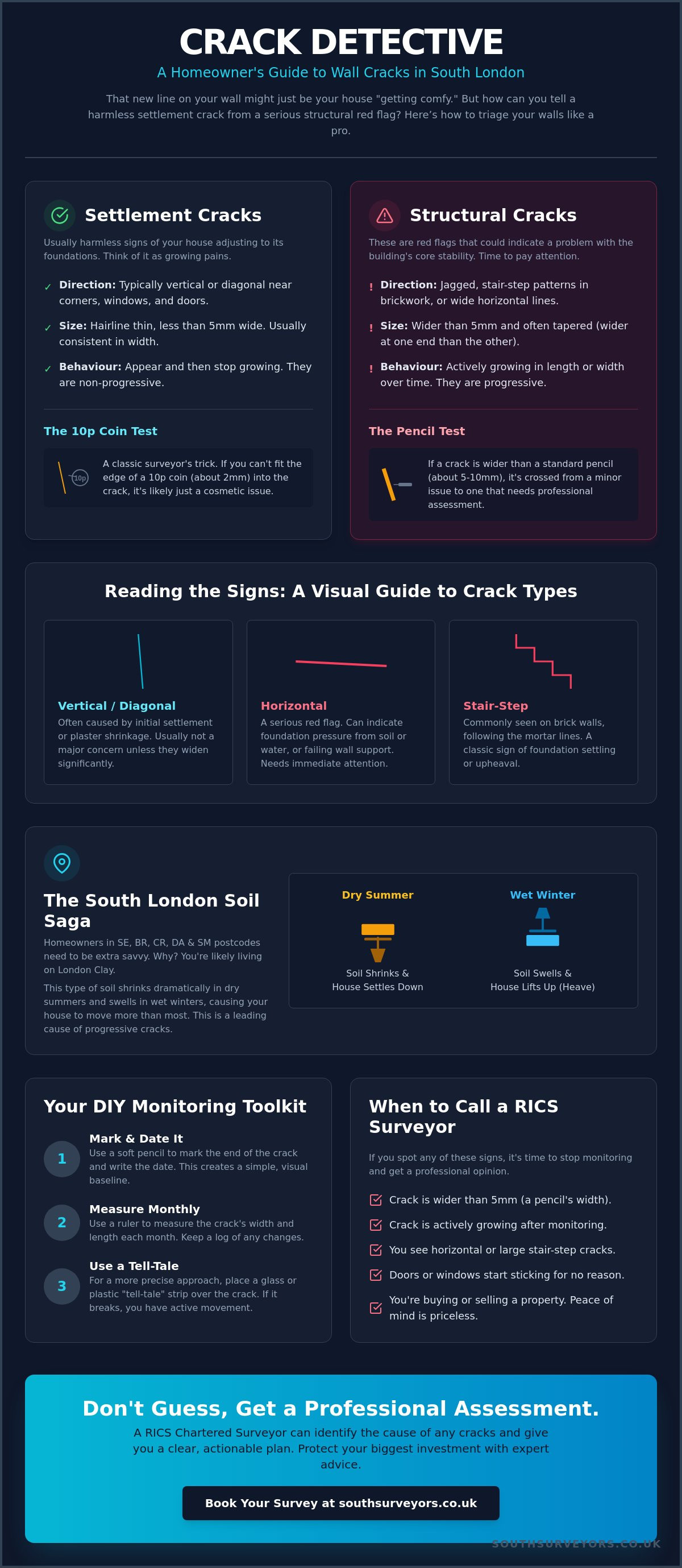
You don’t need a degree in structural engineering to do a basic triage on your walls. While we’ve established that every house moves, the way it moves leaves a distinct visual trail. Grab a 10p coin from your kitchen drawer. It’s a classic surveyor’s trick: a 10p coin is roughly 1.85mm thick. If you can’t fit the edge of that coin into the gap, you’re likely looking at a hairline settlement crack. However, if the gap is wider than 5mm, or roughly the width of a standard pencil, you’ve crossed the line from cosmetic “vibe” to structural “danger.”
The process of identifying structural cracks vs settlement relies heavily on reading the geometry of the damage. In the brickwork of a Bromley terrace or a Sutton semi-detached, keep a close eye on where the crack chooses to live. Is it hovering above a door frame? Is it creeping away from the corner of a window? These are the weak points where movement first reveals itself. If you’re feeling unsure about what your walls are trying to tell you, a professional Home Survey can provide the technical clarity needed to put your mind at ease.
Reading the Direction and Width
Vertical cracks are often the “chill” members of the crack family. They usually indicate simple thermal expansion or the natural drying out of materials. Horizontal cracks, however, deserve a bit more suspicion. In older properties across Croydon, horizontal lines in the brickwork can signal wall tie failure, where the metal bits holding your inner and outer walls together have started to rust. The real red flag in South London is the diagonal or “stepped” crack. Because our houses are mostly brick, movement often follows the easiest path: the mortar lines. If you see a zig-zag pattern climbing your external wall, the ground beneath you is likely doing more than just settling.
Tapering and Multi-Surface Cracks
Width consistency is another massive clue. A settlement crack usually stays the same width from top to bottom. A structural crack often “tapers,” meaning it’s wider at one end than the other. If a crack is wider at the top, it suggests the wall is rotating or pulling away from the rest of the structure. Always check both sides of the wall too. If a crack is visible on your interior plaster and mirrors the exact same path on the exterior brickwork, it indicates the movement has gone right through the “skin” of the building. Finally, try the sticking door test. If your bathroom door suddenly won’t close or your windows are jamming in their frames, the house’s geometry is shifting enough to affect its daily function. That is a clear sign that the movement is more than just a phase.
The South London Soil Saga: Why Your SE, BR, or CR Postcode Matters
If you live in South London, you aren’t just a homeowner; you’re a custodian of a property sitting on a giant, geological sponge. While residents in the north might deal with solid rock, those of us in postcodes like SE19, BR3, or CR2 are intimately acquainted with London Clay. This soil type is the primary reason why identifying structural cracks vs settlement is such a hot topic in our local pubs and WhatsApp groups. From the steep hills of Crystal Palace to the clay basins of Sutton, the ground beneath our feet is constantly in flux.
The geography of our corner of the city creates a unique set of challenges. If you’re in a Greenwich garden with a majestic, centuries-old oak tree, that beauty comes with a hidden cost. Large trees can drink hundreds of litres of water a day, desiccating the soil and causing the ground to shrink away from your foundations. In a dry year like 2026, where hotter summers are becoming the norm, this moisture extraction can turn a stable house into a shifting one in a single season.
London Clay: The Shrink-Swell Nightmare
London Clay is notoriously “volume-active,” meaning it acts like a sponge. During wet winters, it swells with water, pushing upwards. During the increasingly dry spells we’ve seen recently, it shrinks and cracks, leaving voids under your home. South East London is particularly prone to clay-related movement because the region sits on a thick layer of “London Clay” that expands and contracts more aggressively than almost any other soil type in the UK. With insurers having paid out £153 million in subsidence claims in the first half of 2025 alone, the impact of these weather patterns on our local soil is a serious financial consideration for any homeowner.
Period Properties vs. Modern Standards
The Victorian and Edwardian terraces that give East Dulwich (SE22) and Herne Hill their charm were often built with remarkably shallow foundations. In many cases, these houses were built on footings just a few bricks deep, which simply can’t reach the stable soil layers that modern builds in areas like Bexley or Sidcup do. When you add the heavy vibration from bus routes in Lewisham or the constant thrum of traffic in Peckham, these older structures are under constant stress. Often, what looks like a new structural issue is actually a botched historic repair from decades ago finally giving way. Understanding the “Victorian legacy” of your home helps you distinguish between a house that is simply reacting to its environment and one that needs a professional RICS Level 3 Building Survey to ensure its long-term stability.
The Homeowner’s Triage: When to Monitor and When to Call an RICS Expert
If you’ve spotted a fresh line in your Peckham loft or a zig-zag in your Sidcup semi, the urge to fix it immediately is powerful. But property anxiety is best managed with data, not a rushed trip to the hardware store. The process of identifying structural cracks vs settlement often requires a bit of patience. Unless the house is visibly leaning or you can fit a finger in the gap, a “wait and see” approach for a few weeks can reveal if the movement is a one-off event or a progressive issue. Think of yourself as a property detective gathering evidence before the experts arrive.
Setting up a DIY monitoring station is simpler than it sounds. You can use the old-school method of drawing a small pencil line across the crack with a date stamp, or go full “pro-sumer” with a glass tell-tale. These are small glass plates glued across the crack; if the glass snaps, you have active movement. This monitoring is vital because South London’s clay soil follows a seasonal rhythm. A crack that opens in a dry July might naturally close in a soggy January. If you aren’t seeing any changes over a few months, you might just be looking at a historic scar rather than a current threat.
Setting Up a Monitoring Log
Consistency is your best friend here. Grab a ruler and take high-resolution photos of the crack every month. Ensure you hold the ruler against the widest part of the gap for scale. This log is incredibly helpful for a surveyor because it proves whether the movement is active or historic. In areas like Lewisham or Bexley, where traffic vibration is high, keeping a 12-month log helps distinguish between “vibration jitters” and true foundation failure. If the crack is “clean” inside, it’s likely new. If it’s filled with old paint or dust, it’s probably been there since the last century.
The “No-Go” Zone is a rule every homeowner should live by: never fill a suspicious crack before a professional has seen it. Slapping a layer of filler over the evidence is like cleaning a crime scene before the police arrive. It masks the tapering, the direction, and the depth, making it much harder for a surveyor to diagnose the root cause. If you’re worried that the crack is beyond a simple DIY watch-list, it’s time to consider a RICS Level 3 Building Survey to get a definitive answer on your home’s health.
The Red Flag Checklist
While monitoring is great for minor issues, some signs demand immediate action. You should bypass the “wait and see” phase if you notice any of the following:
- Cracks wider than 5mm (the “pencil test”) or any gap where you can see daylight through the wall.
- Windows that suddenly won’t open or doors that jam in their frames, suggesting the house’s geometry is shifting.
- Debris, grit, or strange “crunching” sounds coming from within the wall cavity, especially after a heavy storm.
- Cracks that extend from the ground level all the way to the roofline in a continuous path.
If your home is ticking these boxes, don’t wait for the next season to see what happens. Getting professional property advice early can prevent a manageable repair from turning into a five-figure underpinning project.
Navigating the Fix: How a Professional Survey Demystifies Your Property’s Future
Spotting a crack is only half the battle. The real challenge is deciding what to do next without letting your imagination run wild. While identifying structural cracks vs settlement is a great skill for any homeowner, there comes a point where you need a definitive, professional verdict. A Home Survey isn’t just a box-ticking exercise for your mortgage lender. It’s your best insurance policy against accidentally buying a “money pit” in Bromley or Sutton. We provide the technical depth you need to move from property anxiety to empowered decision-making.
Many homeowners get confused between a structural engineer and a RICS Chartered Surveyor. Think of your surveyor as a highly skilled GP for your house. We look at the whole building, diagnosing why that crack in your Dulwich extension is appearing and how it relates to the rest of the structure. A structural engineer is more like a specialist surgeon; they’re the ones you call once a surveyor has confirmed that a specific, complex intervention like underpinning is required. Our jargon-free reports translate “house-speak” into a clear action plan. This might involve simple seasonal monitoring or digging trial pits to check the depth of your foundations before you commit to a purchase.
Why South Surveyors?
We’ve spent years exploring the unique architectural quirks of the SE, BR, DA, CR, and SM postcodes. We understand how the Victorian terraces of Greenwich differ from the mid-century builds in Bexley, especially when they’re sitting on temperamental London Clay. Our approach is that of a “knowledgeable friend.” We tell you the truth about your property’s health with professional substance but without the corporate robot vibe. As a firm regulated by RICS, we adhere to the gold standard of industry accountability. This ensures every report is meticulous, dependable, and tailored to your specific needs.
Taking the Stress Out of the Process
A detailed survey doesn’t just provide peace of mind; it provides leverage. If we identify an issue that requires significant work, you can often use our findings to negotiate a property price down. This can save you thousands of pounds at the completion stage. We also believe in the personal touch. You won’t just get a cold PDF and a “good luck” message. You get direct access to your surveyor for follow-up questions, ensuring you feel confident in every step of your property journey. Don’t let a crack in the wall ruin your sleep. Book your RICS Level 3 Survey with South Surveyors today and get the clarity you deserve.
Secure Your South London Sanctuary
Your home is more than just bricks and mortar; it’s your biggest investment and your sanctuary. By learning the basics of identifying structural cracks vs settlement, you’ve already taken the first step toward becoming a more empowered homeowner. Whether you’re living in a period terrace in Greenwich or a modern flat in Sutton, understanding how the local geology impacts your foundations is essential for long-term peace of mind. You now know that a hairline gap is often just a sign of a building finding its feet, while diagonal shifts require a closer look.
If you’re still feeling a bit uneasy about a specific gap in your wall, we’re here to help. As a RICS Regulated Firm with deep expertise in the SE, BR, and CR postcodes, South Surveyors brings professional substance and local insight to every inspection. Our hundreds of 5-star reviews highlight our commitment to the “personal touch” and delivering reports that prioritize clarity over jargon. Don’t let uncertainty keep you awake at night. Get a bespoke quote for your RICS Building Survey in South London today. Your house has a story to tell; let’s make sure it’s a happy one.
Frequently Asked Questions
Is a crack in the ceiling always a sign of structural damage?
No, ceiling cracks are rarely a sign of structural failure. Most are caused by the natural expansion and contraction of timber joists or the drying out of plaster. This is especially common in older homes in areas like Forest Hill. If the crack is thin and follows the line of the plasterboard, it’s likely cosmetic. You should only worry if the crack is wider than 5mm or accompanied by a sagging ceiling.
How much does it cost to fix a structural crack in a South London terrace?
The cost varies based on the severity of the issue. For minor cosmetic cracks, filling and sealing might cost between £500 and £1,200 in 2026. However, if the issue is subsidence, the average cost for underpinning a UK house is approximately £12,500 as of May 2024. Getting a professional diagnosis early is the best way to avoid these high-end repair bills.
Will my buildings insurance cover cracks caused by settlement?
Standard buildings insurance policies typically don’t cover cracks caused by settlement. Insurers view settlement as a natural, expected process of a building finding its level. They do, however, usually cover subsidence, which is a structural movement caused by external factors like soil shrinkage. Most subsidence claims carry a minimum excess of £1,000, and insurers paid out £153 million for such claims in the first half of 2025.
Can I sell my house in Croydon if it has visible cracks?
You can sell a property in Croydon with visible cracks, but transparency is key. A buyer’s surveyor will inevitably flag them, which might lead to renegotiations or delays. Mastering the art of identifying structural cracks vs settlement before you list the property allows you to provide a professional report to potential buyers. This builds trust and prevents a sale from falling through at the last minute due to surveyor jitters.
How do I know if the cracks in my new build are normal?
Cracks in new builds are often just drying out pains as materials lose moisture. According to NHBC Standards 2026, hairline cracks are generally considered normal. A good rule of thumb is that cracks wider than 2mm might indicate a defect. If you’re in a new development in areas like Sidcup or Bexley, keep a log of these cracks to show the builder during your end of warranty inspection.
What is the ’10p test’ for wall cracks?
The 10p test is a simple DIY method to gauge the severity of a gap. A standard 10p coin is about 1.85mm thick. If you can’t fit the edge of the coin into the crack, it’s likely a minor settlement issue. If the coin fits easily or the gap is wider than a pencil, you’ve moved into the territory of potential structural concern. It’s a quick way to decide if you need professional advice.
Do I need a structural engineer or a building surveyor for cracks?
You should call a RICS Chartered Surveyor first. We act as the primary diagnostician, determining whether the movement is historic, active, or purely cosmetic. If we find a serious structural issue, we will then recommend a structural engineer to design the specific repair or underpinning scheme. Starting with a surveyor provides a holistic view of the property’s condition beyond just the single crack.
Can trees in my neighbor’s garden cause cracks in my house?
Trees in a neighbouring garden are a very common cause of cracks in South London. Large species like oaks or poplars can extract huge amounts of water from the clay soil, causing it to shrink. This is a frequent issue in leafy neighbourhoods like Greenwich or Chislehurst. If a neighbour’s tree is causing your foundations to shift, it may lead to a complex subsidence claim involving multiple parties and insurers.