

Is that sleek flat roof on your potential new Bromley pad a modern architectural masterpiece or just a very expensive swimming pool waiting to happen? It’s a question that keeps plenty of buyers up at night, as the fear of inheriting a leaky money pit in the SE or CR postcodes is very real. When you’re surveying a house with a flat roof, the difference between a sound investment and a structural headache often comes down to the details that aren’t visible from the garden path.
We know that the jargon around EPDM rubber, GRP fibreglass, and “ponding” water can feel overwhelming, especially when you’re worried a mortgage lender might reject a DA or SM postcode property based on a bit of twenty year old felt. You deserve total clarity before you sign on the dotted line. This guide reveals exactly what RICS surveyors look for, from hidden damp in Croydon extensions to the 2026 Part L thermal performance standards. You’ll gain a realistic understanding of material lifespans and the peace of mind to proceed with your South East London purchase with total confidence.
Key Takeaways
- Learn why modern flat roofing technology has moved past its 70s reputation, making those East Dulwich extensions a much safer bet than you might think.
- Discover exactly how RICS professionals approach surveying a house with a flat roof, from the “Ladder Rule” to spotting “ponding” water that could lead to hidden damp.
- Decode the lifespan of common materials so you can distinguish between a 15-year bitumen felt and a 30-year EPDM “hipster” rubber sheet.
- Use your survey findings to confidently renegotiate property prices in Sutton or Bexley, ensuring a potential repair doesn’t derail your mortgage application.
- See how South Surveyors’ RICS-regulated reports translate technical jargon into helpful, actionable advice for your South East London home purchase.
Surveying a House with a Flat Roof: Why They’re the Marmite of the Property World
If you’re hunting for a home in East Dulwich (SE22) or Bromley (BR1), you’ve likely noticed that flat roofs are everywhere. They are the Marmite of the property world; some buyers love the clean lines and extra headroom, while others worry about inheriting a waterfall in their kitchen. This reputation mostly stems from the “leaky 70s” era, but modern materials have moved the goalposts significantly. Before you panic, it’s worth learning what is a flat roof? and how it actually functions in a modern climate.
When we’re surveying a house with a flat roof, we look at it as a high-stakes engineering puzzle. Unlike a pitched roof that uses gravity to shed water, a flat roof relies on a subtle “fall” and high-performance membranes to keep the interior dry. It has three main jobs: weatherproofing, providing insulation to meet current thermal standards, and ensuring drainage doesn’t pool in the middle. Horizontal surfaces are naturally more vulnerable to the elements. We pay extra attention to these areas because even a tiny pinhole can lead to structural damp over time. This extra diligence is exactly why surveying a house with a flat roof requires a RICS professional who knows how to spot the early warning signs before they become a five-figure repair bill.
To better understand this concept, watch this helpful video:
Common Flat Roof Scenarios in South East London
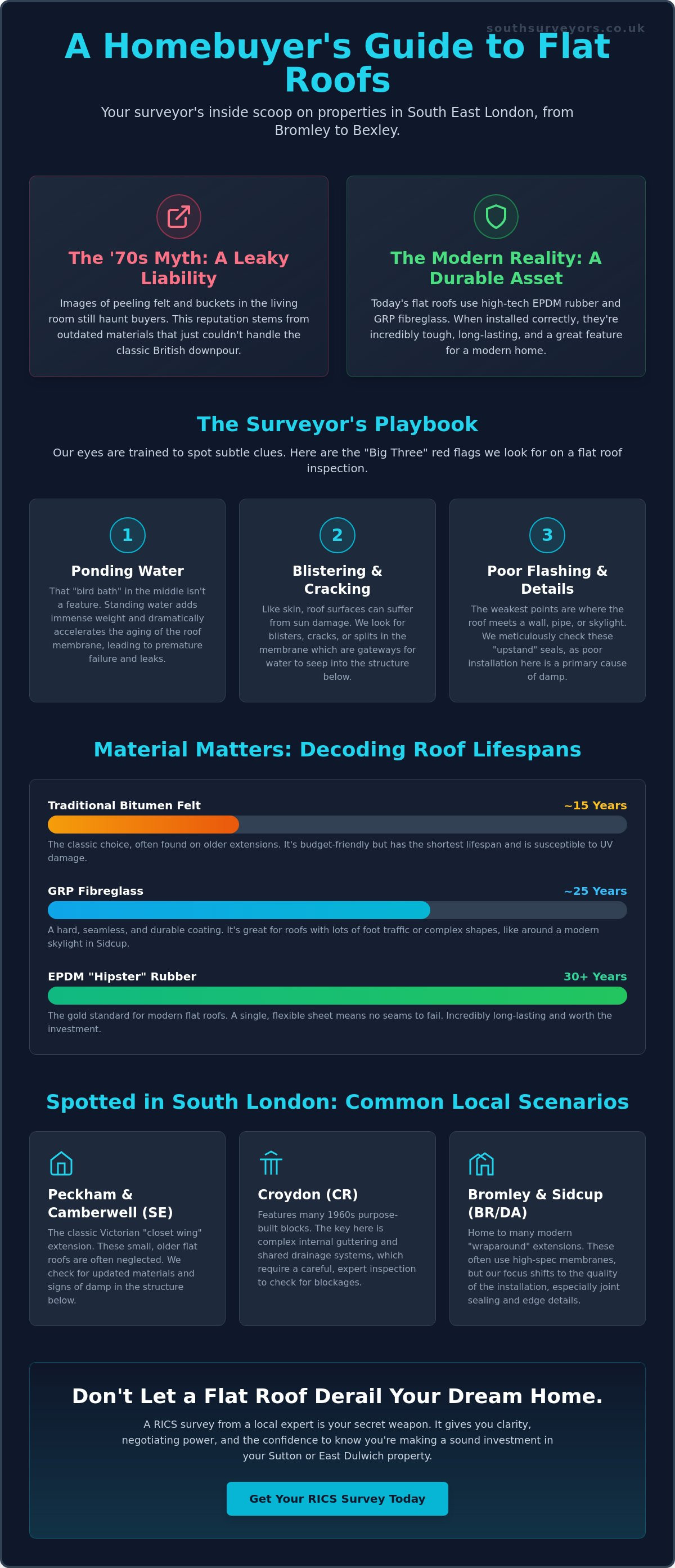
South London has a unique architectural DNA. In Peckham and Camberwell, we often find the classic Victorian “closet wing” extension. These are usually small but prone to neglect if they haven’t been updated in the last decade. Croydon (CR0) features many 1960s purpose-built blocks where drainage is the primary concern, often involving complex internal guttering systems that require a steady hand to inspect. Meanwhile, in Sidcup (DA14), we see a lot of modern “wraparound” extensions. These usually use high-spec membranes that are incredibly durable, provided the joints were sealed correctly by the original builder. Each era brings its own quirks that only a local expert will truly recognise.
The Mortgage Factor: Why Lenders Care About Your Roof
Lenders can be quite sensitive about “non-standard construction.” In plain English, this just means the house isn’t built entirely of brick with a tiled, pitched roof. If a significant percentage of the property is covered by a flat roof, some banks get nervous about future maintenance costs. This is where a RICS survey becomes your secret weapon. By documenting that the roof is in good health through a Level 2 or Level 3 report, you can often avoid a “down-valuation.” This happens when a lender decides the house is worth less than your agreed price because of perceived risks. Having a professional report from South Surveyors helps you speak the lender’s language and keep your purchase moving forward with total confidence.
The Surveyor’s Playbook: What We Actually See When We’re Up There
When surveying a house with a flat roof, our first challenge is often just getting a clear view. RICS surveyors generally follow a 3-metre rule for safety; if we can’t safely access the roof with a standard surveyor’s ladder, we’ll find a high vantage point or use drone technology to get the job done. While our inspection is non-invasive, meaning we won’t be ripping up the felt to see what’s underneath, our eyes are trained to spot the subtle ripples that hint at structural trouble. We look for a hierarchy of defects, ranging from minor surface wear to signs of total structural failure. Interestingly, we spend just as much time looking at the ceilings inside your potential new home in Bexley or Sutton as we do on the roof itself. If there’s a leak, the plasterwork usually tells the truth long before the exterior membrane gives way.
The “Big Three” Defects We Flag Most Often
There are three main culprits that tend to pop up during our inspections across the SE and BR postcodes. First is ponding. In rainy London, standing water is a major red flag. If it hasn’t drained within 48 hours, it’s ponding, which puts immense pressure on the joints and accelerates material decay. Then there’s blistering and alligatoring. Older bitumen roofs in sunny South London spots like Greenwich can suffer from UV stress, where the surface cracks like a reptile’s skin or traps air bubbles that eventually pop. Finally, we check the flashing. The joints between the roof and the brickwork are the most vulnerable points; if these aren’t sealed perfectly, water will find a way in.
RICS Level 2 vs. Level 3: Which One Do You Need?
For an older extension in Croydon (CR0) or a Victorian conversion in Camberwell, a standard Level 2 Condition Report might leave some stones unturned. The RICS Level 3 Building Survey is vital for properties with older flat roofs because it offers a much deeper dive into the roof’s construction and thermal performance. This is especially important for checking compliance with UK Building Regulations for flat roofs, which mandate specific insulation levels for any major renovation or replacement. A Level 3 survey stands as the most in-depth analysis for complex roofs, providing the detailed repair advice you need to negotiate with confidence. If you’re unsure which report fits your potential home, it’s always worth a quick chat with our team to find the right survey for your South London purchase.
Material Matters: Decoding the Lifespan of South London’s Flat Roofs
Not all flat roofs are created equal. While your surveyor is busy spotting property defects elsewhere, identifying the specific material on your roof is the first step to predicting its future. Bitumen felt is the classic choice you’ll see on many 1970s garages in Mitcham (CR4) or older extensions in Carshalton (SM5). Traditional felt usually lasts between 10 and 20 years, while modern torch-on versions can stretch to 25 years. You’ll know it’s reaching its “best before” date when you see significant gravel loss or “crazing” on the surface, which looks like a dried-out riverbed.
Then there’s EPDM rubber, the “hipster” of the roofing world. It’s a single, seamless sheet that can easily last 30 years or more. Surveyors love it because there are no joins for water to exploit, making it a top choice for those sleek kitchen extensions in Forest Hill (SE23). GRP fibreglass is the “bulletproof” alternative often seen in Orpington (BR6). It’s incredibly tough and can last up to 50 years, but it relies entirely on a professional installation. A DIY job often ends up cracking like an eggshell under the summer sun, a defect we see far too often when surveying a house with a flat roof.
Finally, we have Mastic Asphalt. It’s the heavyweight champion found on grander period terraces in Greenwich or Dartford (DA1). It can last 40 years or more if maintained. While it’s incredibly durable, it’s also very heavy and requires a sturdy structural frame beneath it. If you see this on a flimsy-looking shed extension, it’s a red flag for structural stress.
The “Age Test”: How to Guess Your Roof’s Birthday
You can often play detective by looking at the surface finishes. Solar reflective paint or a layer of limestone chippings aren’t just for decoration; they protect the bitumen from UV damage. If the paint is peeling or the gravel is bare in patches, the roof is likely over 15 years old and nearing the end of its life. A professional installation will have neat, “stepped” flashing where the roof meets the wall. If you see messy patches of “flashband” tape or blobs of silicone, you’re looking at a “cowboy” repair that won’t stand up to a South London winter.
Maintenance Tips for the New Homeowner
Once you’ve moved in, a little bit of care goes a long way. A simple “Spring and Autumn” gutter clear-out is a ten-minute job that can save you £10,000 in structural repairs. Blocked gutters lead to “ponding” water, which is the primary cause of premature roof failure. It’s also vital to distinguish between a leak and condensation. If you see damp patches only in winter, it might be an insulation issue rather than a hole in the roof. Modern standards like the 2026 Future Homes Standard push for much higher insulation levels, so upgrading your roof’s thermal layer can often solve “damp” problems while lowering your energy bills.
The “Flat Roof Red Flag” Checklist: Costs, Mortgages, and When to Walk Away
Let’s talk numbers. When you’re surveying a house with a flat roof, it’s easy to get spooked by the prospect of a replacement. However, perspective is everything. A £5,000 roof renovation on a £500,000 property in Sutton or Bexley is just 1% of the purchase price. It’s a maintenance item, not a catastrophe. Many buyers treat a flat roof like a ticking time bomb, but once you understand the “true cost” of ownership, it becomes just another line in your renovation budget. Most flat roof issues are fixable with the right budget. The real trouble starts when you ignore the signs of structural sagging or a “mushy” roof deck, which suggests the wooden rafters underneath have rotted away. If we find that the roof “bounces” underfoot or the ceiling joists are visibly bowing, that is usually the point where we suggest you might want to reconsider the purchase.
The Renegotiation Strategy
Your survey report is more than just a list of faults; it’s your most powerful bargaining tool. By using a RICS Home Survey, you can present the seller with an objective, professional assessment of the roof’s condition. If we’ve flagged that the bitumen felt is nearing its 20-year limit, get a few quotes from local South London contractors to back you up. This evidence makes a price reduction much easier to swallow for a seller who wants to keep the deal alive. It’s about being polite but firm, ensuring you aren’t overpaying for a property that needs immediate work. Most sellers in the current market expect a bit of back-and-forth, especially when a professional report highlights a clear maintenance deficit. If you need a professional eye to start this process, you can book your RICS survey with our team today.
Hyperlocal Concerns: Postcode-Specific Risks
Location matters just as much as materials. In the leafy streets of Dulwich (SE21), those beautiful mature trees are the arch-nemesis of your flat roof. Falling leaves and twigs can block drainage outlets in minutes, leading to the “ponding” issues we’ve discussed. If you’re looking at more urban parts of Croydon (CR9), industrial fallout and grit can act like sandpaper on your roof membrane over time, wearing it down faster than in more rural areas. We also keep a close eye on properties in elevated spots like Crystal Palace. The high winds here can literally peel back poorly installed “flashband” or loose felt edges if they weren’t secured properly. Insurance companies in the SE postcodes often ask about the percentage of flat roofing on a property. Many have a “33% rule” where premiums might rise if the flat roof covers a third or more of the total area. Having a clean bill of health from a surveyor can help you navigate these insurance hurdles with much less stress.
Navigating the Flat Roof Jungle with South Surveyors
Buying a home is stressful enough without having to worry about what’s happening above your head. When surveying a house with a flat roof, you need more than just a checklist; you need a strategy. At South Surveyors, our RICS-regulated status is your gold standard for peace of mind. We don’t just point out that a roof is old; we explain what that means for your bank account and your move-in date. Our reports are designed to be conversational and actually understandable, positioning us as your knowledgeable friend in the property world rather than a corporate robot. We offer bespoke advice that looks at your specific South London home, whether it’s a mid-century terrace or a modern glass-box extension.
We believe in transparency and empowerment. That means we don’t just flag problems; we offer realistic solutions. If we find an issue with a flat roof in Welling or West Wickham, we’ll tell you how to fix it and what to ask the seller. You can book your survey in about 60 seconds, getting a dedicated expert on your side who knows exactly how to handle the quirks of the local market. It’s about giving you the tools to make a sound decision without the sleepless nights.
Our Commitment to South London Buyers
Our expertise isn’t just general; it’s hyperlocal. We have a deep understanding of the building stock across the SE, BR, DA, CR, and SM postcodes. We adhere to the highest RICS standards while keeping our communication human and accessible. One of the biggest complaints in this industry is the lack of follow-up, which is why we provide direct access to your surveyor. If you have a question about a specific comment in your report, you can pick up the phone and talk to the person who was actually standing on that roof in Bromley or Croydon. This personal touch ensures you never feel like just another file in a cabinet.
Ready to Move Forward?
Don’t let a flat roof keep you up at night or stop you from buying the home you love. Most issues are entirely manageable if you have the right information from the start. We have a long history of helping Londoners avoid “money pits” by providing clear, honest, and expert assessments. If you’re looking at a property with a complex roof structure, your best move is to get a RICS Level 3 Building Survey. This provides the most in-depth analysis available, ensuring you can proceed with your purchase with total confidence and a clear roadmap for the future.
Take the High Ground on Your Home Purchase
Flat roofs shouldn’t be the dealbreaker that stops you from landing your dream home in Crystal Palace or Sidcup. We’ve seen how modern membranes like EPDM can outlast traditional felt by decades, and how a bit of savvy maintenance can protect your investment for years to come. The secret is knowing exactly what’s going on above your head before you commit to those mortgage papers. Knowledge is your best tool for avoiding a money pit and ensuring your new extension remains a sanctuary rather than a source of stress.
Surveying a house with a flat roof isn’t just about finding faults; it’s about empowering your decision making and giving you the leverage to negotiate a fair price in postcodes like CR0 or BR1. As an RICS Regulated Firm with hyperlocal South London expertise, we pride ourselves on our 5-star client feedback for clear, direct communication. We don’t just hand you a dry, technical document; we provide a practical roadmap for your future home. Ready to buy with total confidence? Book your RICS Level 3 Survey with South Surveyors today and get an expert friend on your side. You’ve got this!
Frequently Asked Questions
Is a house with a flat roof harder to insure in London?
It can be slightly more complex, as many insurers apply a “33% rule” where premiums might increase if flat roofing covers more than a third of the total property area. You might find fewer “off-the-shelf” quotes online for homes in postcodes like SE21 or BR1. However, providing a clean RICS survey report often helps reassure specialist providers that the structure is sound, making the process much smoother than you’d expect.
How long does a flat roof usually last before it needs replacing?
Lifespans vary wildly based on the material used and the quality of the original installation. Traditional bitumen felt typically lasts between 10 and 20 years, while modern torch-on versions can stretch to 25 years. If you’ve got an EPDM rubber or GRP fibreglass roof, you’re looking at 20 to 30 years, with some high-spec installations reaching 50. Mastic asphalt is the heavyweight champion, often lasting 40 years or more with basic care.
Can a surveyor tell if a flat roof is leaking if it isn’t raining?
Yes, we don’t need a downpour to spot trouble. When surveying a house with a flat roof, we look for “ponding” marks, which are tell-tale rings of dirt left by standing water. We also check for “alligatoring” cracks on the surface and inspect the ceilings inside for damp patches or staining. These visual clues tell the story of a roof’s performance over the long term, regardless of the current weather in Croydon or Sutton.
Will a flat roof stop me from getting a mortgage?
Not typically, but it can influence the lender’s decision if the roof is in poor condition or covers a large percentage of the property. Lenders view flat roofs as higher maintenance, so a “down-valuation” is a risk if a surveyor flags significant defects. Having a professional Level 2 or Level 3 report ready can help demonstrate that the property is a sound investment, keeping your Bexley or Sidcup purchase on track.
What is the most durable material for a flat roof extension?
Mastic asphalt and GRP fibreglass are generally considered the most durable options for South London extensions. Asphalt is incredibly long-lasting but very heavy, requiring strong structural support. GRP is “bulletproof” when installed correctly and can last up to 50 years. EPDM rubber is also a fantastic, single-sheet contender that resists UV damage well, making it a favorite for modern projects in areas like Forest Hill or Greenwich.
How much does it cost to replace a standard 20sqm flat roof?
Costs depend heavily on the material and whether the underlying timber deck needs replacing. A basic felt replacement might start around £1,500, while high-spec GRP or EPDM for a 20sqm extension could range from £2,500 to £4,500. Remember that upgrading insulation to meet the 2026 Part L Building Regulations will also add to the final bill, but it’s an investment that pays off in significantly lower energy costs over time.
Does a RICS Level 2 survey cover the flat roof in detail?
A Level 2 survey includes a visual inspection of the roof from a safe vantage point, but it’s less comprehensive than a Level 3 Building Survey. It will flag obvious defects like ponding or surface cracking. However, for older flat roofs in the SE or CR postcodes, a Level 3 report is often better as it provides a more thorough analysis of the construction and more detailed advice on repair costs.
What are the signs that a flat roof is structurally unsound?
Structural red flags include visible sagging in the roof surface or a “bouncy” feel when walked upon by a professional. Inside the house, look for bowing ceiling joists or large cracks in the plasterwork where the extension meets the main building. These signs suggest the wooden deck or supporting rafters have rotted or reached their weight limit, which is a significant safety concern that requires immediate attention when surveying a house with a flat roof.