

What if the only thing standing between you and your dream Victorian terrace in SE22 is a stuck loft hatch and a pile of old moving boxes? It’s a common worry for homeowners across Bromley and Croydon who feel a sudden jolt of panic as soon as the survey date is confirmed. You’re likely wondering how to prepare for a surveyor’s visit without losing your mind or accidentally blocking access to a crucial fuse box. We get it; whether you are in a leafy DA postcode or a bustling SM neighborhood, the thought of an expert poking around your period property’s unique quirks can feel like a high-stakes interrogation of your home’s character.
We agree that the process feels daunting, especially with the 2026 government reforms shifting more responsibility onto sellers to provide upfront condition reports. This guide is designed to turn that pre-survey anxiety into a smooth, successful property assessment by offering a friend-to-friend look at what actually happens on the day. You’ll gain a clear, actionable checklist to ensure your home is ready for the experts, helping you avoid unnecessary delays in your sale or purchase. We will walk you through everything from clearing access to the loft to understanding South London’s specific structural charms, ensuring you feel confident and fully prepared when the doorbell rings.
Key Takeaways
- Understand that a survey isn’t a pass or fail test, but a professional visual inspection designed to offer transparency and peace of mind.
- Discover how to prepare for a surveyor’s visit by clearing “inspection zones” like loft hatches and ensuring all keys for windows and doors are easily accessible.
- Learn which specific “gubbins” to gather, from Fensa certificates to building regs for that stylish Peckham loft conversion or Croydon extension.
- Find out why “Red” ratings in your final report aren’t a reason to panic, but rather a useful roadmap for future maintenance in your South London home.
What Happens During a Surveyor’s Visit? (And Why You Shouldn’t Panic)
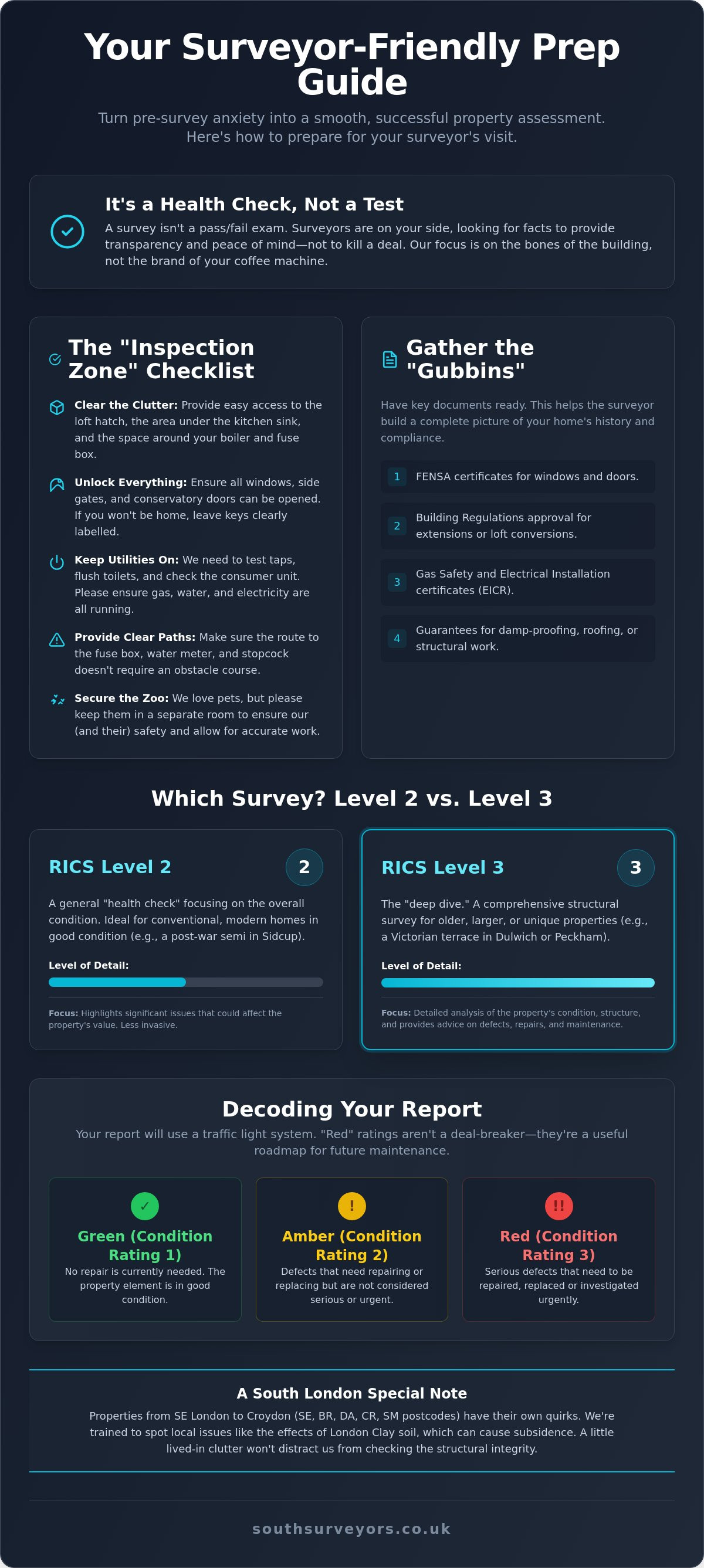
Think of a surveyor’s visit as a professional health check for your house, rather than a final exam where you might fail. Many homeowners in SE22 or BR1 spend days scrubbing floorboards, but our focus is on the bones of the building, not the brand of your coffee machine. To understand the basics, it helps to know what a home inspection is in a broader sense: a non-invasive, visual examination of a property’s physical structure and systems. We are there to identify risks and provide transparency, giving you the power to make an informed decision before signing those life-changing papers.
Learning how to prepare for a surveyor’s visit starts with realizing that we are on your side. We aren’t looking for reasons to kill a deal; we are looking for facts. Whether you are selling a sleek apartment in Croydon or buying a sprawling family home in Dartford, our goal is to ensure everyone knows exactly what they are getting into. To better understand what a professional is looking for during their rounds, watch this helpful video:
RICS Level 2 vs. Level 3: Which prep do you need?
The amount of preparation you’ll need often depends on the type of survey commissioned. If you’re dealing with a relatively modern home in Sutton (SM) or a post-war semi in Sidcup (DA), a RICS Level 2 Condition Report is usually the standard. These are faster and focus on the general condition. However, if you’re eyeing up one of Dulwich’s Victorian gems or a quirky Edwardian terrace in SE London, you’ll likely need a RICS Level 3 Building Survey. This is the “deep dive” where we look into every nook and cranny. Preparing for a Level 3 means ensuring we have clear access to everything, from the depths of the cellar to the highest point of the loft.
The South London context: Why our houses are special
South London properties have a personality all their own, and our surveyors are trained to spot the specific quirks that come with our local postcodes. From the SE to the CR areas, we keep a keen eye on issues like London Clay soil, which is notorious for causing subsidence in older terraces. We aren’t just checking the thickness of the walls; we’re analyzing how the history of the neighborhood, from historic bomb damage to local drainage patterns, affects your specific plot. This hyperlocal expertise is why we can see past your “lived-in” clutter. A bit of dust or a messy cupboard won’t distract us from assessing the structural integrity of your BR family home.
The Ultimate ‘Surveyor-Friendly’ Prep Checklist
If you’re wondering how to prepare for a surveyor’s visit, let’s get one thing straight: we don’t care if you haven’t done the washing up. What we do care about is being able to see the things that actually matter. We call these “inspection zones.” If your under-sink cupboard is a graveyard of old cleaning products and leaking sponges, we can’t check the pipework. If your loft hatch is blocked by a heavy wardrobe, we can’t check the roof timbers. Clearing these paths isn’t just about being polite; it’s about ensuring your report is as thorough as possible. Knowing how to prepare for a surveyor’s visit effectively can save you days of back-and-forth communication later on.
- Clear the clutter: Focus on the loft hatch, the area under the kitchen sink, and the space around your boiler.
- Unlock everything: Ensure all windows, side gates, and conservatory doors are unlocked. If you aren’t there, leave the keys in a visible spot.
- Keep the utilities on: Make sure gas, water, and electricity are all switched on. We need to test the taps and check the consumer unit without playing detective.
- Provide a clear path: Your fuse box and water meter shouldn’t require an Indiana Jones-style expedition to find.
- Secure the zoo: We love dogs, but a jumping Labrador makes it very hard to take accurate measurements. Keep pets in a separate room or with a neighbor.
Access is everything: The ‘Loft Hatch’ rule
In many Croydon semis or Bromley family homes, the loft hatch is tucked away in a cupboard or behind a door. If we can’t get our ladder up safely, we have to list it as a “limitation” in the report. This can be a major headache for buyers and lenders alike. For those in older SE properties, don’t forget the cellar access. Whether it’s a coal hole in Blackheath or a basement in Greenwich, we need to get down there to check for damp and structural issues. If you’re unsure which survey level fits your property’s needs, you can view our range of RICS surveys to see what we’ll be looking for.
Parking and Keys: The logistical hurdles
Logistics can make or break a surveyor’s day. If you live in a permit-only zone in Greenwich or a narrow street in Dartford, let us know where the best spot to park is. A surveyor circling the block for twenty minutes is twenty minutes less spent on your property. Similarly, if an estate agent is handling the keys, double-check they have the right ones for the outbuildings or the garden office. It’s a simple equation: providing easy, unobstructed access leads to a much faster and more comprehensive report for everyone involved. We want to get in, do a thorough job, and get that report back to you without any unnecessary delays.
The Paperwork: Gathering the ‘Gubbins’ for Your Surveyor
While we spend a lot of time poking around lofts and checking for damp, a significant part of how to prepare for a surveyor’s visit happens at your kitchen table. We call this the ‘Gubbins’ phase. Having a neat folder of certificates ready for us is like giving a surveyor a shortcut to a clean bill of health. If you’ve had work done on your SE15 terrace or your BR3 semi, we need to see the proof. Without it, we have to note that certain elements couldn’t be verified, which can make mortgage lenders a bit twitchy.
Start by rounding up the usual suspects. If you’ve replaced the windows, we need the Fensa certificate. Think of Fensa as the industry’s way of promising your double glazing won’t suddenly decide to let in a gale from the Thames; it proves the installation meets building regs. We also look for Gas Safe records and NICEIC certificates for electrical work. If you’ve been busy with a Peckham loft conversion, having the planning permissions and building regulations sign-off to hand is vital. If your project involved shared boundaries, having your party wall act agreement ready will save everyone a lot of stress. Warranties for timber treatment or damp proofing are absolute gold dust during an inspection.
Certificates that save the day
Electrical Installation Condition Reports (EICR) are highly recommended. They give us a clear view of the “invisible” parts of your home’s health. Gas safety records are equally important, especially when we are trying to confirm the ‘Condition’ rating in a level 2 survey. If the boiler hasn’t been serviced since the 90s, it’s going to be a red flag. Don’t forget the Energy Performance Certificate (EPC). Modern buyers in CR0 or SM1 are increasingly focused on energy efficiency, and a valid EPC is a legal requirement that provides much-needed peace of mind regarding future running costs.
The ‘New-ish’ Home Prep
Even if you live in a shiny new development in Dartford or a modern apartment in the DA postcode area, paperwork still matters. For properties under 10 years old, your NHBC or equivalent structural warranty is the most important document in the pile. It protects against major structural defects and is a non-negotiable for most lenders. Modern homes might not have the “period charm” of a Victorian villa, but they still require their paperwork to be in order to avoid frustrating delays. Getting this organized is a core part of how to prepare for a surveyor’s visit because it bridges the gap between what we see and what the law requires. A well-documented home is a home that’s easy to value and even easier to sell.
Exterior and Structural Prep: Curb Appeal vs. Reality
Curb appeal is great for the estate agent’s brochure, but a surveyor is looking for the structural truth hidden behind the ivy. When considering how to prepare for a surveyor’s visit, start by looking at your home from the pavement with a critical eye. If your beautiful wisteria is hugging the brickwork too tightly, it might be hiding cracks or trapping moisture against the wall. We need to see the base of the walls to check for damp proof courses and any potential bridging issues. In areas like Bromley, one of the most common red flags we find is overflowing gutters. It seems like a small thing, but blocked gutters lead to saturated masonry and internal damp, which can easily be avoided with a quick ladder trip before we arrive.
Make sure boundary lines are clear too. If you’ve recently moved a fence or added a new gate in your DA postcode garden, we need to be able to identify where your land ends and the neighbor’s begins. This prevents future legal squabbles and ensures our report is accurate from day one. Taking ten minutes to point out the exact boundary can save hours of back-and-forth between solicitors later in the process.
Garden access and outbuildings
We need to see everything you’re selling, including the shed, the trendy home office, and the “man cave” at the end of the garden. Ensure side gates aren’t seized up or blocked by those giant recycling bins common in Bexleyheath. If we can’t get inside an outbuilding, we can’t accurately calculate its reinstatement cost. In the context of your outbuildings, the reinstatement cost is the total amount it would take to rebuild that specific structure from scratch if it were destroyed. This figure is crucial for your building insurance, so don’t lock us out of the garden studio.
Looking up: Roofs and Chimneys
Our surveyors use high-powered binoculars to inspect the heights, but we still need a clear line of sight. If you have overhanging branches hiding tile damage in Penge, give them a quick prune before the appointment. A thorough building survey looks specifically at chimney stacks for signs of leaning or perished mortar. If your chimney is obscured by a jungle of foliage, we might have to flag it as an uninspected risk. Taking these small steps is the best way to understand how to prepare for a surveyor’s visit and ensure your structural reality is just as impressive as your curb appeal. If you’re ready to get your South London property assessed by the experts, you can book your RICS survey with us today.
After the Visit: Decoding Your Surveyor’s Report
The surveyor has packed away their high-powered binoculars and headed off to their next appointment in Greenwich or Bexleyheath. Now, the waiting game begins. When that report finally hits your inbox, usually as a comprehensive PDF, your first instinct might be to scroll straight to the “Condition Ratings” and panic. If you see a few “Red” marks, take a deep breath. In the property world, red doesn’t necessarily mean the house is a total write-off; it often indicates maintenance issues that need urgent attention, like a leaking gutter or a cracked roof tile. While you focused on how to prepare for a surveyor’s visit by clearing the loft and gathering your Fensa certificates, the report is where that preparation pays off in the form of clear, actionable data.
Think of this document as a long-term roadmap for your home rather than a terrifying “to-do” list that must be finished before Tuesday. It highlights what needs doing now, what can wait six months, and what you should keep an eye on over the next few years. We believe that property documents should be tools for empowerment, not sources of stress. That is why South Surveyors provides summaries in plain English, stripping away the alienating jargon that often plagues the industry. We want you to feel like you’ve had a chat with a knowledgeable friend who happens to be an expert in South London’s unique structural quirks.
The ‘Knowledgeable Friend’ approach
We prioritize direct, helpful communication over corporate fluff in every South London report we produce. Whether you are in the SE, BR, or SM postcodes, our documents are designed to be accessible and easy to digest. If a particular finding leaves you scratching your head, don’t just sit there worrying. Call us! Our experts are always available for a post-survey chat to explain our findings and alleviate any worries you might have. Trust is the cornerstone of our service, built on a foundation of RICS-regulated excellence and a genuine commitment to transparency and empowerment.
Next Steps: From Report to Completion
Once you’ve had a chance to digest the report, your next move is to share it with your solicitor. They will use our findings to address any legal “queries” with the seller’s side, ensuring any structural or boundary issues are resolved before you’re legally committed. You can also use the detailed findings to get accurate quotes from local tradespeople in areas like Bromley, Dartford, or Croydon. Having a professional report in hand means you aren’t just guessing at repair costs; you’re negotiating from a position of strength. If you haven’t booked your assessment yet, Contact South Surveyors today for a quote that brings you peace of mind. Knowing how to prepare for a surveyor’s visit is the first step, but having the right team to guide you through the aftermath is what truly makes the process successful.
Ready to Unlock Your South London Home’s Future?
Navigating the property market in the SE, BR, or CR postcodes doesn’t have to be a source of constant stress. By clearing your “inspection zones,” rounding up your folder of paperwork “gubbins,” and ensuring those gutters in Bromley are clear, you’ve already done the hard part. Now that you’ve mastered how to prepare for a surveyor’s visit, you can step back and let the professionals take it from here. A thorough report isn’t just a list of faults; it’s the ultimate tool for transparency and empowered decision-making.
As RICS Regulated Chartered Surveyors with expert local knowledge and hundreds of 5-star reviews from South London buyers, we pride ourselves on delivering clarity where others offer jargon. We are here to ensure your purchase or sale stays on track with meticulous, dependable insights. If you’re looking for a team that combines professional substance with a personal touch, we’re ready to help. Book your RICS survey with South Surveyors today and move forward with total confidence. Your dream home is waiting, and we’re here to help you get the keys.
Frequently Asked Questions
How long does a surveyor’s visit usually take?
A standard visit for a RICS Level 2 Condition Report usually takes between one and two hours; however, a more in-depth Level 3 Building Survey for a period property in SE London can take anywhere from three to five hours. The exact time depends on the size and complexity of the building. We take our time to be thorough, ensuring every nook and cranny is inspected without rushing the process.
Do I need to be present while the surveyor is at my house?
You don’t need to be present during the inspection, and many surveyors actually prefer to work in an empty house to focus entirely on the property. As long as we have clear instructions on how to prepare for a surveyor’s visit regarding access, we can collect keys from an estate agent in Bromley or Croydon. If you do choose to stay, we just ask for a bit of space to do our thing.
Should I clean my house before the surveyor arrives?
There’s no need to deep-clean your home or hide the laundry, as we are trained to look past the “lived-in” reality of a busy household. Our priority is clear access to “inspection zones” like the loft hatch, boiler, and under-sink cupboards. As long as we aren’t climbing over boxes to reach the fuse box, a bit of dust won’t affect our professional assessment or the final report.
What happens if the surveyor finds a major problem like subsidence?
If we identify a significant issue like subsidence or structural movement, we will flag it clearly in the report with a “Red” rating. Don’t panic; this isn’t an automatic deal-breaker for your sale or purchase. We will provide a professional assessment of the risk and often suggest a specialist follow-up to determine the exact cause and potential repair costs, giving you a clear path forward.
Will the surveyor test my appliances or move my furniture?
We don’t move heavy furniture or lift fitted floorboards, as our surveys are non-invasive visual inspections. Similarly, we don’t carry out technical tests on appliances like ovens or washing machines. We will, however, check the general condition of visible services and test taps or flush toilets to ensure the basic plumbing is functioning correctly for the next occupants.
Can a surveyor tell me how much my house is worth during the visit?
A surveyor won’t usually give you a valuation on the spot, as accurate figures require dedicated market research back at the office. While we are experts in the SE and BR property markets, a RICS Property Valuation involves comparing your home against recent local sales data. We prefer to provide this information in writing to ensure the figure is precise, evidence-based, and reliable.
What is the difference between a mortgage valuation and a building survey?
A mortgage valuation is a brief check carried out for the lender’s benefit to ensure the property is worth the loan amount. In contrast, a RICS Building Survey is a comprehensive health check for the buyer. The valuation protects the bank’s investment, while our survey protects you by highlighting potential repair costs and structural risks that a basic valuation would completely ignore.
How soon after the visit will I receive my written report?
You can typically expect to receive your written report within three to five working days after the site visit. We understand that property transactions in fast-moving areas like Dartford or Sidcup can be time-sensitive. We work efficiently to ensure your report is delivered promptly, giving you the clarity you need to move to the next stage of your purchase or sale.