

What if the most important factor in your home purchase isn’t the number of bedrooms, but which side of the street you live on? It sounds like a London myth, but crossing the boundary from Croydon into Bromley can feel like entering a different country when you see a £500 jump in your council tax. It’s a frustrating reality for many buyers in the SE and CR postcodes who realize that “location, location, location” is actually code for “borough, borough, borough.” Understanding how these invisible lines impact property survey costs in South London is the first step to avoiding a very expensive mistake.
We know the stress of trying to figure out why one council green-lights a loft conversion while another treats it like a crime against architecture. You want to feel confident that you’re not overpaying for a house that sits in a planning permission dead zone. This guide is designed to give you that peace of mind. You’ll discover how borough boundaries dictate your property’s long-term value and why local housing stock in places like Lewisham or Greenwich requires a specific type of RICS expertise.
We are going to dive into the secrets of the London borough system, from the quirks of Victorian terraces in the BR postcodes to the nuances of local survey requirements. By the end, you will have the clarity needed to book the right surveyor and navigate the South London property market like a seasoned pro.
Key Takeaways
- Understand that London’s 32 boroughs act as self-governing mini-cities, each with unique regulations that directly influence your property’s market value.
- Learn how the “Borough Lottery” affects your monthly outgoings through council tax variations and why specific housing stock dictates property survey costs in South London.
- Identify the differences between SE, BR, and CR postcode areas to better navigate school catchments and local demand trends.
- Discover why planning rules like Article 4 Directions in places like Dulwich or Blackheath can restrict your ability to extend or renovate your period home.
- Gain confidence in choosing the right RICS-regulated survey to uncover borough-specific risks before you commit to a high-stakes purchase.
Defining the ‘Borough’: From Medieval Charters to South London Streets
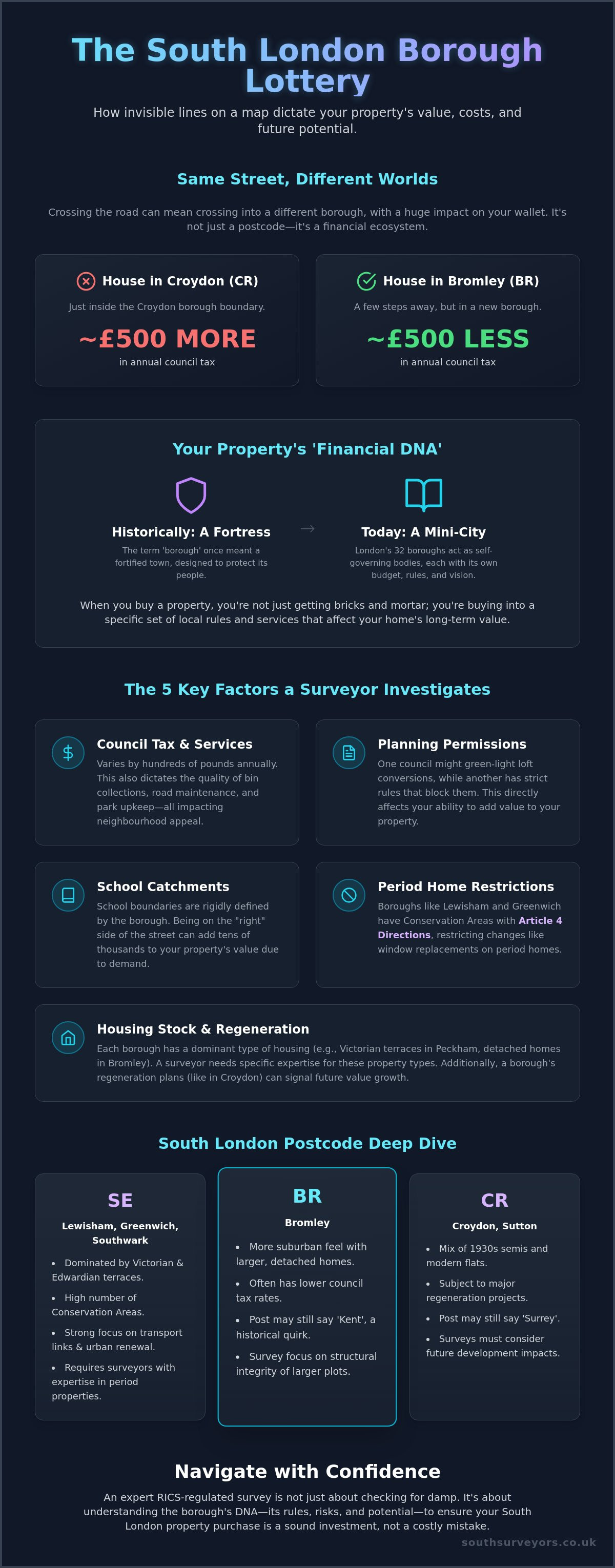
Imagine your property sits within a fortress. Historically, that’s exactly what a borough was: a “fortified place” designed to protect its inhabitants. Fast forward to today, and while the stone walls are gone, the administrative boundaries remain. In the capital, these London boroughs act as 32 individual mini-cities, each with its own personality, budget, and set of rules. Whether you’re eyeing a Victorian terrace in Peckham or a detached family home in Bromley, you aren’t just buying bricks and mortar; you’re buying into a specific local government ecosystem.
These councils handle the essentials that keep your daily life ticking along, from bin collections and road maintenance to the quality of local schools. Because each borough manages its own finances, the efficiency of these services can vary wildly. This local governance is a key factor in determining property survey costs in South London, as different areas present unique structural risks and regulatory hurdles that a surveyor must navigate to give you a clear picture of your investment.
To better understand how professional assessments fit into your property budget, watch this helpful video:
Borough vs. County: The South London Postcode Quirk
If you’ve ever felt a bit of an identity crisis looking at your post, you aren’t alone. Many residents in the BR and CR postcodes still see ‘Kent’ or ‘Surrey’ on their envelopes, yet they pay their council tax to Bromley or Croydon. This is because the modern borough system largely replaced older county structures during the creation of Greater London. While the Greater London Authority (GLA) acts as a high-level umbrella, the 32 boroughs hold the real power over your street. Understanding this distinction is vital when assessing property survey costs in South London, as “county” charm often hides borough-specific planning restrictions that only a local expert will spot.
Why Your Borough is Your Property’s ‘Financial DNA’
Think of your borough as the genetic code of your investment. It dictates everything from the frequency of your recycling collection to the likelihood of a multi-million pound regeneration project landing on your doorstep. In 2026, a borough is defined as the primary regulator of your property’s immediate environment. It serves as the gatekeeper for local bylaws and development. When you move to a new area like Lewisham or Sutton, you’re signing up for a specific set of rules. These bylaws can affect your property’s value just as much as a new kitchen can. It’s more than a name; it is a set of local standards that you are buying into for the long haul.
The Borough Lottery: How Council Choices Affect Property Survey Costs in South London
Entering the “Borough Lottery” is an unavoidable part of every South London house hunt. You might find two identical Victorian terraces on the same road, but because one falls under Bromley and the other under Greenwich, your annual outgoings could differ by hundreds of pounds. It isn’t just about how often the bins are emptied. Council choices ripple through every aspect of your home’s value, from the prestige of the local school catchment to the meticulous upkeep of landmarks like Crystal Palace or Greenwich Park. These factors create a financial ecosystem that unique to your specific street.
A borough’s vision for the future can also skyrocket your home’s value. Look at Croydon, where the council’s ambitious Master Plan has transformed the skyline and attracted massive regeneration investment. When a borough commits to multi-million pound upgrades, property demand follows. However, these benefits often come with local complexities that a surveyor must investigate. This is why property survey costs in South London are best viewed as an investment in local knowledge rather than just another line item in your moving budget.
Council Tax and the ‘Boundary Effect’
Postcode envy is a real phenomenon in the capital. In SE postcodes, buyers often obsess over which side of a boundary line they land on. While one council might freeze rates to attract families, another might hike them to fund local infrastructure. This “Boundary Effect” creates psychological price ceilings for certain roads. Checking your council tax band is just as vital as checking the roof or the foundations before you fall in love with a property. It’s a recurring cost that stays with you long after the moving van has left, and it directly impacts the long-term affordability of your home.
Planning Permissions: The Borough’s Hidden Veto
Your borough acts as the ultimate gatekeeper for your home’s future potential. A loft conversion might be a straightforward “yes” in one area, but a bureaucratic battle in another. Boroughs like Lewisham or Southwark often protect period charm more aggressively, especially in Conservation Areas like Dulwich or Blackheath. If you are planning to extend or renovate, you need to understand the local rulebook before you exchange contracts. We’ve broken this down further in our ultimate guide to building surveys to help you navigate these local hurdles.
Understanding these quirks is essential for any buyer. If you want to ensure your chosen borough doesn’t hold any expensive surprises, you can get a bespoke quote from our local experts who live and breathe these boundary lines every day.
South London Postcode Deep Dive: Navigating SE, BR, and CR Neighbourhoods
Postcodes in this part of the capital are more than just a way to help the postie find your door. They act as a shorthand for the era your home was built and the specific structural quirks you’re likely to encounter. From the iconic Victorian terraces of the SE postcodes, stretching from the creative energy of Peckham to the leafy, disciplined streets of Dulwich, to the expansive 1930s suburban heartlands of the DA and SM postcodes in Dartford and Sutton, each area requires a different lens. Understanding these local nuances is the key to managing property survey costs in South London, as the complexity of the building often dictates the depth of the inspection required.
While a 1930s semi in Sutton might be a sturdy “what you see is what you get” purchase, a converted flat in a SE15 Victorian villa could hide a century of DIY “fixes” and shared structural responsibilities. These suburban gems in DA and SM are fantastic for families, but they still require a surveyor’s keen eye to spot common era-specific issues like wall tie failure or aging roof felt. Knowing your postcode’s architectural history is your first line of defence against unexpected repair bills.
Bromley (BR): The Leafy Giant
Bromley remains a perennial family favourite, offering a blend of Victorian grandeur and reliable 1930s semi-detached homes. It’s an area where the borough meets the “Garden of England,” but that proximity to nature brings its own challenges. Properties near the North Downs or the Green Belt boundaries often sit on heavy clay soil, which can lead to seasonal movement. Our Level 2 surveys frequently uncover minor settlement or drainage issues that, if caught early, won’t break the bank. Local knowledge is vital here, as a surveyor who understands the BR postcode will know exactly which streets are prone to these geological shifts.
Croydon (CR): The Regeneration Hub
Croydon is currently undergoing one of the most significant architectural shifts in the UK. The CR postcode offers a unique mix of brutalist heritage, Victorian villas, and gleaming modern high-rises. This fast-moving market makes a professional RICS valuation an essential tool for any buyer. It ensures you aren’t overpaying in a neighbourhood where prices can fluctuate block by block. You might also encounter the classic CR postcode quirk: living firmly within the London Borough of Croydon while your postal address insists you’re in Surrey. It’s a harmless bit of identity confusion, but it highlights why you need a surveyor who knows where the borough’s legal boundaries actually lie.
Navigating these postcodes can feel like a full-time job. If you want to ensure your investment is sound, why not chat with our team? We live and work in these exact neighbourhoods, so we know exactly what to look for beneath the surface.
Planning Permissions and Period Homes: Why Borough Boundaries Matter for Your Survey
Every London borough operates under its own “Local Plan,” a hefty document that serves as the ultimate rulebook for what can and cannot be built. If you have dreams of a glass-walled rear extension or a sleek loft dormer, these boundaries are more than just lines on a map. They are the difference between a “yes” and a “cease and desist” order. South London’s period homes are particularly susceptible to these variations. While one council might encourage modern additions to Victorian terraces, another might treat a single uPVC window like a crime against heritage. This is why property survey costs in South London are a vital investment; you aren’t just paying for a structural check, but for a professional who understands the specific red tape of your chosen street.
One of the most significant hurdles for buyers in Dulwich or Blackheath is the Article 4 Direction. This is a legal tool boroughs use to strip away your “permitted development” rights. Usually, homeowners can make minor changes without full planning permission, but in these protected pockets, the council wants a say in everything from the colour of your front door to the material of your driveway. A RICS surveyor acts as a property detective here. They compare the physical state of the house with the borough’s planning records to ensure previous owners haven’t played fast and loose with the rules. Inheriting an unauthorised alteration can be a legal nightmare that costs thousands to rectify later.
Conservation Areas in South East London
Living in a protected zone like Greenwich or the Sydenham Ridge comes with a certain prestige, but it also demands a “Borough-approved” aesthetic. In these areas, maintaining your home often costs more. You might be required to install bespoke timber sash windows instead of affordable uPVC alternatives to satisfy the council’s conservation officers. A surveyor’s role includes checking for unauthorised alterations that the borough might penalise you for later, ensuring your dream home doesn’t come with a hidden “correction” bill. This level of detail is why property survey costs in South London vary depending on the historical significance of the neighbourhood.
The ‘Loft Conversion’ Trap
The “Loft Conversion Trap” is a classic South London pitfall. You might see dormers all over your friend’s street in Lewisham, only to find that your new borough in Bromley strictly only allows Velux-style roof lights. Before you exchange, it is worth checking the property’s planning history through the borough’s online portal. More importantly, you need a full RICS Level 3 building survey to ensure a conversion is actually structural. Many “lifestyle” rooms in the roof lack the proper floor joists or fire safety measures required by building regulations, even if they look the part.
Don’t let planning pitfalls turn your period gem into a money pit. If you’re ready to get the facts on your potential new home, book your RICS-regulated survey today and move with total confidence.
Expert Surveys for Every Borough: Making Your South London Move Stress-Free
South London is a complex patchwork of architectural eras and local council quirks. A “one-size-fits-all” approach to surveying simply doesn’t work when you’re moving between the brutalist high-rises of Croydon and the sprawling Victorian villas of Bromley. At South Surveyors, we act as your RICS-regulated experts, covering everything from the bustling heart of SE1 to the leafy edges of the BR postcode. We pride ourselves on being the “knowledgeable friend” you need during a move. We don’t just hand over a dry, technical document; we translate complex borough-specific jargon into plain, actionable English so you can make an empowered decision about your future home.
It is easy to get caught up in the immediate expenses of moving, but property survey costs in South London are a drop in the ocean compared to the price of a missed structural defect. Discovering a hidden “money pit” after you’ve exchanged contracts can derail your finances for years. By investing in a local expert who understands the specific risks of your chosen borough, you’re buying more than just a report. You’re buying the confidence that your investment is secure and that there are no nasty surprises waiting behind those freshly painted walls.
Which Survey is Right for Your Borough?
Choosing the right level of inspection depends heavily on the age and style of the property you’ve fallen in love with. Here is how we typically match our services to South London’s diverse housing stock:
- RICS (level 2) Condition Report: Best suited for modern flats and standard construction houses found in newer developments across Croydon or Sutton.
- RICS (level 3) Building Survey: Essential for the older, larger, or significantly altered Victorian and Edwardian homes common in Dulwich, Bromley, and Herne Hill.
- RICS Property Valuation: A bespoke service often required for shared ownership, Help to Buy, or probate needs across all SE postcodes.
Ready to Secure Your Piece of the Borough?
Getting a quote that reflects your specific property type and local borough quirks is the first step toward a stress-free move. Our team knows the “planning moods” of different councils and the geological risks of specific South London streets. This hyperlocal expertise allows us to spot issues that a non-local firm might miss. Because we are regulated by RICS, you have the ultimate peace of mind that your assessment meets the highest professional standards in the industry. Whether you’re buying a first-time flat or a forever family home, we’re here to ensure your piece of the borough is exactly what it seems. Get in touch with us today for a clear, jargon-free quote tailored to your new neighbourhood.
Move Forward with Borough Confidence
You’ve seen how the “Borough Lottery” affects everything from your monthly council tax to your ability to build a loft conversion. Whether you’re navigating the Victorian gems of Dulwich or the 1930s heartlands of Bromley, understanding these local nuances is what keeps your investment safe. Balancing your moving budget means viewing property survey costs in South London as an essential tool for risk mitigation rather than just another fee. It’s about buying with your eyes wide open and your future protected.
At South Surveyors, we provide the clarity you need to navigate these invisible lines. We are RICS Regulated and Insured, offering expert local knowledge across the SE, BR, CR, DA, and SM postcodes. Our professional, reassuring, and jargon-free reports are designed to empower you. Don’t let a boundary line become a financial burden. Get a bespoke RICS survey quote for your South London property today and take the next step toward your new home with total peace of mind. You’ve got this.
Your Borough and Property Questions Answered
What is the difference between a London borough and a postcode?
A borough is an administrative and political boundary that determines which council you pay tax to and who provides your local services. A postcode is simply a routing system used by Royal Mail. They don’t always match up perfectly. You might live in a house with a CR postcode but find yourself paying council tax to the London Borough of Bromley because the administrative lines don’t follow the mail routes.
Does it matter which borough I live in for property value?
It matters immensely because the borough dictates the quality of local schools, park maintenance, and the scale of future regeneration projects. A property in the London Borough of Greenwich often carries a different price premium than a similar home in Lewisham. Buyers are frequently willing to pay more to land on the “right” side of a boundary line for better council services or lower tax rates.
How do I find out which London borough a property is in?
The quickest way is to use the “Find your local council” tool on the GOV.UK website by entering the postcode. You can also verify the council through the Valuation Office Agency (VOA) when checking the council tax band. Identifying the borough early is a smart move, as local planning quirks and housing stock types are key factors that influence property survey costs in South London.
Why do council tax rates vary so much between South London boroughs?
Each council has its own unique budget, level of government funding, and local service requirements. Some boroughs have higher costs because they manage more social services or infrastructure projects, while others benefit from higher business rate income. This variation is why two identical houses on the same road can have a council tax difference of hundreds of pounds if they sit in different boroughs.
Can a borough refuse planning permission for a loft conversion?
Yes, a borough can refuse permission if your proposal contradicts their Local Plan or conservation guidelines. While many conversions are allowed under Permitted Development, boroughs with Article 4 Directions have the power to strip these rights away. This is why we always check for unauthorised loft work during a survey, ensuring you aren’t inheriting a legal battle with the local council planners.
What are the 32 boroughs of London?
London consists of 32 boroughs plus the City of London. In our local area, this includes Southwark, Lewisham, Greenwich, Bexley, Bromley, Croydon, Sutton, Merton, Kingston, Richmond, Wandsworth, and Lambeth. Each of these authorities has its own specific building regulations and architectural history, which is why property survey costs in South London are tailored to the specific risks found in each individual council’s housing stock.
Is a RICS survey different depending on the borough?
The professional standards set by RICS are consistent, but the surveyor’s focus changes based on the borough’s geography and history. A survey in Bromley might pay closer attention to clay soil subsidence, while one in Southwark might focus on the structural integrity of Victorian conversions. Your surveyor uses their local knowledge to look for the specific red flags common to that particular corner of the capital.
How often do borough boundaries change in London?
Borough boundaries are very stable and have remained largely unchanged since the current system was created in 1965. Minor adjustments occasionally happen to align with new housing developments or ward changes, but these are rare and usually quite small. You can buy a home with the confidence that the council you pay tax to today will almost certainly be the same one you deal with for decades.