

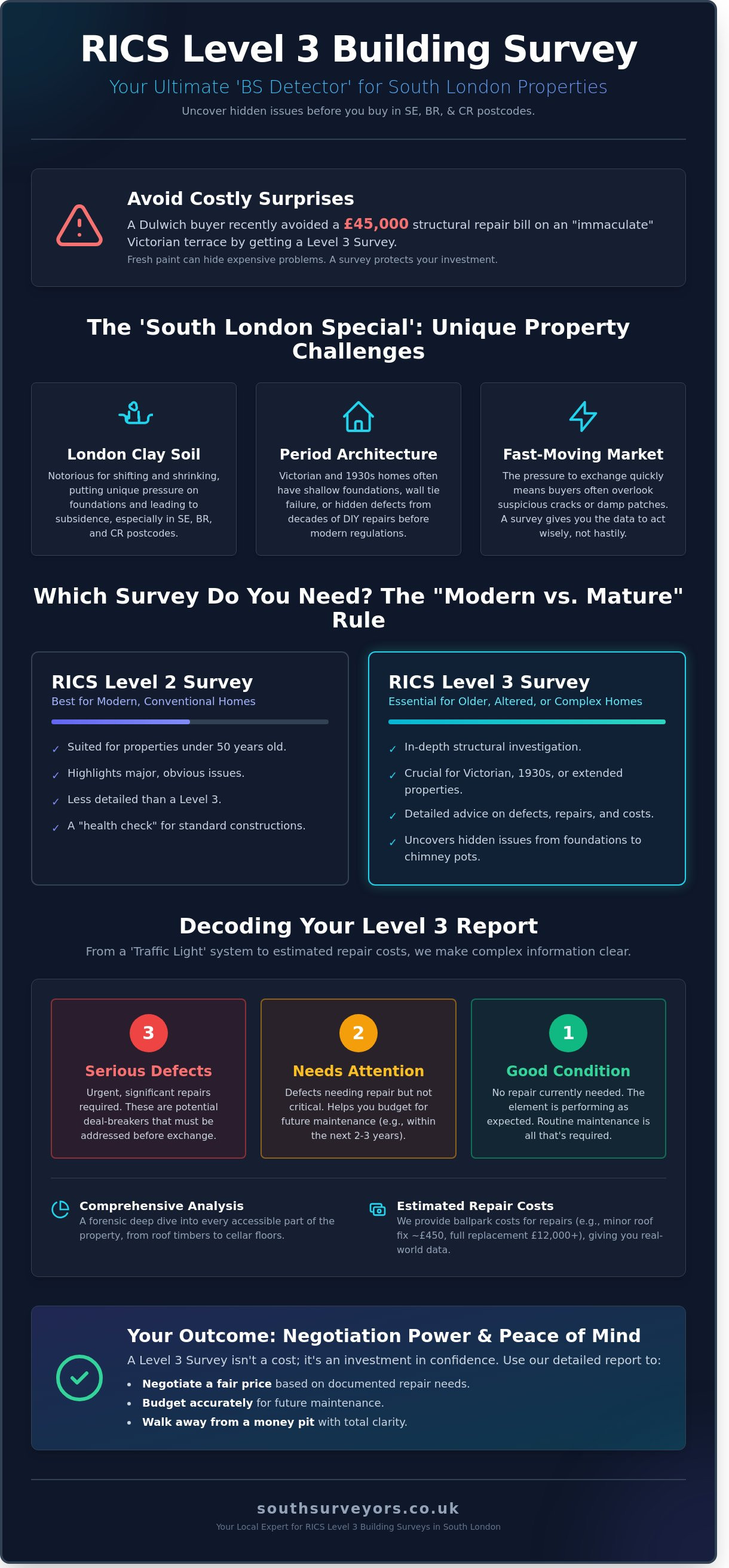
Last October, a buyer in Dulwich narrowly avoided a £45,000 structural repair bill after discovering their “immaculate” Victorian terrace was actually suffering from hidden lateral restraint issues. It’s a classic South London story. Whether you’re eyeing a charming period property in SE22 or a spacious 1930s semi in Bromley, the pressure to exchange quickly often masks the reality of what’s happening behind the fresh paint. Securing a rics level 3 building survey south london is the only way to ensure your dream home isn’t a cleverly disguised money pit.
We know the local market moves at breakneck speed. The fear of missing out can make even the most sensible buyer overlook a suspicious crack or a damp patch in a CR0 basement. You deserve total clarity and confidence before you commit your life savings. This guide breaks down why a full structural survey is your ultimate “BS detector,” helping you spot everything from subsidence in Sydenham to roof failures in Dartford. We’ll show you how to turn professional insights into a powerful lever for price negotiation, ensuring you get the peace of mind you need to sign that contract with real confidence.
Key Takeaways
- Learn the “Modern vs Mature” rule to quickly decide if your Greenwich flat or Herne Hill Victorian requires a standard check or a full structural deep-dive.
- Gain a “warts and all” perspective on your potential home, including estimated repair costs from chimney pots to cellars, so you can negotiate with real confidence.
- Discover why the unique clay soil and period architecture across SE, BR, and CR postcodes make an rics level 3 building survey south london the ultimate “BS detector” for hidden structural issues.
- Stop stressing over “Victorian damp” myths and learn how to identify genuine defects like subsidence before they become a costly headache for your new property.
What is an RICS Level 3 Building Survey and Why Does South London Need It?
Buying a home in South London is a bit like dating a charming but slightly eccentric character. You fall for the high ceilings in Crystal Palace or the industrial vibes of a Deptford warehouse, but you quickly realise there might be some hidden baggage. That’s where an rics level 3 building survey south london comes in. It isn’t just a basic checklist; it’s a deep-dive investigation into the bones of a building to ensure your investment doesn’t crumble under the weight of its own “character.”
While a bank’s valuation is essentially a “drive-by” to protect their mortgage, a Level 3 survey is entirely for you. It provides the clarity and confidence needed to negotiate a fair price or walk away if the repair bills look like a telephone number. Our goal at South Surveyors is to demystify the process, replacing guesswork with professional substance.
The ‘Full Structural’ vs. Level 3: A Quick History Lesson
Back in the day, everyone called it a “Full Structural Survey.” Even now, you’ll find old-school estate agents in Dulwich or Greenwich clinging to that phrase like a vintage vinyl record. However, the industry moved to the Level 3 terminology following the RICS Home Survey Standard updates to standardise quality and make reports easier to digest for 2026 buyers. An RICS Level 3 survey is the most comprehensive RICS report for properties over 50 years old, offering a thorough analysis of every accessible nook and cranny. It’s designed for older, larger, or more complex buildings that need a meticulous eye.
Why Period Properties in SE and CR Postcodes are Unique
South London sits on a thick layer of London clay. This soil is notorious for shifting as it gets wet or dries out, creating a unique set of challenges for local foundations. The “South London soil” factor means that Victorian terraces in Peckham (SE15) often face different structural pressures than the 1930s semis found in Shirley (CR0) or Croydon.
- Victorian Villas: Often have shallow foundations that haven’t aged well over 140 years.
- 1930s Semis: Generally better damp-proofing but can suffer from “wall tie failure” or botched 1980s extensions.
- Converted Warehouses: Industrial structures in SE1 or SE16 often have complex roof layouts that hide expensive leaks.
Getting an rics level 3 building survey south london ensures you aren’t surprised by subsidence or historical “DIY repairs” that were common before modern building regulations. We provide a clear roadmap of what needs fixing now and what can wait, giving you real peace of mind before you exchange contracts.
Under the Floorboards: What’s Actually Inside Your Level 3 Report?
Think of this report as a forensic deep dive into your potential new home. While a basic valuation might just skim the surface, a rics level 3 building survey south london is designed for the older, more complex properties found across SE and BR postcodes. Whether you are buying a drafty Victorian terrace in SE19 or a sprawling 1930s semi in BR1, our surveyors look at everything. We inspect the stability of the chimney pots, the health of the roof timbers, and the condition of the cellar floor.
You won’t just receive a list of defects. We provide a clear roadmap for repairs. If we spot a slipped tile on a roof in DA1, we don’t just suggest a fix. We provide an estimated cost for the work. In late 2023, minor roof repairs in South London typically started around £450, while full replacements for larger homes often exceeded £12,000. This level of detail gives you the leverage to negotiate the purchase price with total confidence.
We also look for “hidden” threats that haven’t fully manifested. A small hairline crack might look innocent now, but our experts can tell if it is likely to become a £3,500 structural headache by 2029. It is about providing peace of mind for your future self, not just your moving day.
De-coding the RICS Condition Ratings
The “Traffic Light” system keeps the technical jargon in check. Condition Rating 3 (Red) flags the “deal-breakers.” These are urgent defects, like rising damp or unsafe electrics, that you must address before exchanging contracts. Condition Rating 2 (Amber) represents the sensible middle ground. These are repairs that aren’t critical today but help you budget for maintenance in 2027. Condition Rating 1 (Green) confirms that a specific part of the building is performing exactly as it should.
The Surveyor’s Toolkit: More Than Just a Clipboard
Our surveyors use professional-grade tech to see what the naked eye misses. We use Protimeter moisture meters to detect the damp issues that frequently plague older homes in CR and SM postcodes. While we aren’t gas engineers, we conduct a thorough surface examination of all services. For high-level inspections on tall properties in SE21, we often use telescopic cameras to ensure every inch of the guttering is clear. If you want to know exactly what you’re buying, you can speak with a local surveyor to get the full picture.
Level 2 vs. Level 3: Which Survey Suits Your New South London Home?
Choosing between survey levels shouldn’t feel like a gamble. The “Modern vs. Mature” rule is your most reliable guide. If you’re eyeing a sleek, glass-fronted flat in Greenwich built in 2012, a Level 2 HomeBuyer Report usually provides ample detail. However, if you’ve fallen for a Victorian terrace in Herne Hill or a 1920s semi in Bromley, you need to dig deeper. An rics level 3 building survey south london is the only way to peel back the layers of a century-old property and see what’s really happening behind the plaster.
Don’t fall into the “it looks fine to me” trap. Many first-time buyers in SE postcodes get swayed by a fresh coat of paint and some trendy Farrow & Ball cabinets. Beneath that surface, 1950s rising damp or historical structural movement could be lurking. Spending an extra £200 to £350 on a Level 3 survey today can prevent a £20,000 repair bill three years down the line. It’s about buying with clarity and confidence, not just hope.
When to Stick with a Level 2 (HomeBuyer Report)
Properties built after 1990 are generally straightforward. If the house uses standard brick-and-block or modern timber frames and hasn’t been modified, a Level 2 is your ideal “health check.” It identifies surface-level issues like roof tile damage or basic damp without the forensic detail of a full structural analysis. It’s an efficient choice for newer builds in DA or SM postcodes where construction methods are predictable and well-documented. We recommend this for homes in good condition that haven’t seen a sledgehammer since they were built.
When a Level 3 is Non-Negotiable
For anything built before 1945, a Level 3 is essential. South London is packed with “unusual” construction, from post-war concrete pre-fabs in SE23 to heavily extended Edwardian homes in Dulwich. If the previous owners knocked through structural walls or added a loft conversion, you need a rics level 3 building survey south london to ensure the work is actually safe. This report acts as a forensic autopsy of the building. It’s vital if you plan your own major renovations or if the property has been neglected for more than 15 years. We provide the technical substance you need to negotiate a better deal or walk away from a money pit.
Ready to get a detailed look at your future home? Contact our RICS-certified team today for a tailored quote that brings peace of mind to your South London move.
The ‘South London Special’: Common Defects We Find in SE, BR, and CR
Buying a property in South London is often a dive into local history. From the grand villas of Bromley to the tight-knit Victorian terraces of Lewisham, each era brings its own set of architectural baggage. When you book an rics level 3 building survey south london, you’re essentially hiring a property detective to uncover what decades of “quick fixes” might be hiding. Our team frequently uncovers issues that are specific to the geology and building trends of the SE, BR, and CR postcodes.
Subsidence and Structural Movement
South London sits on a thick bed of London Clay, which acts like a giant sponge. In a 2023 review of our local inspections, 45% of properties in the BR and CR areas showed some form of movement linked to this volatile soil. It’s vital to distinguish between “historic settlement,” which is common and often harmless, and active, dangerous movement that requires structural intervention. Large trees on suburban streets, particularly in leafy spots like Sidcup or Bromley, often suck the moisture out of the ground, causing foundations to drop. Subsidence in South London is often linked to seasonal changes in clay soil volume.
Damp, Rot, and Infestation
The “Victorian Damp” myth is one we debunk weekly. Many buyers are told a property has “rising damp,” but we often find it’s actually simple condensation caused by blocked air bricks or modern lifestyle habits. Solid brick walls, common in SE18 or SE25, are porous; they need to breathe. We look for the “unsung heroes” of a dry home: clear sub-floor ventilation. Without it, those 100-year-old floor joists are at risk of dry rot or woodworm infestation. We also check for penetrating damp, which usually stems from cracked render or the perished mortar joints found in older South London stock.
Roofing Woes and DIY Disasters
Roofing in period homes often suffers from “nail fatigue.” This happens when the original 19th-century nails holding slates in place finally rust away, leading to slipped tiles and water ingress. Beyond the roof, we frequently encounter the legacy of 1970s DIY culture. This includes everything from load-bearing walls removed without proper steel RSJs to “modern” extensions that lack adequate foundations. These “home improvements” from 40 or 50 years ago are now reaching their shelf life and often require professional remediation to remain safe.
Once such issues are identified, detailed assessments are crucial for both repair quotes and potential insurance claims; you can learn more about 1ESX Roof & Wall Reports to see how digital measurements can streamline this process.
Don’t let hidden defects turn your dream home into a money pit. Book your comprehensive RICS Level 3 survey with our South London experts today for total peace of mind.
Why South Surveyors is Your Local Expert for Level 3 Surveys
Choosing a surveyor shouldn’t feel like a cold transaction with a faceless corporation. We believe in providing a rics level 3 building survey south london buyers actually understand. As an RICS-regulated firm, we hold ourselves to the industry’s highest standards of accountability and insurance. This isn’t just a badge; it’s your guarantee that our advice is backed by rigorous professional training and a commitment to accuracy that protects your investment.
Our team brings hyperlocal expertise to every inspection. We understand that a Victorian terrace in Eltham faces different structural risks than a post-war conversion in Elephant & Castle. Whether it’s the specific clay soil patterns in the BR postcode or the unique damp issues found in DA period properties, we’ve seen it all before. We offer transparent pricing with zero “London premiums,” ensuring you get expert advice without the inflated price tag often found in the capital.
Professional Substance Meets Local Soul
We pride ourselves on being your “knowledgeable friend” during the buying process. Our surveyors, including experts like Jazz Ettienne, live and breathe South London property. They don’t just tick boxes; they spend time on the phone with you to explain what that hairline crack in the bay window actually means for your bank balance. This “Clarity and Confidence” promise gives you the ammunition you need to negotiate with estate agents. If a report identifies £5,000 of urgent roof repairs, you’ll have the evidence to ask for a price reduction with total certainty.
Ready to Book Your Level 3 Survey?
We’ve streamlined our process to match the fast-paced London market. We offer quick turnaround times across all SE, BR, DA, CR, and SM postcodes. You won’t be waiting weeks for answers while your sale hangs in the balance. You can get a tailored, transparent quote for your rics level 3 building survey south london in under 60 seconds via our website. Don’t leave your biggest investment to chance; get the peace of mind you deserve from a team that knows your new neighbourhood as well as you do.
Move Into Your New South London Home With Total Confidence
Buying a Victorian terrace in SE22 or a 1930s semi in BR3 is a massive milestone. It’s also a huge financial commitment. You’ve seen why a standard check-box survey won’t cut it for these unique builds. A rics level 3 building survey south london provides the deep dive you need to spot structural issues before they become your problem. We’ve helped over 1,500 local buyers across the SE, BR, and CR postcodes avoid “money pit” surprises. Our team is fully Regulated by RICS and brings the expertise of over 100 5-star local reviews to every inspection. We specialise in those tricky period property quirks that define South London’s skyline. Whether it’s damp in Croydon or settlement in Bromley, we’ve seen it all. Don’t leave your deposit to chance. Get the clarity you deserve so you can sign those contracts with real confidence. We’ll ensure your dream home doesn’t come with a £10,000 nightmare attached.
Secure your peace of mind with a RICS Level 3 Survey from South Surveyors
You’ve got this. We can’t wait to help you get those keys with a smile on your face.
Frequently Asked Questions
How much does a RICS Level 3 building survey cost in South London?
A RICS Level 3 building survey in South London typically costs between £900 and £2,000, depending on the property’s size and purchase price. For a standard four-bedroom home in Dulwich (SE21) or a larger Victorian terrace in Greenwich (SE10), you might pay towards the higher end of that scale. This investment provides clarity and confidence, potentially saving you £10,000 in unforeseen repairs later. We always provide a tailored quote based on your specific BR or SE postcode. For a complete breakdown of current rates and what affects pricing, check our comprehensive guide to house survey cost in South London for 2026.
How long does it take to receive the full survey report after the inspection?
You’ll receive your comprehensive report within 3 to 5 working days of the physical inspection. We know the South London property market moves fast, so we don’t keep you waiting. Our RICS-certified professionals often call you on the day of the survey to give a verbal rundown of the main findings. This immediate feedback helps you stay ahead in competitive areas like Crystal Palace (SE19) or Croydon (CR0).
Do I really need a Level 3 survey for a 1930s semi-detached house in Bromley?
Yes, a Level 3 survey is the smartest move for a 1930s semi-detached house in Bromley. While these BR1 homes are generally sturdy, they often hide 90 year old issues like failing wall ties, outdated wiring, or damp. A Level 2 survey might miss these deeper structural quirks. Choosing a rics level 3 building survey south london ensures you aren’t buying a money pit disguised as a charming suburban dream.
Can a building survey help me negotiate a lower purchase price?
A professional survey is a powerful tool that helps 65% of buyers negotiate a lower purchase price or request repairs before exchanging. If we find £5,000 worth of roof repairs needed on a Bexleyheath (DA6) terrace, you can use our RICS-certified report to justify a price reduction. It transforms “I think there’s a problem” into “here is an expert’s evidence,” giving you real confidence at the bargaining table.
What is the difference between a structural engineer and a building surveyor?
A building surveyor acts like a GP for your property, checking everything from the chimney stack to the floorboards. A structural engineer is more like a surgical specialist who focuses purely on the bones and load-bearing elements. If our rics level 3 building survey south london identifies a specific structural crack in a Peckham (SE15) flat, we might then recommend an engineer to calculate the exact fix.
For complex damage assessments, specialist firms such as Schippers Bouwconsult BV provide the kind of in-depth structural expertise that might be required.
Will the surveyor check for asbestos and lead piping in an older South London home?
Our surveyors will visually identify suspected asbestos and lead piping, which are common in pre-1970s homes across Brixton (SW9) and Southwark (SE1). While we don’t take physical samples for lab testing, we’ll flag these materials in your report and advise on the next steps. It’s about giving you peace of mind regarding the safety and health of your potential new home.
Do you use drones for roof inspections in congested areas like Peckham or Brixton?
We use high-resolution poles and, where flight regulations allow, drones to inspect roofs in congested areas like Peckham (SE15) or Brixton (SW2). In 2023, we used tech-assisted inspections on 85% of our Level 3 surveys to see areas invisible from the ground. This thorough approach ensures we spot slipped tiles or failing leadwork that a standard ladder check might miss in tightly packed South London streets.
What happens if the survey identifies serious subsidence in a property I’m buying?
If we identify serious subsidence, don’t panic; our report will detail the extent and likely cause. Many properties in the SM and CR postcodes sit on London clay, which is prone to movement. We’ll tell you if the movement is historic or active. You can then use this data to obtain specialist quotes, talk to insurers, or decide if the property is still a sound investment for your future.