

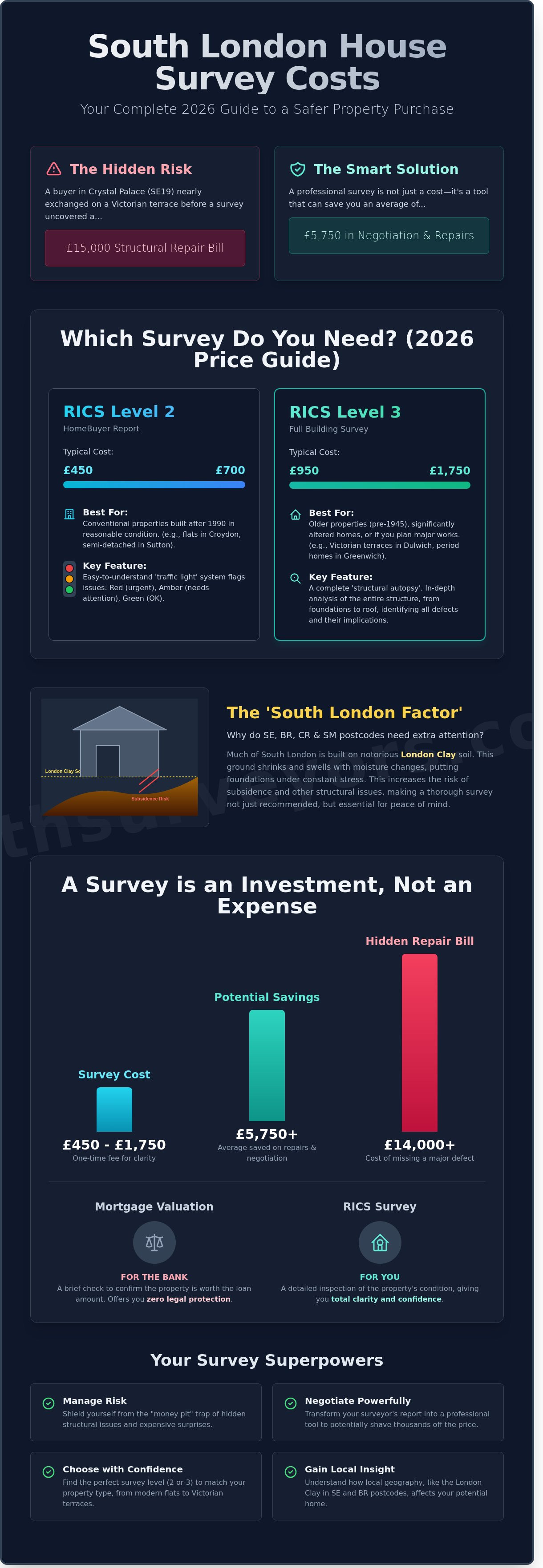
Last Tuesday, a buyer named Sarah in Crystal Palace (SE19) was hours away from exchanging on a Victorian terrace before her RICS-Certified report flagged a £15,000 structural repair. It’s a terrifying thought, especially when you’re already stretching your budget to live in the SE or BR postcodes. You likely feel that a house survey cost is just another “hidden” expense in an already pricey process, or perhaps you’re worried about wasting money if the chain breaks. We get it. Nobody wants to pay more than they have to, but flying blind into South London’s notorious clay soil is a gamble most people can’t afford.
You deserve total clarity and confidence before you sign that contract. This guide breaks down the current rates for 2026 across South London, from the leafy streets of Dulwich to the busy hubs of Croydon (CR) and Sutton (SM). You will discover exactly what you should pay for each RICS level and how a thorough inspection can actually save you an average of £5,750 in future repair bills. We are going to look at price benchmarks for 2026, explain which report fits your specific property, and show you how to use your surveyor’s findings as a powerful tool to negotiate a better deal.
Key Takeaways
- Understand why your **house survey cost** is actually a savvy investment in risk management that shields you from the “money pit” trap of hidden structural issues.
- Navigate the “sweet spot” between RICS Level 2 and Level 3 surveys to find the perfect level of protection for your Victorian terrace or modern South London apartment.
- Learn how local geography, including the dreaded London clay found across SE and BR postcodes, impacts the complexity and pricing of your professional report.
- Discover how to transform your survey from a simple checklist into a professional negotiation tool that can shave thousands off your final purchase price.
- Get the inside track on the specific property details you need to secure a tailored, RICS-certified quote that reflects the reality of the 2026 property market.
House Survey Cost 2026: Understanding the Price of Peace of Mind
Buying a home in the SE, BR, or CR postcodes is likely the biggest financial leap you’ll ever take. In 2026, a house survey cost isn’t just a line item on your solicitor’s completion statement; it’s your insurance policy against the unknown. This fee covers a meticulous physical inspection by a RICS-certified professional and a comprehensive report that translates technical flaws into plain English. It’s about getting under the skin of a property to see what the fresh paint is hiding.
Prices aren’t a flat rate because every property carries its own set of risks. A sleek apartment in Croydon (CR0) presents different structural questions than a sprawling Edwardian home in Dulwich (SE21) or a Victorian terrace in Peckham. You’re paying for expert risk management, not just a person with a clipboard wandering through your potential living room. A professional assessment ensures you don’t inherit a money pit disguised as a dream home.
Why “Cheap” Often Ends Up Being Very Expensive
Cutting corners with non-regulated surveyors is a gamble where the house usually wins. If a cut-price inspector misses a major defect in a Bromley (BR1) semi-detached, such as active subsidence or a failing timber frame, the repair bill can easily exceed £14,000. That is roughly ten times the fee of a thorough professional assessment. In 2026, a basic RICS Level 1 survey for a standard property in South London starts at approximately £450.
Survey vs. Valuation: The Costly Misconception
Don’t confuse a mortgage valuation with a survey. The lender’s valuation is a brief check to ensure the property is worth the loan amount; it’s for the bank’s benefit, not yours. If the roof collapses three months after you move into your new place in Dartford (DA1) or Sutton (SM1), a valuation offers zero legal protection.
Choosing a full RICS-certified survey provides the clarity and confidence you need during an inherently stressful move. It transforms “we think the house is fine” into “we know exactly what we’re buying.” This professional insight allows you to negotiate the house survey cost back from the sale price if significant issues appear, or simply walk away with your savings intact. It’s the difference between a restless night and total peace of mind.
RICS Level 2 vs. Level 3: Comparing Costs and Protection
Choosing the right report is about matching the depth of the investigation to the age and character of the property. You don’t want to pay for a full structural autopsy on a sleek new-build flat in Bromley (BR1), but you definitely shouldn’t settle for a surface-level glance at a Victorian villa in Dulwich. The house survey cost gap between Level 2 and Level 3 usually sits between £400 and £900 in the current 2026 market. While the upfront price differs, the extra spend on a more detailed report often pays for itself ten times over during price negotiations.
The Level 2 (HomeBuyer Report) Price Guide
If you’re eyeing a 2-bed flat in Croydon (CR0) or a tidy semi-detached house in Sutton (SM1), the Level 2 survey is likely your best friend. For these postcodes, expect a price range of £450 to £700. It uses a clever traffic light system to flag issues: green means all clear, amber indicates future work, and red highlights urgent defects. This is the sweet spot for homes built after 1990 that appear to be in standard condition. It provides a RICS Level 2 Survey that gives you real confidence without the deeper price tag of a full building analysis. It’s the professional choice for modern suburban living where the risks are generally more predictable.
The Level 3 (Full Building Survey) Investment
Period homes in Greenwich (SE10) or those iconic terraces in Dulwich (SE21) require a much deeper dive. These properties have long histories; sometimes that history includes hidden damp or structural movement that a basic check might miss. A Level 3 survey typically costs between £950 and £1,750 in the South London market. You’re paying for a thorough and easy to understand analysis of the entire structure. It covers everything from the roof’s integrity to the state of the foundations. For any property built before 1945, or any home in Dartford (DA1) that’s been significantly altered, an RICS Level 3 Building Survey is the only way to avoid nasty surprises. If you’re unsure which level fits your potential new home, you can get a tailored quote to see what suits your specific postcode and property type.
- Level 2: Best for 1990 to 2026 builds in standard condition.
- Level 3: Essential for pre-1945 homes, timber-framed buildings, or properties with visible cracks.
- The Negotiation Factor: A Level 3 report often uncovers £5,000 to £12,000 in necessary repairs, giving you the evidence needed to request a price reduction.
The ‘South London Factor’: Why Your Postcode and Property Type Affect the Quote
Your quote isn’t just a random number. In South London, the ground beneath your feet dictates the price as much as the roof over your head. The infamous London clay is a primary driver of complexity. This soil type shrinks and swells with the seasons; a fact that led to a 25% increase in subsidence insurance claims across the capital following the record-breaking dry summer of 2022. When you’re buying in SE, BR, or CR postcodes, your surveyor spends extra time looking for the tell-tale diagonal cracks that suggest the clay is shifting. This level of forensic detail is why a house survey cost can fluctuate based on your specific street.
Location matters for more than just the commute. A survey for a Victorian terrace in Peckham (SE15) involves navigating narrow loft hatches and checking for 120 years of “DIY improvements” that a 2018 semi-detached home in Dartford (DA1) simply won’t have. Our RICS-certified team knows that South London homes have distinct personalities. Whether it’s the risk of Japanese Knotweed along the railway embankments of Brockley or the damp issues common in the valley bottoms of Caterham, we provide the clarity and confidence you need before signing that contract.
Victorian Terraces and Edwardian Villas
If you’re falling in love with a period property in Herne Hill or East Dulwich, you’re buying into solid wall construction. These buildings don’t have the cavity gaps found in modern homes, meaning they “breathe” differently. We often find that 19th-century bricks have been smothered in non-breathable modern render, trapping moisture. Because these builds require a more invasive, time-consuming inspection to check for timber rot and structural movement, the house survey cost reflects the expertise required to protect your investment.
Modern Developments and High-Rise Living
The skyline in Croydon (CR0) and the new estates in Morden (SM4) offer a different set of challenges. For high-rise apartments, we focus heavily on cladding safety and leasehold obligations. Even for “move-in ready” new builds, a professional eye is vital. We’ve identified significant “snagging” issues in 15% of new South London developments we’ve inspected, ranging from poorly fitted fire doors to inadequate insulation. Using postcode-specific data, we tailor our approach to ensure you aren’t paying for a “standard” service when your property needs a specialist look.
Ready to get a transparent price for your specific postcode? Contact South Surveyors today for a tailored quote and move forward with real confidence.
Why a Survey is the Only “Expense” That Actually Saves You Money
Most buyers view the house survey cost as just another annoying fee to pay alongside stamp duty and solicitor bills. We get it. Moving in South London is pricey enough without adding more line items to your spreadsheet. However, flipping your perspective from “cost” to “return on investment” changes the entire game. A survey isn’t a hurdle; it’s a financial shield that protects your bank account from the skeletons hiding behind that fresh coat of Farrow & Ball.
Take a recent case we handled for a couple buying a Victorian terrace in Bromley (BR1). The property looked pristine, but our RICS-certified inspection uncovered a significant damp issue hidden by clever staging. Armed with our detailed report, the buyers renegotiated the sale price down by £15,250. They spent less than £1,000 on the survey and walked away with a five-figure saving. That is the kind of math we love.
The Art of the Renegotiation
In competitive markets like Croydon (CR0) or Sutton (SM1), sellers can be stubborn. But they can’t argue with facts. A professional RICS-certified report gives you the confidence to go back to the estate agent with a clear, evidence-based argument. It shifts the conversation from “I think it’s too expensive” to “The evidence shows £8,000 of essential roof work is required.” This “informed decisions” mantra is your best friend; it turns a subjective haggle into a professional transaction that sellers find much harder to ignore.
Avoiding the “Money Pit” Scenario
The real danger in South East London postcodes like SE22 or SE15 isn’t the price you pay today, but the repairs you discover tomorrow. Subsidence can easily cost £25,000 to remediate, while a full roof failure might set you back £12,000. Our “Hidden Savings” framework identifies these risks before you exchange contracts. Peace of mind is the ultimate favourite feature for our clients because it ensures the only surprises on move-in day are where you left the kettle.
The math is simple: for every £1 you spend on a professional house survey cost, you are potentially shielding yourself against £40 in unforeseen structural repairs.
Ready to secure your South London investment with total clarity? Get a transparent, fixed-fee quote from our RICS experts today.
Getting Your South London Survey Quote: Clarity, Confidence, and Next Steps
Finding out your house survey cost shouldn’t feel like you are shouting into a digital void. Most big-name comparison sites spit out a generic number based on a basic algorithm, but your potential home in Dulwich or Bromley deserves more than a one size fits all approach. To get a quote that actually reflects reality, you only need three things: the property postcode, the approximate purchase price, and the year the house was built. This data helps us spot potential issues like Victorian subsidence in SE22 or 1930s wiring in BR3 before we even step through the door.
We believe in tailored quotes because no two South London terraces are identical. Whether you are eyeing a flat in Crystal Palace or a detached house in Orpington, your quote will be bespoke to that specific structure. This ensures you aren’t overpaying for a simple inspection or under-investing in a complex one.
What to Look for in a Surveyor Quote
Always verify that the firm is RICS-regulated. This is the non-negotiable gold standard of the industry. Beyond the badge, look for recent local wins. Did they help a buyer in Penge or Beckenham last month? A surveyor who knows the specific soil types of the South London clay belt provides value that a national firm simply cannot match. Finally, check for transparency. Your quote should be a total figure including VAT. You don’t want a £500 house survey cost to balloon into a £750 bill because of hidden travel fees or admin add-ons.
The South Surveyors Personal Touch
We aren’t corporate robots. We are your knowledgeable friends in the industry. Our lead surveyors, including Jazz Ettienne, make it a point to provide a personal follow-up. In fact, 95% of our clients receive a phone call within 24 hours of the survey to discuss the major findings. We focus exclusively on the SE, BR, DA, CR, and SM postcodes. This local obsession means we know which streets in Croydon have specific drainage quirks and which blocks in Sutton are prone to damp. We provide the clarity and confidence you need to sign those contracts without a hint of hesitation.
Ready to secure your piece of South London? Don’t leave your investment to chance. Contact our team today to get a precise, professional quote and take the final step toward your dream home with total peace of mind.
Secure Your South London Slice of Heaven With Total Clarity
Navigating the 2026 property market shouldn’t feel like a high-stakes gamble. Whether you’re eyeing a charming Victorian terrace in SE22 or a sleek apartment in CR0, knowing your house survey cost upfront is your best defence against nasty surprises. A RICS Level 2 survey often pays for itself tenfold by spotting £5,000 damp issues before you exchange contracts. For those older BR or DA postcode fixer-uppers, a Level 3 report is the gold standard for genuine peace of mind. Our RICS-certified professionals combine serious technical expertise with deep local knowledge across SE, BR, DA, CR, and SM. We’re regulated by RICS, ensuring every report meets the highest industry standards. You’ve put in the hard graft to find the perfect spot; now let’s ensure it’s a solid investment for your future. It’s about buying with your head as well as your heart.
Get a Tailored RICS Survey Quote for Your South London Home
You’re almost at the finish line, so let’s get you moved in with total confidence.
Frequently Asked Questions about South London Survey Costs
How much does a RICS Level 2 survey cost in South London in 2026?
In 2026, a RICS Level 2 survey in South London typically costs between £500 and £950 for most standard residential properties. If you are buying a two-bed flat in Greenwich (SE10), you will likely pay towards the lower end, while a larger terrace in Bromley (BR1) might reach the £900 mark. These figures reflect the 4.5% annual increase in professional service fees we have seen across the SE and BR postcodes over the last two years.
Is a Level 3 survey worth the extra cost for a 1930s semi in Bromley?
A Level 3 survey is absolutely worth the investment for a 1930s semi-detached house in Bromley. These homes often hide specific period issues like failing wall ties, original lead piping, or hidden damp in the cavity walls that a standard Level 2 report might overlook. Spending an extra £350 now provides the clarity and confidence you need, potentially saving you from a £12,000 structural repair bill after you have moved into your new BR2 home.
Who pays for the house survey, the buyer or the seller?
The buyer is responsible for covering the house survey cost as part of their essential due diligence before exchanging contracts. It is your personal protection tool, so the RICS-certified expert works solely in your interest rather than the seller’s. In 97% of UK property transactions, the buyer instructs their own surveyor to ensure they aren’t inheriting expensive defects that weren’t visible during the initial viewing.
Can I use my mortgage valuation instead of paying for a survey?
You shouldn’t rely on a mortgage valuation because it is a brief assessment designed to protect the bank’s financial interest, not your personal investment. These valuations often take less than 20 minutes and won’t mention urgent issues like dry rot in the loft or subsidence in a Croydon (CR0) extension. A professional survey is a comprehensive health check that gives you the full picture, whereas a valuation might not even involve the surveyor entering the property.
How long does it take to get the survey report back after the inspection?
You can usually expect to receive your digital survey report within 3 to 5 working days of the physical inspection. At South Surveyors, we know the South East London market moves at a blistering pace, so we often provide a verbal summary on the same day as the visit. This quick turnaround helps you keep your move to Dartford (DA1) or Sutton (SM1) on track without unnecessary delays from the legal team.
What happens if the survey finds thousands of pounds worth of repairs?
Do survey costs vary significantly between different South London postcodes?
The house survey cost remains fairly consistent across the SE, BR, and DA postcodes because fees are based on the property’s value and size rather than the specific street. A £650,000 Victorian conversion in Dulwich will likely command the same fee as a similarly priced modern home in Sidcup. The primary price drivers are the age of the building and the complexity of its construction, not whether the postcode starts with CR or SM.
Can a house survey help me negotiate the asking price down?
A professional survey is your most powerful tool for price negotiation, often resulting in a price drop that is four times the cost of the survey itself. If we discover £4,000 of remedial electrical work needed in a Lewisham terrace, that provides a factual, RICS-backed basis for your “money off” conversation. It moves the discussion away from guesswork and gives the estate agent a clear justification to recommend a lower offer to the seller.