

Last Tuesday, a buyer in Bromley watched their dream home purchase in the BR1 postcode stall because a lender spotted a single heart-shaped leaf in a garden photo. It’s a stressful scenario that often leads to immediate panic about the Japanese knotweed survey cost London residents might face. You’ve likely felt that same anxiety, worrying if a small patch of green is about to devalue your property or if those high-pressure quotes for chemical treatments are a genuine requirement or just a clever sales tactic.
The good news is that clarity is more affordable than the horror stories suggest. This guide reveals exactly what you should pay for a professional assessment in 2026, ensuring you secure a RICS-approved report that satisfies your bank without overpaying for unnecessary extras. We’ll break down local pricing across the SE and CR postcodes, explain how to choose an independent expert over a salesman, and provide the steps needed to move forward with real confidence. You deserve a report that offers both peace of mind and the professional substance your mortgage lender demands.
Key Takeaways
- Get a clear breakdown of the current Japanese knotweed survey cost London buyers should budget for in 2026, including how property size affects fees in SE and BR postcodes.
- Understand why mortgage lenders demand professional RICS-certified reports over “DIY” evidence to protect your property’s valuation and secure your loan.
- Learn to spot the conflict of interest in “free” specialist quotes and why an independent assessment is vital to avoid paying for unnecessary treatments.
- Discover how to decode RICS risk categories to determine if that “red stem” drama is a minor garden guest or a genuine threat to your home’s structural integrity.
- Gain the clarity and confidence needed to navigate the South London property market with expert advice tailored to the DA, CR, and SM postcode areas.
Counting the Cost: What Does a Japanese Knotweed Survey Really Cost in London?
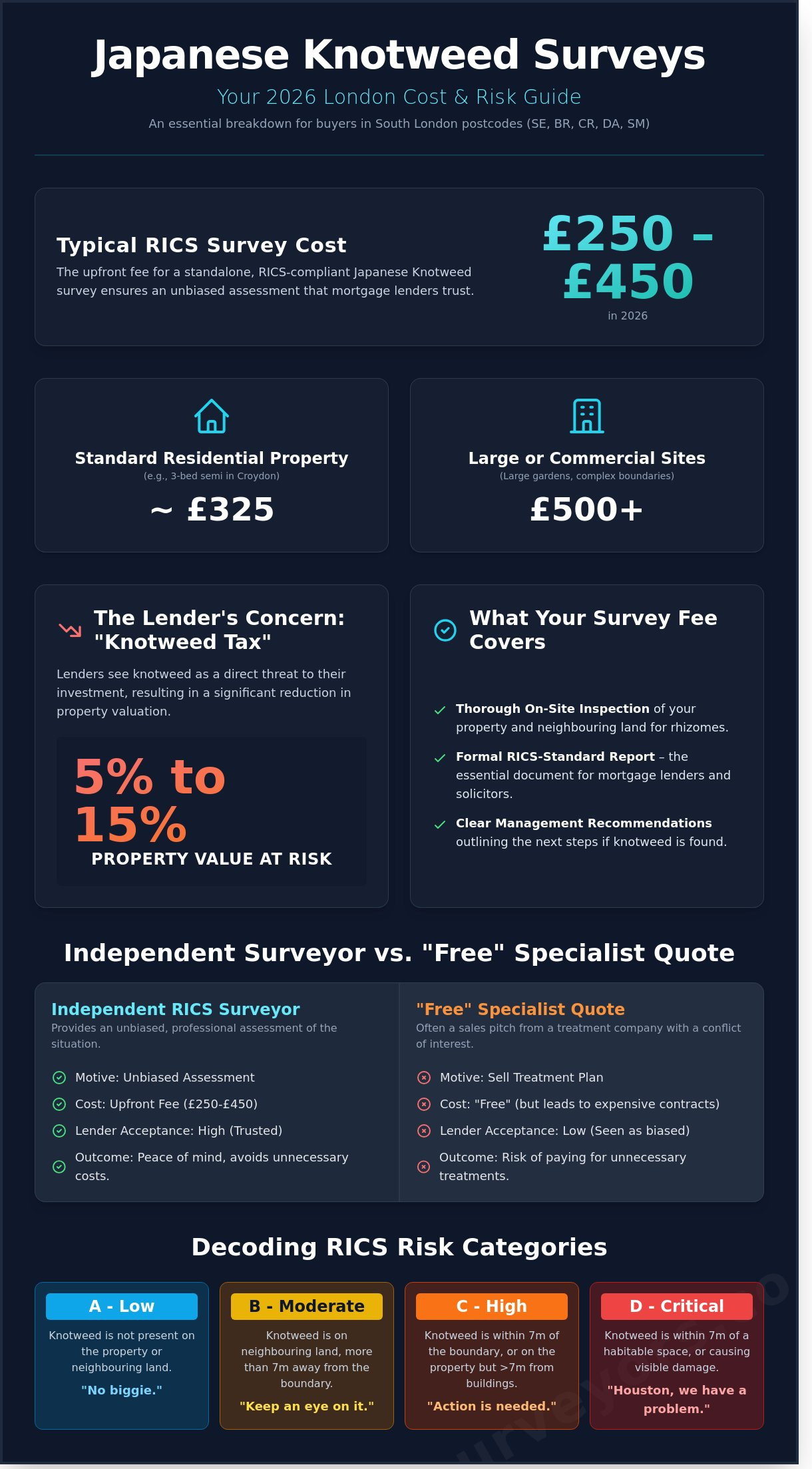
If you’re eyeing a Victorian terrace in Lewisham or a leafy detached home in Bromley, you’ve likely heard the horror stories about invasive plants. Understanding the Japanese knotweed survey cost London homeowners face is the first step toward securing your investment. In 2026, a standalone RICS-compliant survey typically ranges between £250 and £450. This fee ensures you get an unbiased assessment from a professional who isn’t just trying to sell you a decade-long chemical treatment plan. For a comprehensive overview of Japanese knotweed and its biological impact, checking historical data helps explain why lenders are so cautious.
To see why catching this early is vital for your bank balance, watch this helpful video:
Prices in SE and BR postcodes fluctuate based on property size and accessibility. A compact garden in Greenwich might be a quick job, but dense urban areas often present boundary challenges. If your property backs onto railway land or a public park, the surveyor needs more time to inspect the “encroachment risk,” which can nudge the fee toward the higher end of that £450 bracket. Don’t fall for the “Free Survey” offered by some treatment firms. These are often just sales pitches in disguise. A RICS-certified surveyor provides a neutral document that mortgage lenders actually trust. Paying that upfront fee saves you from the potential £15,000 bill of an unnecessary treatment contract that a “free” quote might lead you toward.
Standard Residential vs. Commercial Fees
For a standard 3-bed semi in Croydon or Bromley, expect to pay around £325 for a professional RICS report. Large gardens or commercial sites in the DA or SM postcodes require more legwork, often pushing quotes above £500. We’ve seen cases where complex sites near watercourses in Lewisham demand bespoke pricing due to the environmental risks involved. The Japanese knotweed survey cost London buyers pay is a small price for the clarity and confidence needed to proceed with a sale.
What’s Included in the Price Tag?
A professional survey isn’t just a quick stroll through the garden. It includes a thorough on-site inspection of your property and immediate neighbouring boundaries to check for hidden rhizomes. You receive a formal RICS-standard report, which is the essential document for mortgage lenders and solicitors. If the “green monster” is found, the report provides a clear management recommendation, ensuring you aren’t left guessing about the next steps for your property.
Why Your Mortgage Lender is Obsessed with This ‘Red Stem’ Drama
Lenders aren’t being dramatic when they stall a mortgage application over a few green leaves; they’re protecting their investment. In the high-stakes world of London real estate, the presence of this invasive plant often triggers what’s known as the ‘Knotweed Tax’. This isn’t an official government levy, but a significant reduction in property valuation that can range from 5% to 15% of the total price. For a Victorian terrace in Dulwich (SE21) or a detached home in Bromley (BR1), that percentage represents a staggering amount of equity vanishing into the soil.
Banks view knotweed as a threat to their collateral. Because the plant’s rhizomes can theoretically disrupt drains and light structures, lenders won’t accept a ‘selfie and a guess’ from a seller as evidence of a clear site. They require professional documentation to ensure the legal responsibilities of property owners are being met before they release funds. While the Japanese knotweed survey cost London buyers typically encounter is a modest investment, it serves as the only shield against a declined mortgage offer.
The Mortgage Security Factor
If you’re looking at a property in the CR or SM postcodes, your bank will likely demand a professional management plan if knotweed is identified. This plan must be accompanied by an Insurance Backed Guarantee (IBG), usually lasting 10 years. This guarantee ensures that if the treatment firm goes bust, the remediation continues. Without this, most UK lenders will simply walk away from the deal. A thorough RICS Level 3 Building Survey: A Complete Guide for Home Buyers is the best way to spot these early warning signs before you’re too deep into the legal process.
Knotweed and the London Property Market in 2026
The landscape changed significantly with the updated RICS guidance. In 2026, surveyors and lenders are moving away from the old ‘7-metre rule’ which used to penalise properties even if the plant was in a neighbour’s garden far from the house. In places like Herne Hill or the leafy streets of Sydenham, where gardens are often interconnected, this pragmatic approach is a lifesaver for sales. The RICS 2022 guidance change prioritised the actual impact on the structure and the ease of management over the previous culture of fear and arbitrary distance rules.
For buyers in DA or SE postcodes, getting a professional assessment provides the clarity and confidence needed to negotiate. If a survey identifies an issue, you can use the findings to request a price reduction or insist the seller pays for a certified treatment plan. If you’re currently weighing up a potential purchase and spotted something suspicious in the garden, booking a professional consultation can provide the peace of mind you need to move forward without the drama.
Independent RICS Surveyors vs. ‘Free’ Specialist Quotes: Spotting the Difference
The word “free” carries a lot of weight in the London property market, but it often comes with strings attached. When you’re dealing with potential invasive species, a “free” survey from a remediation company is rarely just a helpful favour. These firms make their money by selling treatment programmes and root barriers. Their business model relies on finding a problem to fix, which creates an inherent conflict of interest. If they mistake common Bindweed for something more sinister, they stand to gain a £3,000 contract while you’re left with an unnecessary bill.
The ‘Specialist’ Conflict of Interest
Specialist treatment companies are essentially sales teams with shovels. They often lack the professional indemnity insurance or the impartial standing required by major mortgage lenders. While they might offer a quick look at your garden, their goal is to secure a long-term management plan. In contrast, an independent surveyor provides an objective set of eyes. We don’t sell treatment services, so we have no reason to “find” knotweed where it doesn’t exist. This provides a level of clarity and confidence that a sales-led quote simply cannot match. For a deeper look at how professional assessments work, try understanding your RICS home survey and the protections it offers.
Misidentification is a frequent issue in London’s leafy suburbs. Many homeowners panic when they see heart-shaped leaves, but it takes an expert to confirm the threat. You can find excellent RHS advice on identifying and controlling various invasive plants to see just how similar they can appear to the untrained eye. An independent professional will tell you exactly what you’re looking at without trying to upsell you a five-year chemical plan.
Why Independence Matters for Negotiation
When you are trying to close a deal in Bexley or Sidcup, an independent report is your strongest tool. If a survey identifies a genuine issue, you can use that data to negotiate the purchase price down. Because South Surveyors are independent, the seller is much more likely to accept the findings as a fair, unbiased assessment. It prevents the “deal-breaker” arguments that happen when a seller suspects a buyer is using a biased contractor’s quote to “gazunder” them.
Local expertise in the SM and DA postcode areas is vital. We understand the soil types and local history of these neighbourhoods, which helps us spot risks others might miss. Your Japanese knotweed survey cost London is an investment in a “gold standard” document. RICS-certified professionals are the only experts London estate agents and solicitors truly respect. Lenders require this level of certification before they will release funds on a property with a history of infestation. Choosing independence ensures your property transaction stays on track without the baggage of a hidden sales agenda.
Navigating the RICS Risk Categories: From ‘No Biggie’ to ‘Houston, We Have a Problem’
Understanding RICS risk categories is the secret to keeping your cool during a property transaction. These tiers, which were significantly updated in March 2022, determine how mortgage lenders view the property and ultimately influence the Japanese knotweed survey cost London buyers and sellers need to budget for. We use these categories to provide a clear, evidence-based assessment of the situation in your garden, ensuring you have total clarity and confidence before signing any contracts.
- Category 1 (The ‘Keep an Eye’ Zone): The plant is more than 7 metres away from the main habitable structure. It’s usually a case of monitoring the situation to ensure it doesn’t creep closer.
- Category 2: The knotweed is within 7 metres of the house but hasn’t caused structural damage yet. While less urgent, 95% of lenders will still require a professional management plan here.
- Category 3: The plant is actively affecting boundary walls or ancillary structures like a garage. This is a red flag that usually triggers a requirement for immediate professional treatment.
- Category 4 (The ‘Call for Help’ Zone): Structural damage to the main property is already occurring. This is the highest risk level, requiring a robust intervention to save the mortgage deal and protect the building.
What Happens During the Visit?
When our RICS-certified experts arrive at your property in Croydon (CR) or Sutton (SM), we conduct a meticulous ground-level inspection. We don’t rely on flashy drones; we use decades of experience and a sharp pair of eyes to find rhizomes hiding in the soil. We identify everything from distinctive heart-shaped leaves to dormant, hollow canes that look like bamboo in the winter months. We also perform a “neighbourhood watch” check. If a neighbour in Bromley (BR) has an infestation, we assess the 85% probability of it migrating across the boundary into your land.
Preparing Your Garden for the Surveyor
It’s tempting to try and “tidy up” with a lawnmower before we arrive, but please don’t. Mowing is the fastest way to spread the problem, as even a 0.5-gram fragment of rhizome can grow into a new plant. Instead, ensure we have clear access to the entire site, including that tricky, overgrown spot behind the shed in your SE or DA postcode property. We organise our route to be as thorough as possible without being intrusive, ensuring we catch every dormant stem. Knowing the Japanese knotweed survey cost London experts charge allows you to plan this essential step with peace of mind.
Don’t let a plant derail your property plans. Book your professional Japanese knotweed survey with our expert South London team today.
Securing Your South London Sanctuary: Next Steps with South Surveyors
Buying a property in the SE or BR postcodes is often a whirlwind of emotions. When you are eyeing up a Victorian terrace in Hither Green or a spacious semi-detached in Bromley, the last thing you want is an invasive plant drama. We understand the local landscape. That is why South Surveyors has become the preferred choice for savvy buyers across South East London. We don’t just dump a technical PDF in your inbox and vanish. We act as that knowledgeable friend who translates complex surveyor-speak into plain, actionable English.
If we identify a problem, we explain exactly what it means for your mortgage and your garden. Our goal is to provide clarity and confidence, helping you see that knotweed is not the end of the world. It is simply a hurdle. With the right professional guidance, it is a hurdle we can help you clear easily. We usually get a surveyor on-site within 48 hours of your enquiry, and we deliver your comprehensive report within 3 working days.
Our Local Expertise in South East London
Our team possesses a deep understanding of the specific soil conditions and property types found from Eltham to Carshalton. Being Regulated by RICS is our ultimate signature of quality; it means we adhere to the highest industry standards. We help you make informed decisions based on facts rather than fear-based guesses. While the Japanese knotweed survey cost London residents pay can fluctuate based on property size, our local focus ensures our pricing remains competitive and transparent. We have conducted over 450 successful surveys in the DA and CR postcodes alone during the last 12 months, giving us a unique edge in spotting local trends.
Get Your Tailored Quote Today
Getting a price for your specific London postcode is a straightforward process. We provide fixed-fee quotes so you aren’t hit with hidden costs later. Many of our clients choose to combine a dedicated knotweed check with a full RICS Level 2 Survey. This combined approach is highly efficient, often saving homeowners up to 15 percent on total inspection fees while providing a 360-degree view of the property’s health.
- Quick turnaround: Reports delivered in 72 hours.
- RICS-Certified: Professional standards you can trust.
- Postcode specific: Expertise in SE, BR, DA, CR, and SM areas.
Don’t let uncertainty stall your property journey. Whether you are buying in Sutton or selling in Lewisham, we provide the expert oversight you need to proceed. Contact South Surveyors for a no-nonsense quote and get the professional reassurance you deserve regarding your Japanese knotweed survey cost London requirements.
Secure Your South London Sanctuary With Confidence
Navigating the London property jungle in 2026 doesn’t have to feel like a trek through an overgrown rainforest. While the sight of a red stem might send a shiver down your spine, remember that clarity is your best tool. A professional assessment ensures you aren’t overpaying or walking into a mortgage rejection. When you consider the average Japanese knotweed survey cost London homeowners face, it’s a small price to pay for total peace of mind. Our team brings over 15 years of local expertise to every inspection across the SE, BR, and CR postcodes. We’ve spent more than a decade helping buyers in areas like Bromley and Croydon make informed decisions with RICS-Certified precision. You’ll get a report that’s easy to understand and backed by the highest industry standards. Don’t let a plant dictate your future or stall your move. Get the facts, secure your mortgage, and step into your new home with real confidence. It’s time to turn that property drama into a done deal.
Get a professional, RICS-certified knotweed survey quote for your London home today
Your property journey deserves the best start, and we’re here to provide exactly that.
Frequently Asked Questions
Is a Japanese knotweed survey mandatory for a London mortgage?
A survey isn’t a legal requirement, but 95% of UK mortgage lenders will insist on one if they suspect the plant is present. If you’re buying a Victorian terrace in Forest Hill or a semi-detached in SE12, your lender typically requires an RICS-regulated report before approving your funds. Without this professional document, your mortgage application will likely stall. Getting a survey provides the clarity and confidence needed to keep your London property purchase moving forward.
Can I just send a photo of the plant for a cheaper identification?
You can start with a photo for a quick opinion, but a digital image won’t satisfy a bank’s strict lending criteria. While we often provide free initial photo assessments, a formal Japanese knotweed survey cost London covers a comprehensive site visit to map the root system. In postcodes like DA1 or SM1, a physical inspection is the only way to secure a RICS-certified report that protects your investment and proves no hidden rhizomes are lurking.
How long does a Japanese knotweed survey report take to arrive?
We deliver our comprehensive reports within 48 hours of visiting your property to ensure your sale stays on track. Our surveyors, such as Jazz Ettienne, often call clients immediately after the inspection to share their initial findings and offer peace of mind. Whether you’re in Bromley or Croydon, you’ll receive a detailed PDF that meets the highest industry standards, allowing you to make informed decisions without the stress of long waiting times.
What happens if the surveyor finds knotweed on my neighbour’s land in Bromley?
If our surveyor spots knotweed within 7 metres of your boundary in Bromley (BR1), it must be recorded in your report as a potential risk. This is because the invasive root system can easily spread underground and damage your property’s foundations or drainage. We’ll categorise the risk based on the 2022 RICS guidance. Finding it next door isn’t a deal-breaker, but it does mean you need a professional plan to safeguard your home’s future value.
Does a standard RICS Level 2 or Level 3 survey include a knotweed check?
Standard RICS Level 2 and Level 3 surveys include a visual inspection for knotweed, but they don’t provide the specialist depth required for treatment. If a general surveyor finds a suspicious plant in a Sutton (SM2) garden, they’ll recommend a dedicated Japanese knotweed survey cost London for a more thorough analysis. Investing in a specialist report ensures you have a detailed excavation map and a costed treatment plan that a standard HomeSurvey report simply won’t provide.
Will finding Japanese knotweed significantly devalue my Croydon property?
Discovering knotweed can decrease a Croydon property’s value by 5% to 15% if a professional management plan isn’t in place. However, having an RICS-certified plan often restores the property’s marketability almost immediately. In the CR0 postcode, we’ve seen buyers successfully negotiate price drops that cover the full cost of a 5-year treatment programme. It’s all about having the correct paperwork to show the bank that the risk is being managed by experts.
How much does a knotweed management plan cost compared to the survey?
A professional survey in London usually costs between £250 and £500, while a full Management Plan (KMP) typically ranges from £2,000 to £5,000. This plan includes a 5-year or 10-year insurance-backed guarantee, which is the essential requirement for most UK lenders. While the initial survey is a small investment, the KMP provides the long-term security required to sell or remortgage your home in areas like Bexley or Lewisham with real confidence.
Can I treat Japanese knotweed myself to save on costs?
You can try DIY treatment, but you’ll likely face significant issues when you try to sell the property. Mortgage lenders don’t accept amateur attempts as a valid solution; they require professional, insurance-backed treatments to mitigate risk. Using the wrong chemicals can cause the plant to go dormant for up to 20 years, only to reappear later. For homeowners in SE9 or BR3, hiring a professional ensures the job is done right first time.