

Last Tuesday, a buyer in SE22 opened their survey report to find a £12,000 damp issue hiding behind a freshly painted Victorian wall. It’s that gut-punch moment every South Londoner fears: do you walk away from your dream home or just suck up the costs? We know the feeling. You’ve spent months scouting postcodes from CR0 to BR1, and the thought of starting over is exhausting. You want to be fair, but you definitely don’t want to move into a money pit.
The good news is that your RICS survey isn’t just a list of problems; it’s your strongest tool for a price reduction. This guide will show you exactly how to renegotiate house price after survey with clarity and confidence. We’re sharing professional, RICS-backed strategies to help you translate technical jargon into a successful “ask” that sellers can’t ignore. From understanding local repair costs to keeping the deal alive, you’ll get the roadmap you need to secure your South London home at a price that actually reflects its condition.
Key Takeaways
- Transform that 50-page RICS report from a source of panic into a powerful bargaining tool by understanding which “Condition Rating 3” items are actually standard for South London’s characterful older properties.
- Learn how to renegotiate house price after survey by identifying specific local red flags, such as clay soil subsidence in Croydon (CR) or damp issues in Victorian Dulwich (SE).
- Calculate your “ask” with precision using the “Repair Quote” strategy, ensuring you account for the “Betterment” rule to keep your request fair, professional, and likely to be accepted.
- Master the art of the non-emotional follow-up with a step-by-step script designed to help you communicate “Big Ticket” defects clearly to estate agents across the SE, BR, and SM postcodes.
- Gain the clarity and confidence needed to secure your home at the right price with RICS-backed insights that provide the professional leverage required in a competitive 2026 market.
The Post-Survey Panic: Why Renegotiation is Normal in 2026
You’ve spent months scouring portals for the perfect Victorian conversion in SE15 or a spacious family home in the CR2 postcode. You finally have an offer accepted, but then the RICS report lands in your inbox. It is 50 pages of technical detail and “Condition Rating 3” warnings. It feels like a deal-breaker, but in the 2026 South London market, this is actually where the real work begins. Receiving a report full of red flags is standard, especially for the period properties that define our local skyline.
Understanding What is a property survey? is the first step toward keeping your cool. Renegotiation isn’t about being difficult; it is a standard price adjustment based on newly discovered material facts. Whether it is damp in a DA1 terrace or structural movement in a SM1 flat, these findings provide the evidence needed for how to renegotiate house price after survey discussions. In South London’s fast-paced environment, sellers usually expect some back-and-forth once the RICS report is published. The goal here is achieving clarity and confidence before you commit to the exchange of contracts.
To better understand this concept, watch this helpful video:
Is it “Gazundering”? Understanding the Ethics
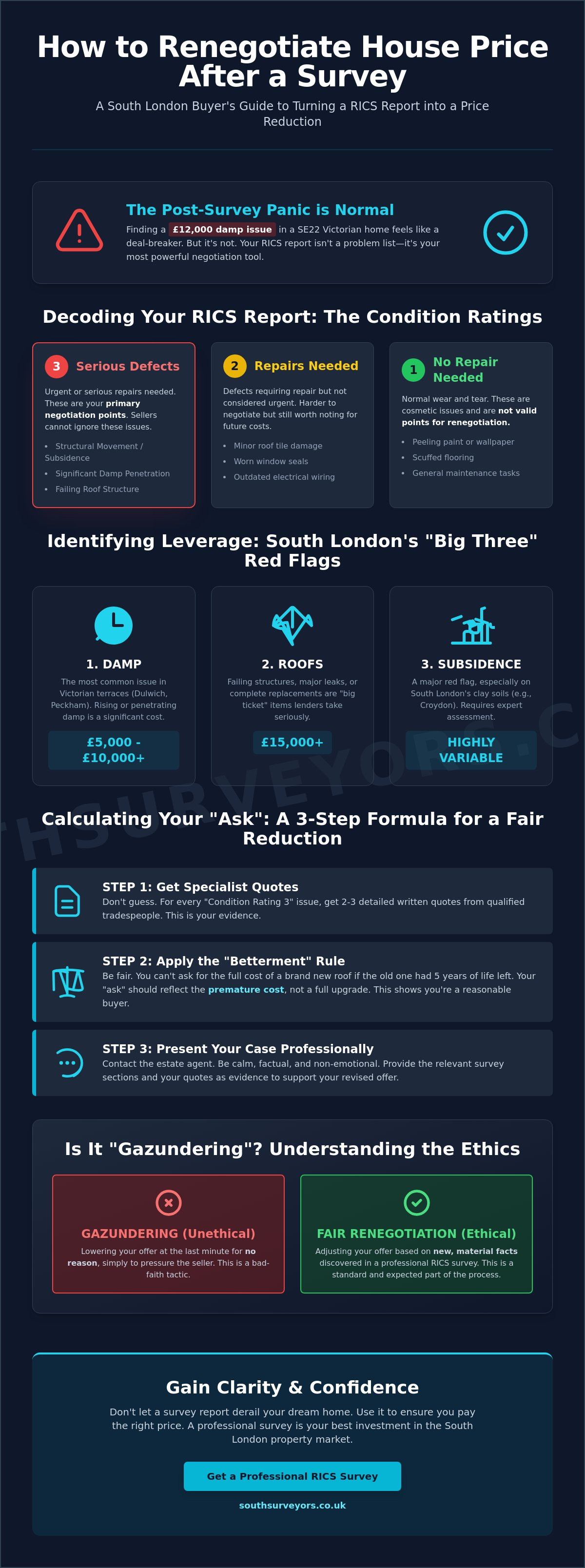
Many buyers worry that asking for a discount makes them “gazunderers.” Let’s be clear: gazundering is an unethical tactic where a buyer lowers their offer at the last minute for no reason other than to squeeze the seller. Renegotiating based on a professional RICS survey is entirely different. It gives you the moral high ground because you are reacting to legitimate defects that weren’t visible during your initial viewing. In many cases, mortgage lenders in 2026 actually require these adjustments. If a surveyor finds £15,000 of urgent roof work in a BR1 property, the lender may adjust their valuation, making it essential to know how to renegotiate house price after survey results to protect your loan-to-value ratio.
The “Knowledgeable Friend” Approach
Think of your surveyor as your secret weapon in the South London property jungle. Instead of losing your head over the traffic light system in the report, use it as a logical roadmap for your next move. A surveyor who is incredibly communicative will help you interpret these findings without the stress. We provide reports that are thorough and easy to understand, ensuring you know which “Condition Rating 3” items are urgent and which are just typical for a house in the SE postcode. Having an expert who can explain the nuances of local builds allows you to approach the seller with facts, positioning you as a serious, informed buyer rather than an emotional one.
Identifying Your Leverage: Common South London Red Flags
Think of your survey as more than just a health check for your future home. It’s a strategic document. When you’re figuring out how to renegotiate house price after survey, you need to separate the “nice-to-haves” from the “must-fixes.” A “Condition Rating 3” in your RICS report isn’t just a warning; it’s a direct line item for your negotiation. These are defects that require urgent attention, and they give you the clarity and confidence to ask for a specific price reduction based on professional evidence.
The key is distinguishing between cosmetic issues, like peeling wallpaper in a Crystal Palace flat, and structural deal-breakers that affect the property’s value. Sellers expect you to handle the painting, but they don’t expect you to swallow the cost of a failing foundation or a leaking roof. By using the survey as a factual anchor, you move the conversation away from “what you want to pay” to “what the house is actually worth” given its current state.
The Big Three: Damp, Roofs, and Subsidence
In the Victorian terraces of Dulwich (SE21) and Peckham, damp is the most frequent uninvited guest. Rising damp or lateral penetration can easily lead to a £5,000 to £10,000 negotiation point depending on the scale of the timber decay and necessary replastering. Meanwhile, period homes in Bromley (BR) often hide “end of life” roofing materials. If the slate is slipping or the flashing is perished, that’s a significant structural cost you shouldn’t ignore. For older or more complex properties, an RICS Level 3 Building Survey provides the granular detail needed to justify a price drop. If we spot subsidence or structural movement, don’t panic. We’ll often suggest a specialist report to quantify the exact repair cost, ensuring you don’t overpay for a property with “shaky” foundations.
Modern Gremlins in CR and SM Postcodes
Newer developments in Croydon (CR) and Sutton (SM) face different challenges. We often look for cladding issues or missing EWS1 certificates in high-rise apartment blocks, which can halt a mortgage application entirely. Suburban homes in Sutton frequently suffer from non-compliant DIY electrical work or outdated consumer units that don’t meet 2026 safety standards. These aren’t just cosmetic gripes; they’re genuine safety risks. For these 1990s or 2000s builds, a Level 2 Survey is usually the professional choice to catch these modern gremlins before you exchange. Understanding these regional quirks helps you decide how to renegotiate house price after survey with real authority and local insight. If you’re feeling unsure about a specific defect, you can always speak with one of our RICS-certified surveyors to get a clearer picture of your next steps.
Calculating the “Ask”: How Much Should You Knock Off?
Once your RICS-certified surveyor hands over the report, the real work begins. You aren’t just looking for a discount; you’re looking for a fair adjustment based on cold, hard facts. To figure out how to renegotiate house price after survey effectively, you need to swap guesswork for evidence. Start by gathering three detailed quotes from local South London contractors. Whether the property is a Victorian terrace in Bromley (BR1) or a 1930s semi in Croydon (CR0), having three distinct figures creates a solid baseline for your “ask.”
In the 2026 market, sellers are increasingly savvy. They won’t respond well to a “rounded-up” estimate. By presenting specific quotes from tradespeople familiar with the SE and DA postcodes, you show you’ve done your homework. If your surveyor flagged damp in a Sidcup basement or subsidence risks in Blackheath, these quotes act as your shield. You should also lean on the RICS Valuation included in your report. If the surveyor’s professional opinion of the property’s value is lower than your agreed price, your lender likely won’t provide the full mortgage anyway. This gives you a powerful, non-negotiable lever to pull during discussions.
The “Betterment” Trap
You might feel tempted to ask for the total cost of a brand-new roof, but property law and standard negotiation etiquette rarely work that way. Betterment is the increase in property value beyond its original state after repairs. If you replace a thirty-year-old roof that was already at the end of its life, you are technically improving the house beyond the condition you originally offered on. To keep the deal alive in competitive spots like Blackheath (SE3), it is often fairer to split the cost. If a repair costs £10,000, asking for a £5,000 reduction acknowledges that you will end up with a superior, more valuable asset than the one you first saw.
When to Walk Away (The “Money Pit” Threshold)
There is a psychological “point of no return” where a project stops being a home and starts being a liability. A reliable rule of thumb for 2026 is the 10% threshold. If the essential structural repairs exceed 10% of the property’s purchase price, you are entering “money pit” territory. For a £500,000 flat in Lewisham, a £50,000 repair bill should be a massive red flag.
Data from early 2026 shows that while buyers in Blackheath are accepting average reductions of 3.1%, those in Sidcup (DA14) are successfully negotiating up to 6.4% off for significant defects. If the seller refuses to budge on a property requiring major work, walking away provides the “peace of mind” that no discount can buy. Sometimes the best investment is the one you don’t make.
The Negotiation Script: What to Say to the Estate Agent
Once your surveyor has delivered the news, it’s tempting to call the estate agent immediately. Take a breath. Knowing how to renegotiate house price after survey results requires a calculated approach, not a panicked phone call. You need to transition from the excited buyer who loved the “period charm” in SE15 to a pragmatic investor who sees a £15,000 roofing liability. Wait for the full written report from your RICS-Certified professional before you open your mouth. Having the PDF in your inbox is your leverage.
When you’re ready, follow this five step sequence to maintain control:
- Step 1: Review the report and highlight the “Big Ticket” items. Ignore the cosmetic scuffs; focus on structural integrity, damp, and safety.
- Step 2: Draft a clear, non-emotional email to the estate agent. Your tone should be: “We still want the house, but the math has changed.”
- Step 3: Attach the specific pages of your South Surveyors report as evidence. Don’t send the whole 50 page document; send the sections that prove your point.
- Step 4: Propose a specific figure. If a roof replacement in a DA or BR postcode costs £10,000, ask for a £10,000 reduction. Don’t guess; use quotes from local contractors.
- Step 5: Be prepared for the “meet in the middle” dance. If they offer £5,000, you have to decide if the remaining £5,000 is a deal-breaker.
Framing the Conversation
In competitive markets like Greenwich or Peckham, agents are used to hardball tactics. Use what we call “Hipster Flair” logic: acknowledge the lifestyle appeal of the property while pivoting sharply to the structural reality. You might say, “We love the proximity to the park and the local cafes, but we can’t ignore the rising damp identified in the report.” Always talk to the agent, not the seller. The agent is a professional buffer who can translate your concerns into a business case for the seller. If they push back, remind them that any future buyer will find the same issues in their own Home Survey, so it’s in the seller’s interest to resolve it now.
Asking the Seller to Carry Out Works
You have two choices: ask for a price reduction or ask the seller to fix the issues before completion. While it’s tempting to let them handle the mess, a price reduction is almost always safer for you. If a seller in CR4 or SM1 is moving out, they have every incentive to choose the cheapest, quickest fix possible. By taking a price cut, you maintain quality control over the contractors you hire. If you do agree to let the seller handle repairs, ensure the work is verified by a follow-up inspection to guarantee it meets RICS standards. This ensures you move in with genuine peace of mind rather than a “patch-up” job.
Need a professional report to start your negotiation? Contact our expert team today for a comprehensive survey across South London.
Clarity and Confidence: How South Surveyors Seals the Deal
Negotiating a lower price isn’t about being difficult; it’s about paying what the property is actually worth in 2026. When you present an estate agent with a South Surveyors report, you’re not just handing over a list of problems. You’re providing a professional, RICS-regulated roadmap that shows exactly how to renegotiate house price after survey findings come to light. Our reports are designed to be clear enough for a first-time buyer to understand, yet technical enough to stand up to scrutiny from the most seasoned South London sellers.
Our team, including experts like Jazz Ettienne, doesn’t just email a PDF and disappear. We take the time to chat. Whether it’s a 15-minute debrief or a deep dive into repair costs, we ensure you have the vocabulary to speak confidently with agents. We’ve seen it all across the SE, BR, DA, CR, and SM postcodes. From the shifting clay soils of Dulwich to the specific damp issues found in Victorian terraces in Herne Hill, our local insight is your biggest asset. We help you distinguish between a ‘nice-to-fix’ and a ‘must-fix’ so you don’t waste your leverage on minor cosmetic issues.
Entering a negotiation without a professional report is like going into battle unarmed. You wouldn’t do it. In the fast-moving 2026 market, agents expect you to move quickly; but moving quickly shouldn’t mean moving blindly. This focused approach is why buyers from Greenwich to Croydon trust us to help them secure a fair price.
Tailored Reports for SE, BR, and Beyond
A national firm might miss the structural quirks of a 1930s semi in Bromley or a conversion in Crystal Palace. We don’t. Our deep roots in South London mean we understand the local risks that others overlook. Because we adhere to strict RICS standards, your evidence is irrefutable during the how to renegotiate house price after survey conversation. If your situation is more specific, we also provide RICS Valuation services for shared ownership and probate cases, ensuring every penny is accounted for.
Your Next Step to a Fair Deal
Don’t let your heart override your head before you’ve seen the data. Booking a survey is the only way to ensure you aren’t inheriting a money pit. We offer a “Peace of Mind” guarantee that gives you the facts you need to walk away or lean in with a better offer. Our surveyors are your knowledgeable friends in the industry, keeping things witty but always accurate. Book your RICS survey with South Surveyors today and get the clarity you deserve.
Take Control of Your South London Property Journey
Buying a home in 2026 shouldn’t feel like a high-stakes gamble. Whether you’re eyeing a Victorian terrace in the SE postcodes or a family semi in the BR and CR areas, you deserve to know exactly what’s happening under the floorboards. Learning how to renegotiate house price after survey isn’t about being difficult; it’s about using hard evidence to ensure you’re paying a fair market rate. A professional report turns technical jargon into a strategic tool that protects your bank balance and your long-term peace of mind.
Don’t let the fast-paced nature of the DA or SM markets pressure you into overpaying for hidden defects. Our RICS-regulated surveyors provide the clarity you need to justify every pound of your renegotiation. With direct phone access to your surveyor for post-report advice, you’ll have a knowledgeable friend in your corner to help you navigate the estate agent’s tactics. You’ve done the hard work of finding the perfect spot; now let the experts help you secure it with total certainty.
Get a RICS-certified survey and negotiate with real confidence
Your future self will thank you for being this thorough today.
Frequently Asked Questions
Can I renegotiate the house price after the survey is done?
Yes, you can absolutely renegotiate the house price after the survey is done. In fact, this is the most common time for buyers in areas like Crystal Palace or Bromley to adjust their offers. If our RICS-certified surveyors identify significant issues like damp or structural movement, it’s standard practice to ask for a price reduction that covers the cost of these essential repairs.
What is the average price reduction after a house survey in London?
While every deal across the SE and CR postcodes is different, data from a 2023 Which? survey shows that buyers who renegotiate typically secure a reduction between £5,000 and £10,000. In high-value South London markets, this figure can be much higher if the report highlights serious defects. Having a professional report gives you the clarity and confidence to ask for a fair adjustment based on real repair quotes.
Should I share the full survey report with the seller?
You aren’t legally required to share the full document, and it’s often better to provide only the relevant excerpts. Sharing specific pages detailing “Condition Rating 3” issues helps justify your request without overwhelming the seller with every minor detail. It shows you’re being transparent about why you want to learn how to renegotiate house price after survey findings come to light, rather than just being difficult.
What if the seller refuses to lower the price after a bad survey?
If a seller in Dulwich or Sidcup refuses to budge, you have three main options. You can accept the original price, ask them to fix the issues before completion, or walk away from the purchase entirely. About 15% of UK property transactions fall through because of survey issues, so don’t feel pressured to ignore a bad report. Your long-term peace of mind is more important than a stressful mortgage on a money pit.
Will a price reduction affect my mortgage offer?
Yes, a price reduction will impact your mortgage offer because the loan-to-value (LTV) ratio changes. You must inform your lender immediately so they can issue a revised offer. If the new price is lower than the original valuation, your monthly payments might actually decrease, which is a nice win for your bank balance. It’s a vital step in knowing how to renegotiate house price after survey results are in.
Is a Level 2 or Level 3 survey better for negotiation leverage?
A RICS Level 3 Survey offers significantly more leverage because it provides a thorough analysis of the property’s structure. While a Level 2 is great for modern flats in Croydon, older Victorian terraces in SE19 often hide complex issues. The detailed repair advice and cost descriptions in a Level 3 report make it much harder for a seller to dispute your request for a discount.
Can I pull out of a house sale after a survey?
You can legally pull out of the sale at any point until the exchange of contracts. In England and Wales, your initial offer is “subject to contract,” meaning you aren’t tied in yet. If our survey reveals “deal-breaker” issues that make the property a bad investment, walking away is a smart way to protect your financial future. It’s better to lose the survey fee than to inherit a property with structural problems.