

What if the difference between your dream Victorian terrace in Dulwich and a £50,000 structural nightmare came down to a single afternoon with a clipboard? With South London house prices remaining a significant investment in 2026 and average mortgage rates sitting around 5.42%, nobody wants to accidentally buy a money pit. You likely already know that the capital’s unique combination of shifting clay soils and aging period properties makes a thorough inspection essential. However, knowing how to choose a chartered surveyor South London residents can actually trust is the real secret to sleeping soundly at night.
We understand that reading through pages of technical jargon can feel more like a chore than a help when you’re trying to secure a home in the SE, BR, or CR postcodes. This guide will show you how to vet a professional like a pro, ensuring you find an expert who speaks “London Clay” and provides the clarity you need to negotiate with confidence. We’ll break down exactly what to look for in a local expert, from their RICS credentials to their knowledge of specific neighbourhoods across DA and SM, so you can move forward with total peace of mind.
Key Takeaways
- Understand why “London Clay” in postcodes like SE21 and SE22 makes local expertise essential for spotting subsidence before it becomes a disaster.
- Learn how to choose a chartered surveyor South London property hunters can trust by verifying RICS regulation and looking for specific indicators of thoroughness.
- Identify whether a RICS Level 2 Condition Report or a full Level 3 Building Survey is the right fit for your specific street, from Croydon to Greenwich.
- Master the traffic light system in modern reports to distinguish between minor cosmetic quirks and serious structural red flags.
- Gain the technical clarity needed to negotiate property prices effectively and protect your investment in the 2026 market.
Why South London Property Needs a Specialist Touch (Not Just a Generic Checklist)
Buying a home in South London is a bit like dating a charming but slightly eccentric character. You fall for the high ceilings in Peckham or the leafy vibes of Bromley, but there’s often a lot going on beneath the surface. If you’re wondering what is a Chartered Surveyor? and why you need a local one, it’s because our corner of the capital has its own unique structural DNA. A surveyor from a national firm might know the RICS handbook inside out, but they won’t necessarily understand the specific “postcode personality” of the CR or SM districts.
When you’re figuring out how to choose a chartered surveyor South London buyers often overlook the importance of hyperlocal geological knowledge. It isn’t just about ticking boxes; it’s about knowing which streets in SE21 or SE22 are currently doing the “clay dance.” A specialist touch ensures you aren’t just getting a generic report, but a deep dive into the specific risks of your chosen neighbourhood.
To better understand the professional standards you should expect, watch this helpful video regarding expert roles in the industry:
The Battle with London Clay and Subsidence
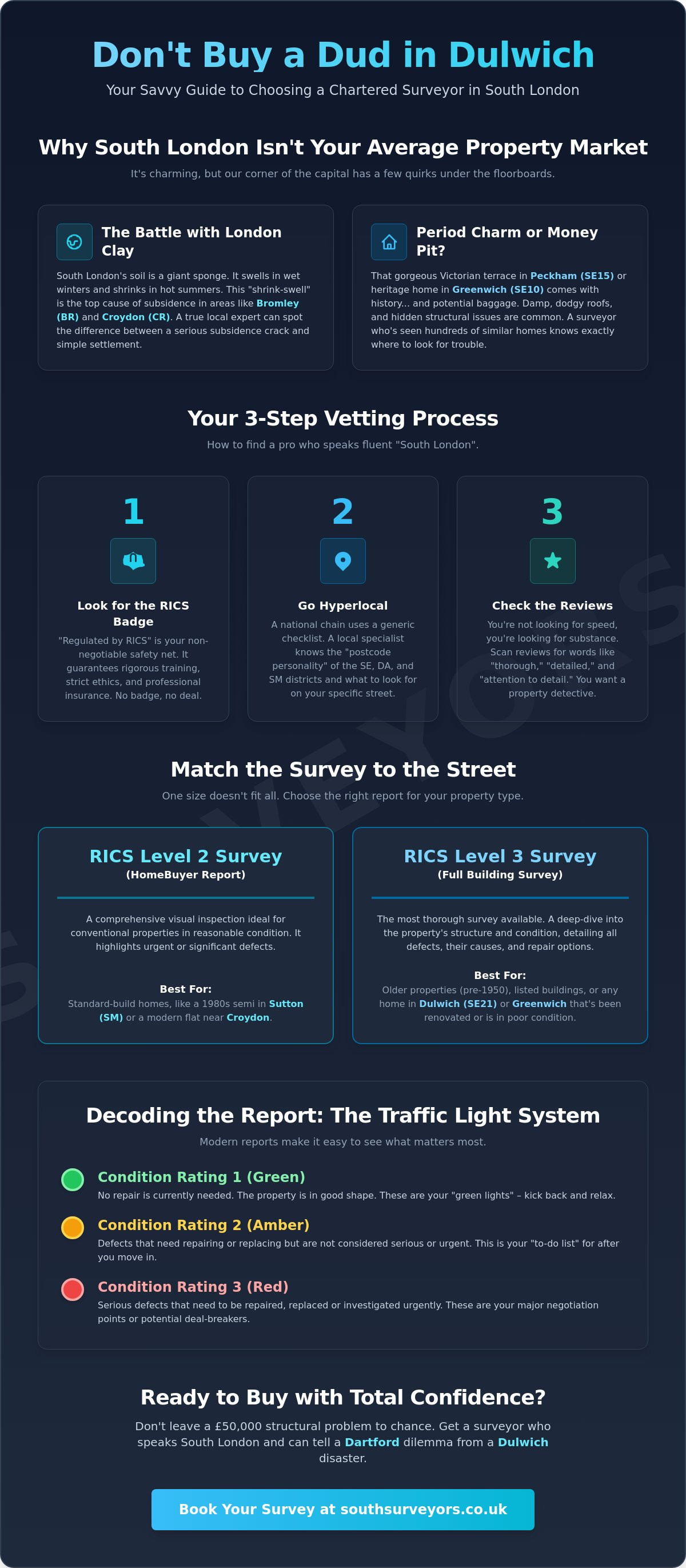
South London sits on a thick layer of London Clay, a soil type that acts like a giant sponge. During wet winters, it expands; during hot, dry summers, it shrinks. This “shrink-swell” cycle is the primary cause of subsidence in areas like Bromley and Croydon. If a property has a large oak or willow tree in a small garden, it can suck the moisture out of the clay and accelerate foundation movement. A surveyor who knows the BR and CR postcodes will look for telltale diagonal cracks that a generalist might dismiss as simple “settlement.”
Period Properties: Beyond the Hipster Flair
We all love a Victorian terrace in Peckham or a heritage home in Greenwich, but these 100-year-old beauties come with baggage. “Original features” like sash windows and fireplaces are gorgeous, but they can hide significant issues. Damp is a frequent guest in older South East London builds, often caused by modern renovations that accidentally “suffocate” the original breathable brickwork. Roofs in Greenwich can also be a hidden money pit. A local expert who has seen hundreds of identical builds in your specific street will know exactly where the skeletons are buried, helping you avoid an expensive mistake.
How to Vet Surveyor Recommendations: The RICS Gold Standard and Beyond
Once you’ve narrowed down your search, it’s time for a vibe check. Vetting a professional isn’t just about comparing quotes; it’s about ensuring your investment is protected by someone who actually knows their stuff. When you are figuring out how to choose a chartered surveyor South London buyers should start by looking for the “Regulated by RICS” badge. This isn’t just a fancy logo. It’s your ultimate safety net. It’s your guarantee that the firm follows strict ethical codes and carries professional indemnity insurance. If something goes wrong, you aren’t left in the lurch.
The RICS Regulation: Your Professional Shield
Think of RICS accreditation as the difference between a Michelin-starred chef and someone who just likes to cook. A “Chartered” surveyor has undergone years of rigorous training and assessment to earn those letters (MRICS or FRICS). A generic “house surveyor” might lack this specific oversight. Without that RICS shield, you’re missing out on a level of accountability that is non-negotiable in the high-stakes London market. You wouldn’t fly with an unlicensed pilot; don’t risk your mortgage on an unaccredited report.
Don’t stop at the badge, though. Read the reviews. Look for mentions of “thoroughness” and “attention to detail.” National chains often operate like factories, churning out reports at high speed. A smaller, local firm will dig deeper into the quirks of your specific property type. Whether you’re eyeing a Victorian conversion in Bromley or a sleek modern flat in Croydon, you need a surveyor who has seen that exact layout dozens of times. Knowing how to choose a chartered surveyor South London residents recommend often comes down to this balance of expertise and approachability. If you want a report that prioritizes your peace of mind over corporate jargon, chatting with an expert at South Surveyors is a great place to start.
Communication Style: Knowledgeable Friend vs. Corporate Robot
There is nothing worse than receiving a 50-page report full of technical fluff that leaves you more confused than when you started. You need a report written in plain English. A great surveyor acts as a knowledgeable friend, explaining that a “spalled brick” just means the face is flaking off. Accessibility is key. Ask if they offer a post-survey phone call to walk you through the findings. This personal touch turns a scary list of defects into a clear, empowered plan for your purchase. You want transparency, not a series of vague warnings designed to cover the surveyor’s back.
Matching the Survey to the Street: From Croydon New Builds to Greenwich Heritage
South London’s architectural landscape is a patchwork quilt. You might find a sleek, glass-fronted apartment in Croydon standing right next to a crumbling Victorian terrace in Peckham. Because our streets are so varied, a “one size fits all” approach to property inspections just doesn’t work. Picking the right survey is about matching the report’s depth to the property’s age, construction type, and complexity. When you’re deciding how to choose a chartered surveyor South London experts recommend, the first question they’ll likely ask is: “What are you actually buying?”
The choice usually boils down to the level of detail you need to feel secure in your investment. While a survey might feel like another annoying upfront cost in an already expensive process, it’s actually your best tool for negotiation. Spending between £700 and £2,000 now can easily save you £20,000 in future repairs if you uncover a structural “money pit” before you exchange contracts. It’s about buying with your eyes wide open, rather than crossing your fingers and hoping for the best.
RICS Level 2 for Modern Living
If you’re eyeing a sleek new build in Kidbrooke Village or a tidy semi-detached house in Sutton or Sidcup built after 1990, a RICS Level 2 Survey (formerly known as a HomeBuyer Report) is often the sweet spot. It uses a clear traffic light system to highlight urgent defects that need your attention. It’s concise and professional, focusing on the main elements of the property without a microscopic deep dive into every floorboard. For a closer look at what this covers, check out our RICS Level 2 Survey guide.
RICS Level 3 for Period Powerhouses
For those moving into a Victorian powerhouse in Dulwich, a large Edwardian home in Bromley, or any property in the SE postcodes that has been significantly altered, a RICS Level 3 Building Survey is non-negotiable. This is the “Deep Dive.” It provides a detailed analysis of the property’s structure, including repair costs and maintenance advice for the future. It’s essential for older homes where 100 years of “DIY fixes” might be hiding behind the plaster. You can find more details in The Ultimate Guide to Building Surveys.
Sometimes, you might only be worried about one specific issue, like a suspicious crack in a Bexleyheath extension. In these cases, a Specific Defect Report can provide the targeted answers you need without the cost of a full survey. Whatever you choose, ensure your surveyor understands the specific nuances of South London’s varied housing stock.
Red Flags and Green Lights: What a Great South London Survey Actually Looks Like
Getting your survey back shouldn’t feel like receiving a cryptic message from a Victorian ghost. A high-quality report translates technical observations into clear, actionable advice. When you are looking into how to choose a chartered surveyor South London buyers can rely on, the clarity of the final document is just as important as the inspection itself. You need to know which issues are “fix it now” and which are “fix it later.” A great report doesn’t just list problems; it provides context and solutions.
The “Subsidence Scare” is a classic South London trope. Because of the clay soil we discussed earlier, almost every period property in Forest Hill or Crystal Palace has shifted slightly over the last century. A professional surveyor distinguishes between historic settlement, which is often harmless, and active subsidence, which is a structural emergency. They examine the shape of the cracks and the alignment of doorframes to tell you if the house is still moving or just settling into its old age. This distinction can save you from unnecessary panic or a very expensive mistake.
Damp is another local favourite. Many Victorian basements in the SE postcodes struggle with moisture, but it isn’t always a reason to walk away. It might just be a blocked air brick or a poorly placed flower bed. By identifying the root cause, your surveyor empowers you to decide if the property is a sound investment. If you’re ready to get a clear, actionable report that gives you this level of control, book your South London survey with us today.
Demystifying the Jargon: From Spalling to Subsidence
- Spalling: This refers to the flaking or crumbling of brick faces, often caused by freeze-thaw cycles or trapped moisture in old SE London masonry.
- Damp isn’t always a dealbreaker; it’s often a ventilation issue that can be solved without stripping the walls to the bone.
- The “Traffic Light” system helps you prioritize, with Condition Rating 3 (Red) indicating urgent repairs and Condition Rating 1 (Green) meaning everything is ship-shape.
Using Your Report as a Negotiation Tool
Once you have the facts, you have the power. Presenting a professional RICS report to an estate agent in Croydon or Bromley changes the conversation from “I think it’s too expensive” to “Here is £5,000 worth of necessary roof work.” In a 2026 market where price growth is steady but realistic pricing is crucial, this data is your best friend. We’ve seen buyers save thousands simply because they could prove a hidden defect required immediate capital. It gives you the “power to say no” or the “power to pay less” with total confidence.
Navigating the South London Market with South Surveyors
Finding your property soulmate in 2026 is about more than just finding a house with a south-facing garden in Dulwich or a short commute from Crystal Palace. It is about understanding the bones of the building and knowing exactly what you are signing up for. At South Surveyors, we don’t believe in the “one size fits all” approach favored by massive national chains. We live and breathe the SE, BR, DA, CR, and SM postcodes. When you are deciding how to choose a chartered surveyor South London residents can rely on, you want a team that pairs professional substance with genuine local insight.
We treat every inspection as if we were the ones moving in. Our reports are designed to feel like a conversation with a knowledgeable friend, not a lecture from a corporate robot. We take the time to explain why a specific quirk in a Greenwich heritage home matters, or why a modern build in Bromley is performing exactly as it should. It is this combination of technical expertise and a personal touch that helps our clients move forward with total confidence.
Meticulous, Dependable, and Hyperlocal
Our primary goal is to provide you with emotional security and mental ease during what can be a high-stakes financial transaction. We focus heavily on the unique Victorian and Edwardian housing stock that defines so much of South East London. Because we are regulated by RICS, our adherence to the highest industry standards is non-negotiable. For us, RICS regulation is a synonym for quality, transparency, and trust. We use our deep knowledge of local construction trends to ensure no stone is left unturned, providing you with the tools for empowered decision-making.
Get Your Bespoke South London Survey Quote
We believe the survey process should be as transparent as the reports we produce. Getting a quote for your dream home in Bromley or a period terrace in Greenwich is simple and straightforward. We don’t hide behind complex fee structures or vague service descriptions. Once the inspection is complete, we prioritize accessibility. Our experts are available for a post-survey phone call to walk you through the findings, ensuring you understand every detail before you commit to the purchase.
Don’t leave your investment to chance in the competitive South London market. Whether you need a RICS Level 3 Building Survey for an older property or a Level 2 Condition Report for a modern flat, we are here to help you navigate the process with ease. Take the next step toward your new home today.
Get a Professional RICS Survey Quote for Your South London Home
Secure Your South London Future with Confidence
Buying a home in postcodes like SE, BR, or CR is a massive milestone. It shouldn’t be clouded by the fear of hidden subsidence or crumbling Victorian brickwork. By prioritizing local expertise and the RICS gold standard, you’ve already taken the biggest step toward protecting your investment. Remember that the right report isn’t just a hurdle to clear; it’s your most powerful tool for negotiation and long-term peace of mind. Understanding how to choose a chartered surveyor South London buyers can truly rely on means looking for that perfect blend of professional accreditation and hyperlocal experience.
As a RICS Regulated Firm and specialists in the SE, BR, CR, DA, and SM areas, we pride ourselves on providing expert advice on Victorian and period properties. We translate technical jargon into clear, actionable insights so you can make empowered decisions. Your dream home in Greenwich or Bromley is waiting, and we’re here to make sure it’s as solid as it looks. Ready to move forward? Get a Professional RICS Survey Quote for Your South London Home and take the stress out of your property journey. Happy house hunting!
Frequently Asked Questions
How do I choose between a Level 2 and Level 3 survey in South London?
The choice depends on the age and condition of the property you are eyeing in areas like Peckham or Sutton. A RICS Level 2 Condition Report is usually sufficient for modern homes built within the last 30 years that appear to be in good shape. However, if you are buying a Victorian terrace in Dulwich or a heavily renovated home in Bromley, a RICS Level 3 Building Survey is essential for a microscopic look at the structure.
Are all surveyors in South London RICS regulated?
No, not every person offering “house surveys” is officially regulated by the Royal Institution of Chartered Surveyors. When researching how to choose a chartered surveyor South London residents can trust, you must look for the “Regulated by RICS” logo on their website. This badge ensures the firm adheres to strict professional standards and carries the necessary indemnity insurance to protect you if things go wrong.
How much does a building survey cost in the SE or CR postcodes?
Industry rates for surveys in South London vary significantly based on the property’s purchase price, its size, and the level of detail required. While you might find national averages online, local prices reflect the complexity of the capital’s housing stock. It is always best to request a bespoke quote that considers the specific quirks of your potential home in Croydon or Greenwich rather than relying on a generic estimate.
Can a surveyor recommendation help me negotiate a lower house price?
Yes, a professional report is one of your strongest negotiation tools in a competitive market. If your surveyor identifies a “Condition Rating 3” defect, such as a roof leak or rising damp, you can present the estimated repair costs to the estate agent. Many sellers in the SE or BR postcodes are willing to reduce the price or fix the issues once they are presented with factual, expert evidence from a RICS report.
What are the most common property defects found in South East London homes?
Subsidence and damp are the two most frequent “uninvited guests” we encounter in South East London properties. Because much of the SE and DA postcodes sit on London Clay, seasonal soil movement often causes historic or active cracking. Additionally, many older homes in areas like Lewisham suffer from dampness caused by modern renovations that have accidentally blocked the original Victorian ventilation systems.
How long does it take to receive a survey report in South London?
You can typically expect to receive your digital report within three to five working days after the physical inspection is complete. While the on-site visit might only take a few hours, your surveyor needs time to analyze the findings and write a clear, jargon-free summary. Knowing how to choose a chartered surveyor South London buyers recommend often involves finding a firm that prioritizes this balance of speed and thoroughness.
Do I need a structural engineer or a chartered surveyor for cracks in a wall?
A chartered surveyor should almost always be your first port of call for an initial assessment of cracks. They will determine if the movement is historic settlement or a sign of active subsidence. If the issue is severe, the surveyor will then recommend a structural engineer for specific calculations. Starting with a surveyor is more cost-effective as they provide a holistic view of the entire property, not just one crack.
Should I get a survey for a new build apartment in Greenwich or Lewisham?
Yes, even brand-new apartments in modern developments can have hidden snags or finishing issues. A RICS Level 2 Condition Report acts as a professional snagging list, ensuring that everything from the windows to the plumbing meets the expected standards. It provides an extra layer of protection beyond the standard builder’s warranty, giving you total peace of mind before you move into your new Greenwich home.