

Your dream Victorian terrace in Dulwich might look perfect on Instagram, but the real deal-breaker isn’t the paint colour; it’s the boiler hiding in the kitchen cupboard. Many buyers mistakenly assume their RICS survey covers every single nut and bolt, but when asking what does a building survey check for gas safety, the reality is often “not as much as you’d hope.” While a surveyor is a pro at spotting structural cracks or damp, they aren’t qualified gas engineers and won’t be taking the boiler apart to check for leaks.
We know that the fear of hidden repair costs in a competitive South London market can be overwhelming. It’s completely normal to feel a bit lost between RICS reports and Gas Safe visits, especially when you’re trying to negotiate with a stubborn seller in SE22 or BR3. This guide will show you why a dedicated gas safety check is your secret weapon for a stress-free home purchase. You’ll learn how to protect your investment, what specific documents to demand before exchange, and how to gain total peace of mind before you sign on the dotted line.
Key Takeaways
- Learn why a seller’s verbal promise isn’t enough and why independent due diligence is the only way to avoid “boiler shock” after moving into your new SE postcode pad.
- Understand exactly what does a building survey check for gas safety so you can distinguish between a surveyor’s visual overview and a Gas Safe engineer’s technical inspection.
- Discover the specific tests-from system “tightness” to burner pressure-that ensure your future home in Croydon or Sutton is efficient and, most importantly, safe.
- Master the art of negotiation by knowing who typically pays for the Gas Safety Record and how to request one from a seller without sounding like a corporate robot.
- Find out how pairing a specialist gas check with a RICS Level 3 Building Survey provides the ultimate safety net against hidden South London property pitfalls.
The Big Question: Do You Really Need a Gas Safety Check Before Buying?
You’ve finally found it: a charming brick-fronted terrace in Greenwich or a sleek apartment in Peckham. The offer is accepted, the champagne is on ice, but there’s a hidden guest at the party you haven’t accounted for: the boiler. A gas safety check is a deep-dive inspection of every gas-fed appliance and flue in the building, conducted by a Gas Safe registered engineer. If you are asking what does a building survey check for gas safety, the answer is usually “the basics,” which is why a dedicated specialist check is such a powerful tool for your due diligence.
When you’re browsing listings in SE10 or SE22, you’ll often hear about legal requirements. Under the Gas Safety (Installation and Use) Regulations 1998, landlords are legally bound to provide a CP12 certificate every year. As a buyer, you aren’t legally forced to get one, but skipping it is a massive gamble. Data suggests that roughly 17% of UK movers, or 1 in 6, inherit a gas headache in the form of an unsafe appliance. In the high-stakes world of South London property, that’s a risk your bank balance doesn’t need to take.
To better understand what a dedicated inspection involves, watch this helpful video:
The Invisible Risk in Period Homes
South East London is famous for its gorgeous Victorian and Edwardian architecture. However, those period features in Dulwich or Crystal Palace often hide aging plumbing. In many older properties, old chimneys have been repurposed as flues for modern boilers. If these aren’t lined correctly or have deteriorated over a century, they become a silent danger. We also see plenty of creative DIY gas work in the SM and CR postcodes. A previous owner might have tried their hand at moving a radiator or installing a gas hob to save a few quid, leaving behind a cowboy-style installation that a standard visual survey might miss. Knowing what does a building survey check for gas safety helps you realize where the surveyor’s job ends and the engineer’s begins.
Peace of Mind vs. The Price of a Boiler
Think of a gas safety check as a safety shield for your investment. A professional inspection might cost you less than a fancy dinner in East Dulwich, but it could save you from a £3,000 surprise boiler replacement the week after you move in. Relying on the phrase “well, it worked when I viewed it” is a recipe for disaster. By arranging a specialist check alongside your RICS Level 3 Building Survey, you’re ensuring that your new home in Bromley or Dartford is as safe as it is stylish. It’s about total empowerment and mental ease before you exchange contracts.
What Happens During a Gas Safety Inspection (and Why Your Boiler Cares)
If you’ve spent any time on property forums, you’ve likely seen people asking what does a building survey check for gas safety. It’s a fair question, but there is a big difference between a surveyor’s visual check and the technical “deep dive” of a Gas Safe inspection. While the surveyor looks for obvious signs of trouble, the engineer is interested in the invisible guts of the system. They start with a “tightness” test. This involves using a manometer to ensure that gas isn’t escaping anywhere between the meter and your appliances. Even a tiny drop in pressure can indicate a slow leak that could become a major hazard down the road.
Next, the engineer checks the burner pressure and gas flow. They compare these readings against the manufacturer’s data to ensure the appliance is burning fuel efficiently. If the pressure is too low, your radiators won’t get hot; if it’s too high, you’re looking at a potential fire risk. They also spend a significant amount of time on the flues. It isn’t enough for the boiler to stay lit; the combustion products, including carbon monoxide, must actually leave the building. In many South London homes, especially those with complex extensions, flues can be blocked or poorly installed, leading to dangerous “blowback” into the living space.
Boilers, Cookers, and Fireplaces
In the SE, BR, and CR postcodes, we see a huge variety of setups. That “charming” vintage gas fire in a Bromley lounge might look the part, but it’s often a ventilation nightmare. Engineers check that there is enough “makeup air” coming into the room so the fire doesn’t starve the residents of oxygen. It’s the same story with gas hobs. The engineer isn’t just looking for a pretty blue flame; they’re checking the flame failure sensors. These safety devices are designed to cut the gas supply immediately if the flame blows out, preventing your kitchen from filling with unburnt gas while you’re in the other room.
The Gas Safety Record (CP12)
Once the inspection is done, you’ll receive a Gas Safety Record, often called a CP12. In 2026, these are almost exclusively digital. You need to look closely at the labels. “At Risk” (AR) means the appliance has a fault that could become dangerous. “Immediately Dangerous” (ID) is exactly what it sounds like; the engineer will likely cap the supply right then and there to keep you safe. These certificates are valid for 12 months, so always check the date. If a certificate is from 2024, it’s about as useful as a chocolate teapot in a negotiation.
If your inspection reveals a boiler that’s seen better days, don’t panic. You can often find energy efficiency grants to help with the transition to a modern, hydrogen-ready system. While the gas expert handles the pipes, a professional RICS Building Survey is the best way to ensure the rest of the property is just as sound as the heating system.
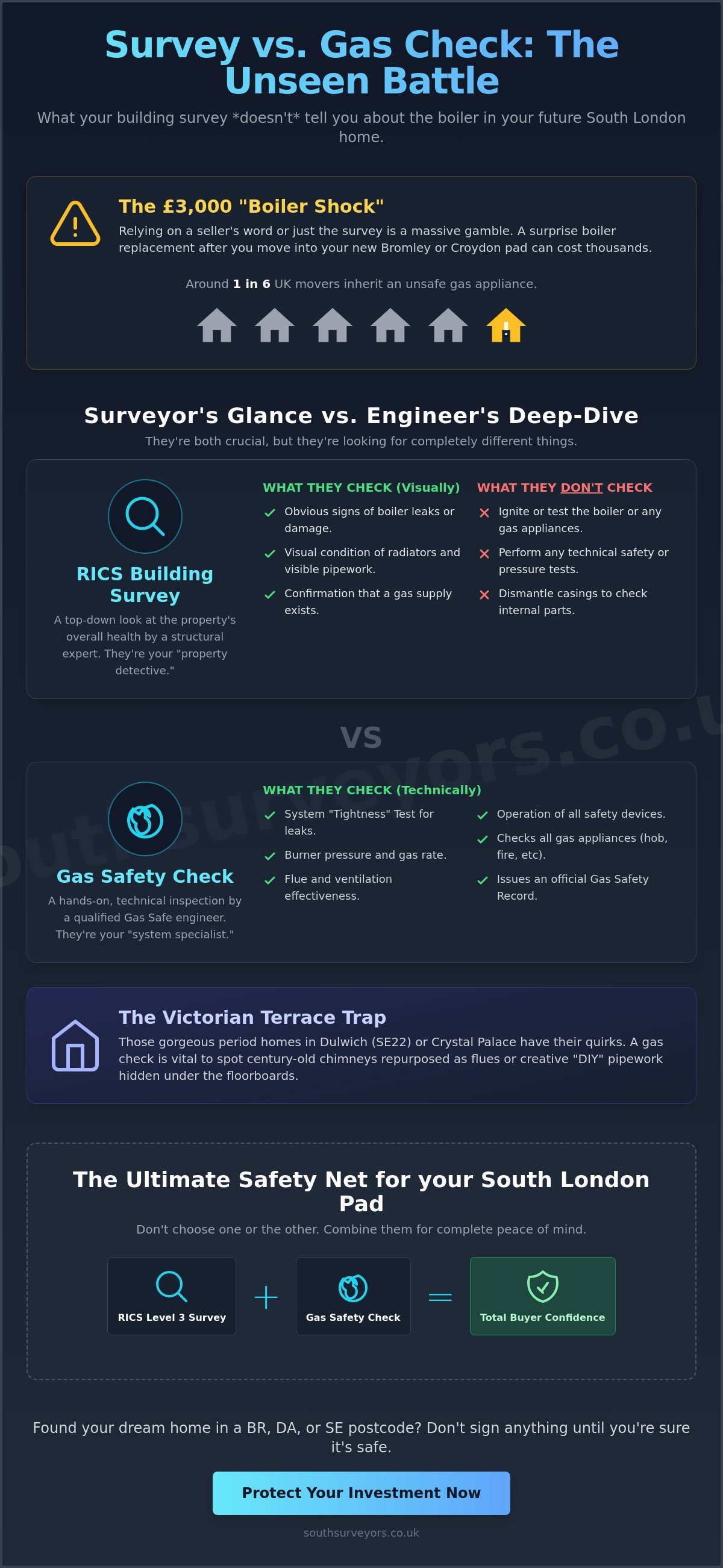
RICS Survey vs. Gas Safety Check: Understanding the Difference
It’s a common point of friction on property forums: the moment a buyer realizes their surveyor isn’t going to fire up the boiler and test for carbon monoxide. When people ask what does a building survey check for gas safety, they’re often surprised to learn it’s a visual, non-invasive inspection. Think of your RICS surveyor as a highly skilled GP. They can spot the symptoms of a problem, like scorching on a boiler casing or a dated lead pipe, but they won’t be performing “surgery.” They check the “services” in a general sense, ensuring that gas is present and that the installation looks professional from the outside.
The big distinction lies in the tools and the permissions. A surveyor is restricted by RICS regulations; they can’t take the boiler apart or perform technical “tightness” tests. Instead, they look for “red flags” that suggest the system might be unsafe. If they see a flue that looks loose or a cooker with a yellow flame, they’ll advise you to consult a specialist immediately. This is where the Gas Safe Register guidance for homebuyers becomes essential reading. It explains why that secondary, technical check is your best line of defense when a visual inspection raises concerns.
What Your Level 2 or Level 3 Survey Will Tell You
In areas like Sutton (SM), where you might be looking at a mix of post-war semis and newer builds, a survey is vital for spotting dated pipework or poor ventilation. If you opt for a level 3 building survey, the inspection is significantly more thorough. We look for signs of scorching around gas fires and flag anything that doesn’t meet modern safety standards. It’s about giving you a clear “to-do” list before you commit to the purchase, especially in period properties where modern boilers have been squeezed into old spaces.
Why You Need Both Professionals
The surveyor understands the house; the engineer understands the machine. These two reports work together to give you a 360-degree view of your investment. We once conducted a survey in South London where we found a patch of damp on a kitchen wall. While it looked like a simple external plumbing issue, the subsequent gas check revealed a hidden, pinhole leak in the boiler’s internal pipework. By combining our home survey with a specialist’s report, the buyer saved thousands in potential repairs. You get the structural context from us and the mechanical detail from the engineer, providing the total empowerment you need to move forward.
Negotiating with Sellers: Who Pays and What if They Say No?
In the high-stakes world of UK property, the principle of “buyer beware” is the law of the land. While you’ve already figured out what does a building survey check for gas safety (it’s mostly a visual “health check” of the visible pipes), the cost of a specialist Gas Safe visit usually falls on you. It’s a bit like buying a used car; you pay the mechanic to make sure the engine won’t drop out on the M25. Asking for this check shouldn’t feel like an interrogation. You don’t need to be a corporate robot; just tell the seller that for your own peace of mind, you’d like a professional to give the system a quick look-over. If a seller flatly refuses access to a qualified engineer, treat it as a massive red flag. Why would they block a safety check unless they’re worried about what might be found?
If you’re eyeing up a gorgeous flat in Greenwich, remember that findings from these reports are your best friends during price negotiations. Most sellers are reasonable, but some will try to hold firm on price even if the boiler is held together with hope and duct tape. Having a professional report in your hand changes the conversation from “we think it’s broken” to “here is the evidence from an expert.” This level of transparency usually helps keep the deal moving forward rather than stalling in a cycle of “he-said, she-said.”
The “Service History” Trap
In areas like Dartford (DA) or Bexley, you’ll often hear sellers say, “Oh, it was serviced last year, it’s fine!” Don’t fall for this trap. A service record is great for showing the boiler runs efficiently, but it isn’t a substitute for a pre-purchase safety check. A service makes sure the boiler is working; a safety check makes sure it isn’t leaking carbon monoxide into your new bedroom. When talking to estate agents, ask specifically for the most recent Gas Safety Record. If they can’t produce one from the last 12 months, it’s time to book your own specialist to avoid inheriting a expensive disaster.
Renegotiating Based on Findings
If the engineer returns a “Dangerous” rating, you have a solid case for a price reduction. You aren’t being difficult; you’re being diligent. Most buyers in South London use these findings to ask the seller to either fix the issue before exchange or knock the repair cost off the final price. Sometimes, the issues found are so severe-like a condemned system in an old Victorian terrace-that walking away is the smartest move. Always use your RICS report as the foundation for these talks. To ensure you have all the facts before you start talking numbers, it’s best to book a RICS Building Survey to see the full structural picture alongside your gas findings.
Beyond the Pipes: How a Professional Survey Completes the Picture
A boiler might be the heart of a home, but the walls, roof, and foundations are its bones. While we’ve spent plenty of time discussing what does a building survey check for gas safety, it’s vital to remember that gas is just one piece of the South London property puzzle. You could have a boiler that’s purring like a kitten, but if the roof is leaking or the foundations are doing a slow-motion slide down a hill in Crystal Palace, you’ve still got a major problem on your hands. A comprehensive RICS survey is the only way to catch these broader structural issues before they become your financial burden.
When you’re buying in a competitive market like South East London, it’s easy to get distracted by a sleek new kitchen or a freshly painted lounge. Our job is to look past the “staging” and find the reality. We investigate for damp, subsidence, and timber decay alongside our visual gas inspection. By combining a specialist gas check with one of our professional reports, you get a 360-degree view of the property. This dual-track approach provides the professional substance you need to exchange contracts with total confidence.
Hyperlocal Expertise in SE and BR Postcodes
We’ve spent years exploring the unique housing stock across the SE and BR postcodes. We understand the specific challenges that come with the territory. For example, the towering, ornate chimneys of Blackheath often require a very different eye than the post-war semi-detached flues found in parts of Bromley. We love South London homes because of their undeniable character, but we also know their hidden quirks and common failure points. Choosing a RICS-regulated firm like South Surveyors means you’re getting a partner who understands the local landscape. It’s about more than just ticking boxes; it’s about providing a bespoke service that prioritizes your emotional security and long-term investment.
Ready to Move Forward with Confidence?
As we head into 2026, the “Safety First” approach to property isn’t just a recommendation; it’s essential due diligence. Your next steps are straightforward. Book your RICS survey and your Gas Safe inspection in tandem so you have all the facts at once. When looking for a gas expert, always verify their credentials on the official Gas Safe Register website to ensure they’re legally permitted to work on the specific appliances in your new home. While they handle the technical mechanicals, we’ll handle the structural integrity and provide the clear, accessible advice you need to make an empowered decision.
Don’t leave your house purchase to chance or rely on a seller’s “it’s always been fine” assurance. Get the expert backing you deserve to ensure your new South London home is safe, sound, and a smart investment for years to come. Get a bespoke quote for your South London survey today.
Exchange with Confidence in Your New South London Home
Buying a property in a vibrant neighbourhood like Peckham or a leafy street in Bromley is a massive milestone. You now understand that when asking what does a building survey check for gas safety, the answer is about spotting the visible red flags rather than performing technical surgery on the boiler. By pairing our structural expertise with a specialist Gas Safe inspection, you’re shielding your bank balance from nasty surprises and ensuring your family’s safety from day one.
It’s all about empowerment. You’ve got the scripts for negotiating with sellers in the SM and DA postcodes and the knowledge to decode a digital CP12. As a RICS Regulated firm with a 5-star rated personal service, we’re the local experts you can trust across the SE, BR, DA, CR, and SM areas. We provide the professional substance and personal touch needed to make your move as smooth as a fresh coat of paint. Secure your peace of mind with a professional RICS survey from South Surveyors. Your future home is waiting; let’s make sure it’s a safe one.
Frequently Asked Questions
Is a gas safety check a legal requirement when buying a house?
Sellers aren’t legally obligated to provide a Gas Safety Certificate to a buyer, which differs significantly from the rules for landlords. In the UK, the principle of “buyer beware” means the responsibility for safety checks falls on you. While it isn’t a law, skipping this step in a competitive market like Lewisham or Greenwich is a huge risk that could leave you with a condemned boiler on move-in day.
Does a RICS Level 2 or Level 3 survey include a gas safety test?
No, a RICS survey does not include a technical gas safety test or any invasive pressure checks. When people ask what does a building survey check for gas safety, they need to understand it’s a visual, non-technical overview. A surveyor will look for obvious signs of trouble like soot or dated pipes, but they won’t take the boiler apart. You’ll always need a Gas Safe registered engineer for a full mechanical inspection.
How much does a gas safety check cost in London in 2026?
In 2026, the average cost for a Gas Safety Certificate in London and the South East typically ranges from £80 to £150. This price usually covers the boiler and a gas hob, but expect to pay an extra £10 to £15 for each additional appliance, like a gas fire in a Bromley Victorian terrace. It’s a small price to pay for total peace of mind before you exchange contracts.
What should I do if the seller doesn’t have a Gas Safety Certificate?
If the seller can’t produce a certificate from the last 12 months, you should ask your solicitor to request that they pay for one. If they refuse, it’s best to arrange and pay for the inspection yourself before you commit. Having your own engineer visit a property in Bexley or Dartford ensures you get an unbiased report on the system’s actual health rather than relying on a seller’s word.
Can I move into a house without a gas safety check?
You can move in without one, but it’s a gamble that could cost you thousands in the first month. Lenders don’t usually insist on a gas check, but moving into a new place in Croydon or Sutton without knowing the boiler is safe is risky. You might inherit a system that leaks carbon monoxide, which is a silent danger that a standard viewing simply won’t reveal.
How do I find a legitimate Gas Safe registered engineer in South East London?
The only reliable way to find a pro is through the official Gas Safe Register website. You can search for registered businesses by entering your new postcode, such as SE22 or BR3. Always ask to see the engineer’s ID card when they arrive at the property. Check the back of the card to ensure they’re actually qualified for the specific type of gas work you’ve booked.
What are the warning signs of a faulty boiler I can spot during a viewing?
Keep your eyes peeled for any brown or black scorching marks on the boiler’s outer casing or nearby walls. If the gas hob is on, the flames should be a crisp blue; lazy yellow or orange flames are a major red flag for poor combustion. Also, look for heavy condensation on windows in the boiler room or a pilot light that seems to struggle to stay lit during your walkthrough.
How long does a gas safety inspection actually take?
A professional inspection usually takes between 30 and 60 minutes, depending on the number of appliances in the home. The engineer needs this time to test the system’s “tightness” and ensure the flues are venting dangerous gases out of the building correctly. It’s a quick process that provides essential security before you sign your life away on a property in the DA or SM postcodes.