

Imagine finding your dream Victorian terrace in East Dulwich, only to realize that the charming “character” features are actually masking a nasty case of subsidence or rising damp. It’s a nightmare scenario that plays out across South East London every week, from the leafy streets of Bromley to the bustling hubs of Croydon. When you’re standing on the doorstep of a massive financial commitment, choosing the right survey for your property is the only thing standing between a savvy investment and a potential money pit.
We know the feeling. The London market is fast, competitive, and frankly, a bit exhausting. You don’t want to get bogged down in RICS jargon or worry if those 1930s foundations in Sidcup or Sutton are actually sound. You just want to move into your new place without a nagging fear of hidden structural issues. This guide is here to clear the fog. We’ll show you exactly how to match the right RICS survey to your specific home and budget. You’ll gain the total peace of mind needed to exchange contracts and a powerful tool to negotiate a better price if surprises crop up. Here is your roadmap to buying with confidence.
Key Takeaways
- Learn why a mortgage valuation isn’t actually a survey and how to avoid the common trap of relying on the bank’s basic paperwork.
- Master the process of choosing the right survey for your property by matching the report depth to your home’s age, whether it’s a Victorian gem or a 1930s semi.
- Discover when to opt for the forensic detail of a RICS (level 3) Building Survey versus the more streamlined RICS (level 2) Condition Report.
- Turn your professional report into a powerful negotiation tool to potentially save thousands on your final purchase price before you exchange.
- Gain total peace of mind by leveraging local knowledge of structural quirks specific to SE, BR, DA, CR, and SM postcodes.
Why Choosing the Right Survey is Your Property Power Move
Buying a home in South London, whether it’s a sleek flat in Croydon or a leafy semi in Bromley, feels like a high-stakes game. You’ve found the place, the offer is accepted, and you’re ready to celebrate. But wait. Before you sign your life away, you need a professional to look under the hood. Choosing the right survey for your property is about moving from “hope for the best” to “know for sure.” A RICS survey isn’t just a piece of paper; it’s a forensic look at your future home’s health. While you might be familiar with what a home inspection covers in a broader context, a RICS survey is a specific, regulated process designed to protect buyers in the UK market.
To better understand this concept, watch this helpful video:
We like to think of ourselves as that knowledgeable friend who actually knows how a boiler works and what “spalling brickwork” means. We’re here to spot the structural cracks you missed while you were busy imagining where the sofa goes. RICS offers a ladder of detail, ranging from Level 1 (a basic overview) to the more detailed RICS (level 2) Condition Report and the RICS (level 3) Building Survey, which is the full forensic deep dive. Choosing the right level depends entirely on the property’s age and condition.
The Mortgage Valuation Myth
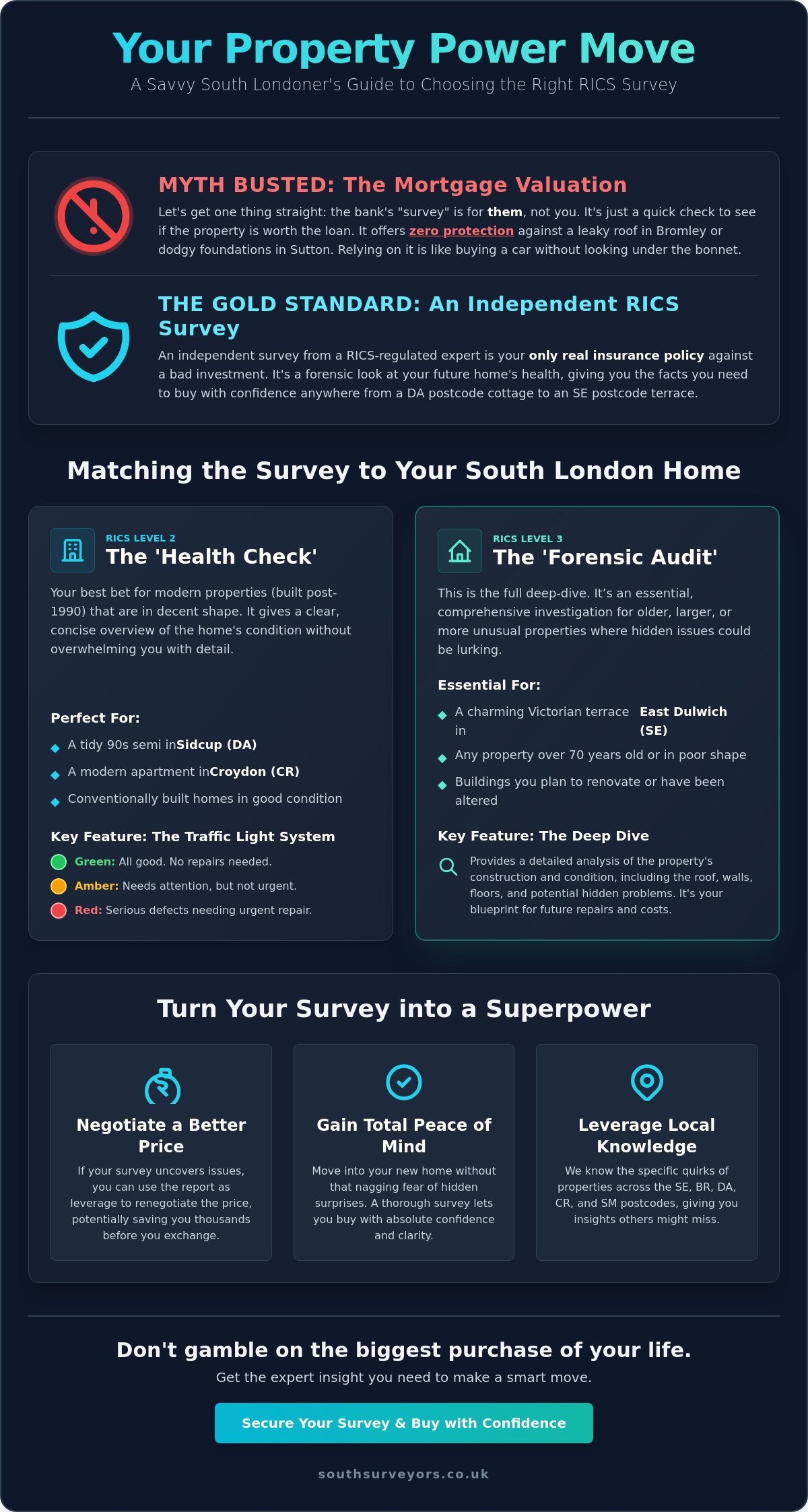
Let’s get one thing straight: the “survey” your bank does isn’t for you. It’s for them. They just want to know if the house is worth the loan. It offers zero protection if the roof leaks or the floorboards are rotten. An independent survey is your only real insurance policy against a bad investment. Buying a house based only on a mortgage valuation is like buying a vintage car because the paint looks shiny, without ever looking under the bonnet to see if the engine actually exists.
RICS Regulation: The Gold Standard
Trust is everything when you’re spending hundreds of thousands of pounds. RICS accreditation is the gold standard in the property world. At South Surveyors, we take this seriously. Being “regulated by RICS” means we adhere to the highest professional and ethical standards in the industry. It’s our central pillar of trust. Whether we’re inspecting a DA postcode cottage or a SM postcode apartment, we provide the same meticulous, bespoke service that keeps our clients in the SE, BR, and CR areas coming back. We don’t just tick boxes; we empower you to make a sound decision.
RICS Level 2 vs. Level 3: Decoding the Jargon
RICS jargon can feel like a secret language designed to keep you guessing. Let’s crack the code. When you’re choosing the right survey for your property, you’re essentially deciding how deep you want us to dig. It isn’t just about the price tag; it’s about matching the level of investigation to the specific risks inherent in the building’s bones. Whether you’re looking at a sleek new build in the CR postcode or a crumbling classic in SE22, the right choice saves you from a world of post-completion pain.
The Level 2 Condition Report: The “Health Check”
Think of the Level 2 report as a professional health check for your potential home. It’s the most popular choice for modern properties built after 1990 that appear to be in reasonable condition. If you’re eyeing a contemporary flat in Croydon or a tidy 90s semi in Sidcup, this is likely your best fit. The report uses a simple traffic light system to highlight issues. Green means everything is fine; amber suggests some maintenance is needed; and red indicates urgent defects that need fixing before you sign. For a deeper look at what’s included, check out our guide on The RICS Level 2 Survey Explained. It’s a clear, accessible way to ensure you aren’t walking into a trap without paying for more detail than a modern home requires.
The Level 3 Building Survey: The “Forensic Audit”
If the house is older, larger, or has been “messed about with” by previous owners, you need the forensic audit. The RICS (level 3) Building Survey is our most comprehensive service. It’s the “everything but the floorboards” approach, essential for those beautiful but temperamental Victorian terraces in Dulwich or 1930s semis in Bromley. We don’t just point out the cracks; we explain why they’re there, how to fix them, and what those repairs might cost. You can find out more in our Level 3 Building Survey: A Complete Guide for Home Buyers. This level of detail is vital because older properties in the SE and BR postcodes often hide structural quirks that a basic check would miss.
Ultimately, getting a survey is a non-negotiable part of the official home buying process. It shifts the burden of risk from your shoulders to our professional indemnity insurance. If you’re still stuck on which path to take, chatting with a local surveyor can help you decide which report offers the best protection for your specific postcode and budget.
Matching Your Survey to South London’s Property Archetypes
South London isn’t a monolith. A flat in a Croydon skyscraper (CR0) has different demons than a Victorian villa in East Dulwich (SE22). Because our local architecture is so varied, choosing the right survey for your property starts with acknowledging that age and architecture dictate the risk. We don’t believe in a one-size-fits-all approach; we believe in matching the inspection to the bricks and mortar of your specific postcode. Whether you’re eyeing a 1930s semi in Bromley (BR1) or a quirky listed building near Greenwich Park, the building’s era tells us exactly where the skeletons are likely hidden.
Period Homes and the Level 3 Necessity
If you’re falling for the high ceilings of a home in Herne Hill (SE24) or East Dulwich, you’re buying into over a century of history. Victorian and Edwardian brickwork requires a specialist eye because these buildings were designed to “breathe” in a way modern homes simply aren’t. We often find that these period gems suffer from rising damp, timber rot in the roof joists, or “roof slippage” where original slates have finally given up the ghost. For these properties, a RICS (level 3) Building Survey is the only sensible choice. It provides the forensic detail needed to understand if that “charming” crack in the bay window is just settling or a sign of something more expensive.
Newer Builds and the Level 2 Advantage
On the other side of the coin, if you’re looking at a purpose-built apartment in Sutton (SM1) or a tidy family home in Sidcup (DA14) built after 1990, the risks change. You likely won’t find Victorian dry rot, but you might find “snagging” issues that could evolve into major headaches. Poorly installed plumbing, inadequate loft insulation, or minor roof defects are common in mass-produced modern housing. In these cases, a RICS (level 2) Condition Report is often your best friend. It balances cost with comprehensive coverage, giving first-time buyers the reassurance they need without paying for a forensic deep dive on a building with modern foundations.
Don’t forget the middle ground. The 1930s semis of Bexleyheath (DA6) or Bromley often hide their own specific “realities,” such as aging electrics, lead piping, or potential asbestos in old textured ceilings. If you’re heading towards Greenwich or Blackheath to buy something truly “quirky” or built with unusual materials, always default to the Level 3. These homes are beautiful, but they don’t follow the standard rules of building physics. We’re here to make sure your “unique find” doesn’t become a unique financial burden.
Beyond the Report: How a Survey Saves Your Sanity (and Your Wallet)
A property survey often feels like just another bill in an already expensive process. But look at it this way: spending a few hundred pounds now is the only way to avoid a five-figure headache later. When you’re choosing the right survey for your property, you aren’t just buying a PDF; you’re buying leverage. We’ve seen cases where a thorough inspection has saved buyers upwards of £20,000 by uncovering issues that were completely invisible during a standard viewing. It’s the difference between moving into your new Peckham pad with a smile and finding out your Bromley semi needs a total rewire three weeks after you get the keys.
The Art of the Renegotiation
One of the biggest secrets in the London property market is that a survey report is a powerful negotiation tool. If a RICS (level 3) Building Survey identifies a significant defect, like a failing roof or damp issues in a Herne Hill terrace, you don’t have to just “suck it up.” You take that professional, RICS-regulated evidence back to the estate agent and the seller. It provides a factual basis to ask for a price reduction or to request that the repairs are completed before exchange. Having an independent RICS Property Valuation alongside your survey adds even more weight to your case, ensuring your final purchase price reflects the true state of the building’s bones.
Avoiding the “Money Pit” Scenario
Sometimes, the best move is knowing when to walk away. We prioritize total clarity over confusing technical jargon so you can understand the gravity of “deal-breaker” issues like active subsidence or major structural failure. Our job is to empower you with the facts. If a property in the DA or SM postcode is a structural “money pit,” we’ll tell you straight. This transparency gives you the confidence to either proceed with your eyes wide open or pull out of the deal before your deposit is at risk. Beyond the immediate purchase, your report serves as a bespoke “to-do” list for future maintenance, helping you plan your budget for years to come in your new SE, BR, or CR home.
Ready to secure your investment and negotiate with confidence? Book your professional RICS survey with our local experts today and buy with total certainty.
The South Surveyors Secret: Bespoke Clarity for Your Big Move
The London property market moves at a breakneck pace, but that doesn’t mean you should rush the most important check of your life. When you’re choosing the right survey for your property, you need more than just a technical report; you need a partner who understands the local landscape. South London has a personality all its own, and its buildings are no different. From the shifting London clay that affects foundations in the SE postcodes to the specific architectural trends found in the leafy suburbs of the BR and DA areas, we’ve seen it all. We don’t just provide data; we provide the context you need to make an empowered decision.
Hyperlocal Expertise You Can Trust
While our base is in Islington, our surveyors spend their days with their boots on the ground across South London. This local presence is vital because we understand the specific soil types and building quirks of the region. Whether it’s the steep hills of Crystal Palace or the sprawling estates of Croydon and Sutton, we know exactly what to look for. We believe in providing “clarity and confidence” to every client, ensuring that the RICS (level 3) Building Survey or RICS (level 2) Condition Report you receive is tailored to the specific risks of your chosen neighbourhood. We bridge the gap between high-level RICS regulation and the practical, everyday realities of owning a home in the CR or SM postcodes.
One of our biggest “secrets” is the personal touch. We’ve done away with corporate gatekeepers and confusing call centres. When you work with South Surveyors, you have the opportunity to talk to your surveyor directly. This open line of communication means you can ask the “silly” questions, dive deeper into specific concerns about a damp patch in the kitchen, or discuss the implications of a RICS Property Valuation. We maintain the highest professional standards while keeping a friendly, accessible vibe that makes the whole process feel significantly less daunting. Our goal is to demystify the technicalities so you can focus on the excitement of your move. If you’re looking for help with the logistics of the day itself, you can visit VP Smart Removals for professional assistance.
Ready to Secure Your South London Sanctuary?
We know that the “property jungle” can feel overwhelming, especially when you’re balancing work, life, and a house move. That’s why we’ve made our booking process as simple and transparent as possible. We’re here to have your back, providing the forensic detail of a RICS survey with the warmth of a knowledgeable friend. You don’t have to navigate the complexities of structural integrity or historical building methods alone. We’ll give you the roadmap you need to move forward with total peace of mind, knowing your investment is sound and your future home is safe.
Don’t leave your big move to chance. Take the first step toward total property confidence right now. Get an instant, no-obligation survey quote today and let us help you secure your piece of South London with clarity and ease.
Step Into Your New Home With Total Certainty
You’ve done the hard part by finding a place you love in a neighborhood like Peckham or Bexleyheath. Now, it’s time to protect that investment. We’ve explored how matching your survey level to the building’s age ensures you don’t overpay for unnecessary detail or miss critical structural flaws. From using your report to negotiate a better price to planning your future maintenance budget, the right paperwork is your ultimate property power move.
Remember, choosing the right survey for your property isn’t just about ticking a box for the bank; it’s about gaining the peace of mind that your new sanctuary is structurally sound. As a RICS Regulated Firm with expert local knowledge of the SE, BR, DA, CR, and SM postcodes, we offer direct communication with your chartered surveyor to demystify the process. You don’t have to navigate the London property jungle alone.
Ready to take the next step? Get a friendly, expert quote for your South London property survey and move forward with total confidence. Your dream home shouldn’t come with nightmares.
Frequently Asked Questions
Do I really need a survey if the house looks fine?
Absolutely. A fresh coat of paint can hide a world of structural sins. Many issues, like rising damp in a Sidcup cottage or timber decay in a Croydon terrace, aren’t visible to the untrained eye during a twenty minute viewing. Choosing the right survey for your property ensures you aren’t fooled by a pretty facade and helps you avoid inheriting someone else’s expensive problems.
How much does a RICS Level 3 building survey cost in South London?
The cost depends entirely on the property’s value, size, and architectural complexity. London properties generally command higher fees because the stakes are higher and the buildings are often older and more complex. While we don’t provide flat rates, we recommend getting a bespoke quote that reflects the specific risks and requirements of your South East London postcode.
How long does it take to get my survey report back?
You can typically expect your digital report within three to five working days after the physical inspection is complete. We know the London market moves fast, so we aim for a quick turnaround without sacrificing the meticulous detail you need. We’ll always keep you updated if a particularly complex property in Greenwich or Blackheath requires a little extra analysis time.
Can I attend the survey inspection with the surveyor?
It’s usually best to let the surveyor work alone so they can focus entirely on the building’s quirks without distractions. However, the real value comes after the inspection. We pride ourselves on direct communication, meaning you can have a one on one chat with your surveyor to discuss the findings in plain English once the report is ready for you.
What happens if the survey reveals major structural problems?
Don’t panic; this is exactly why you got the survey in the first place. You now have the evidence needed to either renegotiate the purchase price with the seller or ask them to fix the issues before you exchange contracts. In some cases, it might empower you to walk away from a bad investment in Bromley or Sutton before your deposit is legally at risk.
Is a Level 2 survey enough for a 1950s house in Bromley?
Generally, a RICS (level 2) Condition Report is sufficient for a 1950s property that hasn’t been significantly altered or extended. These homes were built with more modern methods than their Victorian cousins. However, if the house has a large extension or shows signs of neglect, upgrading to a Level 3 might be the smarter move for total peace of mind.
What is the difference between a RICS valuation and a full survey?
A valuation is a brief check for the bank to ensure the house is worth the loan amount. A survey is a deep dive for you, the buyer, into the actual condition of the building. Choosing the right survey for your property means opting for a report that identifies defects, whereas a valuation mostly ignores them unless they significantly affect the property’s market value.
Will the surveyor tell me exactly how much repairs will cost?
A RICS (level 3) Building Survey often includes approximate costs for necessary repairs to help you plan your future maintenance budget. A Level 2 report, however, focuses on identifying the issues rather than pricing them up. If you’re buying a fixer upper in the SE or CR postcodes, the Level 3 is the way to go for that extra layer of financial clarity.